
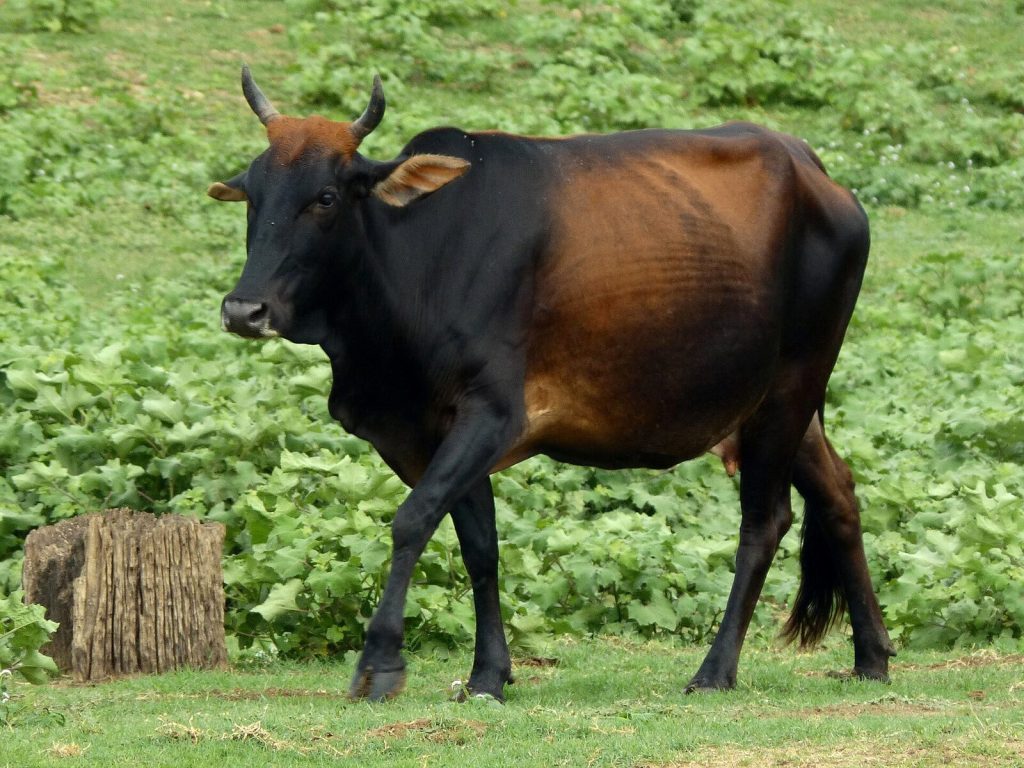
Beef cattle farming in Uganda is mostly not a separate enterprise. Eighteen percent of the national herd is adult male and 44 percent adult female, so most Ugandan beef leaves the farm as a cull cow or a young bull off a herd kept for milk, calves and savings. Anyone planning a beef enterprise is choosing to do something the national herd is not set up for, which is both the opportunity and the difficulty.
That sounds discouraging. It is not meant to be. Everything a Ugandan cattle keeper has to decide, from housing to breeding to milk, is gathered in the cattle and dairy section, and beef is one route through it. It means the useful questions are about feeding, water, weighing and timing rather than about which exotic bull to buy, and the Ugandan research says so with unusual clarity.
What the National Herd Is Actually Made Of
The National Livestock Census counted 14,477,878 cattle in Uganda. Of those, 11,153,707 are indigenous and 3,324,171 are exotic or crossbred, which is 77 percent against 23 percent. The exotic share has moved fast: it was 6.4 percent at the previous census round and it is 23.0 percent now, while the indigenous share fell from 93.6 percent to 77.0 percent across the same gap.
Now look inside that exotic 23 percent, because this is the figure that reframes a beef plan. Of the 3,324,171 exotic and crossbred cattle, 90.3 percent are dairy type and 9.7 percent are beef type. That works out at something on the order of 320,000 improved beef cattle in a national herd of 14.5 million. Every article urging Ugandan farmers to buy improved beef genetics is describing a population that barely exists in this country, and the animals are correspondingly hard to find and expensive when you do.
The age and sex structure completes the picture. About 9.05 million cattle are adults, which is 62.5 percent of the herd and up from 54.7 percent at the previous count. Adult males number 2,634,933 and adult females 6,412,271. Split by type, indigenous herds are 20.9 percent adult male and 43.2 percent adult female; dairy exotic and crossbred herds are 6.7 percent adult male and 49.4 percent adult female; and the small beef exotic and crossbred group is 30.6 percent adult male and 35.6 percent adult female.
Read those three sets of numbers together and a female dominated herd with few mature males cannot supply much beef, whatever anyone does about breeds. The inference is ours; the counts are the census. It is also why ILRI describes a large share of Ugandan slaughter cattle as culls and immature bulls coming out of dairy herds. The beef supply and the milk supply are the same animals at different points in their lives.
The Four Beef Cattle Production Systems in Uganda
MAAIF, the Ministry of Water and Environment, the Ministry of Health and the Office of the Prime Minister sat down with FAO and agreed a classification for Ugandan beef, and it is the most useful starting point a new producer has. Four systems, and they are genuinely different businesses rather than four sizes of the same one.
Commercial ranching holds under 10 percent of the national herd, mostly in the south west and central regions. Herds run from 500 to 3,000 head of mixed indigenous, cross and exotic animals inside perimeter fencing and paddocks, with real money in animal health and breeding, water troughs, spray races, dip tanks and sometimes a valley dam. Ranchers sell to abattoirs, to butchers serving quality conscious local buyers, and to street butchers.
Pastoral systems move animals to find pasture and water, and pastoral plus mixed smallholder farms together hold around 90 percent of the national herd. Herds go up to about 100 head per person and are around 98 percent local breeds. Animal health access is limited and animals are often vaccinated only when a government campaign arrives. This system is dominant in the north east and parts of the south west and central regions.
Agropastoral systems graze cattle on private or public pasture and add crop residues. There are about 8 million agropastoral livestock keepers in Uganda and the average herd is about 10 cattle, mainly indigenous with some crosses. Cereal by products from maize, sorghum and millet go to the animals. Sales are to traders at the farm gate or in a primary market.
Semi intensive systems confine cattle and feed them fodder, compound feed and crop residues, and they hold under 10 percent of the herd, concentrated in central and south western Uganda and around towns. Herds are 1 to 5 animals on small farms, 5 to 15 on medium ones and over 20 on large ones. Most animals are crosses of East African Zebu with Holstein Friesian. They are kept for milk, and their beef comes from cows that have stopped producing.
Carcass Weight by Production System, and Where the Gap Comes From
Here is the reason the system matters more than almost anything else. Carcass weight at slaughter, measured by system rather than by breed:
| Production system | Carcass weight, kg | Typical herd |
|---|---|---|
| Commercial ranching | 145 to 150 | 500 to 3,000 |
| Semi intensive | 135 to 140 | 1 to 20 plus |
| Agropastoral | 120 to 130 | about 10 |
| Pastoral | 110 to 120 | up to 100 |
Top to bottom that is a gap of roughly 30 kg of saleable carcass on the same species in the same country, and the systems differ in feeding, water and health rather than mainly in genetics. A pastoral animal and a ranch animal are frequently the same breed.
One number in circulation needs care, because it is easy to misread in a way that makes Ugandan cattle look far worse than they are. Per animal output has stagnated near 149.6 kg, having crept from 149 kg to 149.7 kg across an earlier three year stretch. That is meat and offal per animal slaughtered, which is a carcass figure, not a mature liveweight. ILRI's own value chain mapping for Uganda puts mature bull liveweight at 352 to 403 kg, cows at 272 to 320 kg and heifers at 83 to 172 kg. A carcass is roughly half a live animal, so the two sets of figures agree once you keep the units straight. The version of this number that gets quoted as a "mature weight" of 149 kg against 600 kg for improved beef breeds is comparing a carcass to a live animal, and it is picked apart on the best beef cattle breeds page.
For scale on the national picture: Uganda produces roughly 217 million kg of beef a year, growing at about 1.9 percent against 6.5 percent over an earlier decade, with animals slaughtered rising from about 1.2 million to about 1.6 million across eight years. Output has grown mainly by killing more animals rather than by getting more from each one. Per person consumption sits near 9 kg a year and Kampala accounts for about 7 percent of the national total.
Feeding Beef Cattle on Natural Pasture and What to Add
Natural pasture is the feed base for Ugandan beef and it will stay that way, because it is the cheapest dry matter in the country and because the arithmetic of buying feed for a slow growing animal rarely works. Producers near towns add agro industrial by products, which is the single most practical improvement available to a smallholder.
The Ugandan finishing trial that runs through this page used a concentrate of 70 percent maize bran, 20 percent cotton seed cake and 10 percent molasses, offered alongside chopped maize stover, with free access to rock salt and water. Those are ingredients a Ugandan farmer can actually buy, from a milling town rather than from a feed catalogue, and the cotton seed cake is the protein that makes the rest work. There is more on each component under cotton seed cake in animal feed and maize bran in animal feeding.
Two things belong alongside the energy. Minerals, because a grazing animal on Ugandan rangeland is short of several and a block is cheap relative to what it unlocks, covered under mineral supplements for livestock. And a planned dry season feed reserve, which is where napier grass farming and silage making come in. Those two pages are written for dairy, and the agronomy is the same for a beef animal while the economics are not.
Feedlot Finishing: What Ninety Days of Feeding Buys
Uganda has an unusually clear answer here, from a Makerere trial run on a ranch in Nakaseke inside the cattle corridor. One hundred and forty four bulls, averaging 191 kg liveweight at around 18 months, were split across three feeding systems for 120 days.
| Feeding system | Gain, g per day | Carcass, kg |
|---|---|---|
| Feedlot | 850 | 145 |
| Grazing plus concentrate | 550 | 132 |
| Grazing alone | 270 | 110 |
Dressing percentage moved with it, at 52, 51 and 50 percent, which implies slaughter weights somewhere around 220 to 280 kg across the three groups. Feeding system changed slaughter weight, carcass weight and dressing percentage, and it did so reliably.
Set that against the genotype result from the same trial, where the widest gap between breed groups was 620 against 500 grams a day. Feeding moved the animal by a factor of about 3.1 from worst to best; genotype moved it by about 1.24, and most of the genotype differences were not large enough to be statistically reliable while the feeding differences were. Both ratios are ours, divided from the trial's own published means. If you have one decision and limited money, that comparison tells you which lever to pull.
A second Ugandan trial answers the next question, which is how long to feed. One hundred and eighty steers aged 9 to 13 months, five Ugandan genotypes, two regimes and three durations of 60, 90 and 120 days, slaughtered at the Uganda Meat Industries abattoir. Carcass and meat quality improved with duration across all genotypes under both regimes. The measures that matter for tenderness, collagen solubility and myofibrillar fragmentation, improved up to 90 days and showed no further reliable improvement after that. So the last 30 days of a 120 day programme bought weight but not eating quality, and whether it paid depends entirely on whether your buyer pays for quality or only for kilos.
Water, Valley Tanks and the Dry Season Feed Gap
Ask a Ugandan beef producer what stops them and the answer is water more often than pasture. Two thirds of producers across the cattle corridor and central and south western Uganda water their cattle from on farm valley tanks. Those tanks have earth walls and floors, they silt up, and ILRI names upgrading them as one of the main reasons a producer would want credit.
That matters for a beef plan in a way it does not for a crop. A silted tank does not reduce your yield by a tenth. It empties in the dry season, and then either the animals walk, which costs weight, or they mix with other people's animals at a shared water point, which is where contagious bovine pleuropneumonia spreads. The water problem and the disease problem are the same problem seen from two sides.
The dry season is also when the pasture stops. Growth of 270 grams a day on grazing alone is a wet season figure on a ranch with managed pasture; a dry season on degraded communal grazing can be negative, and an animal that loses condition in January is paying for it in April. A conserved feed reserve is how you stop the herd going backwards, and the labour, not the crop, is the expensive part of making one.
Disease and Quarantine as Beef Farming Cost Lines
MAAIF's own surveillance puts East Coast fever at the top of the cattle death list, with lumpy skin disease, anaplasmosis and trypanosomiasis close behind on case counts. For a beef producer the loss is usually condition rather than death: a sick animal stops gaining, and on a 120 day programme a fortnight of illness is a meaningful slice of the whole margin.
Measured uptake among Ugandan agropastoralists shows how thin the defence usually is. Vaccination against foot and mouth disease reached 36 percent of them and against contagious bovine pleuropneumonia 21 percent. Equipment was scarcer still: spray pumps on 25 percent of farms, a crush on 9 percent, a drench gun on 2 percent. The crush number is the one to sit with, because 91 percent of those farmers had no safe way to restrain an animal at all, and without that you cannot spray it properly, dose it properly or put a tape round it.
Foot and mouth disease deserves its own line, because for beef it is a market disease rather than a killer. In one MAAIF surveillance quarter it produced 29 reported cattle cases and no deaths, and in that same period it closed subcounties across six districts. The restriction is what costs you: a Ugandan quarantine reaches out about 20 km, covers whole districts, subcounties or parishes, and stays in force while cases keep appearing, which has commonly meant half a year. Add that a recovered animal can still carry the virus for as long as two years and you can see why the gate stays shut after the limping stops. An animal that finishes during a quarantine is an animal you keep feeding. In one Ugandan district 15.2 percent of all sales went informal while a quarantine was running, which is what happens when the market closes and the school fees do not.
The practical planning point is that a beef enterprise should be able to survive a six month sale stoppage. Tick control and the vaccination question have their own pages, at cattle tick control and the cattle vaccination guide, and the honest position on intervals is on the second of those.
Selling Cattle by Weight Instead of by Eye
Ugandan cattle transactions are negotiated on visual estimates of weight. ILRI records it plainly: transaction costs are high and negotiation runs on the eye, and agropastoralists have little information on the Kampala retail price that their animals end up feeding. That combination means the producer who fed the animal is the one guessing.
There is a cheap fix and it is better documented than most people realise. Heart girth, the circumference of the chest immediately behind the front legs, predicts liveweight well enough to negotiate with, measured with a tape or a length of string against a marked stick. A recent African study built prediction equations from 6,026 cattle and 14,545 measurements across seven countries including Uganda, and reached normalised errors of 6 to 13 percent.
Two cautions come with it, and they are the useful part. First, the older published equations are worst exactly where your money is: errors ran 14 to 17 percent at the 75th percentile of heart girth and 27 to 37 percent at the 95th, and accuracy fell away outside the 100 to 450 kg range. The biggest animal in the pen is the one an old weigh tape misreads most. Second, breed group and production system both change the relationship between girth and weight, so a tape calibrated on confined dairy crosses will misread a grazing zebu. Sex and season, by contrast, barely matter.
Weighing also feeds everything else: a weight lets you work out gain per day, gain per day lets you work out what the feed returned, and that is the input to a break even calculation. The mechanics are on how to calculate the break even point in farming, and the record structure is on the livestock record keeping template. For the negotiation itself, how farmers should price produce covers the ground.
Where the Beef Market Actually Is
Kampala is the market. It accounts for about 7 percent of national consumption on its own, and it sets the retail price the rest of the chain works back from. Between the producer and that price sit traders, primary markets, slaughter locations, butcheries and retail points, and the further you are from Kampala the less you know about what your animal is worth at the end of it.
Local demand for beef is not satisfied, which is the honest reason to be in this business. The organised structure that exists is the Uganda Meat Producers Cooperative Union, set up under MAAIF guidance and bringing together over 2,600 beef farmers, which is a route to information and collective negotiation rather than a guaranteed buyer.
Export is worth a paragraph mainly so you stop planning around it. Uganda's beef related exports are live cattle to neighbouring countries. Formal beef export is held back by failure to meet safety and hygiene standards and by recurring foot and mouth outbreaks, and the main beef related import is hides and skins at over 1,000 tonnes a year. Ugandan beef product prices also sit slightly above those in neighbouring countries, which weakens the sector's competitive position. A smallholder finishing ten animals is selling into Kampala, not into the Gulf.
Cooperative marketing and aggregation are the realistic lever, and they come with a documented failure mode: Ugandan farmers side sell to traders paying cash on the day while their cooperative is offering more, because school fees and funerals do not wait for a monthly payment run. Farmer aggregation explained and how agricultural cooperatives work deal with that properly.
Starting Small: A Weaner Herd or a Fattening Operation
Two entry points exist and they are not the same business. Breeding weaner calves for sale means owning cows, waiting on a calving interval, carrying the reproductive risk and holding the animals through a dry season or two. Buying young stock and finishing them for slaughter means short cycles, no breeding risk, and a business whose whole margin sits in the gap between purchase weight and sale weight.
For most people reading this the second is the sensible start, for three reasons that all come out of the evidence above. The cycle is roughly 90 to 120 days rather than years, so a mistake is cheap and a lesson is fast. The gain figures are known for Ugandan conditions, so you can plan against 550 or 850 grams a day rather than a guess. And you can buy your animals from the herd around you, which is mostly indigenous, rather than hunting for the roughly 320,000 improved beef cattle that exist nationally.
What you need in place before the first animal arrives is short and unglamorous: water that will hold through a dry season, a crush, a source of maize bran and cotton seed cake at a price you have checked, a relationship with the district veterinary office, and a weight taken on arrival. The batch arithmetic itself belongs on the cattle fattening business page, and if milk is also on your mind then dairy farming in Uganda is the comparison to read, because on this national herd the two enterprises share the same animals.
Frequently Asked Questions About Beef Cattle Farming in Uganda
How much does it cost to produce a kilogramme of beef in Uganda? ILRI's own field data from Ugandan beef producers put the cost of production at 3,300 to 13,300 shillings per kilogramme of liveweight, and the spread is the finding rather than a nuisance. It varies by production system and by location, so a grazing animal in Karamoja and a finished animal in a Central region feedlot sit at opposite ends. What the range cannot tell you is whether you make money, because that depends on a liveweight price this research could not source reliably for current conditions. Go and get one quote per kilogramme liveweight from a local trader or abattoir and hold it against your own end of that band.
Is beef cattle farming profitable in Uganda? This page publishes no profit figure, deliberately. Every Ugandan cost figure that exists is expressed per kilogramme of liveweight, and no matching current farm gate liveweight price could be sourced to pair with it, so any profit number here would be an invention wearing a decimal point. The structural answer is that your margin is the gap between a cost band of 3,300 to 13,300 shillings per kg and whatever your buyer pays per kg, and that you sit low in the cost band only if your feed is cheap and your animals stay healthy. Work it through on how to calculate the break even point in farming with your own two numbers.
How many cattle can I keep on an acre in Uganda? No Ugandan stocking rate for beef cattle in acres per animal could be sourced during this research, and that absence is worth stating rather than filling. What the evidence does give you is herd sizes by system: 500 to 3,000 head on a commercial ranch, up to about 100 per person in pastoral herds, about 10 on an average agropastoral farm, and 1 to 20 or more in confined semi intensive units. The binding constraint in practice is dry season water and dry season feed rather than wet season grass, so work backwards from what your water source holds in January.
Should I buy Boran or improved beef genetics to start? Probably not as your first move, and the Ugandan trial data is why. In a 144 bull Ugandan finishing trial the feeding system moved daily gain by a factor of about 3.1 while genotype moved it by about 1.24, and the genotype differences were mostly not statistically reliable. Improved beef animals are also scarce here, at roughly 320,000 beef type animals inside a 3.3 million strong exotic herd. Fix feeding, water and health on the animals you can buy locally first. The breed comparison in full is on best beef cattle breeds.
How long should I feed an animal before selling it? The Ugandan quality evidence points at 90 days. A 180 steer trial across five Ugandan genotypes found tenderness and its underlying measures improving up to 90 days of finishing with no further reliable gain beyond that, under both grazing plus supplementation and full feedlot. The animal keeps putting on weight after 90 days; it stops getting better to eat. Whether the extra month pays depends on whether your buyer pays by the kilo alone.
What happens to my plan if there is a foot and mouth quarantine? You stop selling. A Ugandan quarantine typically covers roughly a 20 km radius, applies to districts, subcounties or parishes, and holds until no new cases appear, which is often about six months. Recovered cattle can carry the virus for up to two years, so restrictions outlast visible illness. Plan on being able to hold and feed a finished animal for a season without a sale, because the alternative is what 15.2 percent of sales in one Ugandan district became during a quarantine.
Do I need a weighing scale? No, but you do need a measurement. Heart girth measured with a tape immediately behind the front legs predicts liveweight to within about 6 to 13 percent using current African equations, which is enough to negotiate with and more than enough to tell you whether your feed is working. Take one on arrival and one before sale. Be wary of an old weigh tape on a big animal, because published errors reached 27 to 37 percent at the largest girths.
Can I finish cattle without building a feedlot? Yes, and for most Ugandan smallholders it is the better first step. Grazing plus a concentrate fed overnight gave 550 grams of gain a day against 270 on grazing alone in the Ugandan trial, which is double the growth without a shed, a pit or a full bought ration. The concentrate in that trial was 70 percent maize bran, 20 percent cotton seed cake and 10 percent molasses alongside chopped maize stover.
Is beef or dairy the better use of a Ugandan cow? On this national herd they are not really rivals, which is why the census shows a 44 percent adult female herd and only 18 percent adult male. Most cows earn from milk and calves for years and then leave as beef, and 90.3 percent of Uganda's improved cattle are dairy type. If you are choosing an enterprise rather than an animal, read the cost side of the milk option in cost of dairy farming before you decide, because milk turns cash monthly and beef turns it once.
Finding Cattle, Feed and Veterinary Suppliers Near You
Liveweight prices, maize bran, cotton seed cake and veterinary charges all move with the season, the harvest and the district, so the only figures worth planning on are the ones you collect locally this month. Check current animal prices on the cattle and dairy cow price page, compare feed and veterinary stockists through farm input suppliers, and if you are buying breeding or finishing stock, the listings under where to buy cattle in Uganda are the place to start. Take a tape measure with you, and write down the weight you paid for.