
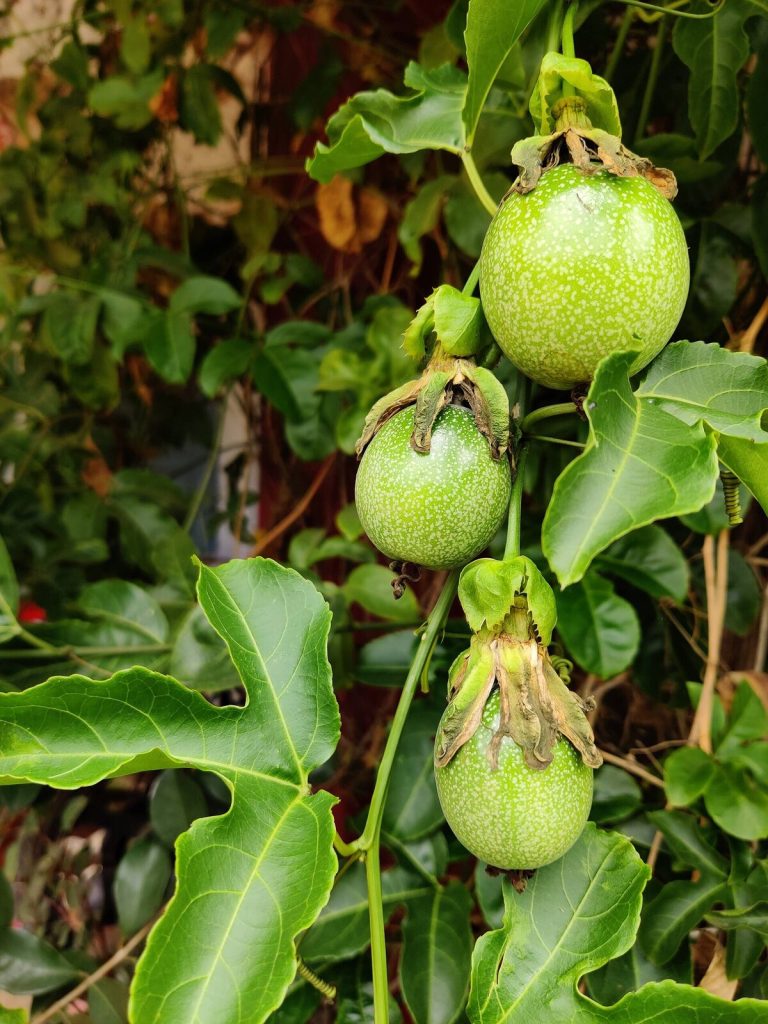
There is no released passion fruit variety in Uganda, so the choice a grower actually makes is between two forms of one species, purple and yellow, plus a rootstock decision on top. Every trade name in circulation, Kasese, Masaka, Kawanda, is a place or a station rather than a registered variety. Knowing which is which changes what you inspect before you pay.
Why No Ugandan Variety List Answers This Question
Ask which maize to plant and Uganda answers with names: Longe 5, Longe 7H, released, catalogued, with a maturity period and a yield attached to each. Ask which passion fruit to plant and the machinery that produces those answers is simply not there for this crop.
NARO's technology catalogue holds 121 released technologies. Every one was enumerated for this page and none is passion fruit. A search for cassava on the same catalogue returns two varieties, so the search works; the crop is absent. The Statistical Abstract does not mention passion fruit across 407 pages, while cassava appears on four of them. The Annual Agricultural Survey does not mention it either. The ministry's own document library, checked through its full sitemap, carries no passion fruit publication.
NARO researchers themselves explain why. Writing about the crop, they describe conventional improvement programmes for passion fruit as ongoing but with little to show for it, held back by reproductive barriers between species, failures in interspecific crosses, low recovery of hybrids and the slowness of the whole process. That is not neglect. Passiflora is a genus of roughly 520 species and crossing them is genuinely hard, which is why the same group turned to tissue culture instead, and why they found the purple form recalcitrant to that too.
So a page that lists Ugandan passion fruit varieties and gives each one a yield is inventing the list. What this page does instead is name the real decisions in the order you face them.
Purple Against Yellow: The Measured Differences That Matter
The purple form, Passiflora edulis f. edulis, and the yellow, P. edulis f. flavicarpa, are both grown in Uganda. A Makerere University team, partnered with NaCRRI for the field sampling, records the local purple type as the country's dominant planting. NARO's own biotechnology group gives the reason each is kept: the yellow for being widely cultivated, disease tolerant, larger fruited and vigorous, the purple for its aroma, flavour and taste.
| Trait | Purple | Yellow |
|---|---|---|
| Fruit weight | 30 to 45 g | 60 to 90 g |
| Yield per plant | About a third of yellow | 3.5 to 7 kg expected |
| Juice share | Higher, 35 to 38 percent | Lower |
| Acidity | Less acid | More acid |
| Self pollination | Sets from own pollen | Often self sterile |
| Root disease | Susceptible | More tolerant |
| Nematodes | Susceptible | Rather resistant |
| Climate fit | Cooler, higher ground | Warmer, lower ground |
Read the yield row and the fruit weight row together, because that pairing is the whole trade. A purple vine carries smaller fruit and less of it. Extension work on both forms puts the best expectation for yellow at 3.5 to 7 kg a plant and says purple would likely give about a third of that. So a grower choosing purple is accepting a yield penalty of roughly two thirds in exchange for the flavour, the juice fraction and the market's preference for a purple skin.
That is often the right call in Uganda, because the market pays for purple. It is only the wrong call when nobody told the grower the penalty existed, and then a yield figure lifted from a yellow crop gets used to justify the planting.
The pollination row hides a trap of its own. Many yellow vines will not set fruit from their own pollen, and two plants raised from cuttings of the same mother vine are the same plant genetically, so they cannot pollinate each other either. Fill an acre with one clone of a self sterile yellow and you can get a wall of leaf and very little fruit. Purple does not have this problem, which is another quiet reason it dominates smallholder plots.
The Names in Circulation and Where Each One Actually Comes From
Four names come up repeatedly when Ugandans discuss which passion fruit to plant. None of them is a registered variety, and each is a different kind of thing.
The commonest claim attached to these names is a lifespan comparison: that plain purple lasts about 18 months while the improved grafted plant lasts five years. Do not plan on it. The two published life expectancies for this crop are three to five years and five to seven years, neither of which supports an 18 month purple, and no Ugandan trial comparing grafted against ungrafted vine longevity could be found. A seller who quotes you a five year life is quoting a sales figure.
KH7 Is the One Ugandan Passion Fruit Variety Name With a Published Record
One name does appear in the peer reviewed literature. When researchers sequenced the first near complete genome of Ugandan Passiflora virus, the symptomatic sample they worked from came from plants of the KH7 variety, collected from a farm in Bushenyi district in western Uganda.
That is worth knowing for two opposite reasons. It is the only Ugandan passion fruit variety designation this project could find in a scientific publication, so it is not a marketing invention. And the reason it appears is that it was infected. The paper is a virus genome description, not a variety release, and nothing in the record attaches a yield, a maturity period or a disease rating to the name. Being in a journal is not the same as being recommended.
Which is the honest position on KH7: a real name, with a real Ugandan provenance, and no performance data behind it. If a nursery offers it, that is at least a plant with a traceable designation. It is not a resistant plant.
Grafted Planting Material Is a Rootstock Choice and Nothing Else
Grafting the purple onto a yellow rootstock is the standard commercial answer to the purple's weakest point, and it is the one intervention on this page with a survey behind it. A study of fungal disease management across eight East African districts found wilt incidence lower than brown spot and dieback incidence, and attributed the difference to growers planting seedlings grafted onto yellow passion fruit rootstocks, which the authors describe as tolerant to Fusarium wilt.
Tolerant, not resistant, and only to that one disease. Here is what the graft does and does not buy you.
The grafting method itself is well documented, and knowing it lets you judge whether a nursery did it properly. Stock and scion are each raised to about 45 cm with a stem roughly the thickness of a pencil. The scion is 8 to 10 cm long with at least two nodes. The rootstock is cut off 25 to 30 cm above the soil line, matching slanting cuts are made through both, the cut surfaces are bound with the cambium layers aligned, and the whole graft is enclosed in a small bag tied shut below the union and kept warm and shaded for 10 to 14 days. A graft union sitting almost at soil level, or a scion that is a thin whip against a thick stock, is a graft made in a hurry.
Sweet Granadilla and Giant Granadilla Are Different Species, Not Varieties
Ugandan lists of passion fruit "types" routinely mix in plants that belong to other species, which matters because their fruit, market and handling are all different.
Giant granadilla, Passiflora quadrangularis, carries irregular oblong fruit 10 to 20 cm long weighing 225 to 450 g or more, with a thick edible rind on top of the seed and juice. Its stem is square in cross section and its leaves are rounded rather than three lobed, so you can identify it at the nursery. It is a vine, like the others, and any source describing it as a tree of 30 m has confused it with something else. It needs mild temperatures to set fruit and may flower without setting when it is hot.
Sweet granadilla, Passiflora ligularis, is a separate species again, sold as a dessert fruit with a hard shell that travels better than passion fruit does. It suits cooler, higher ground.
Banana passionfruit is yet another species, and it is the one most often mislabelled. Any text that introduces banana passionfruit and then describes the yellow form of P. edulis has run two plants together. If you are buying, the fruit shape settles it: banana passionfruit is elongated, and the yellow passion fruit is round to oval.
None of these is a substitute for the other in a buyer's hands. Decide which fruit your market wants before you decide which plant to buy, and if you are still choosing a crop at all, the fruit farming hub sets the section out.
What a Country With Real Passion Fruit Varieties Looks Like
It is worth seeing the alternative, because it shows exactly what is missing, and so what a Ugandan grower has to do by hand.
Australia's passionfruit industry body publishes named cultivars for both forms, several of them recent releases, and lists the licensed plant nurseries that propagate them, so a grower orders a known cultivar from a known propagator for delivery in a known planting window. A national breeding programme funded through a grower levy is running to produce the next set, with stated objectives covering agronomic performance, product quality and comparative performance data across progenies. And even with all of that in place, the same industry publishes that its growers are working to reverse declining yields.
Three things follow for Uganda. A named cultivar is meaningful only where somebody maintains and licenses it, so a name on a Ugandan label carries no such guarantee. Declining vigour in established plantings is a global pattern for this crop, reported in the recent breeding literature as well, so it is not evidence that Ugandan growers are doing something uniquely wrong. And a Ugandan grower has to perform, personally and by eye, the quality control that a certification scheme would otherwise do.
How to Judge Passion Fruit Planting Material When No Scheme Certifies It
This is the part that replaces a variety name, and it is the most useful thing on the page. No Ugandan certification or licensing scheme for passion fruit planting material could be found in any national source checked, so the inspection is yours. Never take the seller's word for a variety, because there is no register to check it against.
Look at the leaves first, and look at several plants, not one. Mottling, mosaic patterning, puckering, upward curling or distortion of young leaves are the symptoms of the woodiness virus complex, and any of them on any plant in the batch is a reason to walk away from the batch. Then accept the hard part: a survey in a neighbouring country detected the virus in 53 percent of samples from plants with no symptoms at all, against 56 percent of symptomatic ones. Clean looking is not clean. Inspection lowers your risk; it does not remove it.
After that, check the things you can verify. Ask to see the mother plants the cuttings came from, and look at their fruit. Check the graft union sits well clear of the soil. Reject plants with roots spiralling in the pot, because a folded root system never recovers. Buy in more than one batch from more than one source, so a single bad lot cannot take the farm. And plant fewer vines than you can afford, keeping the balance for replacements, which on this crop you will need.
One more option exists and it is underrated. Seedlings raised from fresh seed are slower to bear and of unknown parentage, but the woodiness viruses travel in vegetative material rather than in seed, so a seedling block carries a lower virus risk at planting than a block of cuttings from an unverified mother. That trade, slower and poorer against slower and cleaner, is a real choice and nobody offers it because nobody sells it. Seed loses viability inside a year and germinates in 10 to 20 days, and the general principles are on choosing quality seed and testing germination.
Frequently Asked Questions on Choosing Passion Fruit Varieties
Which passion fruit variety is best for Uganda? The purple form is what the Ugandan market buys and what Ugandan growers predominantly plant, so on market grounds it is the default. Grafted onto a yellow rootstock it keeps the purple fruit and gains tolerance to soil borne wilt. Choose the yellow instead only if your ground is warm and low, your soil has a wilt history you cannot graft your way out of, or you are selling into juice processing where fruit size and volume beat skin colour. There is no third answer, because there is no third variety.
What do passion fruit seedlings cost in Uganda? Prices differ between a seedling, a rooted cutting and a grafted plant, and they move with the planting season and with how far you are from whoever raised them. A grafted plant costs more than a seedling because it is two plants and several months of nursery labour. No reliable national price could be sourced for any of the three, so ask at more than one nursery in the same week and compare like with like, which means asking whether the price is for a seedling, a cutting or a grafted plant before comparing at all. Budget a replacement allowance on top, because some plants will fail.
Is a grafted passion fruit plant worth the extra money? On the published evidence it buys tolerance to soil borne wilt and better nematode tolerance, and a regional survey credits grafted seedlings with the lower wilt incidence it measured. It buys nothing against woodiness disease or brown spot, which between them were found on most farms in that same survey. So it is worth paying for on ground with a wilt or nematode history, and it is not a substitute for sanitation anywhere.
Can I tell a grafted plant from an ungrafted one? Yes, and you should check. There is a visible union on the stem, a slight change in bark texture and often in thickness, sitting where the rootstock was cut. On a properly made graft that union is well above the soil line, because a union at ground level lets the scion root into the soil and defeats the whole purpose. If you cannot find a union, you are buying an ungrafted plant.
Does the yellow passion fruit really resist woodiness disease? It is often stated and it is too strong. The yellow form is reported as more tolerant, but resistance screening in the region found the response to be genotype dependent rather than form dependent, and surveys on both sides of Uganda's borders found symptomatic plants on all but a handful of the farms they visited. Treat the yellow form as a plant that copes better, not a plant that escapes.
Where does a Ugandan grower get virus tested passion fruit plants? As far as this research could establish, nowhere. No Ugandan certification, indexing or licensing scheme for passion fruit planting material appears in the national catalogues, the ministry's document library or the statistical record. That is worth saying plainly rather than implying a scheme that does not exist. The practical fallback is the inspection routine above, multiple sources, and a replacement budget.
Should I save seed from my own best vines? You can, and the seed must be sown fresh because viability drops inside a year. What you will get is variable, since a seedling is not a copy of its parent, and yellow seedlings may turn out self sterile. What you gain is that seed does not carry the woodiness viruses the way cuttings do. It is a reasonable way to raise rootstocks for grafting even when it is a poor way to reproduce a good fruiting vine.
Once the planting material is settled, the next two decisions are the trellis and the spacing, and both are set before anything goes in the ground. The dimensions are on the passion fruit trellising guide, the plant population and establishment arithmetic on the passion fruit farming guide, and the symptoms to inspect for on the passion fruit diseases page. Growers weighing this crop against another tree fruit will find the same establishment questions on mango varieties and Hass avocado.
Before buying, ask two or three nurseries what form, what propagation method and what mother plants are behind the vines they are offering, and ask a fresh trader or a juice processor in your district which fruit they are paying most for this season. Those two answers together decide the choice better than any variety list can.