
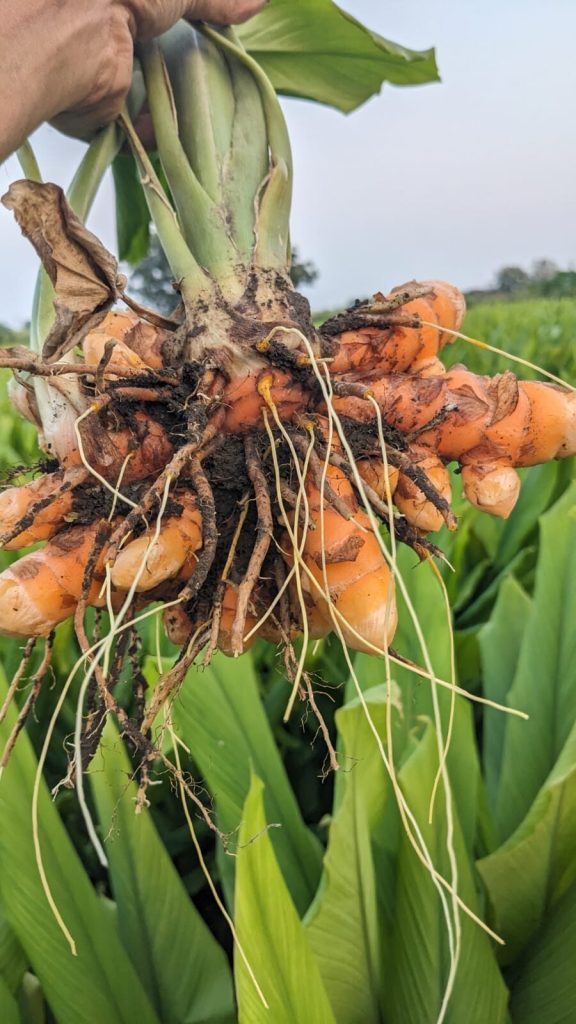
Turmeric farming in Uganda works agronomically, and it asks for nine months of your land before it pays anything. The setts go in with the first rains, the crop fills rhizomes through the wet months, and it is lifted when the leaves yellow and the stems fall over. Turmeric is Curcuma longa, a rhizome crop in the ginger family, grown here on small plots while most of the turmeric Ugandans buy still arrives from India.
Where Turmeric Is Grown in Uganda and at What Scale
Start with what is known and what is not. Turmeric grows in Uganda, it is sold in Kampala as local produce, and Ugandan farm press has published agronomy for it. What nobody publishes is how much. Neither MAAIF nor UBOS breaks turmeric out of its crop statistics, and FAO has no separate Ugandan series for it, so anyone quoting a national tonnage is guessing.
The signals that do exist point the same way. The founder of the Uganda Fruits and Spice Growers Association counts fewer than twenty Ugandans in commercial spice production, says most of them concentrate on ginger and garlic, and lists turmeric among the crops that fewer farmers grow, usually in small plots. He also puts spice import dependence at roughly 98 percent of what the country consumes. Set against that, turmeric powder on a Kampala shelf is far more likely to be Indian than Ugandan.
There is a public research hook, which matters. The National Coffee Research Institute, one of NARO's institutes, lists turmeric among the spices it researches as an intercrop inside coffee and cocoa systems. That is the right frame for most Ugandan growers: turmeric as a shade tolerant understorey crop on a farm that already has a canopy, rather than as a monoculture on open ground.
Where it is grown is less settled. Claims circulate of large plantings in the north around Gulu tied to a Kampala processor, but they come from recruitment material with no corroboration, so this guide treats district geography as open. What decides your site is rainfall, soil and drainage, not a district name on a list.
Soil, Rainfall and Altitude for Turmeric Production in Uganda
Turmeric is less fussy than cardamom and more demanding than cassava. It wants a hot wet growing period followed by a dry spell at maturity, which is exactly what Uganda's rainfall pattern supplies in the south.
Published requirements put it at 1,000 to 2,000 mm of rain a year, altitudes up to about 1,500 m, temperatures between 20 C and 35 C, and organically rich well drained loam with a pH anywhere from 4.5 to 7.5. Indian research adds that friable, well drained loam in wet or garden land is the ideal, and gives a working rainfall figure of around 1,500 mm. Sandy loam suits it; heavy clay that holds water does not, because a waterlogged rhizome rots.
Measure that against Uganda. The US Library of Congress country description records mean annual rainfall above 2,100 mm near Lake Victoria, above 1,500 mm in the southeastern and southwestern mountains, and around 500 mm in the northeast. The southern half of the country has two rain periods, starting in early April and again in October. So the lake crescent, the eastern slopes around Mount Elgon and the western foothills all sit inside turmeric's comfortable range on rain alone. The drier north and the Karamoja side will need irrigation for a crop that stays in the ground three quarters of a year.
Soil pH is the one to test rather than assume. The tolerance band is wide, but the ends of it behave differently, and the fix is slow either way: compost and manure bring a high pH down over seasons, agricultural lime lifts a low one. Neither happens between one rain and the next.
Timing the Turmeric Planting Season Around Uganda's Two Rains
Indian packages give May to June as the planting window, which is an Indian monsoon date and no use here. Work it from the rains you actually get.
Turmeric needs 7 to 9 months in the ground depending on the type, and it wants the last stretch dry so the rhizomes finish and the tops die back cleanly. In southern Uganda that argues for planting at the onset of the first rains, around March into April, which carries the crop through the April to May wet period, through the second rains from October, and into maturity around November to January when the dry spell arrives. Planting late in the second rains squeezes the crop the other way and risks lifting in mud.
One constraint people hit: the second season is shorter, so a September or October planting only works where you can water through the following dry months. If you cannot, the first rains are the only sensible window and you have one shot a year at it.
| Stage | Months after planting | Main operation |
|---|---|---|
| Sprouting | 0 to 2 | Mulch, keep moist |
| Early growth | 2 to 4 | Weed, top dress |
| Rhizome filling | 4 to 7 | Earth up, water |
| Maturation | 7 to 9 | Stop watering |
| Harvest | 7 to 9 | Lift when tops die |
Turmeric Planting Material: Mother Rhizomes, Fingers and Dormancy
This is where most first crops are lost, and it happens before anything goes in the ground.
Two kinds of planting material come off a harvested clump. The mother rhizome is the thick central bulb; the fingers are the slimmer secondary rhizomes growing off it. Ugandan agronomy reports that mother rhizomes give over 50 percent higher yields than fingers, because of the larger diameter and the bigger food reserve behind each bud. Mother rhizomes are also what most growers want to keep and sell, so there is a real tension: plant the good material or sell it.
Either way, cut setts of 4 to 5 cm carrying one or two buds, and aim for pieces of 30 to 40 g with decent diameter. A thin, shrivelled sett makes a weak shoot no amount of manure fixes later.
The dormancy trap is worth spelling out. Fresh rhizome splits bought off a market stall carry roughly three months of dormancy, so they sit in the ground and do nothing while you conclude the seed was dead. Material from a nursery that has already broken dormancy sprouts in 10 to 15 days given enough water, with emergence continuing over four to eight weeks. If you must use market rhizomes, plan the three months into your calendar rather than discovering it.
Land Preparation, Beds and Ridges for a Turmeric Crop
Turmeric is a bed crop. The rhizome expands sideways in the top 15 cm of soil, so the point of the bed is loose earth above the water table and a route for rain to leave.
Ugandan practice makes beds 1 to 1.5 m wide, 15 cm high, with 50 cm paths between them, then forms ridges and furrows across the bed. Indian practice runs ridges and furrows at 45 cm, or raised beds 120 cm wide with 30 cm between them. Either layout does the same two jobs. Bulk organic matter goes in during ploughing, mixed to 35 to 40 cm depth, then the ground is harrowed a few days later and the beds are cut just before planting.
Rotation matters more than it looks. Indian research says do not plant turmeric after banana or after solanaceous vegetables, because both build up the nematode and soilborne problems turmeric is vulnerable to. On a Ugandan smallholding where banana is the default crop, that is a real planning constraint and it is worth honouring.
Turmeric Spacing, Seed Rate and Plant Population Per Acre
Seed rate is the biggest single input in this crop and it is measured in tonnes, not kilos. Ugandan agronomy puts a pure stand at about 1,000 kg of mother or finger rhizomes per acre. Indian research gives 2,000 kg per hectare, which is roughly 800 kg per acre. So the working range is 800 to 1,000 kg an acre, and the deciding factors are sett size, whether you are using mother or finger material, and how tight you plant. Intercropped turmeric drops to 400 to 500 kg an acre.
Spacing published for turmeric is 45 cm between rows by 15 cm within the row in Indian research, at a planting depth of about 4 cm. Ugandan agronomy gives 45 to 50 cm ridges, then in the same paragraph gives 25 to 30 cm between ridges and 15 to 30 cm within rows at 5 to 10 cm deep, which does not agree with itself. Treat 45 cm between rows as the figure to work from, widen the in row spacing toward 30 cm on rich ground where clumps will be big, and go shallower rather than deeper on heavy soil.
If you want the general method for this calculation across crops, the plant population tool sets it out step by step.
Manure, Fertilizer and Mulching Through the Turmeric Season
Turmeric is a heavy feeder, and the bulk of the feeding is organic matter carted onto the plot before anything is planted. Ugandan agronomy calls for about 16 tonnes of farmyard or compost manure an acre, broadcast and mixed in during ploughing. Indian research uses 25 tonnes a hectare, which is about 10 tonnes an acre, plus a cake such as neem or groundnut. The gap between those two is real and it comes down to what your soil already holds and what you can physically move. Ten tonnes an acre is a lot of cartage; sixteen is more. Plots get underfed because of transport, not because farmers do not know the rate.
On inorganic fertiliser the published figures disagree in a way worth knowing about. Ugandan agronomy gives NPK at 60:25:25 kg an acre at planting, with 25 kg of urea an acre as a top dressing a month later. Indian research loads potassium far more heavily and splits it across five top dressings through the season, because the rhizome is a potassium sink. The two recommendations are not reconcilable, so this guide gives you both patterns rather than choosing silently: take a soil test, follow the Ugandan figure as the locally published one, and if your soil test shows potassium is short, treat that as the shortfall to fix rather than adding nitrogen.
Mulch twice. Once immediately after planting, which holds moisture and suppresses the flush of weeds that comes up before the turmeric does, and again around 90 days. Mulch is also erosion control on a bedded crop in a Ugandan rain season, which is not a small point on sloping ground.
Weeding, Earthing Up and Watering a Turmeric Field
Four to five weeding rounds across the season is the Ugandan recommendation, and the first two are the ones that decide the crop, because turmeric is slow out of the ground and loses badly to early competition. After that the canopy closes and the work eases.
Earthing up goes with the top dressings. Pulling loose soil up around the clump at the second and fourth feeds gives the swelling rhizomes room and covers exposed ones, which otherwise green up and lose quality. It is also the moment to spot a clump that is rotting.
Watering: soak before planting and again after, then water at intervals of 7 to 10 days through any dry spell. The stage that punishes drought hardest is rhizome filling, roughly months four to seven, and that is also the stage where irrigation buys the most yield. In the last few weeks before harvest you want the plot drying down, so watering stops.
Turmeric Pests and Diseases, and the One That Ends a Crop
The insect list is short. Thrips scar leaves, rhizome scale attacks stored and planted rhizomes, and shoot borer tunnels into young shoots. Leaf spot, leaf blotch and leaf blight all appear in wet weather and mostly cost you photosynthesis rather than the crop.
Two problems are different in kind. Rhizome rot kills from below and is a drainage and planting material problem before it is a spray problem: clean setts, raised beds, no planting into ground that carried a rotted crop. And root knot nematode, which Ugandan agronomy warns can wipe out the whole crop population if it is not headed off in time. Nematodes are managed by rotation, by not following banana or solanaceous vegetables, by clean planting material and by organic matter, in that order. There is no rescue spray once a plot is infested.
On chemicals: Indian packages name specific products and rates for all of the above, several of which may not be registered in Uganda for turmeric. Do not carry a foreign dose onto your plot. Take a sample to an extension officer, buy only a product registered in Uganda for this crop, follow the rate printed on its label, and observe the pre harvest interval on that label. Turmeric is eaten, the harvested part sits in the soil you treated, and residues on a spice are a trade problem as much as a health one.
Judging Maturity and Harvesting Turmeric Rhizomes
The plant tells you. Leaves turn yellow, the stems fall over and dry, and the crop stops putting on weight. Early types reach that point at 7 to 8 months and medium types at 8 to 9, and Indian research works to a total crop duration of about 270 days.
Cut the leaves off close to the ground first, then lift the clumps with a spade or digging fork rather than pulling them, working from the side of the ridge so the fork comes in under the clump. Broken rhizomes bleed, rot in store and are downgraded, so this is slow careful work and it is worth paying properly for.
Then separate mother rhizomes from fingers while everything is still on the plot. Fingers go for processing. Mother rhizomes are the ones held back for next season's planting, stored in pits lined and covered with sawdust or sand, or heaped in shade under turmeric leaves; Indian practice holds them in open sand under a partial shade frame. Either way, aired, dry and out of the sun.
From that point the crop is a processing job, and the value you get for it is decided at the boiling pot and the drying yard rather than in the field. The whole of that sequence, boiling times, slicing, drying targets, polishing and what buyers actually test, lives in the guide to turmeric processing and drying.
Turmeric Yield Per Acre in Uganda: The Defensible Range
You will be shown yield figures for turmeric that sit five times apart, and both ends have been printed by Ugandan publishers. Here is how they reconcile.
| Condition | Fresh per acre | Source type |
|---|---|---|
| Indian research plots | 10 to 12 t | Irrigated, fertigated |
| Ugandan press top figure | 10 to 15 t | Not measured locally |
| Ugandan well managed plot | Up to 3 t | Ugandan farm press |
| Dried out of fresh | About 20 percent | Curing research |
Read the table the right way round. The 10 to 12 tonnes an acre figure is 25 to 30 tonnes a hectare, and it comes from Tamil Nadu plots on drip irrigation with fertigation and five split top dressings. That is the ceiling of what the crop does anywhere, under conditions almost no Ugandan smallholding has. The Ugandan press figure of 10 to 15 tonnes an acre starts at that ceiling and runs above it, for rainfed plots with no local variety work behind them. It is not a planning number, and this guide does not use it as one.
The 3 tonnes an acre figure, also from Ugandan farm press, is what a well managed local plot has been reported to do. Somewhere between those is where a serious grower with irrigation, proper seed rate and real manure cartage can expect to land after a season or two of learning the crop. Weigh your own plot and keep the record, because that number is more use to you than anything published.
Then apply the conversion, because it changes everything. Dried turmeric comes out at roughly 20 percent of fresh weight. Three tonnes of fresh rhizomes is around 600 kg dried. Comparing a fresh yield to a dried price, or the reverse, is how most turmeric income claims get to be wrong by a factor of five. The same trap sits in ginger yield figures, and for the same reason.
Intercropping Turmeric With Coffee, Maize and Vegetables
Turmeric tolerates shade, which makes it one of the more useful understorey crops available to a Ugandan farm. NARO's coffee institute researches it in exactly that position, inside coffee and cocoa systems.
Published intercrop partners include chilli, onion, French beans, eggplant and maize, and coriander and fenugreek get sown along the sides of ridges in Indian practice. Ginger works alongside it too, though both are rhizome crops sharing the same diseases, so pairing them concentrates risk rather than spreading it. The seed rate drops to 400 to 500 kg an acre in an intercrop, and so does the yield, which is the trade you are making: less turmeric, but the plot is earning from two crops and the canopy above is already paid for.
For a farm already carrying coffee, turmeric under the trees uses ground that is otherwise doing nothing for nine months. That is a better argument for planting it than any yield figure.
Questions Ugandan Farmers Ask About Growing Turmeric
How long does turmeric take to mature in Uganda? Seven to nine months from planting, depending on the type. Early material can be ready at seven to eight months, medium at eight to nine. Plan the harvest to fall in a dry spell, because lifting in mud damages rhizomes and slows the drying that follows.
How much planting material do I need for an acre? About 800 to 1,000 kg of rhizome setts for a pure stand, or 400 to 500 kg intercropped. It is the biggest input in the crop by weight and by value, which is why the sett size and spacing decision matters so much.
Can I plant turmeric bought from the market? You can, with one warning. Fresh splits from a market stall carry roughly three months of dormancy, so they sit in the soil doing nothing while you assume they failed. Nursery material that has already broken dormancy sprouts in 10 to 15 days with enough water.
What does turmeric sell for in Uganda? Ugandan farm press reports a band of roughly 4,000 to 6,000 UGX a kilogram for dried or processed turmeric, and that band moves with quality, volume and season. Fresh rhizomes sell for a fraction of it, and small packed retail powder for a multiple of it, so always establish which form a quoted price refers to. There is no published Ugandan reference price for turmeric, so get current quotes from buyers you can actually reach.
Is turmeric farming worth starting on a small plot? On the numbers available, it is worth starting small and measuring rather than committing land. The crop ties up ground for three quarters of a year, the domestic market is filled mostly by imports, and no Ugandan yield or margin data exists. What does favour it is that the processing step is cheap and adds real value, the dried product stores for a long time without loss, and it fits under an existing canopy.
Which turmeric variety should I plant in Uganda? There is no Ugandan released variety. Growers plant unnamed local material or imported Indian types. If you have a choice, break a rhizome and look at the flesh: deep orange colour tracks with curcumin, and curcumin is what a serious buyer pays on.
Does turmeric need irrigation in Uganda? In the wetter south it can be grown on rain alone, but a dry spell during rhizome filling costs yield directly, so watering every 7 to 10 days through any dry weeks is worth arranging. In the drier north and east, irrigation is not optional for a crop that stands nine months.
Before planting turmeric at any scale, find out what dried rhizomes and powder are currently fetching from the buyers and processors you can actually reach, and compare that against what the same land would earn under something shorter. The turmeric buyer listings, the sources of planting material and bulk supply, and the wider spices section are the places to check that before the setts go in.