
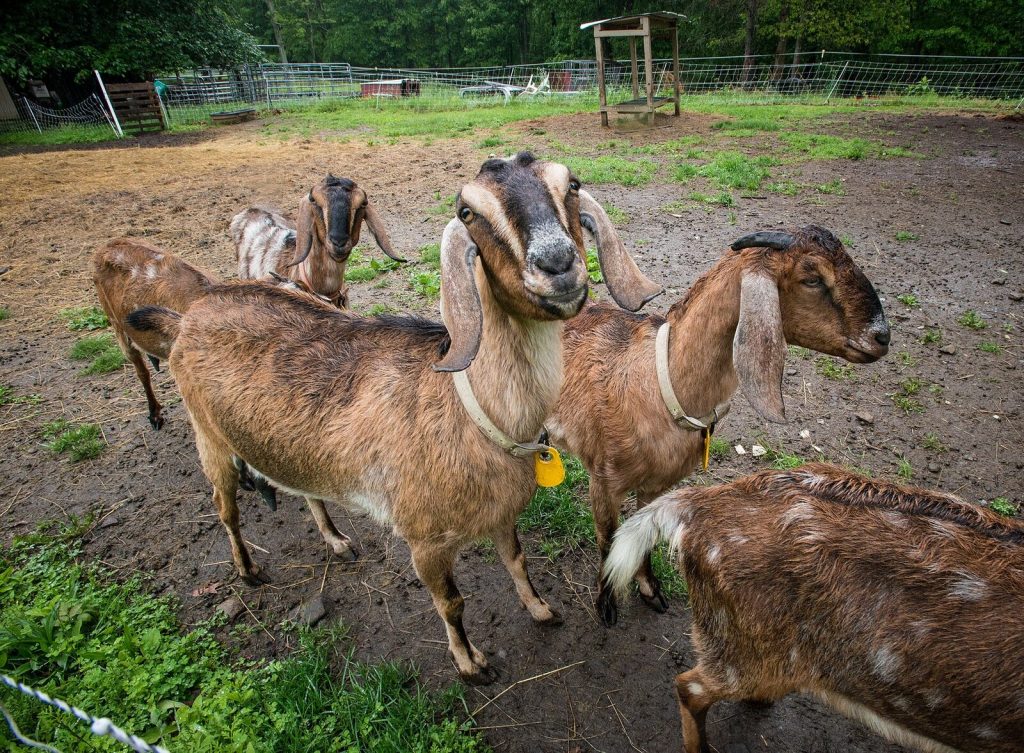
A goat house in Uganda needs a dry raised floor, wall openings for air, separate sections by animal class, and an isolation pen away from the main building. Uganda's ministry sets floor space by class, from 0.5 square metres for a kid to 2.8 for a buck. This goat housing guide works through the specification and where it usually breaks down.
Start with the failure rather than the design. When Ugandan researchers investigated suspected capripoxvirus outbreaks on six goat and sheep farms in the cattle corridor, one of the observed risk practices they wrote down on one farm was that it had no facilities for isolating suspected sick animals. On that farm the kids were worst affected and carried most of the deaths. Across the six herds, up to 40 per cent of animals showed clinical signs.
What a Goat House Has to Do on a Ugandan Farm
Uganda's national genetics agency puts the purpose of a goat house in three words: adverse climatic conditions, predators and thieves. The ministry adds a fourth that most farmers do not think of as a building problem. Housing protects against accidental injuries and against diseases carried by wild animals and microorganisms, and it lets a larger number of animals be handled, fed, watered and looked at one by one.
That last clause is the one that earns the money. A goat you can see individually every morning is a goat whose loss of appetite you catch on day one. A goat in a crowd you walk past is not.
What the house should be is a short list and none of it is expensive: well ventilated, well lighted, easy to clean, drained so the floor is dry at all times, and drought proof, meaning strong winds should not blow through it at the level of the goats. The roof must be waterproof. The materials should be realistic, practical and suited to local conditions, which is the agency's way of saying build with what is in your district.
Goat House Space Per Animal Class in a Ugandan Herd
The government figures are given by class of animal, not per goat, and that distinction does more work than anything else on this page.
| Class | Floor space | Exercise yard |
|---|---|---|
| Kid | 0.5 sq m | With the dam |
| Nanny, not pregnant | 1.5 sq m | 1.5 by 4 m |
| Nanny, pregnant | 1.9 sq m | 1.5 by 4 m |
| Buck | 2.8 sq m | 2 by 5 m |
Look at the spread. A buck needs more than five times the floor a kid needs. So any guidance that gives one square metre figure for every goat in the flock is wrong for most of the animals in it, whichever value it picks, and the figures in circulation on this query run from about 0.84 square metres to 2 square metres per head with nothing between them but assertion.
Build from a class count instead. Count your kids, your dry does, your does likely to be pregnant at the same time and your bucks, multiply each by its own figure, and add the exercise yards on top.
Working Out the Floor Area for Your Own Goat Herd
Here is the arithmetic on a real Ugandan flock rather than an imagined one. A national survey of 323 goat keeping households found a median flock of 24 goats holding a median of 13 does, 3 bucks and 7 kids. Assume five of those thirteen does are pregnant at any one time, which is an assumption rather than a measurement.
Eight dry does at 1.5 square metres gives 12. Five pregnant does at 1.9 gives 9.5. Three bucks at 2.8 gives 8.4. Seven kids at 0.5 gives 3.5. Total floor, about 33 square metres, plus 10 square metres of exercise yard for the bucks and 6 for the nannies at the sourced yard dimensions. That is a derivation from the government's class figures, not a published figure, and your own class counts will move it.
The arithmetic exposes something else. Three bucks in a flock of 24, which is what the survey measured as the median, is a mating problem before it is a space problem, and it is costing that farm 8.4 square metres of building for animals that are not needed for breeding. Our goat breeding guide takes that up.
Slatted Floors and Drainage That Stop Hoof Disease
The floor is the part of a goat house that most affects health, and the ministry's guidelines explain why in one sentence: dust inside the animal house and mud around it predispose goats and sheep to respiratory diseases and hoof rot. Dry floor, dry surroundings, fewer sick animals.
On the raised height, be aware that Ugandan pages in circulation put the figure at 2 to 3 feet, which is roughly 0.6 to 0.9 metres. That is below the ministry's at least one metre. Build to a metre and you have satisfied both, and you have made the space underneath high enough to get a spade into for the droppings.
Hoof care belongs in this section rather than in a health one, because a wet muddy floor is what makes it necessary. The national genetics agency's annual health calendar lists hoof trimming with immersion in either copper sulphate or formalin. Those are the agents it names, and the strength, the contact time and how often to do it must come from the product label and from a veterinary officer rather than from a web page.
Orientation, Ventilation and Roofing for a Ugandan Goat House
The ministry gives an orientation rule that almost no goat housing page carries. Position the house lengthwise east to west, against the direction of sunrise and sunset, which gives shade through the day and lets air move along the length of the building.
Ventilation is handled as a rule rather than a measurement: raise the shed sufficiently high and create openings in the walls so fresh air enters and damp air leaves. That is a better instruction than a height in metres, because the height that works depends on the width of your building and where the wind comes from. Figures for shed height circulate on this query and none of them could be traced to a Ugandan source, so treat them as somebody's build rather than a standard.
Ventilation and wind protection pull in opposite directions and both matter. The national genetics agency asks for a house that is drought proof at the level of the goats, meaning wind should not blow across the animals themselves, while the ministry asks for wall openings. The resolution is height: openings up high where the damp air leaves, solid walling at goat level where the draught would otherwise cross a lying kid.
The roof has one requirement, which is that it must be waterproof, and one consequence, which is that everything else on this page depends on it. A leaking roof produces the mud and the wet floor the guidelines warn about, and it does it in the rains when you are least able to fix it.
Sections Inside the Goat House for Breeders, Growers and Kids
A goat house is not one room. The ministry requires different sections within the structure for adults as breeders and for growing animals as fatteners, and it adds a rule about movement that reads oddly until you see what it is for: the house must be laid out so people and animals move from the young animal section toward the older, and not the other way round.
The reason is that pathogens travel on boots, hands and buckets, and older animals carry more of them while young stock has the least resistance. Walk into the kids first, every time, and finish at the adults. It costs nothing and it changes the direction infection moves in.
Bedding sits with the young stock. The guidelines note bedding is used routinely where dairy goats and kids are kept and that poor bedding hygiene creates conditions where microbes multiply and cause udder, respiratory and navel infection. The instruction is to keep it clean, dry and free of visible contamination, replace it regularly, and never reuse it for another lot of animals. No depth is given and none should be invented.
The Isolation Pen Ugandan Goat Farms Keep Leaving Out
This is the part of the specification that gets dropped, and the outbreak investigation shows what dropping it costs. The ministry requires an isolation pen for sick animals, separated from the main house so it does not contaminate it. It also sets out what happens when animals arrive.
| Stage | Requirement | Why |
|---|---|---|
| At the seller | At least 24 hours apart | Separate before moving |
| On arrival | At least 21 days isolated | Signs take time |
| Distance | At least 3 m from stock | Stops direct contact |
| Position | Near the gate, lower side | Traffic stays outside |
Two details in that table are worth spelling out. Siting the isolation paddock as near the farm gate as possible keeps the vehicle, the trader and the new animal out of the rest of the farm entirely. And putting it on the lower side of the entrance means water running off it runs away from the healthy stock rather than through them.
The guidelines also say to acquire new animals only if necessary and otherwise raise replacements on the farm. On the outbreak farms, all but two had introduced goats within the month before the investigation, and one farm's recorded exposure was proximity to a live animal trader with a suspected infection that was never reported. A herd that breeds its own replacements has fewer of those events to survive.
Exercise Yards and Paddocks for a Housed Goat Flock
The exercise yard is not optional in the national genetics agency's specification. The house must have one, at 2 by 5 metres for bucks and 1.5 by 4 metres for nannies. A goat shut in with nothing to look at eats less, and Ugandan fodder guidance reaches the same conclusion from the feeding side, which is why the yard sits in the specification rather than beside it.
Around the yard, the ministry's perimeter rules are about what comes in. Enclose the farm area so dogs, cats and other livestock cannot reach the goats. Keep buildings in good repair and boundary fences in good condition. Screen and enclose the feed store against vermin. Remove waste and anything else that attracts vermin and wild animals. Provide a footpath where visitors disinfect their footwear and an entrance where vehicle tyres can be disinfected.
One grazing instruction belongs here because it affects how you lay paddocks out: do not graze goats and sheep with other ruminants. On the outbreak farms, three of the six shared a grazing area and water sources and were treated as a single cluster by the investigators, which is what shared water does to a disease boundary.
Bedding, Daily Cleaning and the Manure Pit
Cleaning is a daily job in the ministry's guidelines, not a weekly one: clean pen areas daily to remove manure and other organic material. Water and feed troughs get cleaned and disinfected regularly, and anywhere an animal has died or aborted or a placenta has been handled gets cleaned and disinfected too.
Manure goes to a composite manure pit, where it becomes organic fertiliser rather than a fly nursery next to the house. A raised slatted floor makes this the easiest job on the farm, because the droppings are already collected in one place under the building instead of trodden into bedding.
Dead animals get removed as soon as possible and disposed of by incineration or deep burial. Poor carcass disposal was among the exposure practices recorded on the Ugandan outbreak farms, and it is a housing decision in the sense that you need to have decided where the pit goes before you need it.
Housing Goats at Night Does Not Stop Disease Coming In
Night housing is already common. In the Buyende district study, 55 per cent of goat keepers housed their animals at night, and every one of the six farms in the capripox investigation housed its herd overnight and grazed it free range by day.
Those six farms still recorded clinical signs in up to 40 per cent of their animals, 520 out of 1,305, with the attack rate reaching 64 per cent in one district against 32 in another and 0.5 in a third. None of them had ever vaccinated against sheep pox or goat pox. So the building was doing its night job while the exposure was arriving in daylight, through communal grazing, shared water, traffic on and off the farm, and newly bought animals.
The honest reading is that a goat house is one control among several and it is the one you can build. It will not substitute for quarantine, for vaccination decided with a vet, or for keeping other people's animals and vehicles out. Those sit on our farm biosecurity guide, the livestock vaccination calendar and our guide to common goat diseases, and what to vaccinate against and when is a question for a veterinary officer rather than for any page.
Building a Goat House From Local Materials at Low Cost
Nothing in the government specification requires bought materials except the roof. Timber for a slatted floor, poles for uprights, offcuts for a ramp and a wall built high enough to break the draught at goat level all come from what is locally available, which is exactly what the national genetics agency asks for when it says materials should be realistic, practical and suited to local conditions.
Build for the flock you expect in two years rather than the one you have, because the class mix moves as does kid and kids grow. Adding a section to a building you already own is cheap. Rebuilding the floor at a different height is not, and the sequence in our page on the cost of starting goat farming puts the shed behind the land and the breeding does for exactly that reason: the building earns nothing on its own.
Goat Housing Figures Ugandan Farmers Should Not Trust
Three patterns come up repeatedly in goat housing advice and all three are checkable.
A single space figure for every goat. It cannot be right. The government's own class figures run from 0.5 square metres for a kid to 2.8 for a buck. Any one number is too small for the buck or too generous for the kid, and on a flock where kids are a quarter of the animals that is most of the building.
A raised height below one metre. Widely circulated as 2 to 3 feet. The ministry says at least one metre. The higher figure costs a little more timber and it is the one written down by a government that has to answer for it.
Dimensions imported with the advice. If a housing guide names an animal, a climate or a predator that does not occur in Uganda, every measurement in it arrived from the same place. Check what continent the page is describing before you cut timber to its numbers.
The site's own older goat content is not exempt. One of its sections asks for a minimum of 1.5 square metres for every goat while another puts an adult at 0.5 to 0.75, and the two sit on one page. Both cannot be a recommendation, and the reason the contradiction was possible is that neither was tied to a class of animal.
Goat Housing Questions Ugandan Farmers Ask
How big a house do ten goats need? Depends entirely on which ten. Ten dry nannies need 15 square metres at the government figure. Eight nannies with two bucks need 17.6. Five nannies, one buck and four kids need 12.3. Count the classes and multiply, then add the exercise yards at 2 by 5 metres for bucks and 1.5 by 4 metres for nannies.
Does a goat house floor have to be raised? Where the flooring is wooden, the ministry says build it at least one metre above ground level with a ramp or steps of planks, and leave gaps of 1.0 to 1.5 cm so dung and urine fall through. A floor at ground level can work if it is sloped to a drain and kept genuinely dry, and that is harder than it sounds in a Ugandan rainy season. Raised is easier to keep dry and far easier to clean under.
What does it cost to build a goat house in Uganda? There is no national figure worth quoting, because it turns on timber prices in your district, how much of the material comes off your own land, roofing sheet prices, and whether you or a hired carpenter builds it. The useful output is square metres, which this page gives, so take a class count and a materials list to two local builders. Our startup cost guide sets out where the shed sits in the wider budget, and its conclusion is worth knowing before you spend: the cheapest adequate shed is usually the right one.
Can goats share a house or a paddock with cattle or sheep? The ministry's instruction is not to graze goats and sheep with other ruminants, and its housing section asks for sections and separations within the goat house itself. Shared water and shared grazing were what turned three separate Ugandan farms into one outbreak cluster.
Do goats have to be housed at night in Uganda? Most Ugandan keepers do it, and the reasons in the government documents are weather, predators and theft rather than infection. Understand what it does not cover. Housed herds in the capripox investigation still saw clinical signs in up to 40 per cent of animals, because the exposure arrived by day and through the gate.
Where should the isolation pen go? Separated from the main house, at least 3 metres from stock already on the farm, as near the farm gate as possible, and on the lower side of the entrance so run off moves away from the healthy animals. Give it its own bucket, its own boots and its own overall.
What should the walls and roof be made of? Whatever is practical locally, with two conditions. The roof must be waterproof, because a leak makes the floor wet and the wet floor is what causes hoof and respiratory trouble. And the walling must break the wind at the level of the goats while still leaving openings higher up for damp air to escape.
Get two local quotes against your own class count before you cut a single pole, because timber, poles and roofing sheet all move by district and by season. An animal standing in your isolation pen that is not improving needs a vet rather than more time, and our note on when to call a veterinarian covers making that call. Everything else about the enterprise runs from the livestock guides hub: feeding, breeding, worm control and goat farming in Uganda.