
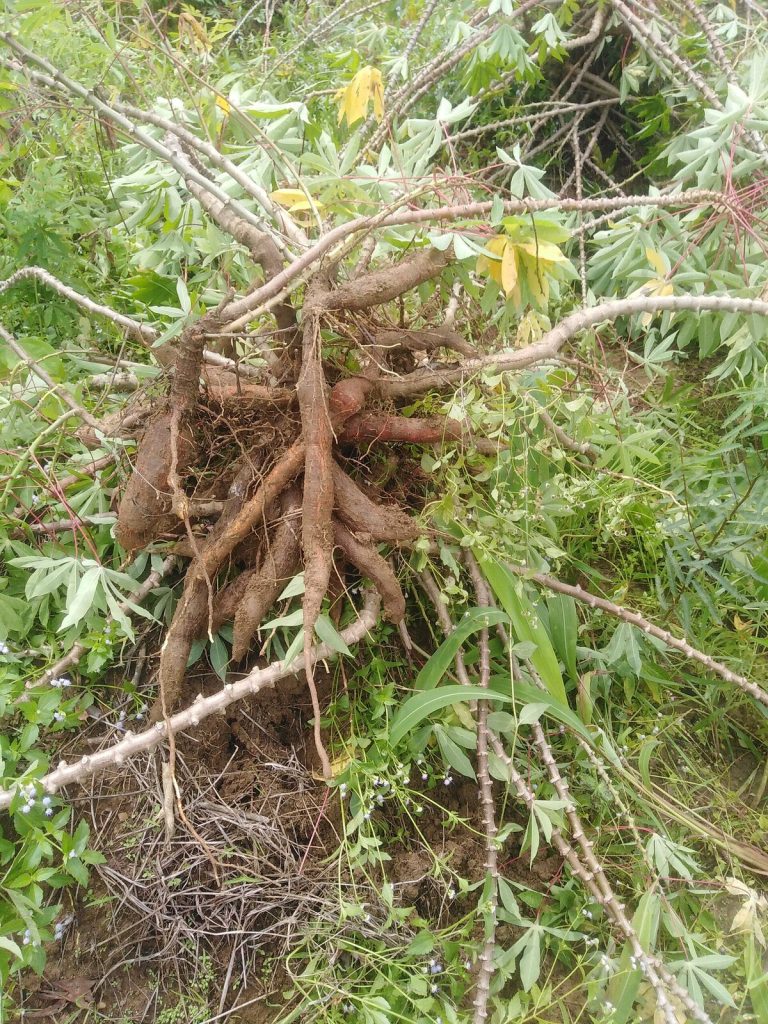
Cassava farming in Uganda starts with the planting material rather than the land, because the crop is grown from stem cuttings that carry their own diseases from one field into the next. Plant clean cuttings at one metre by one metre, weed hard through the first two months, and expect roots at about twelve months. Cassava is Uganda's second most grown food staple after bananas, and part of the diet of roughly 57 percent of the population.
That ordering matters more than it sounds. A maize grower buys a sealed packet of seed and inherits none of last season's problems. A cassava grower cuts next season's crop out of this season's stems, and whatever was living in those stems comes too. Two virus diseases, one whitefly, a mealybug and a mite all move around Uganda this way.
Where Cassava Grows Well in Uganda: Soils and Site
NaCRRI's root crops programme puts cassava on more than 80 percent of Uganda's arable land, which is close to saying the country has no cassava climate problem. What the country does have is a soil drainage problem in specific places, and cassava is unforgiving about it. The crop wants deep, well drained loam. It will grow on poor soil, which is why it ended up as the food of last resort, but it will not tolerate waterlogging, because storage roots sitting in standing water rot.
Three site signals are worth reading before you plough. Dense vegetation cover suggests fertile soil underneath. A moistened handful of soil that holds a shape but falls apart under pressure is loam, the texture you want; gritty soil that will not form a ball at all is sandy, and soil that holds its shape stubbornly under pressure carries too much clay. Grey soil with green or blue mottling is telling you it waterlogs, and that is the one signal to walk away from.
Topography settles the seedbed. Flat or gently sloping ground is best. On steep ground cassava is an erosion risk during its first months, before the canopy closes, and the fix is ridges across the slope plus mulch. In shallow soil, planting on the flat drives storage roots into hard ground and the crop gives you short, stubby roots; mounds or ridges gather enough topsoil to prevent that. Sandy soils that drain freely take minimum tillage and flat planting. Clay and any soil that holds water take mounds or ridges every time.
Selecting Healthy Cassava Planting Material
This is the section that decides the crop. Cassava planting material in Uganda is stem, cut from a standing field, and both the diseases that matter and most of the insect pests travel inside it.
Cut from a field that is nine to eighteen months old. Younger stems are not woody enough and older ones sprout poorly, which is why NaCRRI's brief draws the line at eighteen months. Within a plant, take the middle brown skinned portion of the stem. The green top dehydrates in days, produces weak sprouts and is the part most easily damaged; the extreme base is the part most likely to carry mosaic disease through into the sprout.
If your material is slightly infested with stem borne pests, IITA's guide describes a heat treatment that needs nothing you have to buy: hold the cuttings for five to ten minutes in water made by pouring one part boiling water into one part cold, just before planting. That kills pests sitting on the surface of the stem. It does nothing whatever to a virus already inside the stem, which is why selection comes first and treatment second. Choosing material you can trace is a broader problem than this crop alone, and it is covered in the guide on how to choose quality seed.
Cassava Spacing and Plant Population Per Acre
For a sole crop, the Ugandan recommendation is one metre by one metre, one cutting per hole. That geometry gives about 4,050 plants in an acre; NaCRRI's brief rounds it to 4,000, and 4,000 is the number to buy cuttings against.
One cutting per hole is worth stating because the habit of pushing two cuttings into one station is common and it does not increase yield. It doubles your planting material bill and puts two plants into the space and root volume of one. If you are worried about gaps, the answer is gap filling rather than double planting: NaCRRI's brief has you replacing dead plants one month after planting, by which time you can see which stations failed.
Plant population is also where intercropping gets decided, because you cannot keep the sole crop population and add a second crop on top of it. If you want the arithmetic for other spacings, the method is set out in the note on how to calculate plant population.
Planting Cassava: Depth, Orientation and One Cutting Per Hole
Planting depth is 6 to 10 cm. Orientation is the one point where two Tier 1 sources disagree, and the disagreement is real rather than an error in either.
NaCRRI's brief says plant horizontally, laying the cutting flat and burying it. IITA's guide says horizontal planting kills surface pests on the stem, which is the case for it, but produces storage roots close to the surface where rodents and birds reach them, and throws up several weak stems instead of a strong one. IITA prefers planting at an angle in loam, and vertical with two thirds of the cutting buried in sandy soil, where roots need to go deep.
Read it as a choice conditioned on your soil and your pest picture rather than a rule. Horizontal on loam where rodents are not a problem and your material is doubtful. At an angle on loam otherwise. Vertical in sand. What all three share is that the cutting goes in with the buds pointing the way they grew, not upside down.
Choosing the Planting Season That Rain Will Support
Every extension guide says plant at the onset of the rains, and every guide is right, but the reason is usually left vague. There is a measured version. On farm and on station trials across Kenya and Uganda found that cassava's response to fertiliser collapses where rainfall in the first three months after planting falls below about 400 mm. Root bulking is set up in those first months, and a crop that goes short of water then does not use the nutrients you bought.
Uganda's national monthly rainfall climatology on the ERA5 reanalysis, averaged over three decades, lets you check which planting months clear that bar. These are national means, so a district figure will differ, and the north runs one long season rather than two.
| Planting month | Rain, first 3 months | Fertilizer response |
|---|---|---|
| March | About 500 mm | Clears the bar |
| April | About 488 mm | Clears the bar |
| May | About 402 mm | Only just clears |
| June or July | 371 to 391 mm | Falls short |
| August | About 462 mm | Clears the bar |
| September | About 483 mm | Clears the bar |
| October | About 442 mm | Clears the bar |
| Nov to February | 223 to 388 mm | Falls short |
The practical reading: March to May and August to October are the planting windows where buying fertiliser has a measured chance of paying. Plant in December or January and the first three months carry barely half the water the response threshold needs, so that is the season to plant without fertiliser and accept a smaller crop, not the season to spend on inputs. Early planting also gives the crop enough growth to carry dry season pest pressure, which hits late planted cassava hardest.
Weeding Cassava in the First Two Months
Cassava is often described as a crop that suppresses weeds. That is backwards for the first two months, and the first two months are the ones that count. A young cassava stand has almost no canopy, and weeds establishing before the crop closes over take the yield with them.
A trial in Zambia on three varieties with contrasting canopy shapes put the critical period for weed removal at about 60 days after planting, with the range across sites falling between 48 and 73 days. Yield differences between the weeding treatments in that trial ran from 18 to 75 percent. The Zambian setting is not Uganda, so treat the 60 day figure as the shape of the problem rather than a Ugandan number, but the mechanism travels: keep the crop clean until the canopy closes and the crop will hold the line afterwards.
NaCRRI's brief puts the Ugandan weeding regime at three to four passes depending on the weed species present. Weed suppression after canopy closure is real, and it is a property of variety architecture rather than of cassava in general. Varieties that branch early, low and often shade the ground quickly; tall, sparsely branching varieties never do, and they need weeding for longer. That is one of several reasons variety choice is about more than yield, and it is taken up in the guide to the best cassava varieties in Uganda.
Soil Fertility and Fertilizer Response in Cassava Production
Cassava's reputation for growing on exhausted soil is earned, and it has made most Ugandan cassava an unfertilised crop. Whether that is the right call is measurable, and the answer is uncomfortable: it depends on the field, and the spread is enormous.
In those Kenyan and Ugandan trials, unfertilised yields ranged from 4.2 to 25.7 tonnes a hectare between sites and seasons, a sixfold spread before anyone applied anything. Adding mineral fertiliser changed yields by anywhere from minus 0.2 to plus 15.3 tonnes a hectare. On the poorest soils, those under 10 grammes of organic carbon a kilogramme, the range was wider still, from minus 8.6 to plus 24.4 tonnes. Some fields lost yield.
What predicted the response was soil fertility, rainfall and weed management. What did not predict it was variety, pest and disease pressure or harvest age. Two implications follow. First, a blanket fertiliser recommendation for Ugandan cassava is not available from the evidence, so the honest route is a soil test before fertilizer application and a small trial strip on your own field. Second, organic matter does work that fertiliser alone does not: manure, mulch and legume intercrops improve structure and water holding, and the trials found that fertilised plots suffered less from weeds because better ground cover shaded them out. The routes into that are in the organic fertilizer guide.
The Pests and Diseases That Arrive Inside the Cuttings
Two virus diseases dominate Ugandan cassava production: cassava mosaic disease and cassava brown streak disease. Both are spread by planting infected cuttings and by one whitefly, Bemisia tabaci. Neither responds to a fungicide, because neither is a fungus, and IITA's own pest field guide tells growers to avoid pesticides on cassava because the natural enemies holding the mealybug and the green mite in check are killed by them.
Three field practices carry most of the control. Rogue the young crop: pull out and replace plants that sprout with mosaic symptoms, which is best done three to four weeks after planting when the cuttings have just sprouted, and NaCRRI's brief extends the window to two to three months. Take next season's cuttings from plants you watched sprout clean, tagged at the time. After harvest, destroy stems and roots showing disease rather than leaving them at the field edge.
Timing changes what damage costs you. Storage roots start swelling three to four months after planting, and by roughly seven months the plant has set the number of roots it will carry; after that the roots get bigger but no more appear. Disease or pest damage inside those first seven months costs you root number, which the plant never replaces. Damage later costs root size, which is recoverable in part. The full picture, including the bacterial and fungal diseases and the vertebrate pests, is in the guide to cassava diseases and pest control.
Intercropping Cassava With Beans or Maize
Most Ugandan cassava is not a sole crop. In the national agricultural census, 3.1 million plots carried cassava and only 1.9 million of them, about 61 percent, were pure stand. The mean cassava plot was 0.28 hectares.
NaCRRI's brief has the intercrop going in one month after the cassava has germinated, with beans or maize as the named partners. The one month gap gives the cassava its establishment head start, which is the whole point; sow both at once and the faster crop wins. Legumes are the better partner on poor soil because they put nitrogen back, and IITA's guides name cowpea and groundnut alongside beans for that reason. If maize is the partner, the two crops are competing for the same light at the same height for several months, so drop the population of both rather than keeping either at full rate. Guides for the two common partners are at bean farming in Uganda and maize farming.
Harvesting Cassava and the Twelve Month Decision
NaCRRI puts maturity at twelve months, and IITA gives the wider harvest window of nine to eighteen months across varieties. Cassava can then sit in the ground for two to three years depending on variety, which is the reason it functions as a household food reserve rather than a harvest.
Leaving it there has a measured price where brown streak is present. Six Ugandan varieties were lifted at four separate ages, from twelve months out to twenty four, at two sites with different disease pressure. Past the twelve month mark the share of roots still fit to sell fell by roughly 14 to 27 percent, and necrosis inside the roots deepened at both sites. Dry matter content, interestingly, was unmoved by harvest date. One of the six came out almost undamaged at twenty four months, which is the useful part: in ground storability is a variety trait, so the question is not whether cassava can wait but whether yours can.
Labour across the whole cycle runs 75 to 125 person days a hectare from land preparation to harvest in IITA's estimate, which is 30 to 50 person days an acre. Harvesting is hand work on a heavy, deep rooted crop, and the two weedings before it are the other labour spike.
What Happens to Cassava Roots After Harvest
Fresh cassava roots start deteriorating within days of leaving the plant, and this is the single largest loss in the Ugandan fresh root trade. Dark radial streaking appears in the flesh about four days after harvest. A Ugandan screening study puts losses at 40 to 60 percent within the first seven days, reaching total loss within another two to five days if the roots are not eaten or processed.
Two things reduce it. The first is variety, because the eight Ugandan varieties in that study ranged from about 5 percent deterioration at day seven to over 50, and those results are tabulated on the cassava varieties guide. The second is pruning: cutting the leaves off the standing plants and leaving them a week before lifting the roots reduced deterioration by an average of 44 percent across the varieties tested, with the largest gains on the varieties that deteriorate worst. It costs nothing but a pass through the field.
The other postharvest requirement is processing, and it is a safety requirement rather than a preference. Cassava roots contain cyanogenic glycosides, and the quantity varies hugely by variety. Sweet varieties carry up to about 100 parts per million; bitter or wild types reach as high as 2,000 parts per million on a dry weight basis, against a reference safe level under 10 parts per million for flour ready to eat. The gap between those numbers is what processing exists to close.
The published detoxification sequence is peeling, soaking in water for four to six days, sun drying or roasting, scraping off the outer layer and then grinding. Shortening the soaking or the drying leaves the glycosides intact. Uganda has a documented case of what that means: a public health investigation in Kasese District traced an outbreak with 98 probable cases and two deaths to a single batch of cassava flour that tested at an average of 88 parts per million of cyanide, more than eight times the reference level. The flour was pure white, which is typical of wild cultivars, rather than the creamy colour of flour from sweet varieties, and it had been bought because it was cheaper than the alternatives. If you are buying flour or roots to process for sale, colour and price are both signals worth reading, and a district health or standards officer is the person to confirm a batch. Processing at scale is covered in the note on cassava flour production.
Cassava Farming Questions Ugandan Growers Ask
How long does cassava take to mature in Uganda? NaCRRI puts maturity at twelve months, and the harvest window across varieties runs nine to eighteen months. Roots can then be left in the ground for two to three years in a healthy crop. Where brown streak disease is present, that patience costs money: a two site Ugandan trial measured marketable root yield falling by about 14 to 27 percent between twelve and twenty four months.
How many cassava cuttings do I need for one acre? About 4,000, at one metre by one metre spacing with one cutting per hole. NaCRRI's field brief expresses it as eight bags of 500 cuttings. Buy a margin above that for gap filling in the first month, because some stations always fail.
What does it cost to grow one acre of cassava in Uganda? The only Ugandan survey that costed it line by line came to UGX 320,000 an acre, and that figure is now some years old, so treat the shilling total as historical and the structure as the durable part. What the structure says is useful: the two weedings together were the largest item at about 37 percent, ploughing about 25 percent, planting material about 22 percent and planting labour about 16 percent. That stack excludes harvesting and it excludes family labour, which the report that published it says plainly. So cassava is not a cheap acre with a low input bill, it is a labour bill with weeding at the top of it. Current input and labour rates are worth checking against the latest Ugandan farm prices before you plan.
What price do cassava growers get for fresh roots? The share is more durable than the shilling figure. In the one Ugandan study that tracked the whole chain, the grower received about 19 percent of the retail price, with a rural assembler, a travelling wholesaler and a retailer between the farm and the consumer. The same study put the weighted average retail price at just under UGX 1,000 a kilogramme once discounting was accounted for, against an undiscounted first day price around a third higher. Retailers cut hard as roots deteriorate, by as much as 93 percent by the third day, and that risk is priced into what they offer upstream. It is the main reason the farm gate figure sits so far below what you see in a Kampala market. Those shilling amounts are from a survey some years old, so use the share rather than the amount and check the current price page for today's level.
Can I plant cassava cuttings from my own last crop? Yes, and most Ugandan growers do, but not indiscriminately. Take cuttings only from plants you watched sprout without mosaic symptoms and that carry no cankers, gum, streaking or dieback. In varieties that branch, take the branches rather than the main stem, because cuttings from branches sprout clean far more often. Avoid a field older than eighteen months, because those stems sprout badly. Recycling material from a field that already shows disease is how an infected stand reproduces itself.
Does cassava have to be processed before eating? Bitter and wild types must be, and sweet varieties still need processing before they are made into flour. The documented sequence is peel, soak four to six days, sun dry or roast, scrape and grind. Uganda's Kasese poisoning outbreak came from flour made without adequate processing, so this is not a quality question.
Is there a market for cassava stems? There is, and it is often overlooked in planning. A first cassava crop yields stems along with roots, and clean planting material is in short supply: growers in a Ugandan value chain survey named lack of good quality planting material among their main constraints, with about 80 percent of respondents in both study areas raising it. A field of known clean material has two products rather than one.
Prices for fresh roots, chips and flour move with season and with distance to the nearest mill, so check current Ugandan crop prices before you commit an acre, and look through the supplier listings for cuttings and inputs near you. Where you can, see the field your cuttings came from before you buy them. Start from the crop growing guides for the crops you might rotate or intercrop with, and read the companion pages on cassava yield per acre and disease control before your first planting.