
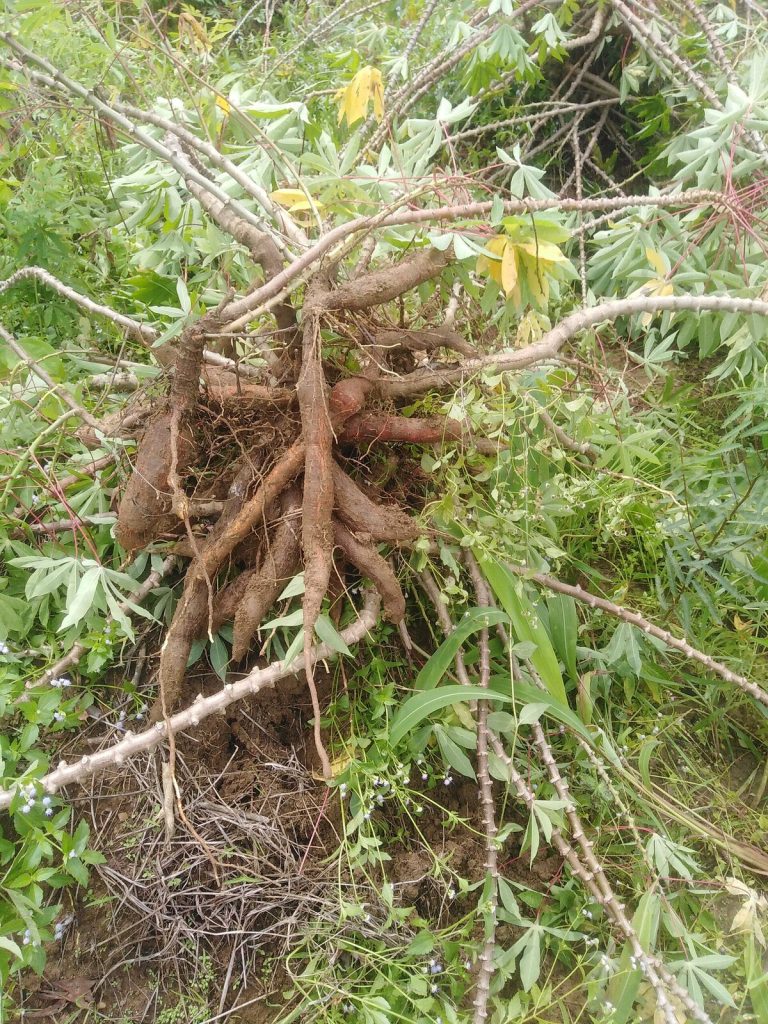
Cassava flour production follows one of two routes, and choosing between them is a safety decision rather than a quality preference. One soaks peeled roots for several days before drying. The other finishes everything inside a single day and has no soak at all. Both make flour. Only one of them removes cyanogenic glycosides by soaking, and the other leaves that job to the variety you planted.
The Two Cassava Flours in Uganda, and Why the Difference Is a Safety Difference
Almost every guide to making cassava flour presents a single line of nine or ten steps. That is where the trouble starts, because two genuinely different processes are being flattened into one.
The traditional route peels roots, soaks them in water for four to six days, sun dries or roasts them, scrapes off the outer layer and grinds the result. The Codex standard for edible cassava flour describes this same sequence in its own product definition, specifying that flour prepared from bitter cassava is detoxified by soaking the tubers in water for a few days before drying. The soaking is not a softening step. It is the step during which the plant's own enzymes break cyanogenic glycosides down.
The high quality route works the opposite way. Roots are peeled, washed, grated into a mash, pressed to squeeze water out, dried thin and fast, milled and sifted, and the whole thing is completed within 24 hours of harvest. The product is very white, low in fat, not sour, carries no fermented smell and blends into wheat flour for bread and biscuits. There is no multi day soak anywhere in it.
So the short route buys quality by removing the very step that handles the toxin. Its own published guidance resolves this the only way it can: use low cyanide, less bitter varieties. On the high quality route, variety selection is the cyanide control, and that is not a footnote you can leave out of a business plan.
Which Cassava Varieties and Roots Make Flour Worth Selling
Root age and condition set the ceiling on everything downstream. The high quality route asks for roots 10 to 12 months old, harvested carefully to avoid bruising, healthy, firm and freshly lifted, with white flesh, no cracking and few fibrous roots. Roots that are too old or damaged spoil during processing, which is a loss you pay for twice because you have already peeled them.
Maturity can be judged in the field without equipment, by snapping a root and reading the flesh. That check belongs to the buying point and is set out on the cassava processing business page, along with what to weigh and what to ask the seller.
Variety decides two things at once here, bitterness and dry matter, and they pull against each other. Bitter material often carries more dry matter, so flour yield per tonne of root is better while the detoxification burden is heavier. Sweet material inverts that trade. Which way you go should follow from the route you intend to run rather than the other way round. Which Ugandan varieties are actually released and buyable is the place to start, and the disease page matters here too, because brown streak damage shows up as necrosis in the root you were planning to peel.
The Traditional Route: Peeling, Soaking and Sun Drying Into Chips
Chips are the intermediate product on this route: slices roughly 5 to 15 mm thick, dried and later milled. In Uganda they are also a traded commodity in their own right, moving from farmers to wholesalers and on to retailers who mill piecemeal as customers ask for flour.
The sequence that matters is peel, soak, dry, scrape, grind, and each duration does work. Peel the roots and remove the stalk, woody tips and fibrous roots with a sharp knife, because incomplete peeling shows up as off colour in the finished flour. Soak for four to six days. Sun dry or roast. Scrape the outer layer from the dried pieces. Then grind. If either the soaking or the drying time is cut short, enzymatic breakdown is incomplete and cyanogenic glycosides stay high.
Where this route goes wrong in Uganda is the surface, not the sequence. In a survey of 210 cassava value chain actors, about half of farmers peeled cassava directly on bare ground, and roughly the same share dried chips on bare ground. The split is regional: eastern farmers mostly dried on bare ground at 42.2 percent, northern farmers mostly on tarpaulin at 48.1 percent. A smaller number dried on rock or paved road at 3.9 percent, on gunny bags at under 2 percent, and some on a surface smeared with cow dung and left to harden. Soil is where the moulds that produce aflatoxin live, so the surface is not a detail.
Drying took six days on average, and 88.9 percent of farmers judged dryness by breaking a chip to test how it snaps. That is a reasonable field test and it is also the only test most of the chain has. It says nothing about moisture in percentage terms, which is what a buyer with a meter will measure.
The High Quality Route: Grating, Pressing and Drying Within a Day of Harvest
Nine steps, and the clock is the specification. Select healthy freshly harvested roots. Peel with a sharp stainless knife and keep the peel for drying into animal feed or compost. Wash the peeled roots in clean water to remove sand, soil and leaves. Grate into a fine mash, using a perforated iron sheet or a mechanical grater. Pack the mash into a clean jute or sisal sack that lets water escape and press it with a screw press or hydraulic jack until the material is crumbly. Spread the pressed mash thinly on a clean black sheet on a gentle slope in full sun, raised off the ground if possible, covered with netting against flies and birds, until it is very floury. Mill. Sift. Pack.
Pressing is the step people skip and it is the one that makes the route work. Squeezing water out mechanically means the mash dries in hours rather than days, and speed is what keeps the flour white and free of the sour fermented note that lost Ugandan bakeries to wheat in the first place. Rusty equipment and any delay between grating and pressing produce that fermented odour directly.
One material warning worth carrying. FAO records that iron in contact with wet cassava can react with hydrocyanic acid to produce ferrocyanide, which tints the product bluish, and that trials elsewhere used copper, brass or bronze equipment instead. If your flour has an odd cast to it, the machine may be the reason.
Milling, Sifting and the Particle Size That Decides Your Market
Milling is usually a hammer mill, the same machine a village posho mill uses. Sifting through a simple sieve removes fibre and lumps and is what makes flour free flowing rather than lumpy, which matters to a baker weighing ingredients.
Particle size is specified, and few small producers know it. The Codex standard for edible cassava flour defines fine flour as flour of which at least 90 percent passes a 0.60 mm sieve, and coarse flour as at least 90 percent passing 1.20 mm. The same standard caps crude fibre at 2.0 percent and ash at 3.0 percent, and requires the flour to be free of abnormal flavours, odours and living insects. Fibre and ash are laboratory numbers, but they are also a direct verdict on peeling and on how much soil reached the drying surface.
A hammer mill treats soft dried cassava differently from grain, and grinding too fine wastes energy while grinding too coarse fails the sieve test. Hammer mill selection and screen sizes are covered separately.
Drying Cassava Flour to the Moisture the Standard Allows
The Codex standard for edible cassava flour caps moisture at 13 percent by mass, and it adds its own condition in the same clause: lower limits should be required for some destinations, depending on climate and on how long the flour will be in transport and storage. So 13 percent is a ceiling for a product moving a short distance in good conditions, and a flour heading for a long haul or a humid store needs to be drier than that.
Do not import the grain figure here, close as the two numerals look. Maize is traded against a different specification, whose two published editions disagree with each other, and that argument is reconciled on the maize storage guide. The cassava flour ceiling comes from the cassava flour standard, and the coincidence of numerals between two unrelated documents is not a reason to quote one for the other. The same applies to package weight: the 50 kg cap that grain traders work to belongs to a grain specification, and the cassava flour standard sets no weight at all, only that containers must be clean, sturdy and strongly sewn or sealed.
What Ugandan storage actually looks like is some distance from either figure. The practices survey found 86.7 percent of farmers storing chips and flour in kitchens and bedrooms, on the reasoning that kitchen smoke preserves cassava and a bedroom deters thieves, while only 5.83 percent had a store built separately for crops and 5 percent used metal barrels. Wholesalers did little better: 95.2 percent packed chips in single layered gunny bags placed straight on the floor, and only 22.4 percent used pallets. Ambient moisture measured inside those stores ranged from 12.6 to 26 percent with a mean of 15.6, which is a statement about the room rather than about the flour, and a room that damp will pull a dry product back up. How moisture behaves in a store transfers directly.
Why the Village Mill Is Where Maize Toxin Reaches Cassava Flour in Uganda
Ugandan cassava flour carries a measurable mycotoxin load, and the numbers point at a specific place in the chain. Across 192 samples, half flour and half chips, drawn evenly from farmers and wholesalers in eight districts, 54 percent carried at least one of eight regulated mycotoxins and 49.8 percent were above the limits used as a benchmark.
Read the benchmark carefully, because this is where published figures get misquoted. Mycotoxins are not regulated in cassava at all. The study says so directly, noting that hydrocyanic acid in cassava does carry legislative limits while mycotoxins do not. Lacking a cassava figure, the researchers borrowed the European cereal limits: 5 micrograms per kilogramme of aflatoxin B1, and 10 for total aflatoxins, both written for maize and other cereals. So a cassava aflatoxin ceiling quoted to you is a cereal ceiling wearing the wrong crop name.
Flour ran higher than chips on fumonisins, zearalenone and deoxynivalenol. Flour held by farmers ran far higher than flour held by wholesalers on aflatoxin B1, on total aflatoxins and on ochratoxin A. Both of those directions point the same way: something happens between the chip and the flour, and between milling and the household store, that adds contamination rather than diluting it.
The mill is the obvious candidate. In the surveyed districts there was roughly one milling machine for every 180 customers bringing cassava, each handling about 26 kg per customer, and only one machine in fourteen was registered with the Uganda National Bureau of Standards. The same machines mill maize, sorghum and millet, and operators said they never clean between crops. Cereals carry a heavier toxin load than cassava does. Then 73 percent of consumers blend cassava flour with maize, millet or sorghum at home, because blended meal is preferred on taste, which imports the same toxins a second time by a different door.
If you intend to sell cassava flour on quality, the mill has to be yours, it has to run cassava only, and it has to be cleaned between batches. That is a bigger quality claim than any packaging design.
Packaging, Storage and Shelf Life for Cassava Flour
The high quality route's own guidance is specific. Pack sifted flour in airtight, moisture proof bags, seal them properly rather than folding them over, label with the date of manufacture and an expiry date, overpack the bags in a carton to keep light off them, and store the cartons somewhere cool, dry and ventilated. On that handling, the flour keeps for about six months.
Codex adds the labelling rule that catches people out: the name on the label is edible cassava flour. Non retail containers must carry at least the product name, the lot identification and the name and address of the manufacturer or packer, or an identification mark that ties back to accompanying documents. Lot identification is what makes a recall possible, and a producer who cannot identify a lot cannot answer a complaint.
On shelf life, note what is and is not established. The six month figure belongs to the high quality route in sealed moisture proof packaging. Ugandan farmers in the practices survey hold flour for up to a year, and wholesalers and retailers hold chips for 30 to 90 days, but that survey measured practice rather than product quality, so a year in a bedroom is not evidence that a year is safe. What a package has to carry and do goes into the labelling side in more detail.
What Ugandan Bakeries and Millers Reject Cassava Flour For
Colour, odour and contamination. Those are the three faults Ugandan confectioners named when they abandoned cassava flour after trying it, in the one survey of the Kampala and Jinja trade that asked them, and the abandonment was close to total. Their costs had come down while they used it. Product quality had come down further. Several said they would test a properly made high quality flour, particularly for biscuits, which says the specification is the obstacle rather than the appetite. The market side of that finding sits on the business page.
Those three rejection reasons map exactly onto three process steps. Colour comes from incomplete peeling, from old or bruised roots, and from iron equipment. Odour comes from delay between grating and drying, and from rusty tools. Contamination comes from the drying surface, the packaging and the shared mill. None of them is about the crop. All of them are about the process, which means the specification is winnable.
Aim at the buyer who measures. A household buyer judges flour by colour and price. A baker weighs, tests moisture and notices a sour note in a finished loaf. The second buyer pays for consistency, and consistency is the only thing a small producer can offer that a bigger one cannot copy overnight. The wider business case, the supply base you need and the buying side all sit on the cassava processing business page, and this page sits within the value addition guides.
Frequently Asked Questions
How many kilogrammes of fresh cassava make one kilogramme of flour? No measured Ugandan ratio could be sourced, so rather than borrow one, here are the two inputs that set it for your own material. Dry matter in Ugandan cassava runs from roughly 25 percent in local varieties to about 45 percent in newer clones, with published Ugandan variety trial cohorts sitting around 36 to 40 percent. Manual peeling discards the inner peel, which alone is 8 to 15 percent of whole root weight, plus the outer skin and the woody tips. Weigh one whole batch in and the finished flour out, and you will have a number that is true for your variety and your peeling standard, which a borrowed ratio never is.
How dry does cassava flour have to be? The Codex standard for edible cassava flour caps moisture at 13 percent by mass and states in the same clause that lower limits should be required for some destinations, depending on climate and the length of transport and storage. Treat 13 percent as the outer limit rather than the target, and go drier for anything travelling or sitting in store. This figure comes from the cassava flour standard and is not the maize grain figure, which belongs to a different specification.
Does cassava flour have to be soaked, or can I skip it? You can skip it only by changing the variety. The recognised sequence for bitter or unknown material is peel, soak four to six days, dry or roast, scrape, grind, and a short soak or a short dry leaves cyanogenic glycosides high. The high quality route has no soak, and its own guidance restricts it to low cyanide, less bitter varieties for exactly that reason. In the Kasese outbreak, flour from the implicated batch averaged 88 parts per million of cyanide against a World Health Organization reference below 10, with 98 probable cases and two deaths. Colour is no help: that flour was pure white, which is typical of wild cultivars, where sweet cultivar flour is creamy. A semiquantitative picrate paper test for cyanogenic potential exists and can be used by untrained staff.
What can I sell cassava flour for, and who buys it? Current Ugandan prices move with season, district and quality, so price against what buyers near you are quoting rather than against a figure in an article. What is durable is the sensitivity: in modelling of Ugandan cassava flour production, a fall of roughly one sixth in the selling price took the modelled return down to about 6 percent, and a 5 percent loss in extraction efficiency was enough to move the enterprise between profit and loss. On the buyer side, Uganda declares exports of root and tuber flour of roughly 1,900 to 3,600 tonnes a year against imports under 25 tonnes, at declared unit values of about 0.31 to 0.37 US dollars a kilogramme, going mainly to South Sudan, Burundi, Kenya and the Democratic Republic of the Congo. Domestically the buyers are millers, the chip trade, bakeries and confectioners, brewers and feed compounders.
How long does cassava flour keep? About six months for high quality flour packed in airtight moisture proof bags, sealed, overpacked in a carton and stored cool, dry and ventilated. That figure belongs to that packaging and that route. Ugandan farmers commonly hold flour for up to a year in kitchens and bedrooms, which is practice rather than evidence, and the survey that recorded it did not test the flour afterwards.
Can I grind cassava at the village mill and still sell the flour as high quality? Not honestly. In the districts surveyed, the same machines mill maize, sorghum and millet, operators said they never clean between crops, and there was about one machine for every 180 customers, so the queue in front of you is part of your product. Cereals carry more mycotoxin than cassava does. A dedicated, cleaned, cassava only mill is the requirement, and registering it with the Uganda National Bureau of Standards is worth asking your district commercial office about, since only one machine in fourteen had done it.
Is fermented cassava flour the same product? No. It is a distinct product with its own market and its own taste expectations. FAO's processing guidance records that allowing roots to ferment before pounding gives incomplete yields and inferior quality where starch is the aim. Sell it as what it is rather than as a cheaper version of high quality flour, because the two answer different buyers.
Decide which of the two routes you are running before you buy anything, because the grater and press only earn their keep on the short route and the soaking pits only matter on the long one. Equipment, sieve sizes, sealing gear and packaging all vary by supplier and by whether a unit is imported or locally fabricated, so collect several written quotations against one written specification and ask what spares each supplier holds. The supplier directories are the place to start looking for equipment and packaging sources.