
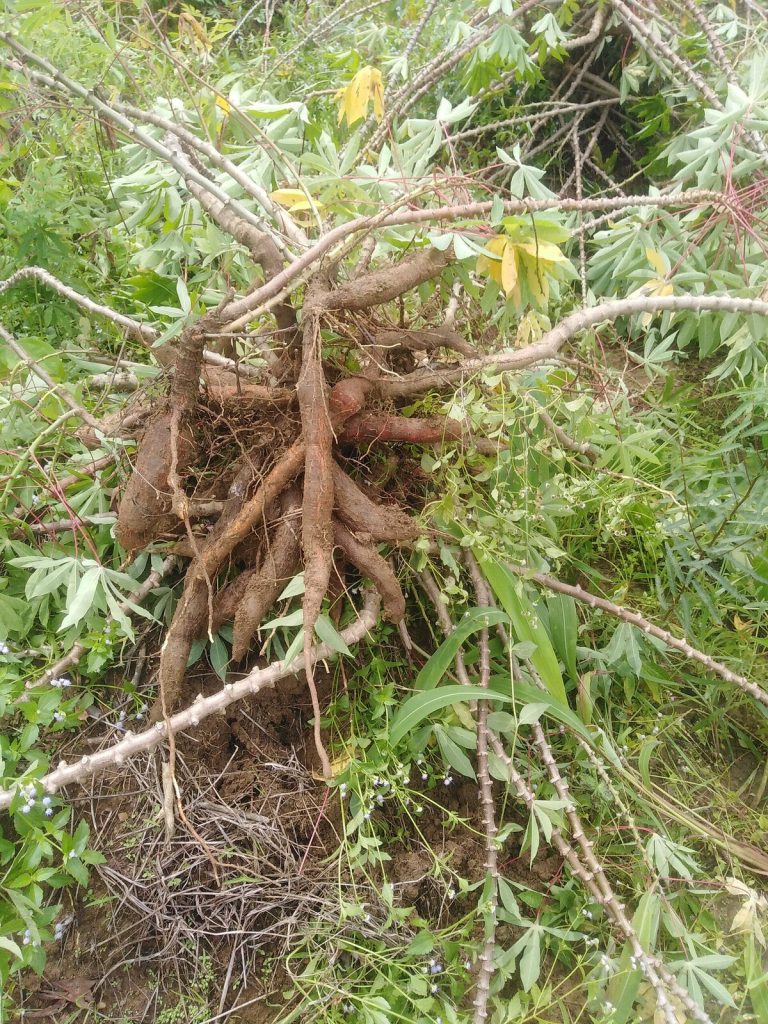
A cassava processing business turns fresh roots into dried chips, flour, starch or animal feed within days of harvest, and the timing is what decides which of those products you can still make. The machine is the cheap decision. What separates a working unit from a stalled one in Uganda is how fast roots reach the line and whether you are paying for weight or for solids.
What a Cassava Processing Business Actually Sells in Uganda
Four product families come off a Ugandan cassava line, and they are not interchangeable. Dried chips are sliced root, roughly 5 to 15 mm thick, sun dried and sold on to millers, wholesalers or industry. Flour is milled chips, or in the high quality route, milled fresh mash. Starch is the purified granule, separated in water, and it is a different business with a different customer. The peel and the milling residue go to livestock feed.
Cassava is the second most widely grown and consumed food crop in Uganda after bananas, and it is a staple in the diet of roughly 57 percent of the population. That is the reassuring part. The uncomfortable part is what happened the last time Ugandan cassava flour was offered to the food industry at scale. In a survey of confectionery manufacturers in Kampala and Jinja, 74 percent had tried cassava flour in their products and every one of them had stopped using it, citing colour, odour and contamination. Several said they would test a properly made high quality flour, particularly for biscuits. The market was not lost on price. It was lost on quality.
Starch is thinner ground than most business plans assume. When 80 Ugandan companies were surveyed, only 30 percent used starch at all, and within that group 80 percent used maize starch against 10 percent cassava. National starch consumption then sat around 1,000 to 1,500 tonnes a year across pharmaceuticals, food and non food users. Cassava starch competes into a small pool against an incumbent.
The Harvest Clock That Decides Which Cassava Product You Can Make
A lifted cassava root begins to deteriorate almost at once. Vascular streaking shows at around four days, and Ugandan variety work puts the loss at 40 to 60 percent of value within seven days of harvest, with total spoilage in a further two to five days. FAO's own processing guidance is blunter for a starch line: roots arrive from the field as soon as possible after harvest and cannot be held more than two days.
That clock is the first thing to design a business around, ahead of any machine. It rules out buying roots from far away, it rules out a supply base that cannot be harvested to order, and it rules out any product that needs the root intact after a week.
Growers already know this, which is why fresh roots are discounted so hard in Ugandan markets: retail price data from a Ugandan value chain study shows discounting of up to 93 percent by the third day. A processor who can guarantee same day collection is buying at the only point in the week where the seller has leverage and the buyer has quality.
Choosing Between Cassava Chips, Flour, Starch and Animal Feed
Chips are the lowest bar and the crowded end. They need slicing, a drying surface and bags, and the Ugandan trade already moves them in volume. Flour is one step up and needs a mill. Starch needs water, settling tanks and a great deal more care, and FAO notes one genuine advantage of the root here: because cassava carries relatively little secondary material, a first rate flour can be obtained using only clean water and no chemicals, which is what makes it suited to small rural units in the first place.
Feed is the by product that decides whether the arithmetic closes. Peel can go to livestock after drying, and the milling residue with it. Nothing about a cassava line should leave the yard unsold.
Where the products differ most is in what they forgive. A chip buyer inspects colour and snap. A baker measures. If you intend to sell into the food industry rather than into the chip trade, the product choice is really a decision to be measured, and that starts at the buying point.
Buying Cassava Roots at the Farm Gate: Grading and Weighing
Starch factories elsewhere set the root price on a starch content basis, with a discount or a premium for deviation from an agreed level. The content is judged either by laboratory analysis or by a field test any buyer can learn: snap a medium sized root in two. If it breaks with medium force and the flesh is firm, white and dry, the root is mature and near its maximum starch, which FAO puts at about 30 percent. Flesh that is slightly yellow with a translucent watery core is immature and low in starch. A root that needs real force has gone woody and the crop is past its prime.
Ugandan dry cassava buying works differently. In a survey of 210 value chain actors, wholesalers reported judging chips on white colour and brittleness, and nothing else. Both of those are real signals. Neither is a measurement, and one of them is actively misleading about the hazard that matters most, which the cyanide section below deals with.
Weight is the other unmeasured term. FAO's guidance states that root weight estimated at the farm by simple means does not reflect the true yield, and recommends weighbridges at the factory for roots and for finished product alike. This is the same problem the site records across Ugandan produce trade: a sale by basin, tin or unmarked bag is a price the seller did not set, and a record kept in basins can never become a cost per kilogramme. If you are building a processing unit, the scale is not an accessory. It is the instrument that makes every other number on this page real, and the case for owning one is set out under the scales a farm or buying point actually needs.
Sizing the Cassava Supply Base in Acres
The supply base is where most plans quietly fail. Modelling of Ugandan cassava flour production found that below roughly 20 acres of raw material the modelled profitability fell away sharply, and that groups which did not plant a reasonably large area quickly, inside about two years, were less likely to build a viable enterprise. That finding runs against the instinct to start small and grow, and it is worth sitting with.
The same modelling showed how thin the margin is elsewhere. A 5 percent loss in extraction efficiency was enough to move the enterprise between healthy profit and loss, and a fall of roughly one sixth in the selling price of flour took the modelled return down to about 6 percent. Neither of those is a price forecast. Both tell you the business has very little tolerance for sloppy processing or for a weak buyer.
Acreage converts into product through dry matter, and the Ugandan figure is not one number. Across published variety work the span runs from about a quarter of the root to nearly half, so two neighbouring fields can differ by a factor approaching two on the only quantity you are really buying. Manual peeling then takes more again, the inner peel alone accounting for 8 to 15 percent of whole root weight. Put one batch of your own material through the whole line and weigh both ends rather than trusting a ratio from an article, and see what Ugandan cassava actually yields per acre before you commit acreage to a line. Variety choice interacts with this directly, which the released Ugandan varieties page covers.
Processing Equipment and the Cost Each Machine Decides
Equipment sequence follows the product. Chips need knives or a chipper, a clean raised drying surface and bags. Flour adds a mill, and village posho mills already do this work across Uganda. High quality flour adds a grater and a press between washing and drying, because pressing water out of grated mash is what lets the material dry fast enough to stay white and unfermented. Starch adds rasping, screening, settling tanks and a drying floor.
Two engineering numbers are worth knowing before you buy. Rasping frees only part of the starch on each pass, between 70 and 90 percent, which is why pulp is often rasped twice after screening and why extraction efficiency swings so hard with machine condition. And engine driven rasping starts to make economic sense above roughly 10 tonnes of fresh roots a day, below which hand or foot driven graters are the honest answer. Milling choices carry across from cereals, and the milling machine guide covers what a hammer mill does and does not do.
Where Aflatoxin Enters a Ugandan Cassava Chain
This is the part no competing page covers, and it changes where a processor spends attention. A study of 192 Ugandan cassava samples, half flour and half chips, drawn evenly from farmers and wholesalers across eight districts, found 54 percent carrying at least one of eight regulated mycotoxins and 49.8 percent above the limits used as a benchmark.
The benchmark needs explaining, because it was borrowed. No mycotoxin limit exists for cassava anywhere, which the study states outright while pointing out that cyanide in cassava is regulated. What the researchers used instead were Europe’s cereal thresholds, 5 micrograms per kilogramme of aflatoxin B1 and 10 for total aflatoxins, both drafted for maize rather than for a root. Two consequences for a buyer. You cannot fail a cassava lot against a limit, because there is none. And you cannot pass one either, so a supplier claiming compliance is claiming something unavailable.
The direction of contamination is the useful finding. Flour held by farmers averaged far higher than flour held by wholesalers on every toxin measured: aflatoxin B1 at 27.1 against 8.91 micrograms per kilogramme, total aflatoxins at 78.2 against 5.79, ochratoxin A at 79.6 against 2.44. Flour also ran higher than chips. Contamination is being generated at the farm and during milling and storage, not acquired later in the chain, which means a processor buying chips is buying a history it did not create.
That history is written into the surface the chips were dried on. Bare ground, tarpaulin, rock, paved road, gunny sacking and cow dung hardened into a pad all appear in the Ugandan survey data, and the split runs by region rather than by ability, with eastern farmers mostly on bare ground and northern farmers mostly on tarpaulin. Soil holds the fungi. Asking one question at the buying point about where a lot was dried tells you more than any visual inspection will.
Milling is the other step you inherit. Almost none of the machines in the surveyed districts were registered with the Uganda National Bureau of Standards, each was serving roughly 180 customers, and every one of them was also grinding cereals without being cleaned in between. A processor who owns a dedicated mill starts from a measurably cleaner product than one who rents queue time, and that difference is worth more than any label. The flour page works through the mill and the drying surface in detail.
Drying and the Cyanide Step No Cassava Business Can Skip
Every cassava root carries cyanogenic glycosides. Removing them is a timed process, not a formality, and a buyer of dried chips has no way of confirming it happened. That makes it a commercial exposure rather than a technical detail.
Uganda has one documented outbreak to reason from. In Kasese District, a batch of flour traced to a single wholesaler produced 98 probable cases of cyanide poisoning and two deaths, with a median patient age of ten years. Five samples from that batch averaged 88 parts per million of cyanide, against a World Health Organization reference below 10. The batch had been bought cheap and traced back across the Tanzanian border, and investigators suspected wild cultivars, whose content runs as high as 2,000 parts per million of dry weight. Sweet cultivars reach about 100, and still need processing.
Two things follow for anyone buying. First, cheap material of unknown origin is the risk profile in that outbreak exactly. Second, the visual test does not help you: eyewitnesses described the implicated flour as pure white, which is what flour from wild cultivars looks like, where sweet cultivar flour is creamy. Ugandan wholesalers meanwhile select chips on whiteness. The one thing the trade looks at is pointing away from the one hazard that can kill.
What does help is knowing the grower, the variety and the processing history, which is another argument for contracting rather than buying on the open market. A semiquantitative picrate paper test for cyanogenic potential exists and can be run by untrained staff, so a processor has no excuse for not knowing. The processing sequences themselves, and why the fast route changes the safety logic, sit on the flour page.
Market Standards and Registration for Cassava Products in Uganda
For flour intended to be eaten, the Codex standard for edible cassava flour is the specification a serious buyer will hold you to. It caps moisture at 13 percent by mass, and that clause carries its own escape: a drier product is called for wherever the climate or the length of the haul demands it. It also sets fibre, ash and particle size limits, which the flour page works through, and requires packaging that is clean, sturdy and sealed or strongly sewn.
Two absences in that standard are worth knowing. It sets no cyanide figure of its own, deferring to the general contaminants standard, and it sets no aflatoxin figure for cassava either. So compliance with the flour standard does not demonstrate that either hazard was handled. You have to demonstrate that yourself, through the process.
Do not carry the grain figures across. Maize grain is traded against a different specification with its own moisture ceiling and its own grade tolerances, reconciled on the maize storage guide. The numerals happen to be close and the standards are not the same document.
On the registration side, the practices survey records UNBS calling on milling machine owners to register so that machines can be inspected against quality standards, and records that almost none had. A processor who registers is buying a difference that is visible to an institutional buyer.
Buyers for Cassava Chips, Flour and Starch in Uganda
Three declared trade flows tell you where the volume already goes, and they come from Uganda's own customs declarations rather than from an estimate. Across three recent years Uganda declared dried cassava imports of roughly 18,000 to 31,000 tonnes a year, with almost the entire volume in the most recent of those years arriving from one neighbour, Tanzania. Declared dried cassava exports over the same years ran between about 2,000 and 22,000 tonnes and were dominated by Rwanda in the strongest year, with Kenya, South Sudan, Burundi and the Democratic Republic of the Congo taking the rest. Declared exports of root and tuber flour ran at roughly 1,900 to 3,600 tonnes a year against imports under 25 tonnes.
| Commodity | Declared imports | Declared exports | Main partners |
|---|---|---|---|
| Dried cassava | 18,000 to 31,000 t | 2,000 to 22,000 t | In from Tanzania, out to Rwanda |
| Root and tuber flour | Under 25 t | 1,900 to 3,600 t | South Sudan, Burundi, Kenya |
Ranges cover three recent years of Uganda's own customs declarations, rounded. Every declared partner row is a Uganda declaration and the rows add up to the published totals, so these are counts rather than estimates.
Read together, those flows say two useful things. Regional demand for Ugandan cassava products is real and already being served, mostly into neighbouring countries rather than overseas. And a large quantity of dried cassava of unknown processing history crosses into Uganda each year, which is a sourcing risk for anybody buying chips on the open market rather than contracting growers.
The domestic outlets are millers, the chip wholesale trade, bakeries and confectioners, brewers, livestock feed compounders and institutional caterers. The one route that consistently works in the region is the one FAO describes: a processor contracts growers, supplies technical support and an agreed variety, and prices on measured content. How selling into a processor works from the grower's side is worth reading before you offer anyone a contract, and the cassava growing guide covers what you are asking those growers to do. This page sits within the value addition guides alongside the other processing enterprises.
Frequently Asked Questions
How soon after harvest do cassava roots have to be processed? Inside 24 hours if you want the high quality flour route, and no more than two days for starch, which is FAO's stated limit because enzymatic change begins at lifting. Ugandan measurement puts the loss at 40 to 60 percent of value within seven days. Traditional chip and fermented flour routes tolerate a few days more, at the cost of cutting out discoloured tissue.
What does it cost to set up a small cassava processing unit in Uganda? No current Ugandan equipment price can be sourced to anything other than a dealer listing, so no figure is published here. The decision structure is more useful anyway. Hand or foot driven graters are the honest choice until throughput approaches roughly 10 tonnes of fresh roots a day, above which an engine driven rasper starts to pay. Collect at least three written quotations against one written specification, and cost the drying surface, the store and the waste soak pit as part of the plant rather than as extras. Current equipment and packaging prices move with the exchange rate, so treat any figure you are given as needing a date.
How much land do I need under cassava to keep a processing unit working? Modelling of Ugandan cassava flour production found profitability falling away sharply below about 20 acres of raw material, and that groups needed to establish a reasonably large area inside roughly two years. Work your own requirement from your own dry matter and yield rather than from a rule of thumb, because Ugandan dry matter readings run from about 25 percent for local varieties to 45 percent for newer clones.
Is cassava flour safe if it was never soaked? It depends entirely on the variety, and that is not a hedge. The high quality flour route has no soak in it, and its own guidance answers the question by restricting the route to low cyanide, less bitter varieties. Bitter or wild material needs the full peel, soak for four to six days, dry, scrape and grind sequence. Uganda's one documented outbreak involved flour averaging 88 parts per million of cyanide against a World Health Organization reference below 10, and it was pure white rather than creamy. Colour is not a safety test.
What price do Ugandan cassava products fetch, and what do imports and exports tell me? Current domestic prices move by season and by district, so treat any figure printed in an article as needing a date and price against what buyers near you are quoting this week. The gap between a farm gate price and a retail price is the part worth getting straight before you negotiate either side of it. On the trade side, Uganda's declared dried cassava exports came in at roughly 0.22 to 0.32 US dollars a kilogramme across three recent years, while declared imports of the same commodity came in far lower, between about 0.05 and 0.13. The import end of that range moves enough between years to treat with caution, so use it as a direction and not as a number. For growers, the share is the durable figure: Ugandan value chain work puts the grower at about 19 percent of the retail price of fresh roots, with retail discounting of up to 93 percent by the third day after harvest.
Do I need to register a cassava milling machine? The Uganda National Bureau of Standards has called for milling machines to be registered so they can be inspected against quality standards. In the districts surveyed, one machine in fourteen had done so. Confirm the current requirement and the process with your district commercial office or UNBS directly, because institutional and industrial buyers increasingly ask for it, and it is one of the few visible differences between a registered unit and the mill next door.
Can I use the same mill for cassava and maize? You can, and the Ugandan evidence says you should not. The same machines mill maize, sorghum and millet in most Ugandan trading centres, operators reported never cleaning between crops, and cereals carry a heavier toxin load than cassava. A cassava only mill is the single clearest quality claim a small processor can make.
Before committing to equipment or packaging, work out your product and your buyer first, then price the machine that makes it. Current equipment, bag and sealing prices vary widely by supplier and by whether the unit is imported or locally fabricated, so gather several written quotations on one specification and ask each supplier what after sales support and spare parts they actually hold. Start with the supplier directories to find equipment and packaging sources near you, and the packaging guide for what your labels have to carry.