
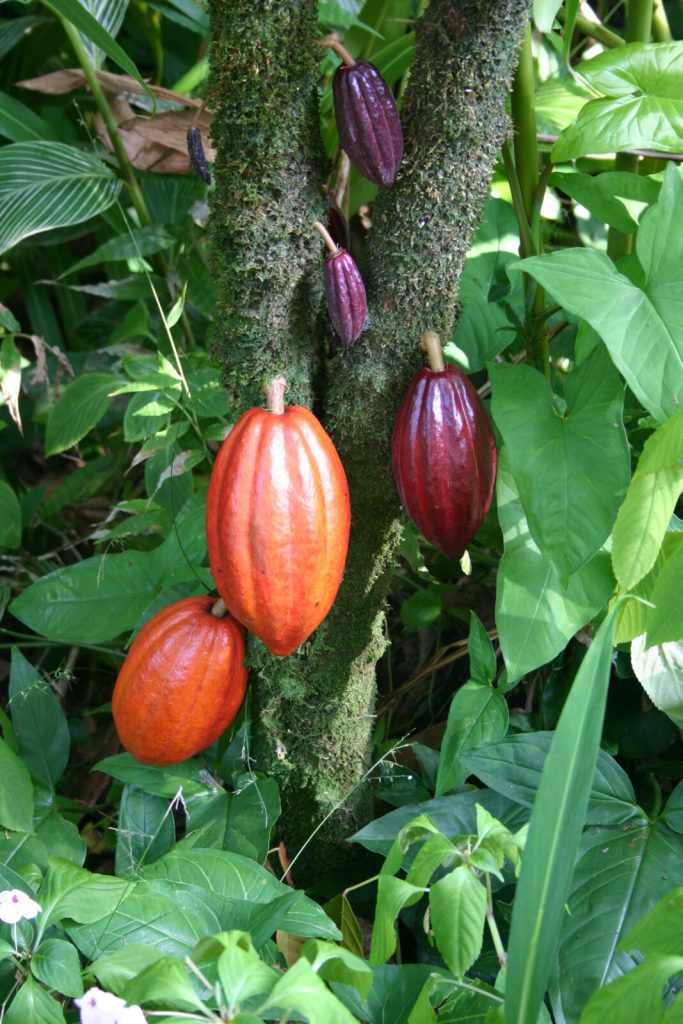
Cocoa farming in Uganda is a shaded perennial enterprise: trees planted three metres apart under retained forest shade, first pods at two to five years, and peak bearing from about seven. Bundibugyo, Mukono, Buikwe, Hoima, Jinja and Kamuli carry most of it, and the crop now ranks second in the country's agricultural export earnings. It is patient farming rather than a quick planting.
Before any of the agronomy, a warning about what you will read elsewhere. Several pages covering Ugandan cocoa tell you to watch for frosty pod rot, witches' broom and the cocoa pod borer. The ministry's own cocoa manual lists none of the three. What it does list, and what those pages leave out, is black pod disease and the cocoa mirids. Scouting for the wrong symptoms is how a garden gets lost while the farmer is looking elsewhere.
Where Cocoa Is Grown in Uganda
Cocoa reached Uganda through the British in 1901 and was first planted at Entebbe Botanical Gardens. It stayed a minor crop for most of the century and has moved quickly since. The ministry names Bundibugyo, Mukono, Buikwe, Hoima, Jinja and Kamuli as the main producing districts, and records the crop spreading into West Nile, Acholi, Lango, Teso, Bugisu and Busoga on the back of government research and extension work.
Those first districts matter for a practical reason. Ugandan research sampling cocoa quality found Mukono, Bundibugyo and Hoima together account for over eighty percent of national output, and it found contamination patterns that differ by zone. Where you farm changes which problem finds you first.
Cocoa Rainfall, Temperature and Soil Requirements
Published rainfall requirements for cocoa vary more than they should. The ministry's manual gives 1,250 to 3,000 mm a year in one section and 1,150 to 2,500 mm in another. The crop monograph literature gives 1,500 to 2,500 mm. Three bands from two sources, which tells you the annual total is not the test that matters.
The test that does matter is distribution, and here the sources agree. Cocoa wants no more than three consecutive months below 100 mm. A site with 1,800 mm falling evenly grows cocoa. A site with 1,800 mm and a four month dry spell stresses the trees through flowering, and the ministry records exactly that mechanism: heat makes flowers shrivel and drop, which cuts pod formation before you have anything to lose. Check your rainfall pattern rather than your rainfall figure.
Temperature is less contested: the ministry gives 18 to 32 degrees, and the monograph gives mean maxima of 30 to 32 and mean minima of 18 to 21, with an absolute floor around 10. Soil wants depth above all, at least 1.5 metres, well drained, with hardpans and rocky ground avoided. On pH the manual disagrees with itself, giving 5 to 7.5 in two sections and around 6.5 to 7.0 in a third, so read the wider band as the tolerance and test before you plan any fertilizer.
Cocoa Spacing and Plant Population Per Acre
This is the most solid number in Ugandan cocoa and two sources reach it independently. The ministry pegs the field at 10 feet by 10 feet, which is 3 metres by 3 metres, and its own budgeting buys 450 seedlings and digs 450 planting holes per acre. Convert: 450 an acre is 1,112 a hectare, and the monograph gives field densities of 1,100 to 1,200 trees a hectare. The arithmetic closes.
Line the rows out with sisal or nylon rope marked at the spacing, running east to west. Beds about 7.5 metres wide with drains between them handle the water, which matters because black pod thrives where the canopy stays wet. Planting holes go in at 2 feet by 2 feet, top soil separated from sub soil, then the top soil mixed with about a basin of manure and backfilled to the level of the hole. Peg the centre so you can find it when the seedlings arrive.
Both ploughings should be finished before the rains break. That is not a tidiness instruction: it lets the young seedling use the nitrogen flush the first rains release, and it means you are not digging in mud on the day the planting material turns up. If you want to check the population arithmetic for a different spacing, the plant population method is the same for any tree crop.
Choosing Cocoa Planting Material in Uganda
Ugandan extension guidance ranks the four options rather than listing them neutrally, and the ranking is the useful part. A nursery raised seedling from a certified operator is what the ministry recommends. Sowing beans straight into the garden is recorded as something farmers do and something they should not, on survival grounds. Clonal and grafted plants are held to be still in research here and not yet released.
So the real choice on a Ugandan farm is between raising seedlings yourself and buying them in. Either way the question that decides the next thirty years is not how tall the plant is. It is where the bean came from, because cocoa's quality is set in the seed garden that produced it and cannot be judged by looking at a seedling. Ask before you order. The seedling and nursery page works through raising, judging and costing planting material, and through the transplanting rules that decide whether what you paid for survives its first week.
One field level condition is worth carrying here. Nothing leaves a nursery unless it is properly hardened and carrying at least three pairs of leaves. A date on a calendar is not a readiness signal, and a soft seedling planted on time does worse than a tough one planted late.
Shade Trees and Food Crop Intercropping in a Young Cocoa Garden
Cocoa evolved in forest understorey and its leaves saturate at low light, which is why shade is a design decision rather than a preference. The ministry gives the numbers: young trees from planting to three years want about 70 percent shade, and from four years onward 30 to 40 percent. So shade is something you build, then take away on a schedule.
Permanent shade comes from trees left standing when you clear, or planted ahead of the cocoa. Musizi, Terminalia, Milicia excelsa, Grevillea, Gliricidia, Acacia and Albizia are the species the manual names. Spacing guidance is inconsistent: pickets for permanent shade at 18.3 metres in one section, shade trees at 40 to 50 feet in another, which works out anywhere between about 12 and 27 trees an acre. Take the wider figure on a hot, exposed site and the lower one where forest canopy already stands.
Temporary shade is where the cost saving sits. Bananas at 6 metres by 6 metres and Gliricidia at 4 metres by 4 metres carry the young cocoa through establishment, and the manual recommends intercropping with food crops such as banana, cassava, yam, beans, soya bean, groundnuts and maize so the plot feeds the household during the years the cocoa earns nothing. Choose the intercrop for the shade it throws and space it as though the cocoa were the main crop, which it is.
Mulch does the rest. Cocoa pod husks and crop residues returned to the surface hold moisture, suppress weeds and feed the soil, and the husks are free once the trees are bearing. Cover crops, preferably legumes, protect the surface between the rows while the canopy is still open.
Pruning Cocoa Trees for Yield and Airflow
A cocoa tree grows in storeys. The single upright stem runs up until the apical bud stops and five side buds break out sideways at the same level, forming the fan branches. That junction is the jorquette, and where it forms decides how you work the tree for the next thirty years.
The recommendation is a jorquette at 1.5 metres or above, with three to five main branches. Sources differ on timing: the ministry says a seedling can start jorquetting at about six months under good conditions, while the monograph puts the first jorquette at 1 to 1.5 metres tall, usually about a year after field planting. Either way, if the crown forms below a metre, pick a shoot that runs straight up and let it build a new crown higher. A tree that jorquettes at knee height is one you will be crouching under for decades.
After that, three jobs. Formation pruning runs to the third or fourth year and sets the shape. Structural pruning holds the tree to one main stem with four or five branches and a working height of about 4 metres, done at the start of each rainy season. Sanitary pruning removes crowded, thin, dried and damaged branches, unwanted chupons in the canopy, and any parasitic plants. Cut on a slant so water drips off the wound rather than sitting on it, cut cleanly with a saw, and keep away from the flower cushions, because that is where next season's pods come from.
Light and regular beats heavy and occasional. Opening the canopy moves air through the tree, and moving air is the cheapest black pod control there is.
Fertilizer and Manure Rates on Cocoa in Uganda
The ministry publishes a rate for young trees and stops. From 6 to 12 months, 100 g of NPK 17:17:17 per tree. From 13 to 18 months, 100 g of NPK 25:5:5. From 19 to 24 months, back to 100 g of NPK 17:17:17. Each split into two applications across the two growing seasons.
Beyond twenty four months the manual gives no rate and tells you to test the soil and apply accordingly. That is an honest gap rather than an oversight, because a mature tree's requirement moves with yield, shade level and soil. For scale, the monograph literature puts a mature hectare at 50 to 100 kg of nitrogen, 25 of phosphorus and 75 of potassium a year, with the higher nitrogen figure for lightly shaded or unshaded cocoa, and notes that a tonne of cured beans removes about 20 kg of nitrogen, 4 of phosphorus and 10 of potassium. Heavily shaded cocoa needs less. Those are per hectare figures, so divide by about 2.5 for an acre.
Apply in a ring at the edge of the canopy, not against the trunk. Scratch the soil to about three inches without cutting roots, spread the fertilizer or manure in the ring, and cover it so rain does not carry it off. Organic manure is the other half of the job: farmyard manure, compost, green manure ploughed in, or vermicompost, plus the liquid cow dung preparation the manual sets out. On what each compound fertilizer actually delivers, the NPK explainer covers the ratios.
Cocoa Pests and Diseases That Occur in Uganda
The ministry's Ugandan list is short, and short is useful. Two diseases: black pod and cocoa verticillium wilt. The major insect pests: cocoa mirids, also called capsids, stink or shield bugs, and cocoa stem borers. Sucking pests include aphids, scales and mealybugs. Minor ones include leaf defoliators, termites, grasshoppers, pod borers and psyllids, plus rodents.
Black pod attacks pods in over shaded gardens during heavy rain, rots them from either end with a sharp line between healthy and diseased tissue, and destroys the beans inside. It also causes stem canker, flower cankers and seedling blight, and it fades when the rains stop. The control that costs nothing is cultural: hold the 3 metre spacing, prune, cut shade back to reduce canopy humidity, maintain drainage, and remove infected pods away from the garden rather than dropping them under the tree.
Verticillium wilt is soil borne and enters through root injuries, then kills the tree branch by branch from the tips, leaving dried leaves hanging. Trees under water stress, without enough shade, and weeded with a hoe around the roots are the ones that get it. There is no chemical control. What works is clean and disinfected pruning and harvesting tools, removing diseased branches, uprooting and burning affected trees, and in some cases a trench 60 cm wide and 60 cm deep around an affected tree.
Now the geography, because this is where most writing about Ugandan cocoa goes wrong. Frosty pod rot and witches' broom are placed by the crop monograph literature in tropical America, and neither appears in Uganda's manual. Vascular streak dieback is a South East Asian disease. The cocoa pod borer moth is South East Asia's most serious cocoa insect. Swollen shoot virus is a genuine African problem that devastated Ghana, spread by mealybugs from indigenous trees, and it is not on Uganda's own list either. None of that means any of them could never arrive, and a page claiming they are absent from the country would be overreaching. It does mean that scouting advice built around them is advice for a different continent.
Ugandan field research supports the short list from a different direction. A study of cocoa farms in Mukono found growers spraying preventatively on a calendar against green stink bugs and mealybugs, and found that taking up alternative pest and disease management practices cut both the quantity of pesticide used and the money spent on it by a margin large enough to matter. What drove adoption was farmer training and confidence in the practice, not spare labour. Median synthetic pesticide use in that sample was low to begin with.
Rates and products are not published here. Where a fungicide or insecticide is the answer, the rate, the interval and the pre harvest interval are on the product label and must be followed, and a local extension officer or the district production office should confirm the product is registered for cocoa in Uganda. Learning to read the label properly and to apply safely is worth more than any number a web page can give you.
Cocoa Yield Per Acre in Uganda Against the Planning Figure
The ministry's own budgeting assumes 450 kg of dry beans per acre in the third year and 675 kg in the fourth. Two things to notice before planning around either. The fourth year figure is exactly one and a half times the third, which makes it an assumed step up rather than anything observed. And 450 kg an acre works out at 1,112 kg a hectare, so divide it out before you compare it with anything.
Set that against what the literature records for whole countries: about 300 kg a hectare in Ghana, about 550 in Ivory Coast, 650 to 700 in Malaysia and Indonesia, and a world average near 400. Mature estates in South East Asia reach 1,500 to 2,000 kg a hectare. So the ministry's planning figure sits above every national average in the literature, and at roughly twice what Uganda's own national statistics imply. It is what a well managed acre can reach, not what an acre will do.
Uganda's national figure will not settle the question either. The international series puts Ugandan cocoa yield between 376 and 533 kg a hectare over thirteen years, but every yield value in it is flagged estimated, the planted area behind it is imputed rather than surveyed, and the production numbers come from an international body for most years. Three years are official, and those three are the ministry's fiscal year figures placed on calendar years. It is an arithmetic quotient, not a measurement.
The practical conclusion is dull and correct: plan on something well below 450 kg an acre for the first bearing years, treat 450 as what good shade management, pruning, replacement of dead trees and proper drainage might buy you, and note that the same figure read as kilogrammes per hectare would sit comfortably in the middle of the national averages. Unit labels on export crop yields deserve a second look.
Timing is the other half. The manual puts first production at two to five years, peak productivity from seven to thirty years, and useful life beyond fifty with decline after thirty to forty. Flowering happens twice a year, pods take about five to six months from pollination to maturity, and pollination itself is done by tiny midges rather than by hand, with only a small fraction of flowers ever becoming a mature pod. That last point is worth absorbing: a tree covered in flowers is normal and does not forecast the crop.
Harvesting Cocoa and What Happens Next
Uganda has two harvests. The main crop runs September to March and a mid crop runs May to August, and because pods do not ripen together you go through the garden repeatedly rather than once. Ripe pods turn yellow or orange, and purple on some types.
Cut the pod through the stalk without damaging the cushion it grew from, collect into baskets rather than heaping on the ground, and keep diseased and damaged pods out of the collection entirely. Everything after that, the pod storage period, the breaking, the fermentation, the drying target and the grading, decides what the beans are worth, and it is covered in full on the harvesting and fermentation page. It is worth reading before your first crop rather than during it.
Selling Cocoa Beans and What Buyers Measure
Buyers do not buy weight. They buy weight at a moisture content, with a defect ceiling and a bean size. The manual's market requirements section asks for beans uniform in size, shape and colour, free of twigs, stones, soil and insect fragments, of at least 1.0 gram per bean, and graded into large, medium and small so roasting is even. Beans under that weight carry proportionally more shell and yield less nib, which is why they are discounted.
On moisture the manual disagrees with itself, giving 7 to 8 percent in the post harvest chapter and 6 to 7 percent at sale in the marketing chapter. The monograph literature says 6 to 7 and the international cocoa body says about 7.5. The safe instruction that clears every one of those is to dry to about 7 percent and no higher, measured with a calibrated meter on a representative sample rather than by feel. The same principle applies across stored produce, and the moisture management guide covers how to sample properly.
Grading turns on the bean count in a hundred gram sample and on defects found in the cut test. The manual's ceilings are under 3 percent each for slaty, mouldy and defective beans at grade 1, and under 5, 4 and 5 percent at grade 2. Pack in food grade jute or sisal sacks, on wooden pallets at least 7 cm clear of the floor, with a 60 cm passage between the bags and the walls, and keep the store away from paraffin, agrochemicals and kitchen smoke, because cocoa takes up smells.
Certification is a separate question from quality. Organic, Fairtrade and Rainforest Alliance schemes each require records, self assessment against a checklist and an annual audit by an accredited certifier. Worth knowing before you start: Ugandan growers who converted and stopped using synthetic pesticide were still not being paid a premium at the point researchers came back to ask. Treat a promised premium as a promise until it appears in a payment, and read up on how contract arrangements actually bind before signing.
Common Questions About Cocoa Farming in Uganda
What does it cost to establish an acre of cocoa, and when does it pay back? The ministry's own four year budget for one acre gives total production costs of 2,768,000 shillings in year one, 750,000 in year two, 1,950,000 in year three and 1,250,000 in year four, with no income until year three. Note one thing before you use it: the table prints the year two gross margin as a positive 750,000 when income that year is zero, so it is a loss of 750,000, not a gain. Years one, three and four reconcile correctly. Its unambiguous rates are 450 seedlings at 1,000 shillings each, 450 planting holes at 500 shillings of labour each, one truck of manure at 400,000, and 20 shade trees at 5,000 each.
What farm gate price should I plan on for dry beans? The ministry's manual gives 21,000 shillings a kilogramme in its budget table and 27,000 in the risk analysis on the facing page, which is a 29 percent difference inside one section. Use them as a band and check locally, because the second test is sobering. On Uganda's own customs declarations, cocoa beans left the country at about USD 5.85 a kilogramme in the most recent year available, against about USD 2.30 to 2.40 for most of the preceding eight years. Taking an exchange rate assumption of 3,500 to 3,900 shillings to the dollar, which you should replace with the current Bank of Uganda rate, the whole border value is roughly 20,500 to 22,800 shillings. A 21,000 shilling farm gate leaves nothing for the aggregator, the transporter or the exporter, and 27,000 sits above the border price entirely. Plan on a price the chain can actually pay.
Does organic or Fairtrade certification pay more? Not automatically, and not immediately. The Ugandan research above found a group of Mukono farmers who had been converting since 2017 and were still not receiving a premium at the second round of interviews. The compliance costs, the records and the audit start before the premium does, if it arrives.
How long until the first cocoa harvest? The manual gives two to five years to first production and peak from seven. The monograph puts first flowering at 1.5 to 5 years after field planting depending on material and conditions. Plan for the wide end.
Can I grow cocoa without shade trees? Only on the best soils with a full nutrient programme, and the trade is a shorter productive life. Retaining some shade cuts moisture stress and insect and fungal damage, which is why it is normal practice rather than a compromise. Unshaded cocoa also demands more nitrogen to sustain the extra growth it puts on.
Is swollen shoot virus a problem in Uganda? It is not in the ministry's Ugandan disease list, so it is not something to build your planting plan around. It is a real African virus and it is spread by mealybugs from indigenous trees rather than by trees touching, which is why the advice to plant at 33 foot spacing to avoid it, which circulates widely, would cost you about nine tenths of your plant population and would not work.
How many pods make a kilogramme of dry beans? It varies by type, which is why the trade uses a pod index. A pod holds 20 to 60 beans, beans make up about a quarter of the fresh weight of a mature pod, and dry beans should weigh at least a gram each. Count your own pods against your own dried weight for one harvest and you will have a figure that is true for your trees.
Are grafted cocoa seedlings available in Uganda? The ministry's position is that clones and grafts remain at trial stage in research and have not been disseminated. If offered grafted material, ask where the budwood came from and what the rootstock is.
Finding Certified Cocoa Seedlings and Checking Market Prices
Two things to settle before you clear any land. First, where your seedlings will come from, because a certified nursery operator raising seed from known parents is the difference between a garden and an experiment, and the ministry is explicit that direct seeding is not recommended. Second, what a kilogramme of properly dried, graded bean is actually fetching where you are, from more than one buyer, with the moisture and defect standard they will hold you to.
From there, the seedling and nursery guide covers raising or judging planting material, the harvest and fermentation guide covers the week that sets your price, and export basics explains what sits between your store and a shipment. The rest of the export crop guides let you weigh cocoa against the alternatives on the same land.