
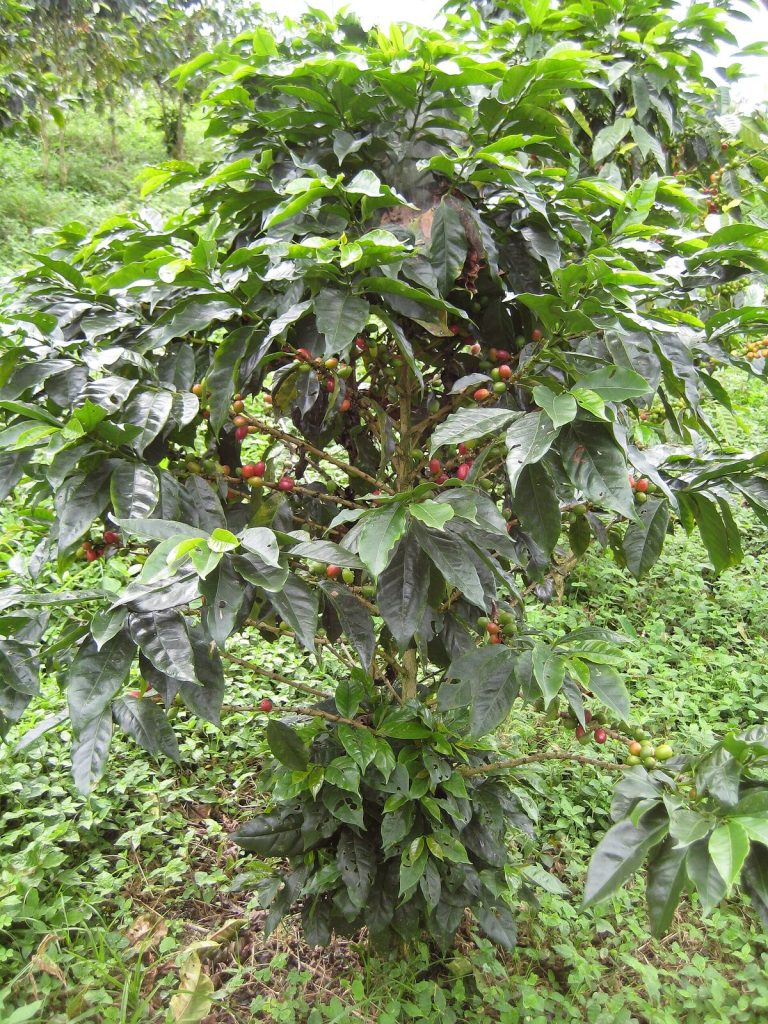
Coffee harvesting and post harvest handling decides most of what a Ugandan grower is paid, because the cup quality a buyer tests was either kept or lost between the tree and the store. Selective picking of red ripe cherries is the recommendation for every farmer. From there the crop goes down one of two routes, dry processing into kiboko or wet processing into parchment.
Nothing on either route improves the coffee. Every step from the basket onward can only hold the quality that was in the cherry or take some of it away, and the ministry's own handbooks map each step to the flaw it produces. That map is the useful thing to carry into a harvest, because it turns a vague instruction about cleanliness into a list of named consequences.
Selective Picking, and How Often the Harvesting Round Comes Back
Ugandan coffee varieties do not ripen evenly, so a tree is picked several times rather than once. The instruction is to take only the bright red ripe cherries by hand and leave the green ones on the branch to finish.
How soon you come back is where the handbooks give three answers, and they are worth seeing together rather than averaged. The Robusta handbook's opening to its harvest chapter says cherries may be picked at intervals of 10 to 15 days over several months. Two pages later, describing selective picking, the same handbook says the green cherries left behind are harvested 6 to 8 days later. And the berry borer control section in the same document says ripe cherries should be picked at least every two weeks.
The round comes back somewhere between about one and two weeks, and the condition that decides where in that span you sit is pest pressure. If the coffee berry borer is in the garden, the shorter interval is not a quality refinement, it is the main control measure available, because the beetle lives inside cherries and every ripe cherry left hanging is a breeding site. Where pressure is low, the longer interval costs less labour. Coffee pest and disease control covers what tips that decision.
Two harvest seasons run in Uganda, a main crop and a minor season the trade calls the fly crop. Their months are not national: the handbooks publish separate calendars for central, Masaka, eastern, western and south western, and mid northern Robusta, and for the Bugisu, Kapchorwa, Kasese, West Nile and Kigezi Arabica areas. Which of the two seasons falls first differs between them, so a harvest calendar borrowed from another region will be wrong by months rather than by weeks.
Sorting the Harvest at the Tree Before Anything Moves
Three things happen at the tree, and all three are free.
Why Cherries From the Ground Never Join the Harvest
This is the shortest rule on the page and the one with the clearest reason behind it. Cherries picked off the ground are frequently heavily contaminated with Ochratoxin A, produced by moulds growing on them. Both handbooks say the same thing in the same terms, and both put it among the harvest quality controls rather than among the storage ones.
A mycotoxin problem is not a flavour problem. It travels with the lot, it cannot be washed out, and it is exactly the kind of issue that gets a consignment rejected at a level far above the individual farm. Ugandan produce has met regional market rejection over mould toxins in other crops, and the mechanism here is identical: wet material, warm conditions, mould, toxin.
Ground cherries are not worthless, and pretending otherwise is how they end up in the main lot. Keep them separate, dry them separately, and sell them as what they are. The tarpaulin under the tree exists to make that separation automatic rather than a decision somebody has to make at the end of a long day.
Strip Picking Also Takes Next Season's Yield
Strip picking means running a hand down a branch and taking everything on it. It is faster, and it is the practice both handbooks tell farmers to avoid at all times.
The quality cost is obvious once stated. A stripped lot carries green immature cherries, insect damaged cherries and overripe cherries together. After drying, every cherry turns black, so the qualities inside the lot can no longer be told apart except by cup tasting, at which point the damage is priced in. Unripe and diseased cherries are among the main causes of black beans, overripe ones bring fermented flavours, and stripping also interferes with the bean's own density and weight, which is what screen grading measures.
The less obvious cost is next season's crop. Stripping breaks leaves, destroys the bearing loci on the branch and damages parts of the primary branches, and both handbooks say plainly that this reduces yields in the following season. So a grower who strips is borrowing labour savings against a crop they have not grown yet. What an acre should be producing in the first place is set out under coffee yield per acre.
Choosing the Post Harvest Route: Dry Processing or Wet Processing
The routes differ in one thing, which is how the fresh cherry is treated in the first hours. Everything after that follows from it.
Dry processing is the simple route. The cherry goes straight to drying with the bean still inside the fruit, and the product is dry cherry, known throughout Ugandan trade as kiboko. It needs no equipment and no water. Most Ugandan Robusta goes this way, and dry processed Arabica is sold at export as Drugar, being dry Ugandan Arabica, which the handbook says comes mainly from Kasese and the south west while the rest of Uganda's Arabica is washed.
Wet processing removes the skin and the sugary mucilage first, leaving parchment coffee to be dried. It produces better quality green coffee and commands higher prices, and it costs equipment, clean water and management attention. It splits again into a full wash route and a semi wash route.
| Route | Water per kg cherry | Product | Loss at hulling |
|---|---|---|---|
| Dry processing | None | Kiboko | About 50 percent |
| Full wash | 2 to 10 litres | Parchment | 20 to 38 percent |
| Semi wash, pulper and mucilage remover | About 0.5 litres | Parchment | 20 to 38 percent |
Read the water column twice. A full wash mill using ten litres per kilogramme of cherry needs twenty times the water of a pulper and mucilage remover unit doing the same job, and it also needs fermentation tanks, washing channels and somewhere for the waste water to go. The handbook recommends the pulper and mucilage remover combination for semi washed processing on exactly those grounds, and notes that the saving is set against the capital cost of the units. The loss at hulling depends on parchment grade: parchment type 1 loses 20 percent, type 2 loses 32 percent and type 3 loses 38 percent, which is another reason careless wet processing is expensive. Coffee processing methods goes further into the equipment side.
Pulping, Fermentation and Water in Wet Processed Coffee Production
In the full wash route the pulping machine, manual or powered, strips the skin off the fresh cherry with water. The mucilage still coating the parchment is then left to ferment for one to two days, after which the parchment is washed thoroughly until no trace of fermented mucilage remains.
Both ends of that fermentation are hazards. Stop too early and mucilage stays on the parchment, which grows mould and produces mouldy or musty flavours. Run too long and the lot goes fermented, fruity, sour or onion tasting. Worse, poor hygiene in the tanks leaves a handful of extremely overfermented beans behind, and those become stinker beans, which produce a foul or sour flavour out of all proportion to their number. A few beans can mark a whole lot.
The semi wash route removes fermentation from the equation. A mucilage remover strips the coating mechanically straight after pulping, the parchment is washed at once and goes to drying clean. There is no fermentation to judge and no tank hygiene to maintain, which is why the handbooks describe these units as a consistent way to reach high quality.
Two more failures sit in this section of the chain and neither is about fermentation. Holding fresh cherry for long periods before pulping produces fermented and fruity flavours, so cherry picked in the afternoon is pulped that day rather than the next. And poor or badly adjusted pulping equipment nips the beans, and a nipped bean becomes a stinker bean, which brings the problem back around to the same defect from a mechanical cause.
The Defect Chain From Tree to Coffee Buyer
The Arabica handbook carries a table mapping each process step to what goes wrong there and what the cup then tastes like. It is the most useful page in either document, because it lets a grower work backwards from a buyer's complaint to the step that caused it.
| Step | What goes wrong | What the buyer finds |
|---|---|---|
| Harvesting | Green cherry picked | Grassy or woody |
| Harvesting | Overripe cherry | Fermented, fruity |
| Harvesting | Old cherry off the ground | Mouldy, musty |
| Pulping | Cherry held too long | Fermented, fruity |
| Pulping | Beans nipped by the machine | Stinker beans |
| Fermentation | Run too long | Sour, onion |
| Fermentation | Dirty tanks | Foul, rotted |
| Washing | Mucilage left on | Mouldy, musty |
| Drying | Dried on bare ground | Earthy, mouldy |
| Drying | Rewet part way through | Mouldy, musty |
| Drying | Dried too hot or uneven | Faded, bland |
| Drying | Over dried | Faded, breaks at hulling |
| Storage | Stored too wet | Mouldy, musty |
| Storage | Stored near fuel | Foul odours |
| Hulling | Wrong huller setting | Bean damage |
| Transport | Leaky tarpaulin | Mouldy, musty |
Drying itself sits between this page and the next. The short version: kiboko dries to 13 to 14 percent moisture and parchment dries to 12 to 13 percent, both of them off the ground and turned, and everything about how that is done is on the drying page.
Coffee Storage After Drying, and the Store That Protects the Cup
Coffee dried correctly can still spoil in a store, which is why storage carries its own rules rather than inheriting the drying ones.
The grain side of storage has its own detail worth reading across, since the moisture and mould logic is the same crop to crop: see grain moisture management.
Transporting Coffee to Market Without Losing the Cup
Transport poses the same risks as storage in a shorter window. The handbooks are specific: the truck's tarpaulins must be sound, because a leak rewets the load and produces mould or musty flavours, and a hot container standing for long periods in a humid port does the same thing from the inside.
Carry coffee on its own. A load shared with fuel drums or agrochemicals arrives tainted, and the taint is permanent. Keep the transit as short as can be arranged, make sure the vehicle is mechanically sound so the load is not sitting somewhere overnight, and pack so the bags arrive intact. None of this costs anything beyond attention, and all of it appears in the same chapter as the grading rules, which tells you how the trade sees it.
Out Turn and Grading: What the Coffee Market Measures
Out turn is the share of clean coffee recovered from a known weight of dry cherry or parchment, and it is both a quality test and the number that decides what a lot is worth. The handbook's method needs a sample scale and a hand huller: weigh a kilogramme of kiboko or parchment, hull it, winnow off the husk, weigh what remains and express it as a percentage. Its worked example recovers 540 g from a kilogramme, being 54 percent. Fifty to sixty percent is normal and 50 percent is the minimum out turn a buyer will accept on kiboko.
Grading is the second assessment and it looks at four things in a sample: moisture content, bean size, the count of defects, and foreign matter. Bean size is measured on screens numbered 10 to 20, which are metal trays with round holes from 4.00 mm up to 8.00 mm that retain beans above a size and let smaller ones through. Bigger beans usually fetch better prices, and the handbook is careful to add that cup quality does not necessarily follow bean size. Roasters want a uniform screen for a practical reason: small light beans over roast when they are mixed with large heavy ones.
Moisture has two different compliance levels and knowing both prevents an argument. The requirement is 13 to 14 percent at primary level and 11 to 12.5 percent at export level, and moisture is described as the single factor most able to spoil a grade. Defect tolerances are set grade by grade rather than sliding evenly with screen size, so read the tolerance for the grade you are selling into rather than assuming a bigger screen always allows fewer defects.
One last thing about the weighbridge. The national coffee authority publishes an itemised discount that a dry cherry lot meets at the farm gate, covering uncalibrated scales, moisture, bag weight and foreign matter, and on its own worked example those four together come to about 13 percent of the lot. Three of the four are things this page has already covered. The itemisation and what it costs is worked through on cost of coffee farming, and current indicative bands for each product are on the coffee price page. Buyers themselves are covered under where to sell coffee, general establishment under coffee farming in Uganda, and this page sits in the export crops hub.
Common Questions About Coffee Harvesting and Post Harvest Handling
How many times should one tree be picked in a season? As many rounds as the tree needs, at intervals the handbooks put variously at 6 to 8 days, 10 to 15 days, and at least every two weeks. Somewhere between one and two weeks, with the shorter end justified where coffee berry borer is present because picking is the main control for it.
Can I mix cherries picked from the ground with the main lot? No. Ground cherries are frequently heavily contaminated with Ochratoxin A from mould, and mixing them contaminates the whole lot. Keep them apart from the moment of picking, which is what the tarpaulin under the tree is for.
Is wet processing worth the trouble on a smallholding? It produces better green coffee and higher prices, and it needs equipment, clean water and close management. The semi wash route with a pulper and mucilage remover cuts water use to about a twentieth of a full wash mill and removes fermentation judgement entirely, which is why the handbooks recommend it for semi washed coffee. Whether the price gain covers the capital depends on current bands, so check them rather than assuming.
What is the difference between kiboko, parchment and FAQ? Kiboko is dry cherry, the whole fruit dried with the bean inside. Parchment is the wet processed bean dried with its papery hull still on. FAQ, or Fair Average Quality, is the hulled clean bean that gets graded and sold for export.
Why does my coffee taste musty when I dried it properly? Because mould and musty flavours enter at five separate points in the chain, not one. Mucilage left on the parchment, drying on bare ground, rewetting during drying, bagging or storing while too wet, and a leaky tarpaulin in transport all produce the same complaint. Work back through the steps rather than assuming it was the drying.
Does a bigger bean always mean better coffee? It usually means a better price, since grading runs on screen size. The handbook adds that cup quality does not necessarily follow the same trend, so the two are related and not the same thing.
Why can I not store coffee with my maize and beans? Two reasons the handbook names: pests carry across between stored crops, and coffee absorbs odours from whatever shares the room and keeps them into the cup. A coffee store holds coffee only.
How do I know what out turn my coffee will give before I sell? Test it. Weigh a kilogramme sample, hull it with a hand huller, winnow off the husk and weigh what is left. That figure divided by a thousand and multiplied by a hundred is your out turn, and knowing it before you reach the buyer is the difference between negotiating and being told.
Check what buyers are currently paying for the specific product you are selling, since dry cherry, parchment and clean coffee are priced separately, and price a hand huller and a moisture meter before the next season starts rather than during it.