
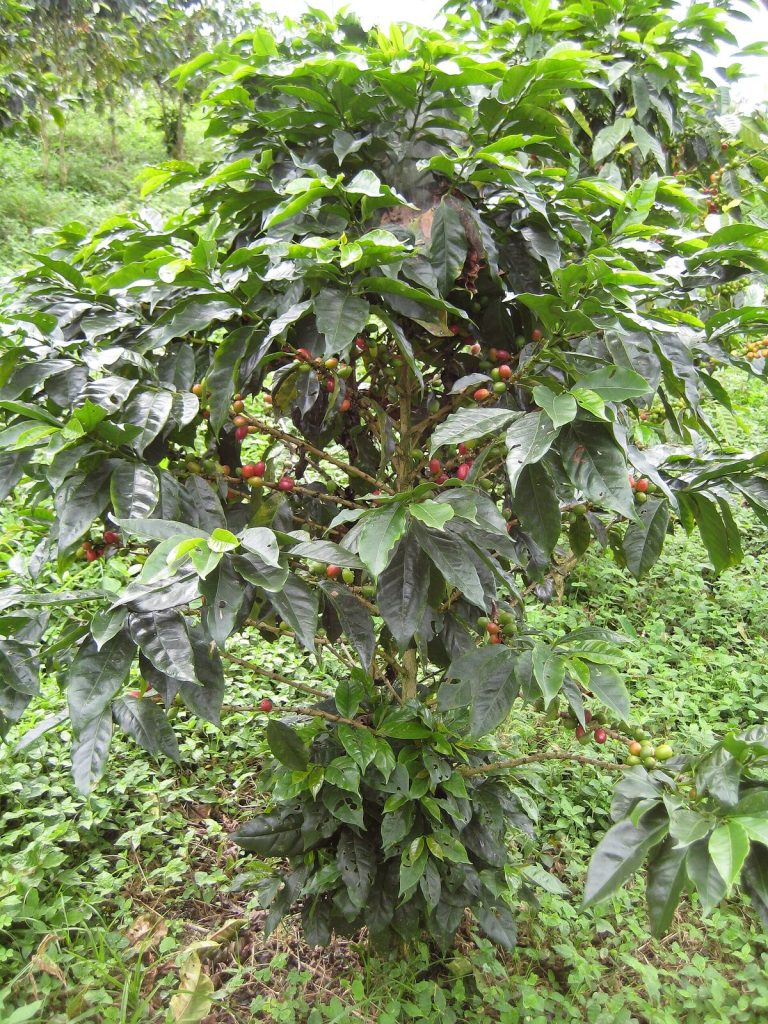
The cost of coffee farming cannot be reduced to one figure per acre the way maize or tomato can, because coffee is a perennial crop. You spend for years before there is anything to sell. An honest answer splits in two: what it costs to establish an acre, and what it costs to keep that acre every year once it bears. The gap between them is measured in years.
That distinction is the whole article. Uganda's national coffee authority, whose functions now sit inside the Ministry of Agriculture, publishes five year budgets for both Robusta and Arabica, and those budgets are the backbone of everything below. They are worth reading closely, because they show something most coffee pages hide: the first year is a loss, the second year is still a loss, and the money only turns around in year three.
Why One Cost Per Acre Figure Means Nothing for Coffee Farming
Ask what an acre of maize costs and the question makes sense, because an acre of maize is a season. Ask what an acre of coffee costs and the question has no answer until you say which year.
A coffee tree planted this rainy season will not give a crop worth harvesting for at least two years and realistically three. In between, you keep paying: weeding, mulching, fertilizer, pruning, erosion control, gap filling for the plants that died. So a single number per acre collapses three different things into one, and whichever of the three it happens to be, it will mislead somebody.
The three numbers that actually matter are these. Establishment, what it costs to get trees in the ground and standing. The carry, what it costs to keep them alive through the years before they pay. Annual maintenance, what a bearing acre costs every year afterwards, which is the number that decides whether the enterprise works long term. Anyone quoting you one figure for coffee has merged at least two of those.
There is a fourth cost almost nobody mentions, and it arrives around the tenth year. Coffee is cut back and regrown on a cycle, and the year you do it there is no crop. That one is covered further down.
Establishment Costs for One Acre of Coffee
Uganda's agriculture ministry publishes a coffee and cocoa establishment cost annex with per acre unit rates, and it is the firmest cost document available for this crop. It works on 463 planting holes an acre. Here is what it costs out, per acre, at those rates.
Add the year one lines and establishment alone comes to about 2,180,000 an acre at the ministry's rates, with another 139,500 for gap filling in the second year. That figure covers getting trees planted and nothing else. It excludes weeding, mulching, erosion control, tools and the first fertilizer, all of which arrive in the same twelve months.
Once those are added, the coffee handbooks put a full first year at roughly 2,970,000 an acre for Robusta and 3,420,000 an acre for Arabica, converted from their per hectare budgets. Arabica costs more to establish for one reason: it is planted closer, so there are more holes, more plantlets and more of every per tree operation.
Seedlings must come from a certified nursery, and this is the one place where saving money reliably costs money. A cheap plantlet carrying coffee wilt disease or a twisted taproot has ruined the whole investment before it starts. Our guide to sourcing coffee seedlings covers what to check.
How Many Years Before a Coffee Acre Pays Anything
This is the number that decides whether you can afford coffee at all, and here is the plain answer. Nothing in year one. A token crop in year two. The first real harvest in year three. Full production from year four.
Both of the ministry's five year budgets are built exactly that way, and Ugandan industry sources put the first harvest at twenty four to thirty six months after planting depending on whether you planted clonal cuttings or elite seedlings, and on how well the trees were managed.
For Arabica the shape is identical and the product is different: about 240 kg of parchment an acre in year two, about 650 kg in year three, and about 1,010 kg from year four. Parchment and dry cherry are not comparable by weight, which is why the two crops are never compared on kilos alone.
The practical consequence is a financing problem, not an agronomy one. You need two to three years of maintenance money in hand, or another income source on the same land, before the trees start paying. Planting more acres than you can carry through year two is the commonest way Ugandan coffee investments fail, and it fails quietly, as neglected trees rather than as a dramatic loss.
Annual Maintenance Costs Once the Coffee Is Bearing
Once an acre is bearing, the cost settles into a repeating annual figure, and it is smaller than establishment but far from small. From the ministry's budgets, a bearing acre runs at roughly 2,260,000 to 2,740,000 a year for Robusta and roughly 2,490,000 to 2,940,000 a year for Arabica, the upper end being the years when mulching and manure come round again.
Worth noticing: annual maintenance on a bearing acre is not much below the cost of establishing one. Coffee is not a crop you plant and then coast on. The spend is permanent, and the difference is that from year three there is revenue against it.
Three things drive the annual number.
Fertilizer is the biggest single line. The ministry's budgets apply 500 g of compound fertilizer per tree per year, using CAN and NPK 25:5:5, and cost a 50 kg bag at 140,000. At around 450 trees an acre that is roughly 225 kg, or four and a half bags, so somewhere near 600,000 to 650,000 an acre annually. Arabica is planted closer, so the same rate per tree works out nearer 850,000 to 950,000 an acre. A Ugandan agribusiness budget costs the same fertilizer product at 130,000 a bag, which is the cross check. Ugandan fertilizer prices move with the exchange rate rather than with the coffee season, so treat those as planning rates and get current figures from our fertilizer price page.
Weeding is the biggest labour line. The budgets cost four weeding rounds in the establishment years and fewer once the canopy closes and mulch is doing part of the job. That drop is real and it is one of the few places where coffee gets cheaper as it matures.
Harvesting is paid by the kilo. Both budgets cost picking at 150 a kilogram of fresh cherry, which means this line grows exactly in step with the crop. A good year costs more to harvest than a bad one, which is the right way round but does need to be in the cash plan.
Pruning, pest control, tools, tarpaulins and gunny bags fill out the rest. Bags are costed at 3,000 each and a bag of dry cherry weighs 75 kg, so the bag cost per acre is a function of the harvest. Fertilizer timing and pruning method are agronomy and belong on our coffee fertilizer guide and coffee pruning guide.
Robusta and Arabica Coffee Costs Compared
The two crops diverge on cost in ways that have nothing to do with which tastes better.
| Item | Robusta | Arabica |
|---|---|---|
| Spacing | 10 ft by 10 ft | 8 ft by 8 ft |
| Trees an acre | About 450 | About 660 |
| Product sold | Dry cherry or FAQ | Parchment or Drugar |
| Year one cost | About 2,970,000 | About 3,420,000 |
| Bearing year cost | 2,260,000 upward | 2,490,000 upward |
| Unit cost a kilo | About 1,100 to 1,260 | About 2,630 to 3,850 |
Arabica costs more on every line because there are half again as many trees on the same ground, and its unit cost a kilo looks far worse until you remember it sells for several times the Robusta price. That is the trade, and it is a real one rather than a preference.
Two further cost differences that the table cannot hold. Arabica is grown at altitude on slopes, so erosion control and terracing are heavier and transport off the farm is harder and dearer. Robusta carries coffee wilt disease, which Arabica does not, and the released clonal Robusta varieties bred against it are the reason a Robusta grower buys clonal plantlets rather than raising seedlings. Our comparison of Robusta and Arabica farming works through the rest.
Drying, Hulling and Marketing Costs Per Kilo
Coffee costs money after it leaves the tree, and these are per kilo costs rather than per acre ones, which makes them easy to forget in an annual budget and impossible to avoid in practice.
The national coffee authority publishes the rates a farmer meets on the way to market. Drying is costed by the lot, a lot of 400 to 600 kg of dry coffee at 35,000. Then, if a grower hulls rather than selling dry cherry at the gate: loading at 10 a kilo, transport to the hulling facility at 20 a kilo, offloading at 10 a kilo, and hulling itself at 150 a kilo. Commission runs at 50 a kilo per level, and a grower selling through a group and an association pays it twice. Moving hulled coffee to a city buyer adds about 50 a kilo in transport.
The reason to know these is that they are the price of a choice. Dry cherry sold at the farm gate carries almost none of them. Hulled coffee carries all of them and sells for roughly twice as much a kilo, because hulling loses weight: the authority's own worked example uses an out turn of 58 percent, meaning 1,000 kg of dry cherry becomes 580 kg of clean coffee. Coffee sold as dry cherry must reach a minimum out turn of 50 percent to be saleable at all.
So the arithmetic of value addition is not "hulling pays" or "hulling does not pay". It is: does your extra price a kilo, on 58 percent of the weight, beat about 240 a kilo of handling plus the commissions? At the authority's own figures it does, by a margin that widens the further up the chain a grower goes, which is why grouping to reach a hulling facility is one of the few reliably profitable decisions in Ugandan coffee. The processing side is covered on our coffee processing guide.
The Cost of Poor Quality Coffee at the Farm Gate
This is the cost that never appears in a budget and routinely exceeds the fertilizer line.
The coffee authority publishes an anatomy of what a farmer loses selling 1,000 kg of dry cherry badly, and it is worth reading item by item. Uncalibrated scales take 50 kg. A moisture discount, for coffee not dried down properly, takes 40 kg. The weight of the gunny bag gets deducted, 10 kg. Foreign matter in the coffee, stones and husk and trash, takes 30 kg. That is 130 kg off 1,000, or 13 percent of the load.
Drying on tarpaulins, raised platforms or a cemented floor, picking only red ripe cherry, and owning a moisture meter between a handful of growers are the cheapest returns available on a coffee farm. None of them appear as costs in the ministry's budgets, because they cost almost nothing.
Stumping: The Cost Cycle Nobody Budgets
Coffee is not planted once and harvested forever. Trees lose vigour, and the national recommendation is to cut them back and regrow them from suckers, called a change of cycle. It happens first at nine to ten years after planting, then every six or seven years after that.
The Five Year Coffee Cost Ladder Per Acre
Put the whole thing on one ladder. These are the ministry's Robusta figures converted from per hectare to per acre, and they include the banana and bean intercrop that the budget assumes alongside the coffee.
| Year | Cash out | Coffee sold | Position |
|---|---|---|---|
| One | 2,970,000 | None | Deep loss |
| Two | 1,830,000 | About 200 kg | Still a loss |
| Three | 2,260,000 | About 1,800 kg | Turns positive |
| Four | 2,740,000 | About 2,470 kg | Clearly positive |
| Five | 2,720,000 | About 2,470 kg | Compounding |
On the ministry's own arithmetic the cumulative position per acre is a loss of roughly 1,470,000 after year one, still a loss of about 1,260,000 after year two, a gain of about 1,880,000 after year three, about 6,450,000 after year four and about 11,000,000 after year five. The Arabica ladder has the same shape and crosses into profit in the same year.
Two honest caveats on those cumulative figures, and they pull in opposite directions.
The first is that they include intercrop income, not just coffee. The second matters more. The farm gate prices those budgets assume are well below what the authority currently publishes. The budgets work on roughly 2,650 to 2,700 a kilo for dry Robusta cherry and 7,000 a kilo for Arabica parchment. The authority's own current indicative farm gate range is several times higher for both. That does not change the shape of the ladder, because the shape is set by the years, but it does mean the payback in the published budget is conservative at today's prices. Check what buyers are paying now on our coffee price page before you build a projection, and run the arithmetic yourself with our farm profit calculator.
One figure to be careful with. A widely circulated Ugandan budget claims 6,800 kg of clean coffee an acre at peak production. The national coffee authority's own handbooks put well managed clonal Robusta at 3,000 to 4,000 kg of clean coffee per hectare, which is roughly 1,200 to 1,600 kg an acre, and elite seedlings at about 600 kg an acre. The circulating figure is around four times the best documented yield, and every revenue and profit number built on it is inflated by the same multiple. Yield claims are covered properly on our coffee yield per acre page.
Intercropping Bananas and Beans to Carry the Early Costs
The reason Uganda's published coffee budgets are survivable at all is that they do not assume a bare coffee field. Both of them cost in bananas at four coffee to one banana, and beans between the rows in the first two years, and both count the income from those crops against the coffee spend.
This is the practical answer to the two year gap, and it is worth reading as a cost decision rather than as a farming preference. The intercrop costs money to establish, banana suckers and bean seed and the labour to plant and manage them, and it returns income in exactly the years when coffee returns nothing. The banana also provides shade for young coffee, which is a cost avoided rather than an income earned.
Intercropping is not free. It competes for nutrients and water, which is why the budgets also carry heavier fertilizer and manure lines, and banana pruning and thinning appear as their own annual cost from year two onward. But a grower who plants bare coffee has chosen to fund two full years of maintenance out of pocket, and that choice should be made deliberately rather than by default. Spacing for both crops together is covered on our coffee spacing page, and the agronomy sits in our coffee farming guide.
Coffee Farming Cost Questions Answered
How much money do I need to start one acre of coffee?
Budget the first year at roughly three million shillings an acre for Robusta and a little over three and a half million for Arabica, then budget the second year too, because there is nothing worth selling until the third. The mistake is funding establishment and not the carry. An acre you can maintain for three years beats three acres you abandon in year two.
Why is Arabica more expensive per acre than Robusta?
Density. Arabica is planted at 8 ft by 8 ft against Robusta's 10 ft by 10 ft, so there are about 660 trees an acre instead of about 450. Published Ugandan figures for the Arabica stand actually span 463 to 703, which is a 52 percent spread and enough to move a fertilizer bill, so it is worth knowing where it comes from. 680 is the exact count at 8 ft by 8 ft and is what the handbook text and the ministry training manual both give, 660 comes from a costing annex worked per hectare, 703 is the count at the metric spacing printed beside it, and 463 is a grant annex applying one figure to both species. Use 680 unless you are reconciling with a specific published budget, and see the spacing page for the derivation. Every per tree cost, holes, plantlets, planting labour and fertilizer at 500 g a tree, scales up by half again. Arabica also grows on slopes, so erosion works and transport cost more.
Should I sell dry cherry at the farm gate or hull it first?
Hulling costs about 150 a kilo plus roughly 40 a kilo of loading and transport, plus 50 a kilo of commission at each level, and it reduces 1,000 kg of dry cherry to about 580 kg of clean coffee. Against that, clean coffee sells for roughly twice the price a kilo. On the authority's own worked figures the margin improves, more so if you can reach a city buyer rather than a local one. The barrier is volume, which is why groups do it and individual smallholders often cannot. Who buys at each stage is covered on our coffee buyers page.
How long does a coffee tree keep producing?
Longer than the planting decision suggests, but not without interruption. Trees are cut back and regrown, first at nine to ten years after planting and then every six or seven years, and a fully stumped field produces no coffee for a year. Stumping in halves, or stumping only the weak bushes each season, spreads that out. Plan the interruption in rather than discovering it.
Why does my coffee get discounted at the farm gate?
Four reasons, and the authority publishes all four. Uncalibrated scales take the largest share. A moisture discount applies to coffee not dried down to 13 to 14 percent. The gunny bag weight is deducted. Foreign matter, stones and husk and trash, takes the rest. Together they run to about 13 percent of a load, and the total loss from dealing in poor quality coffee runs to 10 to 15 percent. Insisting on a calibrated scale, drying off the ground and winnowing before sale removes most of it.
What happens if I do not fertilize my coffee?
The trees live and the crop shrinks, which is the situation most Ugandan smallholder coffee is already in. The published yields belong to the published fertilizer assumption of 500 g per tree a year, so a garden without it should not be judged against them. Manure is the middle path, and the budgets carry it alongside compound fertilizer rather than instead of it, because it feeds soil structure and water holding at the same time.
Do I really need shade trees?
The national recommendation includes them, at roughly forty an acre, and they are costed into the establishment budget rather than treated as optional. Young coffee needs protection from full sun, and shade moderates temperature in the mature garden. Too much shade cuts yield, which is why the recommendation is a spacing rather than a canopy. Where a grower is intercropping bananas, the banana does part of the shading job while the coffee is young.
What happens in the year I stump my coffee?
On a full stumping, the field is out of production and there is no coffee income for a year while weeding, fertilizer and pruning carry on. That is the year to have annual crops in the ground between the stumps, which is exactly what the published budgets assume. Growers who cannot absorb a blank year stump half the field at a time, or stump only the tired bushes at the end of each harvest.
Why do the published budgets include bananas and beans?
Because a bare coffee field has no income for two years and the budget would be unsurvivable without them. Both budgets plant bananas at four coffee to one banana and beans between the rows in the early years, and count that income against the coffee spend. The banana also shades the young coffee. It is not free: the intercrop competes for water and nutrients, which is why the same budgets carry heavier fertilizer and manure lines and add banana pruning as an annual cost.
Coffee prices and input costs both move, the first with the world market and the second with the exchange rate, so treat every figure here as a planning rate rather than a quotation. Before committing land, price seedlings from a certified nursery near you, get a current fertilizer quote, and check the indicative farm gate price for your coffee type this month. A local extension officer or the coffee department's regional office can confirm which nurseries in your district are certified, and the rest of our farming business guides run the same arithmetic for other enterprises.