
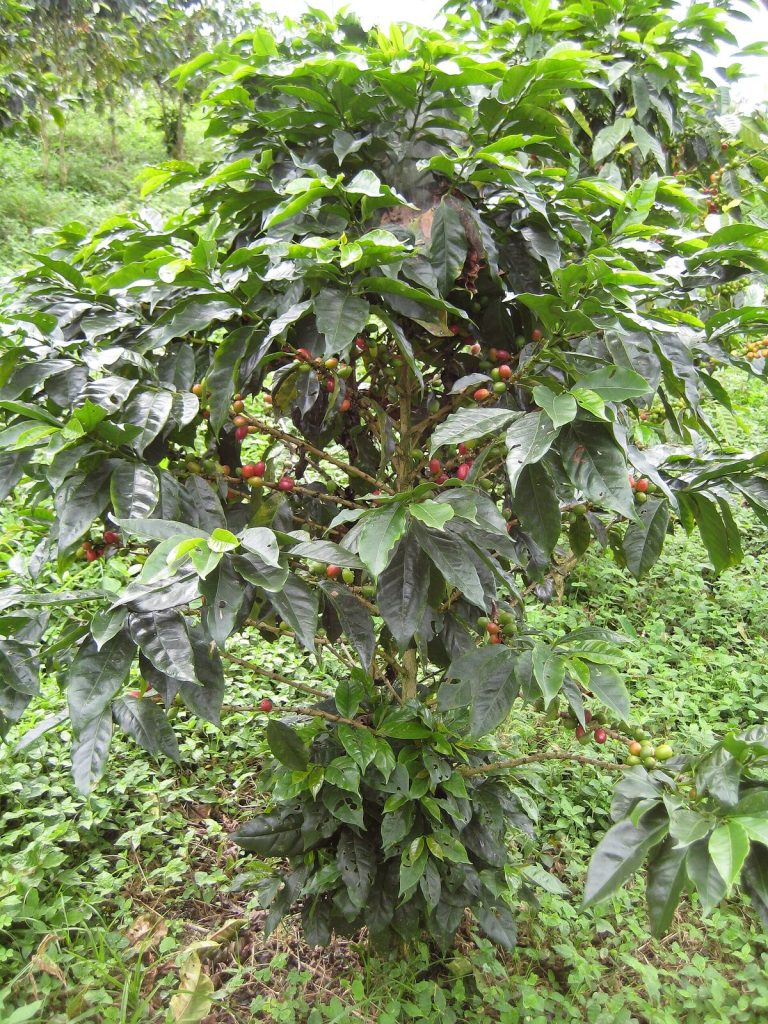
Coffee yield per acre in Uganda sits at about 215 to 235 kg of clean coffee on the national figures, about 600 kg on an acre managed to the ministry's recommendation, and about 1,200 to 1,600 kg on well managed clonal Robusta. Those three bands come from different sources and all three are published. What separates them is management. Figures above that range are usually per hectare numbers wearing an acre label.
That last sentence is the whole problem with this search. A hectare is 2.47 acres, so a figure with the wrong unit on it is not slightly wrong, it is wrong by a factor of two and a half, and every income calculation built on it carries the same error through to the bottom line.
What an Acre of Ugandan Coffee Actually Yields
Start with the measured figure, because it is the one nobody quotes. FAO's production series for Uganda gives green coffee yields of 530 to 583 kg per hectare across the ten most recent reported years, which converts to about 215 to 235 kg per acre. Green coffee is the hulled, cleaned bean, the same thing Ugandan trade calls Fair Average Quality.
One caveat belongs with that figure and it is not a small one. In that dataset the production series is flagged as official, while the yield series is flagged as estimated and the area harvested series is mostly imputed. So the number is official production divided by an estimated planted area rather than a yield measured in anybody's garden. It is the best national figure available, and it is an estimate.
Next to it sits the ministry's own target. The Robusta handbook states that Robusta under recommended management should produce at least 1,500 kg of clean coffee per hectare per year, which is about 600 kg per acre, and that clonal coffee under the same management can reach 3,000 to 4,000 kg per hectare, about 1,200 to 1,600 kg per acre.
The distance between about 225 kg and about 600 kg per acre is not a rounding question. It is the difference between what Ugandan coffee land produces on average and what the extension recommendation assumes it can produce, and that gap is the honest subject of this page.
Robusta Coffee Yield Per Acre, Built From Trees Per Acre
Every honest per acre yield figure is a per tree figure multiplied by a density, so the density has to come first. Robusta is planted at 10 ft by 10 ft, which the handbook says gives about 450 plants per acre, and its own budget works on 1,110 plants per hectare, which divides out to 449 per acre. The two agree.
Now divide the yields by that density. At least 1,500 kg of clean coffee per hectare over 1,110 trees is 1.35 kg per tree. The clonal band of 3,000 to 4,000 kg per hectare is 2.7 to 3.6 kg per tree. Both divide cleanly, which is a small but useful sign that the density and the yield figures were built from the same model rather than borrowed from different places.
Hold on to 2.7 to 3.6 kg of clean coffee per tree. It is the single most useful number on this page, because it is the ceiling against which any per tree claim can be tested in one step, and it takes no equipment to apply. Walk a row, pick a well managed mature bush, and ask whether it could plausibly deliver three kilogrammes of hulled bean in a year. Spacing itself is covered under coffee spacing per acre, and how to calculate plant population handles the geometry for a garden that was not planted to the recommendation.
Arabica Coffee Yield Per Tree and the Gap to the Recommendation
Arabica is where the gap between measured and recommended is stated most plainly, because the Arabica handbook publishes both figures a few pages apart and in the same unit.
Its opening chapter gives the national average productivity of Ugandan Arabica as 0.3 kg of clean coffee per tree per year. Its field management chapter says Arabica under recommended management will produce 1 to 2 kg of clean coffee per tree, or 1,680 to 3,360 kg per hectare. So the recommendation is three to seven times what the national average delivers, from the same institution, in the same document.
Arabica goes in at 8 ft by 8 ft. The handbook's yield statement only reconciles at 1,680 trees per hectare, being 1,680 divided by 1 and 3,360 divided by 2, while its establishment budget works on 1,640 per hectare. That puts the density at about 660 to 680 trees per acre, and the difference between the two figures is small enough to ignore for planning and worth knowing if you are reconciling the documents yourself.
Here is the cross check that makes the measured band on this page trustworthy rather than merely quoted. Arabica at 0.3 kg per tree across 660 to 680 trees gives about 200 kg of clean coffee per acre, or roughly 490 to 505 kg per hectare. FAO's national all coffee figure is 530 to 583 kg per hectare. An extension measurement counted per tree and an international production series built from customs and survey data land within about ten percent of each other, and neither was derived from the other. Two roads, one answer.
Why National Coffee Production Doubled While Yield Per Hectare Did Not
Over the ten most recent reported years Uganda's coffee production rose from about 220,000 tonnes to about 468,000 tonnes. That is a real and large increase, and it is the figure the sector reports.
Over the same years the area harvested rose from about 378,000 hectares to about 850,000 hectares. Production grew about 2.1 times. Area grew about 2.25 times. And the yield per hectare drifted slightly down across the span rather than up.
One more absence is worth recording, because it shapes what can honestly be claimed. That dataset carries a single coffee item for Uganda, green coffee, with no Robusta and no Arabica split. There is no measured national yield for either species separately to be had from it, which is why the species specific figures on this page come from extension documents rather than from statistics.
The Released Clonal Varieties and Their Published Yields
NARO's coffee research institute has released ten clonal Robusta lines, KR1 to KR7 in 2009 and KR8 to KR10 in 2017, and the Robusta handbook publishes a yield for each alongside its disease resistance. All ten are listed as resistant to coffee wilt disease and to leaf rust, and tolerant to red blister.
| Planting material | Released | Per hectare | Per acre |
|---|---|---|---|
| Elite seed | Older | 2,000 kg | 810 kg |
| Six old clones | Older | 2,500 kg | 1,010 kg |
| KR1 | 2009 | 2,200 kg | 890 kg |
| KR2 | 2009 | 2,600 kg | 1,050 kg |
| KR3 | 2009 | 4,900 kg | 1,980 kg |
| KR4 | 2009 | 2,300 kg | 930 kg |
| KR5 | 2009 | 2,900 kg | 1,170 kg |
| KR6 | 2009 | 2,600 kg | 1,050 kg |
| KR7 | 2009 | 3,000 kg | 1,210 kg |
| KR8 | 2017 | 3,100 kg | 1,250 kg |
| KR9 | 2017 | 3,900 kg | 1,580 kg |
| KR10 | 2017 | 4,800 kg | 1,940 kg |
Read that table as a ranking between clones, not as a forecast for your garden, and for two reasons.
The first is that the handbook contradicts itself. KR3 at 4,900 kg and KR10 at 4,800 kg per hectare sit above the same document's prose ceiling of 3,000 to 4,000 kg per hectare for clonal coffee under good management. Both statements are published here because both are in the source. The reading that fits is that the table carries variety trial potential while the prose carries what good farm management is expected to deliver, and a farm is not a trial plot.
That distinction deserves more weight than it usually gets, because of where it puts the problem. The largest single overstatement a Ugandan coffee grower is likely to meet is not on a blog. It is in the ministry's own variety table. The top figure in it works out at about 1,980 kg per acre, which is roughly eight to nine times the measured national yield per acre and above the same handbook's own ceiling for well managed clonal coffee. A blog that relabels hectares as acres is easy to dismiss once you know the trick. A government table is not, and it is the number a nursery will quote back at you.
The second is availability. The handbook notes that the coffee research institute was still building plant stock of KR8, KR9 and KR10 to pass on to nursery operators, so the three highest figures in the table belong to the three least available clones. The older seed material at the top of the table is what a great deal of Ugandan coffee land is actually carrying, and the handbook describes elite seed as being phased out and the six old clones as susceptible to coffee wilt, leaf rust and red blister. Sourcing is covered under where to buy coffee seedlings, and it is the one decision on this page that cannot be revisited for a decade.
Three Circulating Coffee Yield Figures, and the Arithmetic on Each
Kiboko, Parchment or Clean Coffee: Which Yield Are You Quoting?
Ugandan coffee is weighed at three different points and the same tree produces three different numbers. This is where most published disagreement actually comes from, rather than from any real difference in productivity.
Dry cherry, known in the trade as kiboko, is the whole fruit dried with the bean inside. Parchment is the bean with its pulp removed by wet processing, dried with the papery hull still on. Clean coffee, or Fair Average Quality, is the hulled bean ready for grading. Yield figures on this page are clean coffee throughout, because that is the basis both handbooks use and the basis FAO reports.
Out turn is not fixed, either. It rises with good field management and falls with poor drying and poor picking, which is why the harvesting and post harvest handling and coffee drying methods pages carry yield consequences and not merely quality ones. For converting the published per hectare figures yourself, acre to hectare conversion does the arithmetic.
What Actually Moves Coffee Yield on Your Own Acre
Four things account for most of the distance between about 200 kg and about 1,200 kg of clean coffee per acre, and none of them is a secret.
Planting material comes first and is irreversible. A garden of elite seed at a published 2,000 kg per hectare cannot become a KR9 garden at 3,900 without replanting, and the older material is the material that catches coffee wilt. Nutrition comes second: the handbook is direct that fertilizer application raises yields, and the coffee fertilizer guide covers rates and timing.
Third is pest and disease loss, which is a yield line rather than a footnote. A national survey across 26 districts found 8.6 to 10 percent of berry bearing twigs killed by the black coffee twig borer, and the handbook puts the loss from an uncontrolled infestation at up to half the crop. Coffee wilt takes whole trees and does not give them back. That range of outcomes is set out in coffee pest and disease control.
Fourth is canopy management. Pruning and removing suckers decide how much of the tree is carrying cherries rather than wood, and the pruning guide covers it. The species decision underneath all four sits in Robusta against Arabica coffee farming, and general establishment in coffee farming in Uganda. This page sits under the export crops hub.
When a Coffee Bush Stops Earning Its Space in the Acre
A yield per acre figure quietly assumes every tree on the acre is productive, and on an older garden that assumption is wrong. The handbook gives a threshold that turns this into a walk rather than a judgement: look at each bush and identify those giving less than one kilogramme per tree. Those are the ones due for stumping.
The stumping cycle itself is a yield event. The first change of cycle is recommended 9 to 10 years after planting and every 6 to 7 years after that. Stumping takes a bush out of full production for a season, which is why the handbook advises stumping no more than a third of the trees at once, and why single stem stumping leaves a breather stem carrying a small crop rather than none. No published figure exists for what that stumping year yields, so none is given here.
The practical point for anyone budgeting an acre is that a mature garden on a proper cycle has roughly a third of itself in some stage of renewal at any time, so the acre's average yield is below the yield of its best trees. A figure quoted from a peak bearing block is not a figure for the acre.
Common Questions About Coffee Yield Per Acre
How many kilogrammes of coffee should one acre give in Uganda? On the measured national figures, about 215 to 235 kg of clean coffee. On the ministry's recommendation for Robusta, at least about 600 kg. On well managed clonal Robusta, about 1,200 to 1,600 kg. Arabica under recommended management gives about 680 to 1,360 kg. All four are clean hulled bean, not cherry.
How many coffee trees fit in an acre? About 450 Robusta at 10 ft by 10 ft, and about 660 to 680 Arabica at 8 ft by 8 ft. Those densities are what the per acre yields on this page are built on, so a garden planted differently needs its own arithmetic.
Why do some pages quote 4,800 kg per acre? Because that is the top of the handbook's released clone table with the unit changed from hectare to acre. The figures were not recalculated. A hectare is 2.47 acres, so the claim is out by that factor at both ends of its range.
When does a coffee tree start yielding? The published five year budgets show nothing in the first year, a token crop in the second and a real crop from the third, which is also what Ugandan agribusiness sources put at 24 to 36 months depending on planting material and management. Peak bearing comes later still.
Does Arabica yield more than Robusta per acre? Not in Uganda on the recommendation. Robusta at about 600 kg per acre under recommended management, and about 1,200 to 1,600 clonal, against Arabica at about 680 to 1,360 kg per acre. Arabica carries more trees per acre and less per tree, and it attracts better prices, which is a separate question from yield.
Why is my yield so far below the recommendation? The national average is too, which is the point of publishing both. Old planting material, no fertilizer, an uncontrolled twig borer infestation, and an ageing canopy nobody has stumped will each take a share, and they compound. The recommendation assumes all four have been dealt with.
Which figure should I use in a budget? Use the one that matches your planting material and your management, and state its basis in the budget so the next reader can check it. If you are planning rather than recording, the conservative move is to budget on the recommended figure for your material and treat the clonal ceiling as an upper case, not the reverse. The cost side is worked out on cost of coffee farming.
Does the price depend on which product I sell? Yes, and heavily, because dry cherry, clean coffee, Arabica parchment and dry processed Arabica are four separate products with four separate bands. The national coffee authority publishes indicative prices for each of them daily and they move, so no figure is given here. Check current bands on the coffee price page and the buyer side under where to sell coffee.
Before committing to an acre on any of these numbers, price the planting material and check what buyers are paying for the product you intend to sell, because the yield you can reach depends on the material you can get and the figure that matters is the one measured on the basis your buyer weighs.