
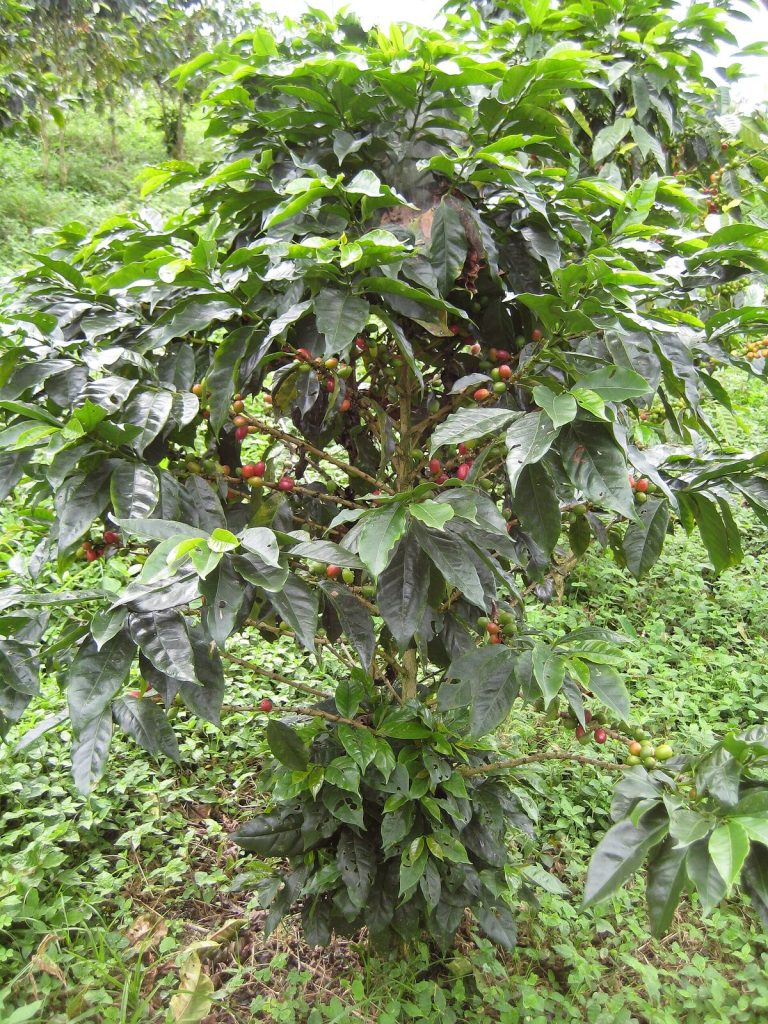
Coffee pest and disease control in Uganda starts with telling two agents apart, because one kills a twig and the other kills the tree. The black coffee twig borer and coffee wilt disease were both first recorded in Bundibugyo in 1993, and the national coffee authority publishes a control programme for each. Robusta and Arabica carry different problem lists, and the altitude a garden sits at decides much of the rest.
That distinction is worth more than any spray decision. Coffee wilt disease has no chemical remedy at all, so a farmer who reads wilt as beetle damage buys something that cannot work, and then loses the tree anyway. A farmer who reads beetle damage as wilt uproots a tree that would have recovered from a hard pruning.
Telling Coffee Wilt Disease Apart From Twig Borer Damage in the Field
Both agents produce a dying, brown, leafless part of a Robusta tree. The signs that separate them are small and they are reliable.
Two further checks settle awkward cases. Coffee berries on a wilt infected tree ripen early, dry out and stay attached to the primary branches. And a tree killed by wilt stays firmly rooted when pushed, whereas one killed by the root rot fungus topples over, which is how those two get separated.
The Black Coffee Twig Borer: the Pest on Most Ugandan Coffee Farms
The black coffee twig borer, Xylosandrus compactus, is a very small dark oval beetle that bores into the underside of a coffee twig and lays eggs inside. It does not eat the wood. It grows a fungus in the gallery and the brood feeds on that, which is why the absence of a favourite food plant is no protection. The hollowed section blocks water and nutrients moving out to the branch, so the twig dries, and the twigs that dry are the ones that were going to carry cherries.
The ministry's Robusta handbook puts the yield loss from an uncontrolled infestation at up to half the crop. A national survey across 26 districts, reported to the International Coffee Organization, measured what is actually happening on farms.
Control is cultural first. Cut out infested twigs and stems, then chop and burn or bury them, and do it as a routine inspection rather than a campaign. Plant at the recommended spacing and keep the bush open by removing suckers, because bushiness and shade both favour the beetle and damage runs higher in the dry season under shade trees. Avoid Musizi and Musambya, the two shade and intercrop trees the handbook names as alternate hosts, and buy planting material only from a certified nursery so an infested cutting is not carried in.
Fertility matters here for a reason that has nothing to do with vigour. Infestation runs highest where phosphorus is limiting, so a soil fertility problem shows up as a pest problem. The coffee fertilizer guide covers the nutrition side.
Then there is the trap, which NARO developed and which the handbook specifies in full. A transparent water bottle holds water that drowns the beetle, a small dispenser vial holds an ethanol attractant at 75 percent strength, and a wire or string hangs the assembly two thirds of the way up the tree. Published density is 15 traps per hectare, which is about six per acre. Hang them at the start of the rains, and clean and refill them every two weeks, because a trap nobody services is a hook with nothing on it.
Biological agents exist and are named in the handbook: two insect killing fungi, a parasitic wasp and a predator ant that eats twig borer eggs. None of them is a substitute for cutting and burning.
Coffee Wilt Disease and Why There Is Nothing to Spray
Coffee wilt disease, caused by the fungus Fusarium xylarioides, is the biological threat the ministry ranks above all others for Ugandan coffee. In Uganda it attacks Robusta only, and that is not a local quirk: the pathogen has split into host specific lineages, one adapted to arabica and one to robusta, which peer reviewed genomic work has now traced through a century of outbreaks. The fungus blocks the vascular system, so water and nutrients stop moving up from the roots, and the plant dries from the top down.
The disease lives in the soil and moves in ways that are entirely under a grower's control. Spores travel on infected soil and planting material, in running water, on unsterilised tools, in coffee husks used as mulch, and in dried coffee branches carried home as firewood. Infected trees do not recover from pruning or stumping, and any sucker that sprouts afterwards wilts too.
What control looks like, then, is a set of habits rather than a product. Uproot a diseased tree and carry it out without dragging it past healthy ones. Do not harvest berries from an infected tree, because the husks spread the fungus. Do not mulch coffee with coffee husks. Sterilise cutting tools between trees and before entering a clean field, and never move a blade straight from an infected tree to a healthy one. Treat any wound near the collar or on the roots, because that is where the fungus gets in, which is also why careless weeding with a hoe is a disease risk and not merely untidy.
Replanting is where the handbook disagrees with itself, and the disagreement is worth knowing rather than smoothing over. One sentence says an infected and cleared field should not go back into coffee for at least a year and a half. A later sentence on the same page says at least two years, to let the fungus in the soil decline. Two years clears both statements, so that is the figure to plan around, and the exception both sentences allow is replanting with a resistant cultivar.
Resistance is the real answer. The released clonal Robusta lines KR1 to KR10 are listed as resistant to coffee wilt and to leaf rust, and tolerant to red blister. The coffee yield per acre page carries their published yields, and where to buy coffee seedlings covers sourcing from a certified nursery.
Coffee Leaf Rust and Red Blister Disease
Coffee leaf rust, Hemileia vastatrix, shows first as pale yellow spots on the lower leaf surface. The spots swell and produce orange spores, and older parts of each lesion go brown and dead. What follows is the damaging part: the tree sheds leaves early, loses photosynthetic surface, and starts drawing on carbohydrate reserves in the roots to fill the berries it is already carrying. Fine feeder roots die back, berries fail to fill, young berries drop, and repeated seasons of this run a bush slowly downhill.
Spraying decisions split by species, and the handbook is unusually direct about it. On Robusta, chemical control is not economical and not recommended. Good field preparation, clean planting material, pruning and weeding carry the load, and a resistant variety settles it. On Arabica the disease can be destructive enough to justify a fungicide, and the handbook's own trigger is 20 percent or more of leaves affected, with timing before and during the early rains and reapplication if rain washes the spray off. The target is the underside of the leaf. No commercial biological control exists for rust.
Red blister disease, Cercospora caffeicola, is close to a Ugandan speciality: it has been recorded only in Uganda and the Bukoba area of Tanzania. Small raised red spots appear on green and ripening cherries, spread, and join into blisters whose centres dry and blacken. Infected dry cherries do not pulp properly, so the loss lands at the wet mill rather than in the field. It is worst on old traditional seedling coffee in lower lying areas. Control is tolerant varieties, sound soil fertility, correct spacing, pruning, destroying infected debris, good drainage, and at least half shade cover, which discourages the disease rather than encouraging it. Under that management the handbook says no spray is needed.
Coffee Berry Borer and Antestia Bugs: the Pests That Get Into the Bean
The coffee berry borer, Hypothenemus hampei, is a black beetle about 2.5 mm long. The female tunnels into a green cherry at the navel end roughly eight weeks after flowering, waits inside until the bean hardens, then lays about fifteen eggs, which hatch in about ten days. Larvae tunnel through the bean. Attacked young cherries often drop; the ones that hang on carry a damaged bean that the buyer will either remove or grade down. Both handbooks put the loss at 50 to 100 percent of yield, which reads as a statement about the pest worldwide rather than a Ugandan measurement, and it is quoted here as the handbooks' figure and nothing more. The measured Ugandan survey work is about the twig borer.
Sanitation is the whole game with the berry borer, because the insect spends its life inside cherries. Pick ripe cherries at least every two weeks. Bury or burn every fallen berry, since a cherry on the ground carries the beetle through the gap between crops. Strip and burn old dried berries left hanging on the tree, which are the other reservoir. Pruning to open the canopy exposes the beetle to its natural enemies, and shaded trees attract more birds, which eat them. The same trap used against the twig borer works here at the same density.
Antestia bugs, Antestiopsis lineaticollis, are brown or bronze insects with yellow orange markings, and they matter mostly on Arabica. They suck sap from flower buds, flowers, berries, leaves and soft stems. Flowers and berries abort, beans rot, and heavily attacked stems throw out multiple short branches in a witches broom pattern. In wet processed coffee the damage prints itself on the parchment as black zebra streaks, which is a defect a buyer sees. The handbook's line that two or three bugs on a tree can wipe out its berries is what makes the monitoring threshold worth the walk.
Coffee Mealybugs, and How Spraying Creates Them
Mealybugs, Planococcus species, are sucking insects about 3 mm long that sit in white waxy colonies under tender leaves, around cherries, and on young roots near the trunk where the soil is loose. They are worse in the dry season when trees are under water stress. Their honeydew feeds a black sooty mould on the leaves and attracts ants, and the ants then guard them against the insects that would otherwise eat them.
Here is the part that changes how a grower behaves. The handbook states that serious mealybug infestations are often found where insecticide sprays have been used, and points at broad spectrum organophosphate sprays in particular, because they kill almost every insect in the garden including the mealybug's natural enemies. A mealybug outbreak is frequently a symptom of spraying, not a reason to spray again.
Biological control is normally sufficient on its own. The mealybug ladybird, a reddish brown beetle about 4 mm long with black wings, feeds on them directly, and a parasitic wasp and lacewings do the rest. The cultural measures are cheap: remove suckers and any branch touching the ground so the ants cannot climb in, and replace a tree that is too far gone. If ants are the problem, the ants are the target.
Stem Borers and Root Rot: Pest Problems That Split at 1,500 Metres
Arabica carries two stem borers and they occupy different altitudes. The yellow stem borer, a wood boring beetle one to two centimetres long, sits mainly in South Western Uganda above 1,500 m. The white stem borer is severe on Arabica below 1,500 m. Both do their damage as larvae, tunnelling as much as 20 cm down into the roots and up to a metre up the main stem. The sign is wood shavings pushed out of a round hole. Attacked stems snap easily, trees under two years old are often killed outright, and survivors are left open to a second fungus that finishes the job.
Two of the controls need nothing bought. Push a wire or a bicycle spoke down the tunnel to kill the larva. Cover the bark to about half a metre up with banana fibre or maize cob strands, which stops the female laying. Trees that are too far gone are uprooted and burnt with the borers inside. Good shade reduces damage here, which is the opposite of the twig borer, and that tension between shade for one pest and openness for another is the single hardest judgement in a Ugandan coffee garden. The coffee pruning guide deals with the canopy decision itself.
Root rot, or collar crack, is caused by Armillaria mellea and turns up mostly on land recently cleared from forest, spreading tree to tree by root contact. Nothing shows above ground until the collar or several big roots are gone, after which growth slows, foliage goes stunted and yellow, and the tree dies. White fungal growth is visible on the roots, the wood rots to a wet white mass with black lines through it, and vertical cracks open at the stem base.
The control is slow and it starts before the forest trees come down. Ring barking a tree standing, which means taking off a band of bark while leaving the wood alive, cuts off the sugars moving down to the roots. The roots exhaust themselves and the fungus in them starves, and that takes two to three years. Only then is the tree felled, and the stump and as much root as can be reached are removed and burnt. Replanting on the spot waits at least another two years. On forest land, in other words, root rot is a decision taken at clearing, not a disease treated later.
What the Ministry's Own Pest Chapters Get Wrong
The two handbooks are the best source a Ugandan coffee grower has, and they carry five errors that a reader can walk into. Publishing them is more use than pretending the documents are clean.
Start with the one that costs actual money, because it is a buying decision rather than a reading problem. The Arabica handbook's opening chapter states that the four recommended and authorised elite Arabica varieties in Uganda are SL14, SL28, KP423 and KP162. Its own variety table, a few pages later, marks two of those four as not recommended for cultivation, and marks both of them very susceptible to coffee leaf rust and to coffee berry disease. Those are the two diseases this page has just spent two sections on. A grower who reads the prose and asks a nursery for what it names can be sold a variety the same document tells them to avoid, on exactly the grounds that matter most.
The safe reading is that the variety table governs, because it carries the disease column and the prose does not, and that no variety should be bought on a prose sentence alone. Ask the nursery which line it is selling, then check that line's resistance in the table rather than the paragraph.
Next, the Arabica handbook runs the page header "insect pests of Robusta coffee and their management" across every page of its Arabica pest chapter. The text underneath is correctly Arabica, covering the stem borers, antestia and the lace bug, none of which the Robusta chapter carries. So the header is wrong and the content is right. Read the section, not the running head.
In its coffee berry disease section, the same handbook calls thiabendazole and tebuconazole "copper based fungicides". Neither is a copper compound. This is the failure worth carrying away from this page: a class word printed in front of a product name does not tell you what is in the tin. Read the active ingredient off the label, every time. How to read agrochemical labels covers where to find it, and fungicides explained covers what the classes actually do.
The Arabica handbook's leaf rust section states that Arabica districts lie between 1,000 and 1,500 m, which is the Robusta handbook's sentence with the species changed. Its own opening chapter puts Arabica between 1,200 and 2,500 m, and its own coffee berry disease section puts the worst disease pressure above 1,600 m. Three readings in one document, and the growing zone figure of 1,200 to 2,500 m is the one the rest of the handbook works from.
Last, the Robusta handbook numbers its leaf rust control section 7.1.3, which is the number it already gave coffee wilt control. Anyone working down the numbering lands on wilt control while looking for rust, and those two prescriptions point in opposite directions, since wilt has no spray and Arabica rust does.
Why Coffee Pest Control Fails When Only Half the Village Does It
A twig borer female disperses at least 200 metres on her own and further on the wind, and she can start a population without mating, in which case every offspring is male. Her life cycle closes in about a month. Put those three facts together and a clean garden next to a neglected one is a garden that gets reinfested on a monthly cycle, whatever its owner does.
This is why the handbook and the survey report both push towards collective action at village level rather than individual effort. It is also the strongest argument for the least glamorous measure on this page: destroying cut material rather than stacking it. The 14.9 percent of surveyed farmers who cut infested twigs and left them in the field were doing the hard part of the work and then throwing the result away, and their neighbours paid for it too.
Long distance spread runs on transported plant material, which is the reason certified nurseries matter more in coffee than in an annual crop. A tree lives for decades and carries whatever came with it. Sourcing is covered under coffee farming in Uganda, and the species level differences in pest pressure sit in Robusta against Arabica coffee farming. Wider input safety belongs with safe pesticide application and where to buy pesticides. This guide sits under the export crops hub alongside the rest of the coffee cluster.
Common Questions About Coffee Pest and Disease Control
Does it pay to spray Robusta coffee for leaf rust? The ministry's Robusta handbook says chemical control of leaf rust is not economical on Robusta and does not recommend it, reserving fungicides for Arabica where the disease can be destructive. Money spent on a resistant clonal variety, clean planting material and proper pruning does more on Robusta than money spent on spray. Current input and coffee prices sit on the coffee price page.
What does a beetle trap cost to put together? The published specification is a transparent water bottle, a small dispenser vial, a length of wire or string, and ethanol at 75 percent strength for the lure, at about six traps per acre. Component prices move with supplier and season, so no figure is given here. The pesticide and input suppliers page is the place to price the lure locally.
Can a tree with coffee wilt disease be saved by stumping it? No. The handbook is explicit that infected plants do not recover from pruning or stumping, and that any suckers which sprout afterwards wilt and dry as well. The tree is uprooted and removed, and it should not be dragged past healthy trees on the way out.
How long before an infected field can go back into coffee? The Robusta handbook gives at least a year and a half in one sentence and at least two years in another, both on the same page. Plan on two years, which satisfies both, unless you are replanting with a cultivar listed as resistant, which both sentences allow as the exception.
Is it safe to mulch coffee with coffee husks? Not while coffee wilt disease is present in the country. Husks from infected berries carry the fungus, and the handbook advises against using coffee husks as mulch for that reason. Bean haulms, maize stalks and banana leaves are the alternatives it names for mulching.
Why did mealybugs get worse after I sprayed? Because broad spectrum insecticides kill the ladybirds, wasps and lacewings that were holding the mealybugs down, and the mealybugs come back faster than their predators do. The handbook records serious infestations turning up precisely where spraying has been heavy. Removing suckers and ground touching branches to keep ants out is the first move, not another spray.
Which pest problems does altitude decide? Several. Coffee berry disease is worst on Arabica above 1,600 m. The yellow stem borer sits mainly above 1,500 m in the south west and the white stem borer below it. Red blister is a lower lying problem. Coffee wilt is a Robusta problem in Uganda, so it follows the Robusta districts rather than the highlands.
Is the twig borer only a Robusta pest? It prefers Robusta and the Robusta handbook describes it as mainly a Robusta pest, but the report to the International Coffee Organization states that it attacks Arabica too. An Arabica grower should still be checking twigs.
Prices for planting material, lures and spray equipment move with season and supplier, so the sensible next step is checking what they are now rather than working from a figure on a page. Compare current coffee prices before deciding what a control programme is worth on your own acreage, and ask a district extension officer to confirm any product and rate against the label before it goes into a sprayer.