
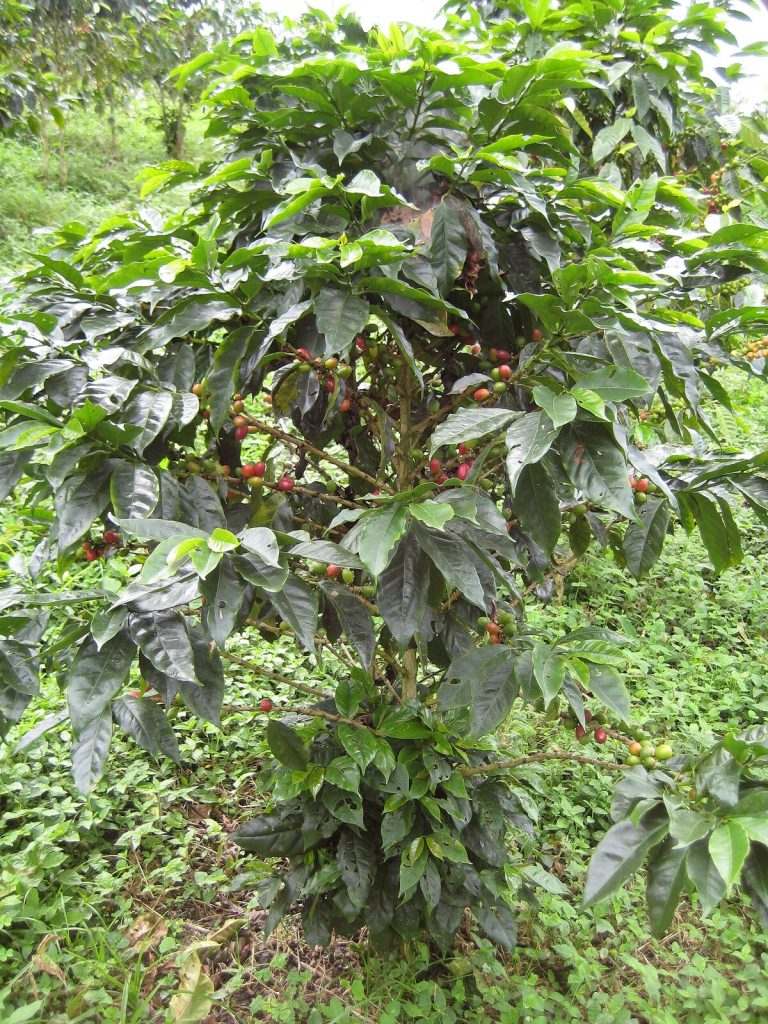
Coffee spacing per acre in Uganda is 10 ft by 10 ft for Robusta, giving about 450 trees an acre, and 8 ft by 8 ft for Arabica, giving about 680. Those are the figures three separate ministry documents publish. The arithmetic behind them is less settled than it looks, and for Arabica the published plant count per acre varies by half depending on which official document you open.
That matters because plant population is the multiplier on almost everything else you buy. Seedlings, planting labour, manure per hole, fertilizer per season and harvesting labour all scale with the number of trees, so a plant count that is 20 percent wrong makes every quantity you order 20 percent wrong. This page walks the geometry, sets out every official population figure with the arithmetic checked, and tells you what to count in the field instead of trusting any of them.
Recommended Coffee Spacing for Robusta and Arabica
The national coffee research institute at Kituza gives Robusta spacing as 10 ft by 10 ft, written alongside 3 m by 3 m as though the two were the same measurement. Arabica is 8 ft by 8 ft, written alongside 2.4 m by 2.4 m. Both are square grids with rows and within row distances equal, and both handbooks specify the row direction: east to west for Robusta, to make the most of sunlight, and along the contour for Arabica, because Arabica ground is usually sloping.
The ministry's own training manual repeats both spacings and attaches the plant counts directly: 450 trees an acre for Robusta at 10 ft by 10 ft, 680 for Arabica at 8 ft by 8 ft. The regulator's extension guidance gives the same two spacings in feet. So the spacing recommendation itself is stable across every Ugandan source. It is the conversion into plants per acre that wobbles.
One more thing the Robusta handbook says out loud, which is unusual and worth respecting: trials are running at Kituza aimed at raising tree density per acre, with results and revised practice guidance expected in the short to medium term. The spacing is not a permanent law. It is the current recommendation, and the institution that sets it is actively testing whether it is too wide.
Coffee Plants Per Acre: Why the Published Figure Moves
An acre is 43,560 square feet, or 4,046.86 square metres. A hectare is 10,000 square metres, or 2.471 acres. Every population figure in Ugandan coffee comes from dividing one of those by the area each tree occupies, and the wobble comes from a single conversion: 10 ft is 3.048 m, not 3 m.
Work it through for Robusta. At exactly 10 ft by 10 ft each tree holds 100 square feet, and 43,560 divided by 100 is 435.6 trees an acre. At exactly 3 m by 3 m each tree holds 9 square metres, and 4,046.86 divided by 9 is 449.7. The published figure of about 450 is the metric count. Peg your field in feet with a tape and you will fit about 436 trees on it, roughly 14 fewer than the number on the page. The gap is a little over 3 percent.
Arabica goes the other way. At exactly 8 ft by 8 ft each tree holds 64 square feet and an acre takes 680.6, which is where the published 680 comes from, so for Arabica the official figure is the exact imperial count. At exactly 2.4 m by 2.4 m each tree holds 5.76 square metres and an acre takes 702.6. Peg in metres and you fit about 23 more trees than the published figure, because 2.4 m is slightly tighter than 8 ft.
Five Official Plant Populations Per Acre for Arabica Coffee
Robusta is the easy case. Every Ugandan source lands between about 436 and 463 trees an acre, a spread of under 7 percent, and 450 is a sound planning figure. Arabica is a different situation, and anyone budgeting from a document rather than a field needs to see the spread laid out.
| Source type | Arabica per acre | Per hectare |
|---|---|---|
| Grant costing annex | 463 | Not stated |
| Viability study, implied | About 607 | 1,500 |
| Handbook budget annex | About 664 | 1,640 |
| Handbook text | 680 | About 1,700 |
| Metric spacing counted | About 703 | 1,736 |
Top to bottom that is a 52 percent spread on the single number every other Arabica quantity depends on. The grant costing annex is the outlier and the reason is visible once you notice it: that annex applies 463 planting holes an acre to Robusta and Arabica alike, as a single rate for both crops. It is a unit rate sheet, built for pricing operations, and it was never a density recommendation. Using it as one puts an Arabica field nearly a third short of its stand.
The viability study's figure is implied rather than stated: it prices compound fertilizer at 500 g a tree a year and totals 750 kg a hectare for Arabica, which only divides at 1,500 trees. That is a study assumption, not an agronomic recommendation either.
So the defensible answer is the one two independent ministry publications state directly and the geometry confirms: about 680 Arabica trees an acre. Where a document gives you something else, check whether it is a costing rate or a modelling assumption before you plant to it.
Marking Out Coffee Rows and Planting Holes
Marking out is called pegging, and it is done before any hole is dug. Run the rows in the direction each handbook specifies, drive a peg at every planting position, and only then start digging. Holes are circular, 60 cm deep and 60 cm across, which is the two foot cube in the extension diagrams, and they go in at least three months before planting. Keep topsoil and subsoil in separate heaps, with topsoil on the uphill side on a slope so it falls back in first.
On sloping land the spacing interacts with the terracing, and the two handbooks handle it the same way. Up to a 15 percent slope, run the rows across the slope with a fall of 1 to 2 percent for drainage. Above 15 percent, contour planting becomes compulsory, and the contours are located one row spacing apart up the hill, which for Arabica means the next contour line sits 8 ft or 2.4 m above the last. Contours are found with a wooden A frame about 5 ft high with legs 4 ft apart and a weighted string hanging from the apex.
How Many Coffee Seedlings to Order Per Acre
More than your plant count, and the ministry's own establishment budget says how much more. That grant annex plants its acre in year one and then carries a separate line in year two for gap filling: 93 replacement plantlets against 463 planted, which is 20 percent. One plant in five is expected to need replacing within two years.
That is a published allowance rather than a pessimistic guess, and it fits what the handbooks say elsewhere about the first two years being a survival problem. Deaths come from planting into dry soil, from drought in the first dry season, from collar rot where soil was heaped against the stem, from damaged taproots, and from seedlings that carried a pest out of the nursery.
Practically, then: order to your peg count for the first planting, and budget a further 15 to 20 percent over the following two seasons rather than buying it all at once, since plantlets held too long in pots deteriorate. Choose material on the recommendation column of the released variety list, not the yield column, and buy only from a certified nursery. A district extension officer or the regional coffee extension office will confirm which nurseries near you are certified, and where coffee seedlings are sourced is worth settling before you dig.
Shade Tree Spacing Per Acre in a Coffee Garden
Shade trees are spaced far wider than coffee and the published range is wide enough to be confusing until you see the condition that sets it. Both handbooks give approximately 20 to 40 m between shade trees in normal conditions. Both then tighten it for hot dry country: the Arabica handbook reduces it to 10 to 15 m in warmer areas such as the mid north, and the Robusta handbook says shade spacing should be closer in warmer and drier areas after a field recommendation from an extension officer on site.
Counted per acre, those spacings produce a very wide band, which is why two official documents can look like they contradict each other when they do not.
| Shade spacing | Trees per acre | Condition |
|---|---|---|
| 40 m | About 3 | Wide canopy species |
| 20 m | About 10 | Normal conditions |
| 18 m | About 12 | Extension page figure |
| 15 m | About 18 | Warmer areas |
| 10 m | About 40 | Hot and dry areas |
The grant costing annex prices 40 shade trees an acre, which corresponds to about 10 m spacing, the hot and dry end of the published range. That is defensible as a costing assumption and wrong as a default for a cool highland Arabica site, where it would be four times too many. Choose from the spacing range by how warm and dry your site is and how wide the canopy of your chosen species will get, and keep the trees pruned to a maximum height of 4 to 5 m so they stay manageable.
Two spacings within shade management are separate from the between tree distance. Mature trees retained during land clearing are left at roughly 20 by 20 m. And a young coffee field needs its shade established at least a year ahead of the coffee, so shade spacing is a decision you make a full season before you peg the coffee.
Windbreaker Spacing on the Coffee Farm Boundary
Windbreakers are a boundary job, not a field job, so their count depends on the perimeter of your block rather than its area. The preferred species for the purpose is Ficus natalensis, planted at 60 ft by 60 ft, with avocado, jackfruit and mango also named. Rows of windbreakers are shown about 30 m apart on flat ground and about 15 m apart on a slope, where wind runs faster and the trees need to be closer.
A square acre measures about 209 ft on each side, so its boundary runs roughly 835 ft. At 60 ft spacing that is about 14 boundary trees for a square acre, and fewer per acre as blocks get bigger, because perimeter grows more slowly than area. That is a derived figure rather than a published one, so treat it as a starting point for your own measurement. A long narrow block needs proportionally more.
Keep the two lists apart when you order. Avocado is named as a useful windbreaker and is also named as an alternate host of the black coffee twig borer, which is why the handbooks exclude it from the in field shade mix. On a boundary, away from the coffee canopy, it is treated differently from a tree standing in the middle of the garden.
Spacing the Banana Intercrop at One Banana to Four Coffee
The coffee and banana field is the commonest system in Uganda and it has a published ratio: one banana to four coffee, so each banana shelters four bushes and each bush sits under one banana. The spacings that deliver it are 20 ft by 20 ft for banana on a 10 ft Robusta grid, and 16 ft by 16 ft for banana on an 8 ft Arabica grid. Both are exactly double the coffee spacing, which is what makes the ratio come out at one in four.
Counted per acre that is about 109 banana stools with Robusta and about 170 with Arabica. Check the division and it holds: 436 Robusta divided by 109 is 4, and 681 Arabica divided by 170 is 4.
There is one thing the documents do not settle, and it changes your coffee stand by a quarter. They give both spacings and the ratio, but they do not say whether each banana occupies a coffee position or sits between them. If the bananas take coffee positions, an acre of Robusta carries about 327 coffee and 109 banana rather than 436 coffee. If they sit in the gaps, the coffee stand is unaffected. Peg both crops before digging anything, decide deliberately which you are doing, and order seedlings against the decision rather than against a table. Bananas planted more thickly than one in four are recorded as competing with the coffee for nutrients instead of sheltering it.
Annual intercrops have their own spacing rule and it is about clearance rather than grid. Beans, groundnuts, soya and vegetables in a young coffee field are confined to the central 2 m of the inter row with a clear 0.5 m left between them and the coffee stem, for the first two years, at two crops a year. Maize, millet, rice, cassava and potatoes are excluded as heavy feeders. Beans are the usual choice, rotated rather than repeated, since continuous beans on the same plot in humid areas bring aphids.
Stem Density: Spacing Inside the Coffee Tree
Ground spacing is only half of coffee density in Uganda, because the crop is grown on a multiple stem system. Each bush is trained or capped young to carry three bearing stems, with four as the recorded maximum. So the number of bearing stems on an acre is roughly three times the tree count: about 1,350 stems on a Robusta acre at 450 trees, and about 2,040 on an Arabica acre at 680.
That has two consequences worth planning for. Canopy closes faster than the tree count suggests, which is why de-suckering runs through the year rather than once a season, and why a garden that looks correctly spaced on the ground can still be too humid inside the canopy for comfort where black coffee twig borer is present. And stem count is the number that changes at the change of cycle: stumping drops a bush from three or four stems to one breather, so canopy density on a stumped block falls by two thirds or more for a year or two while the suckers grow. The pruning guide covers how stems are built and renewed.
Suckers are also spaced, at the base of the stump. The kept suckers are selected low, at about 15 cm from ground level, and deliberately spread around the stump rather than clustered, so they have room to expand and do not shade each other out.
What Coffee Spacing Does to Your Fertilizer and Seedling Quantities
Ugandan fertilizer guidance for coffee is written per tree, and the per acre totals in the tables are simply the per tree rate multiplied by the plant count. So spacing sets the quantity you buy, directly and permanently.
At the published minimum of 100 g per tree per rain season for coffee up to two years old, a Robusta acre at 450 trees takes 45 kg per season and an Arabica acre at 680 trees takes 68 kg. At the published minimum of 200 g per tree per rain season for producing trees, the same two acres take 90 kg and 136 kg. Arabica's requirement per acre runs about 51 percent above Robusta's for no reason other than spacing, and that difference repeats every season for the life of the field.
Manure scales the same way. One 20 litre basin per planting hole means about 450 basins on a Robusta acre and about 680 on an Arabica acre, and the ministry's costing annex prices manure by the truckload rather than the basin, so the two units have to be reconciled before you order. Harvesting labour scales with trees too, since it is paid per kilogramme of cherry picked and the cherry comes off the trees you planted.
This is why the plant count is worth getting right before anything else. Order seedlings against a peg count, then use that same count as the denominator for every quantity afterwards. A plant population calculation does the arithmetic, the coffee fertilizer guide gives the rates per tree, and the main coffee growing guide sets the spacing decision in context alongside what those trees are likely to yield. Spacing arithmetic of this kind recurs across the export crops section, since every perennial there is bought by the plant and sold by the kilogramme.
Coffee Spacing Per Acre: Questions Farmers Ask
Before you buy seedlings, peg the block and count. Then get current quotations for plantlets, manure and fertilizer from more than one supplier in your district, because those rates differ by region and by season, and confirm with the district agricultural office or the regional coffee extension office which certified nurseries are distributing recommended varieties near you.