
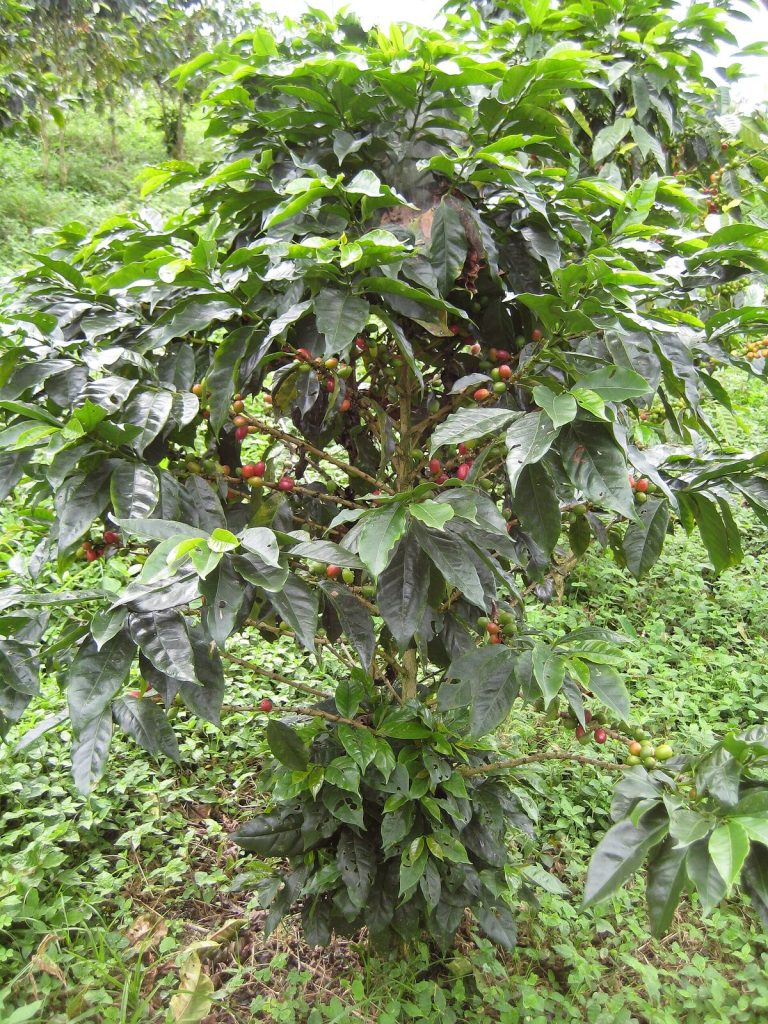
Robusta coffee farming in Uganda runs on low altitude land between about 900 and 1,500 metres, on planting material raised from cuttings rather than seed, and on a garden that carries several different clonal lines instead of one. Robusta is roughly 80 percent of the national crop. The single decision a grower cannot undo later is which material goes into the hole.
Almost everything else on a Robusta garden can be fixed. Weeding can be caught up. A missed feed can be made good next season. Shade can be thinned, stems can be recut, a hole can be dug deeper. What cannot be repaired without pulling the trees out is the material itself, and that is where this guide starts, because it is also where most of the advice in circulation is thinnest.
Where Robusta Coffee Grows in Uganda: Altitude, Rainfall and Soil
Robusta is a low altitude species and the ministry's own handbooks give its band twice, at different widths. One passage puts it at 900 to 1,200 metres and the clonal nursery manual repeats that figure. Two other passages in the same handbook give 900 to 1,500 metres. So the floor is settled and the ceiling is not, with two documents behind the lower reading and one behind the higher. The handbook then notes that Ugandan Robusta averages about 1,200 metres, which lands exactly on the contested line. Read that as a warning rather than a contradiction: the higher your ground, the more the published guidance starts to hedge, and above about 1,200 metres you are in territory where the same institution cannot agree with itself.
Temperature is less ambiguous and more useful. Robusta wants 22 to 28 degrees. Past 30 degrees the handbook records flower abortion, poor fruit set, premature ripening and a drop in photosynthesis. That figure is worth holding onto, because pages describing Ugandan conditions as ideal often quote a range topping out at exactly 30. Thirty is not the top of the comfortable range. It is the published damage threshold. At the other end, frost damage can happen near zero, which matters on high open ground on a clear night.
For rainfall the handbook asks for 1,200 to 1,800 mm spread over nine months, and says the distribution matters as much as the total. A different figure sits in the same document: its good practice list for intercropped coffee asks for a site with more than 900 mm a year. Those are not the same requirement, and the lower one belongs to the intercrop guidance rather than to the species. Where rain is short, the handbook's answer is not a different variety but supplementary watering to pull flowering into one flush, since scattered rain scatters the flowering and a garden that flowers over five months has to be picked over five months.
Soil wants to be deep, free draining and slightly acidic, pH 5.5 to 6.5, with a minimum working depth of 1 to 1.5 metres in moist areas and up to 3 metres in drier ones. Volcanic red earth and well structured sandy loams are named as the best. Robusta will not tolerate standing water. Below pH 5.5 the handbook calls for liming, and a soil test before anything is bought is the cheapest way to find out whether you are in that position; the case for testing soil before buying fertilizer applies here with unusual force, because a perennial crop locks in the mistake for decades.
Why Robusta Coffee Is Grown From Cuttings and Not From Seed
Here is the fact that reorders everything else. Robusta is self sterile. The clonal nursery manual states it plainly: the flowers of one tree cannot fertilise each other, while trees of different clones cross fertilise freely. A peer reviewed study of crosses in the species describes it the same way, as a self incompatible plant with wide natural variability. Two unrelated sources, one a ministry manual and one a research paper, and neither is talking about Arabica.
Two consequences follow. The first is that seed from your best tree will not reproduce that tree. Because the species outcrosses, a seedling population segregates, and the manual lists exactly what drifts: leaf appearance, fruit and bean size, tree vigour, drought tolerance, fruit formation, internode length, ripening time and uniformity. A grower who plants beans from a good bush gets a lottery, not a copy. That is why commercial Robusta in Uganda is raised from nodal cuttings taken from a mother garden of known lines. Grafting works too, but rootstock is scarce, so cuttings carry the trade.
The second consequence is the one nobody writes down.
Sales talk pushes the other way. One line always has the highest number attached to it, and a buyer who wants the best naturally asks for that one and nothing else. Follow that instinct across a whole acre and you have bought a pollination problem that no amount of fertilizer will solve.
Choosing Clonal Planting Material and What to Reject at the Nursery
Ugandan Robusta planting material falls into three classes, and they are not interchangeable. The class matters more than the individual line, because it decides whether the trees can get coffee wilt disease at all.
| Material | How raised | Coffee wilt | Status |
|---|---|---|---|
| Elite | Open pollinated seed | Susceptible | Being phased out |
| Six older clones | Cuttings | Susceptible | Superseded |
| Seven lines released in 2009 | Cuttings or tissue culture | Resistant | Recommended |
| Three lines released in 2017 | Cuttings or tissue culture | Resistant | Recommended, stock limited |
The ten released lines, written KR1 to KR10, are recorded as resistant to coffee wilt disease and to leaf rust and tolerant of red blister. Elite seed and the six older clones are recorded susceptible to all three. That is the whole of the buying decision in one sentence, and it is the reason cheap material is rarely cheap.
There is an awkward twist in availability. Both ministry documents record that the research institute was still building up plant stock of the three most recently released lines to hand out to nursery operators. Cross read against the handbook's own ranking, those three newest lines carry the top figures in its table. So the lines rated highest are the ones hardest to get hold of, which is the opposite of what a price list implies. The per acre yield figures behind that ranking are worth reading before treating any of them as a forecast, because the handbook's own table sits above the ceiling the same handbook states for field conditions.
Buy from a certified nursery and confirm current certification at the district agricultural office rather than from a signboard. The same care applies to any perennial planting material, and the general rules on judging quality in planting material transfer directly. If you are pricing material, the supplier side of buying coffee seedlings is handled separately.
Preparing Land for a Robusta Coffee Garden
The handbook asks for the land to be prepared a full year before seedlings go out, and the reason is a fungus rather than a calendar. Old tree stumps and their roots are a frequent source of Armillaria infection in young coffee, so forest trees are ring barked at least a year before they are felled and the stumps and roots come out rather than being left to rot in place. Clearing a plot and planting into it the same season is how a garden gets root disease it never recovers from, and it is precisely the step that gets skipped when a grower is in a hurry.
Couch grass gets called the worst enemy of coffee, and it has to go completely before planting, by digging and handpicking or with a herbicide. Where a chemical is used the handbook names a glyphosate based product for grass weeds and says the rate is on the container label. Two of its own cautions are worth more than the product name: slash first and spray the tender regrowth, and avoid herbicide altogether until the coffee is at least two years old. Protective clothing is not optional either, and the list given is overalls, a helmet, eye protection, gumboots, gloves and a nose and mouth mask. Confirm any product and its rate with the label and a local extension officer before mixing anything.
Rows run east to west, which the handbook says makes the most of the sunlight. Windbreaks go in along the boundaries before the coffee, and mature trees are left for shade at roughly 20 by 20 metres during clearing. Planted shade trees are spaced wider, 20 to 40 metres apart depending on species and canopy, tightened in warmer drier districts on the recommendation of a field officer who has seen the site. Keep shade trees to a maximum height of 4 to 5 metres so they can be managed, and prune them at the start of the rains, because dense shade raises humidity and humidity is what coffee leaf rust and the black coffee twig borer want.
Which species to plant matters less than which to avoid, and the handbook gives reasons rather than a bare list: skip alternate hosts of the black coffee twig borer, hardwoods that draw pit sawyers, anything very slow growing, conical canopies that shade a narrow strip and bake the rest, species whose leaves take years to rot down, thorny species and poisonous ones.
Holes are dug 60 cm deep and 60 cm across, at least three months before planting, with topsoil kept separate from subsoil, and backfilled about a month ahead. Manure goes into the top 20 cm of the hole, not the bottom, because a young coffee plant has a shallow root system and cannot reach what is buried deep. The handbook's instruction at planting is a handful of a phosphate in the root zone, not touching the stem; the nursery manual puts a number on that handful for a mother plant, at 50 grammes. Feeding after that belongs on the coffee fertilizer guide, which also audits the arithmetic in the ministry's own per acre column.
Planting Out and Watering Through the First Three Years
Without irrigation, planting follows the rains: March to May and September to October in Central, Western, Rwenzori, South Western and Busoga, and April to August in the Northern and Elgon regions. Get plants in within the first two to three weeks after the rains break. Plant early in the morning, late in the afternoon, or on a cloudy day, and soak the seedlings thoroughly first.
Set the collar level with the surrounding soil or a shade higher to allow for settling, firm the soil by hand, and leave neither a hollow nor a mound around the stem. Every plant gets temporary shade, a tree branch or a split banana pseudostem, and a ring of mulch that does not touch the stem. Then walk the field regularly and replace anything that dies, because a garden with gaps never catches up.
Watering is where published advice and common practice diverge most. The recommendation is not a daily can.
Mulch carries the moisture between waterings. Maintain a layer 5 to 15 cm deep each season, kept 15 cm clear of a young stem and 30 cm clear of a mature one, because mulch against the trunk invites collar rot and hands ants a bridge into the tree. The handbook also lists the drawbacks honestly, and two are worth knowing before you commit: prolonged use of elephant grass or swamp straw has been recorded yellowing and killing coffee, so rotate the material, and heavy mulching can tie up zinc and magnesium.
Training Robusta Stems by Bending to Three Bearing Stems
Robusta in Uganda is grown on a multiple stem system, and the stems are created deliberately. At 5 to 6 months, or once the plant is about 60 cm tall, the single stem is bent along the row in an east to west direction and pegged down at about 45 degrees. Bending breaks the dormancy of buds at the base and pushes up suckers.
Select suckers from as low as possible, around 15 cm from the ground, and take two if you are keeping the bent stem or three if you intend to cut it later, so the bush ends on three stems. Four is the stated maximum. When the suckers reach about 30 cm the peg comes out and the original stem lifts again. Everything bends the same way, towards the west and along the row, so the garden stays walkable.
The alternative is capping. A plant 4 to 6 months old has its tip removed at 15 to 30 cm above the ground, which does the same job of forcing multiple stems without the pegging. Either route ends at the same place, and the choice is mostly about labour and how confident the person doing it is. Detailed canopy work from that point on, including de suckering, belongs to the coffee pruning guide.
Coffee Wilt Disease and What Resistance Does and Does Not Buy
Coffee wilt disease is the reason the Ugandan Robusta planting system looks the way it does, and the history explains the whole of it. Material collected in the early 1900s fell into two broad types the trade called Erecta and Nganda. By the mid 1930s deliberate selection was recognised as worthwhile, and by the end of the 1960s about 25 lines had been picked out on early maturity, yield, bean size, cup quality and fungal disease resistance. Those were narrowed to eight, then to six in 1995, and the six went out to nursery operators as the recommended clones.
Then coffee wilt disease was identified in 1993, and the six clones turned out to succumb to it along with everything else. By 2002, about 56 percent of Uganda's Robusta trees had been destroyed. Breeding for resistance produced the ten lines now recommended, released in two batches, and they are available through both cuttings and tissue culture, with the quantity reaching farmers described as still low.
Two things follow for a grower. The first is that a wilt resistant garden is a recent thing rather than a default, and older material still circulates. The second is what resistance covers. These lines are recorded resistant to coffee wilt disease and leaf rust and tolerant of red blister. They are not recorded resistant to the black coffee twig borer, the coffee berry borer, mealybugs, leaf miner or root rot, and a resistant line in a badly kept garden still gets those. Diagnosis, monitoring thresholds and what the ministry does and does not recommend spraying sit on the coffee pest and disease control page. Nothing on this page names a chemical or a rate, and neither should any page: the label and a local extension officer settle that.
Sanitation is the part a grower controls. During any cutting work, disinfect tools before starting, between one tree and the next, and at the end of the day, since sap on a blade carries pathogens from bush to bush. The handbook names disinfectant products and their strengths, which belong on the container rather than on a web page, and it also gives a method that needs nothing bought: pass the tools over hot burning charcoal.
The Change of Cycle: When a Robusta Bush Is Due for Stumping
Robusta stays productive for 40 to 50 years, but not on its original stems. Productivity is renewed by cutting the bush back and growing new stems, which the trade calls stumping or the change of cycle. Past about 40 years the handbook says replanting beats rehabilitating.
Most guidance gives this as a number of years, and the handbook does too, twice, at different values. It says the first change of cycle comes at 10 years in one paragraph and at 9 or 10 years in another, and that later cycles come every 7 years in one place and every 6 to 7 in another. Take it as 9 to 10 years, then every 6 to 7, and read the disagreement as the handbook telling you the calendar is not the real test. The physical signs are.
When you cut, cut at about six inches from the ground on a slant so rain runs off rather than sitting on the stump and rotting it. Leave one vigorous stem as a breather to keep feeding the stump while dormant buds break, and never cut every stem off a bush, which can kill the whole stump. Where a bush has only one stem, the handbook's answer is to cut three quarters of the way through and bend it over rather than remove it. When the new suckers reach about 20 cm, select three or at most four and groom those for the next cycle.
Stumping the whole garden at once gives a uniform stand and a bigger cash flow when the suckers bear, at the cost of a season with no coffee. Phasing it across parts of the garden spreads both the labour and the loss. Taking scattered bushes at random spreads cost too, but the unstumped neighbours overshade the new suckers and you end up with stems of every age on one farm, which makes planning feeding nearly impossible. The sequencing detail is on the pruning guide.
Intercropping Robusta With Bananas and Food Crops
Coffee and banana together is one of the main Ugandan systems, and the recommended ratio is one banana to four coffee, so each banana shades four bushes and each bush is shaded by one banana. The banana carries income while the coffee is too young to give any, drops mulch that returns potassium to the topsoil, and shelters the coffee from heat and wind. The catch is competition for water, nutrients and light, and the handbook is clear that dense shade cuts coffee yield and makes fertilizer a poor investment.
How much the system adds is a figure the two handbooks disagree about. The Robusta handbook says a banana and coffee system raises total revenue per unit area by over 50 percent against a coffee monocrop. The Arabica handbook, in the same table position, says about 30 percent. Both are the same institution. Treat the direction as sound and the size as unsettled. Management of the banana side is covered under banana farming, and it is real work rather than a free extra.
Annual food crops go between the young coffee for the first two years, two crops a year, confined to the central 2 metres of the inter row with half a metre left clear around each coffee tree. Bananas, green pepper, cabbages, tomatoes, soya beans, groundnuts and non climbing beans are named as suitable. The exclusions are sorted by appetite rather than by habit, and five crops come off the list on that count: maize, millet, rice, cassava and potatoes, all of them heavy feeders competing with a tree whose roots have not yet gone anywhere. Two further cautions: continuous beans on the same plot in humid districts brings on aphids, and nothing climbing goes anywhere near young coffee. Plant population and how intercropping moves it is worked through on the coffee spacing page, along with a method for counting plants per acre on your own layout.
Harvesting Robusta Cherry and Getting It to the Shed Clean
The recommendation is selective picking of red ripe cherry only, with green cherries left on the tree and picked about 6 to 8 days later. Stripping a branch of everything is faster and it drags unripe and overripe beans into the same bag, which shows up in the cup and in the price. Robusta takes 10 to 11 months from flower to ripe cherry, and the ripening is irregular, so several passes are the normal case rather than a sign that something went wrong.
Three handling rules from the handbook cost nothing and protect the whole crop. Use clean containers, because dirty ones grow mould. Spread a tarpaulin or a hessian square under the bush while picking, so that what falls stays separate from what was picked and can be gathered fast if rain comes. And never pick cherry off the ground: it is frequently contaminated with ochratoxin A from mould growth, and one contaminated handful can pull down the grade of a whole lot.
Uganda has two harvest seasons in every Robusta region, a main crop and a smaller one the trade calls the fly crop, and the calendar differs by region. The ministry publishes a regional grid and the harvesting and post harvest page handles it, along with the defect chain from picking to sale. After picking, remove leaves and twigs and start drying at once; out turn is where a careless drying job turns into lost weight, and what you actually carry to the buyer decides which price band applies, which is why who you sell to and in what form is worth settling before the first pick.
Robusta Coffee Yield Per Acre and the Gap Worth Planning Around
Measured output on Ugandan Robusta farms, from a field study that costed farms in four Robusta districts, came to about 232 kg of clean coffee an acre under traditional practice, about 505 kg under improved practice and about 841 kg under recommended practice. The published target for recommended management is at least 1,500 kg a hectare, and clonal coffee under the same management is put at 3,000 to 4,000 kg a hectare.
One caveat belongs with those measured figures, because nobody else prints it. The study's own sample frame was 96 farmers in total: six sub regions, one district each, one sub county each, four management categories, four farmers per category. Four of the six districts were Robusta. So each Robusta figure rests on roughly 16 farms. That is enough to show a direction and not enough to set a budget on. The full ladder from measured output to trial potential, and the arithmetic for moving between per tree, per acre and per hectare, is on the coffee yield per acre page, with unit conversion alongside it.
The useful reading of that ladder is not the top rung. It is the distance between the first and the third, which is a factor of about three and a half on the same land with the same species. Nothing in that gap is a variety. It is feeding, canopy work, weeding and a planned response to pests, done on time.
How Robusta Farming Compares With the Other Ugandan Coffee
If your land sits between 1,200 and 1,500 metres you have a genuine choice to make, because that band is where the published Robusta and Arabica ranges overlap. Below it, Robusta is the only one of the two that fits. The two species differ in far more than altitude: different planting material systems, different stem training, different disease pressure and different processing at the far end. That decision is worked through on Robusta against Arabica as a farming choice, and the Arabica growing guide covers the highland species on its own terms. For how coffee fits the wider picture of Ugandan export cropping, start at the export crops hub or the general coffee farming guide.
Robusta Coffee Farming Questions Growers Ask
Before buying anything, get current material prices and confirm which certified lines are actually in stock near you, since the published recommendation of five different clones is only useful if five can be sourced. The district agricultural office can confirm current nursery certification, and a soil test before the first hole is dug is the cheapest decision in the whole sequence.