
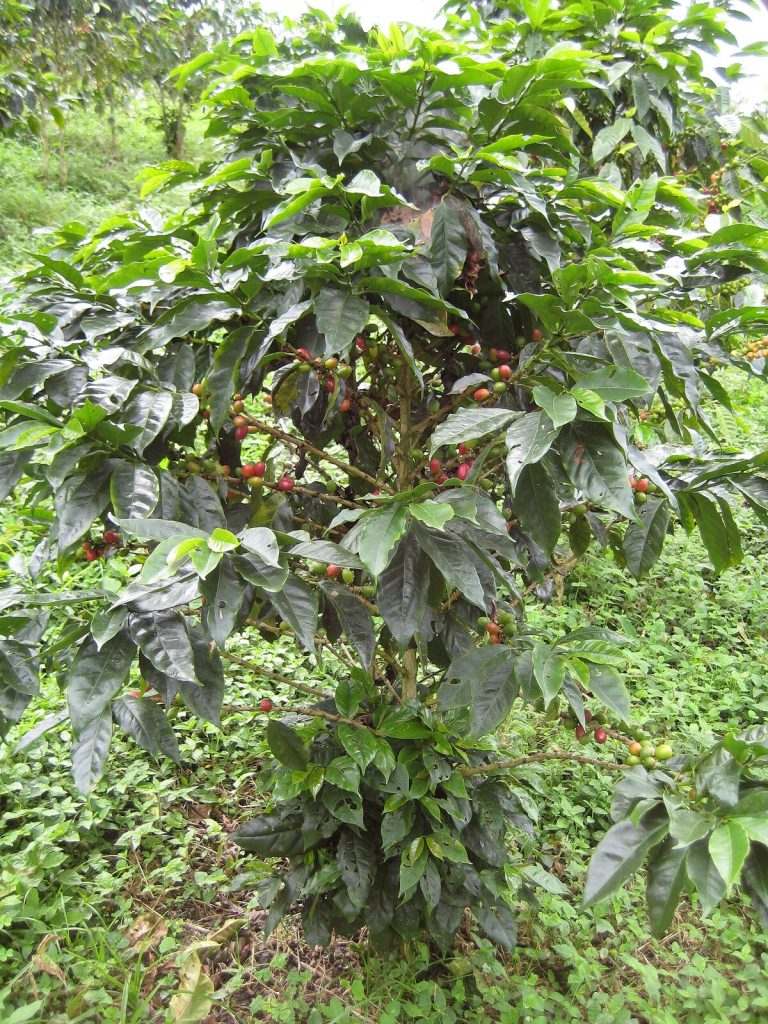
Arabica coffee farming in Uganda is a highland business, confined to ground between about 1,200 and 2,500 metres by a plant that stops photosynthesising above 24 degrees. It is about 20 percent of the national crop and it earns more per kilogramme than Robusta. The hard part is not the growing. It is what a grower can actually buy to plant.
Most guides to this crop start with soil and rain. That order hides the decision that matters most, so this one puts the variety question second, right after the ground. On Arabica the material you plant sets how much disease work the garden needs for the next forty years, and the published Ugandan list is short, old and mostly susceptible to one or both of the two diseases that matter in the highlands.
Where Arabica Coffee Grows in Uganda and Why Altitude Decides Quality
Arabica sits on the Ugandan highlands: the slopes of Mount Elgon in the east, the Rwenzori in the west, Mount Muhabura in the south west, the Okoro highlands in West Nile, and other high ground. The handbook gives the growing range as 1,200 to 2,500 metres, with a floor of 1,300 metres in one passage. Then it says something separate that most pages fold into the same number.
Temperature is the reason for all of it, and it is the tightest figure in the whole guide. Arabica wants a daily range of 15 to 24 degrees. Above 24 the handbook records plant stress leading to a cessation of photosynthesis, and below a mean of 15 it calls growth limited and the conditions sub optimal. That is a working window nine degrees wide. Arabica is also susceptible to frost damage, which is why the handbook recommends shade trees partly to reduce frost incidence rather than only to cut heat.
Rainfall is 1,200 to 1,800 mm spread over nine months, the same figure the ministry gives for Robusta, with distribution mattering as much as the total. Soil wants to be free draining and slightly acidic at pH 5.5 to 6.5, with volcanic soils named as best and at least about a metre of depth before roots meet an impermeable layer. That last figure is a real difference from the other species: Robusta's stated requirement runs to 1 to 1.5 metres in moist ground and 3 metres in drier ground, so Arabica asks less depth of the soil. Neither tolerates standing water.
The Arabica Variety Problem: Reading the Ministry's Own Table
The handbook's opening chapter names four recommended and authorised elite Arabica varieties for Uganda. Its variety table, a few pages later, tells a different story, and the table is the part a grower needs.
| Variety | Released | Leaf rust | Berry disease |
|---|---|---|---|
| SL14 | 1950s to 1960s | Highly susceptible | Less than KP lines |
| SL28 | 1950s to 1960s | Very susceptible | Very susceptible |
| KP423 | 1950s to 1960s | Less susceptible | Very susceptible |
| KP162 | 1950s to 1960s | Very susceptible | Very susceptible |
| Ruiru II | 1985 | Tolerant | Resistant |
| Catimor 129 | 1970 | Resistant | Resistant |
Two of the four named in the prose carry remarks in the table reading not recommended for cultivation and not recommended for commercial cultivation. The remaining two are each recorded very or highly susceptible to one of the two diseases: SL14 to leaf rust, KP423 to coffee berry disease. Both are recommended in the table, SL14 for medium to high altitude and KP423 for medium altitude, so they are usable, but neither is covered against both problems.
Only two entries in the whole table are recorded resistant or tolerant to both. Ruiru II is tolerant to leaf rust and resistant to coffee berry disease. Catimor 129 is resistant to both. The table attributes Ruiru II to Kenyan breeding and describes both as grown by only a small number of small scale farmers in the Mount Elgon area. Catimor 129 carries a warning of its own: not popular with farmers because of its high feeding demand and the lightness of its bean.
There is a second mismatch worth knowing. The handbook's text credits NARO with having improved upon and released seven varieties. The table lists six entries, attributes four of them to East African selection at a quarantine station and two to breeding in Kenya. By the table's own attribution column, not one of the six is a Ugandan release. That is a statement about this handbook and this table, which is what a grower is likely to be shown, rather than a claim about what exists in every research record. The practical reading is that a grower asking which Ugandan bred Arabica variety to plant will not find the answer in the published list, and should ask the district agricultural office what is genuinely certified and in stock locally.
Why is the list this old? A peer reviewed review of coffee breeding programmes puts variety development time at more than twenty years and names it among the most urgent operational constraints in the field. Two decades from cross to release is why a list assembled from 1950s and 1960s selections is still the list. It also means nothing a grower does this season changes it. The response has to be agronomic: choose the variety whose weakness you can manage on your site, and manage it. Diagnosis and control belong on the coffee pest and disease control page, which also covers how the ministry's spraying guidance differs between the two species.
Preparing Land and Planting Arabica Coffee Seedlings
The handbook asks for land to be prepared a full year ahead and gives ten establishment steps rather than the nine it gives for Robusta. The extra step is planning the farm layout, and on this species that is not paperwork. The layout has to place a drying yard and a coffee store, because most Ugandan Arabica is wet processed and wet processing needs somewhere for parchment to dry and somewhere clean and dry for it to sit afterwards.
That year of lead time is mostly waiting on two things. Forest trees have to be ring barked well before they come down, and every stump has to leave the ground with its roots attached, both to keep the root disease described on the Robusta guide out of a young stand. Selected mature trees stay, spaced at around 20 by 20 metres, which shades without heavy competition for water and nutrients. Couch grass is the other job, and it has to be gone before the plough rather than after: dig and handpick it, or use a herbicide at the rate printed on the container, checked with an extension officer first.
Planting is at 8 ft by 8 ft, which the handbook says gives about 680 trees an acre, and 680 is the figure its own feeding tables use as their denominator. Several other density figures circulate for this crop, including one from the handbook's own budget annex, and they are reconciled on the coffee spacing page rather than here. Holes, backfilling and manure placement follow the same pattern as for the other species, and feeding from that point on is set out on the coffee fertilizer guide.
On watering the published guidance has a problem a grower should know about rather than try to follow.
Nipping Arabica Seedlings and the Stem Count Question
Arabica is not trained the way Robusta is. Instead of bending the stem over and pegging it, Arabica seedlings are nipped, which means clipping the tip off the growing seedling to force stems from lower down. It is done at a height of 15 to 40 cm, between 4 and 6 months, while the seedling has not exceeded 30 to 40 cm. The shoots that come are then groomed as the future bearing stems.
Whatever the count, the canopy work that follows is the same trade: enough stems to carry a crop, few enough that light gets in and air moves. The coffee pruning guide walks the life of a tree through it.
Leaf Rust and Coffee Berry Disease in Highland Arabica Gardens
The two diseases in the variety table are not incidental. Coffee leaf rust and coffee berry disease are highland problems, which means they are Arabica problems, and the ministry's own table records the widely available older varieties as very or highly susceptible to one or both. That is the central agronomic fact about growing this species in Uganda and it follows from the buying decision rather than from anything a grower does afterwards.
One consequence reaches back into the layout. Shade reduces heat stress and frost risk, both of which Arabica needs, but the handbook also lists increased leaf rust risk as a drawback of shade trees and warns that dense shade cuts photosynthesis and makes fertilizer a poor investment. So shade on Arabica is a balance rather than a good, and the adjustment is pruning the shade trees at the start of the rains to keep air moving and light coming through, holding them to a manageable height.
Nothing on this page names a fungicide, a rate or a spray interval. The ministry's guidance differs between the two species in a way that matters, and it is set out with its own thresholds on the pest and disease page. Any product, rate and pre harvest interval comes off the label and gets confirmed by a local extension officer.
Washed Arabica Against Drugar: Your District Decides Your Product
This is the section most Arabica guides leave out, and it is a planting decision rather than a processing one. Uganda makes two quite different Arabica products, and the handbook says plainly which districts make which: most Ugandan Arabica is washed, except in Kasese and South Western Uganda, where it is dried whole as kiboko and sold at export level as Drugar.
Both routes then converge: dry parchment or dry cherry is hulled, sorted and graded into clean coffee before sale. Method detail sits on the coffee processing methods page and the drying methods page, and the equipment side is covered under coffee processing machines.
Storage decides whether careful drying survives to the buyer. Cool the coffee before it goes into a store, or condensation rewets it. Use sisal or jute bags; polythene bags are prohibited. Keep store humidity below 65 percent, stand the bags on pallets raised at least 15 cm and stack them at least 30 cm off the walls. Keep fuel, fertilizer, chemicals and other produce out of the same room, because coffee takes up smells and the buyer tastes them.
Arabica Harvest Seasons and Picking for the Washed Grade
Bugisu, Kapchorwa, Kasese, West Nile and Kigezi each get a main harvest and a smaller second one, on a regional grid the ministry publishes. Two things follow from that. The first is that a neighbouring district's picking dates are not yours. The second is that labour has to be found twice a year rather than once, and the second call is smaller and easier to under resource. The grid itself, and the chain of defects that runs from the tree to the sale, sit on the harvesting and post harvest page.
Picking standards matter more on a washed crop than on a dry processed one, because a pulper cannot tell an unripe cherry from a ripe one and the fault carries straight through to the parchment. Selective picking of red ripe cherry, clean containers, and nothing lifted off the ground are the three rules that protect the grade. Ripening is uneven, so several passes are normal rather than a problem.
Stumping Arabica and Keeping a Garden Productive for Forty Years
Arabica varieties in Uganda are recorded as sustaining good yields for 40 to 50 years, and like Robusta they do it on renewed stems rather than original ones. The handbook says a bush is due for its change of cycle when it has reached ten years from planting, its bearing heads are under a metre, it gives under 2 kg of fresh cherries per tree, and its stems have grown too tall for pickers. After the first stumping, cycles are renewed every seven years.
The wording on that second sign is worth noticing. The Arabica handbook specifies fresh cherries, where the Robusta handbook says only cherries. So on Arabica you have a figure you can actually weigh: pick one bush across a season, weigh the fresh cherry, and if it is under two kilogrammes the bush is telling you it is due regardless of what the calendar says. Cutting technique, the breather stem and how to sequence a garden so you do not lose a whole season of income are on the pruning guide.
Intercropping Arabica With Bananas and Food Crops
The recommended pairing is coffee at 8 ft and banana at 16 ft, one banana to four coffee, so each banana shades four bushes. The banana pays something while the coffee is too young to, and its leaf litter feeds back into the topsoil. The handbook puts the revenue gain from a banana and coffee system at about 30 percent over a coffee monocrop. The Robusta handbook, in the same table position, says over 50 percent. Same institution, two figures, so treat the direction as sound and the size as unsettled.
Annual crops go in for the first two years only, two crops a year, held to the central 2 metres of the inter row with half a metre clear of each coffee tree. The Arabica list names bananas, non climbing beans, soya beans, groundnuts and tomatoes, and excludes maize, cassava and potatoes as heavy feeders. Note the list differs slightly from the Robusta one, which adds green pepper and cabbages and excludes two more crops, so use the list for the species you are growing. The banana side is real work in itself and is covered under banana farming.
What Arabica Coffee Actually Yields Per Acre in Uganda
The measured national average productivity is 0.3 kg of clean coffee per tree per year. Under recommended management the handbook puts the target at 1 to 2 kg a tree. That is a gap of three to seven times on the same species, and no variety in the table closes it.
Field measurement across Ugandan Arabica farms at three management levels came to about 180 kg of clean coffee an acre under traditional practice, about 473 kg under improved practice and about 805 kg under recommended practice. Two limits belong with those figures and neither is usually printed. The study's sample frame was 96 farmers in total across six sub regions with four per management category, and only two of the six districts were Arabica, so each Arabica figure rests on roughly eight farms. One of those two districts is a Drugar district and the other a washed district, so the Arabica figures also average across two different products. Useful for direction, not for a budget. The full ladder and the conversions sit on the coffee yield per acre page.
Is Arabica the Right Coffee for Your Land?
Above about 1,500 metres Arabica has a clear argument and Robusta is outside its published range. Below 1,200 metres the question does not arise. Between the two the choice is genuine, and it turns on more than altitude: different planting material, different stem training, different disease exposure, different processing and a different product at the far end. That comparison is worked through on Robusta against Arabica as a farming choice, the low altitude species has its own Robusta growing guide, and the general coffee farming guide and the export crops hub set both in context.
Arabica Coffee Farming Questions Growers Ask
Before buying anything, check current material prices and confirm with the district agricultural office which certified varieties are genuinely available near you, since the published list and local stock are two different questions. If you are choosing between the two species, work out your altitude first and who buys which product in your district second, because both are settled before a hole is dug.