
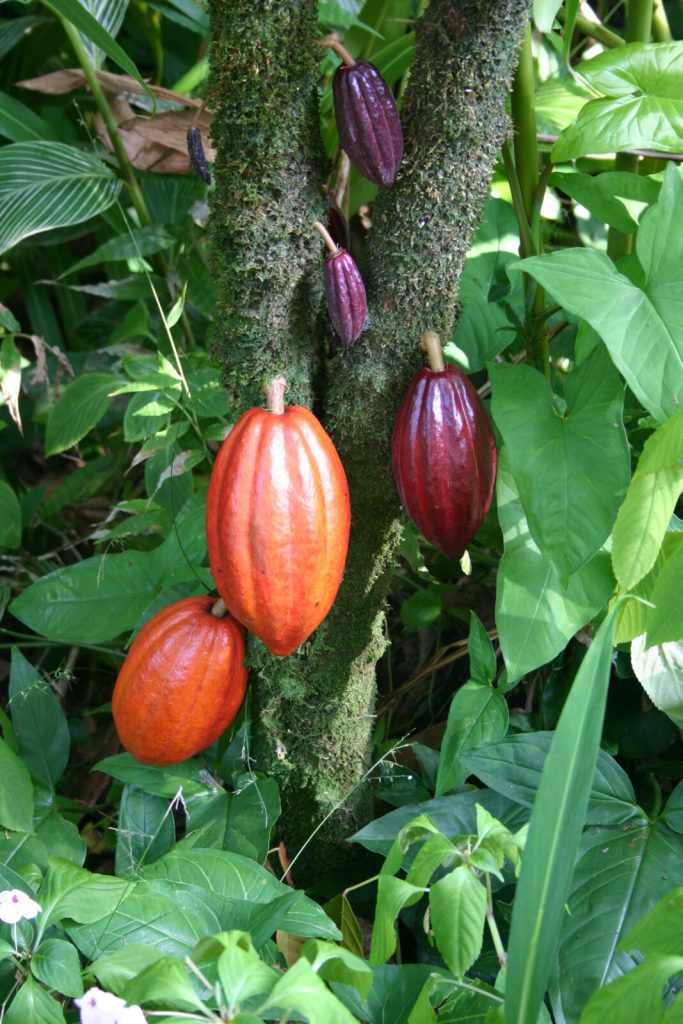
Cocoa seedling management begins with a choice, not a task: seed sown direct, a seedling raised in a nursery, a clone or a graft. Uganda's agriculture ministry recommends one of the four and advises against another, and the difference shows up as survival in the field. Everything after that, the bag, the soil, the shade and the water, is protection for a decision already made.
The decision deserves that weight because of what a cocoa tree is. You are planting something that should still be bearing in thirty years. A seedling that goes out small, etiolated or carrying disease does not catch up. It comes into bearing later, needs more looking after, and stretches the years before your first income.
Choosing Cocoa Planting Material: Seed, Seedlings, Clones or Grafts
The ministry's cocoa manual sets out four options and is unusually direct about them.
That position on clones and grafts is about infrastructure rather than skill. The technique is routine in Malaysia and Papua New Guinea, where budding is done onto seedlings as young as two weeks or onto stems of two to four months, and the finished clonal plant is ready for the field two to three months after juvenile budding or three to four after mature budding. What makes it possible is a certified budwood garden, and a budwood garden has to be planted two to three years before the clones are needed. Elsewhere in the world most cocoa is grown from seed produced in bi clonal seed gardens, hand pollinated so the hybrid is fully legitimate. In other words the quality of a cocoa seedling is decided in a seed garden you will never see.
Which leads to the question to ask when you buy. Not "how tall is it" but "where did the seed come from". The ministry recommends certified nursery operators without publishing a list of them, and no public register of certified cocoa nurseries could be found for this page. The district production office is where to ask, and it is worth asking before you order rather than after.
Why Cocoa Seed Cannot Be Stored
Cocoa seed is recalcitrant, which means it will not survive drying and cannot be held. The crop monograph literature is specific: there is no effective way of prolonging viability in storage beyond four to five weeks without the seed starting to germinate, and seeds inside an unopened pod stay viable for only three to four weeks after harvest, kept dormant by an inhibitor in the mucilage.
Malaysian plantation guidance confirms the same property from the other side. Cocoa seed in transit generates heat, and heat build up kills it, so bags of seed must be opened and spread out for airing and checking the moment they arrive rather than left in a store. If you order seed, somebody has to be there to receive it.
Two practical consequences. First, any instruction to store cocoa seed in a cool dry place is wrong, and the version that adds "in a wet cloth" contradicts itself in the same sentence. Second, seed and sowing have to be scheduled together. Work backwards: the field planting date, then the nursery period, then the day the pods are broken. There is no waiting stage in the middle. The general rules for judging seed quality mostly assume a seed you can store, and cocoa is the exception.
Siting a Cocoa Seedling Nursery
Four conditions, and one of them is the one people get wrong.
Well drained ground, so bags are not standing in water. Good top soil within reach, because you will move a great deal of it. Close to the plot you intend to plant, because seedlings travel badly. And close to reliable water, which is the condition that decides everything else, for a reason the numbers below make plain.
Add protection from animals and from theft, and keep the whole thing where you can walk past it daily. Lay out the area so there is space for the bags at their final spacing, plus paths, drains and a route wide enough to move seedlings out without stepping over them.
Filling Polybags: The Soil You Choose Decides the Disease
Use only good top soil, from roughly the top 75 mm, with a texture between sandy clay loam and clay loam. It has to drain, let roots through, and hold together when the bag comes off at transplanting. Heavy clay can be made workable with coarse river sand at about one part sand to four parts soil, mixed properly rather than folded over on top. Check pH and correct it to between 5.5 and 6.5 if it is too acidic. That guidance is Malaysian commercial plantation practice, and the texture and pH figures travel well because they describe the crop rather than the country.
Now the part that does not appear in most nursery guides. The Papua New Guinea smallholder handbook says to fill bags with black topsoil from bush, not too sandy, and not from cocoa groves with a lot of black pod infection. The reason is that the most serious disease of young plants in a cocoa nursery, seedling and shoot blight, is caused by Phytophthora palmivora, the same organism that causes black pod in the field. Uganda's own manual lists seedling blight among black pod's effects, which is the same fact arriving from the other end.
So a bucket of soil scraped from under a cocoa tree that has been dropping rotten pods is an inoculated growing medium. Take the soil from bush or from ground that has never carried cocoa, and the commonest nursery disease becomes much less likely before you have sown anything.
Practical sequence for the bags themselves: perforate the bottoms for drainage, fold the bottoms in so the bag stands upright, fill with a hopper if you have one, never fill when the soil is wet, and do not fill more than two or three weeks ahead of sowing. Let the soil settle before the seed goes in.
One more thing, and it is free. Space the bags out at their final spacing before you sow, not afterwards. Cocoa seedlings grow badly once they have been shifted, moving several hundred bags twice costs real labour, and a nursery left crowded produces etiolated seedlings that establish poorly and sometimes cannot stand up without support.
Sowing Cocoa Seed and What Germination Looks Like
Rub the mucilage off the wet beans first. Sawdust works and is what smallholders in Papua New Guinea use. Then sow on the side, about a centimetre deep, which is about one knuckle.
Shallow is the instruction and there is a reason for it. Cocoa germination is epigeal, meaning the cotyledons are pushed up above the soil rather than staying below it. Bury the seed and you are asking it to lift a load of soil with the two halves of the bean. Malaysian guidance puts it plainly: deep planting must be avoided, and you should not try to cover the seeds over as the cotyledons come up.
What follows is quick. Fresh seed germinates almost immediately, and the closed cotyledons appear above the soil within a week. A few weeks later the cotyledons open and expose the growing point. The first growth phase ends when the first four leaves harden and sit out horizontally at the same level. After that, new leaves come at roughly six week intervals, spaced in a spiral up the stem.
Counting leaf flushes is how you read a seedling's age without asking. Where non germination is expected to be high, seed can be pregerminated before it goes into bags, which is an option rather than a default.
Shade Over Cocoa Seedlings and When to Reduce It
Shade is adjusted rather than set. Malaysian plantation practice starts at about 80 percent shade at sowing and reduces it gradually to about 50 percent by the time seedlings go to the field, usually at five to seven months. Build the structure so it can be opened up, with palm fronds, shade netting or a plastic roof laid over a frame you can thin.
Read that alongside Uganda's field figures, because the two together show something a single schedule hides. The ministry puts young field cocoa, from planting to three years, at about 70 percent shade, and mature trees from four years onward at 30 to 40 percent. So the seedling comes down from 80 to about 50 in the nursery, then goes out into roughly 70 in the field, then works down again over years as the canopy closes. It is not one long ramp. The nursery reduction is there to toughen the plant for transport and transplanting, and the field shade goes back up because a young tree in the open dries out.
Which is why temporary shade in the garden has to be standing, or planted at the same time, before the seedlings arrive. Bananas at 6 metres by 6 metres or Gliricidia at 4 metres by 4 metres do the job in the field establishment stage. If you are building a shade structure from scratch, the principles in the nursery shade house guide apply to any tree seedling.
Watering Cocoa Seedlings Without Drowning Them
Watering is the largest recurring job in a polybag nursery and the easiest to get wrong in both directions. The Malaysian rate is half to three quarters of a litre per seedling, once a day, rising to twice a day in unusually long dry spells, with the medium moist at both the top and the bottom of the bag. A sprinkler system doing the equivalent of about 6 mm of rain a day covers it where one is available.
Over watering is the named risk, above all in the first two to three months, when a young cocoa seedling is extremely sensitive to waterlogged soil. So the instruction is not to keep the bags wet. It is to check the bag: dry at the bottom means increase, soggy means cut back. Water gently rather than with force, since a hard stream washes the medium out and knocks over seedlings that have just come up. After germination, morning and evening on days it has not rained.
Now convert the rate into work, because nobody does and it is the reason nurseries fail.
Nutrient requirements in the nursery are low and small balanced applications are enough. Rock phosphate mixed through the medium and calcium limestone to lift pH are what Malaysian practice uses. No rate is given here, and the guidance itself warns that the soil to fertilizer ratio has to be calibrated properly, because a nursery is a small volume of soil and it is easy to burn young roots. Ask your extension officer for a rate matched to your medium.
Nursery Diseases and Culling Weak Cocoa Seedlings
Seedling and shoot blight, caused by the black pod organism, is the one to expect. Reduce it by taking your potting soil from ground that has never carried infected cocoa, by keeping the bags spaced so air moves between them, by draining the nursery floor, and by removing sick plants from the nursery altogether rather than leaving them among the healthy ones.
Leaf eating beetles are the other common nursery problem, and damage tends to be worse along open edges and roadsides. Even moderate leaf loss sets a seedling back badly, because it is running on a small root system in a small volume of soil. A barrier of fronds or vegetation along the perimeter is the cheap control.
Malaysian nursery guidance also names a leaf disease and vascular streak dieback. Vascular streak dieback is a South East Asian disease and it is not on Uganda's list, so it is mentioned here only so you do not go looking for it.
Where a fungicide is genuinely needed, no rate appears on this page. The dilution, the interval and any handling restriction are on the product label and must be followed, the product has to be registered for use on the crop, and an extension officer or the district production office should confirm both before you mix anything. Cultural control comes first anyway, because the guidance that names the nursery blight also says the blight is less where the soil was clean. Learn to read what the label actually tells you before buying, and the fungicide explainer covers how the classes differ.
Culling is part of management, not an admission of failure. Runts, seedlings that grew crooked, seedlings that lost their leaves and seedlings that never hardened their first flush will not become good trees. That is what the 40 percent extra seed is for. Keep records as you go: where the seed came from, how many were sown, how many germinated, how many were culled, and how many are actually fit to plant. Those five numbers tell you next year whether the problem was the seed or the nursery, and the crop production record template gives you somewhere to put them.
Hardening Cocoa Seedlings Before Field Planting
A seedling that has lived under 80 percent shade and been watered daily will scorch if it goes straight into a garden. Hardening is the bridge, and it takes about two weeks. Open the nursery cover progressively so more sun reaches the leaves, and let the watering ease back toward what the plant will actually get outside.
Then the transplanting day itself, where Uganda's manual is worth following closely. Water heavily before you lift anything. Get the plant out of the polypot with the soil ball intact. Late afternoon is the right time and the start of the rains is the right week. The mistake that costs whole seedlings is soil heaped against the stem above the collar, which rots the collar and either kills the plant or stunts it for good. And if the seedlings travelled any distance, stand them upright in shade, watered, for a day before they go anywhere near a hole.
Readiness is a condition rather than a date. The crop literature puts seedlings at field size four to six months after sowing, at 40 to 50 cm tall, Papua New Guinean practice says about four months, and the Malaysian spacing table assumes five to seven. Uganda's manual sidesteps the calendar and gives the test instead: plant only well hardened seedlings with at least three pairs of leaves. If the plant does not meet that, the month does not matter.
How Many Cocoa Seedlings You Need Per Acre
Start from the spacing and work back. At 3 metres by 3 metres, an acre holds 450 planting points, which is the figure the ministry's own budgeting uses for both seedlings bought and holes dug. Add the roughly 40 percent allowance for non germination, culling and gap filling, and you need 630 seeds in bags.
Bag size follows the nursery period. A five to seven month nursery uses a bag around 25 cm by 40 cm at 0.3 metre spacing. Seedlings you intend to hold beyond seven months, to fill gaps later in the season, want a larger bag nearer 30 cm by 50 cm and wider spacing at 0.3 by 0.5 metres, because they keep growing while they wait.
Raise a few more than 630 if you can, and hold them. Gap filling in the first year is normal, the ministry budgets for it, and a replacement seedling out of your own nursery is worth more than one bought in a hurry in the middle of the rains.
Planting Out and the First Year in the Cocoa Garden
The garden has to be finished before the nursery is. Holes dug and backfilled, temporary shade standing, both ploughings done. Get that order wrong and the seedlings sit in their bags growing past the size they should go out at, which is the one outcome the whole nursery schedule exists to prevent. A seedling held two months too long is not a bonus. It is a plant with a root system pressing against plastic.
Watch the first year for two things. The plant should run up as one upright stem, and the side branches should not break out below about a metre and a half, because where that junction forms sets how you work the tree for the next thirty years. If it forms lower, pick a straight shoot and let it build a higher crown. Gaps will appear, which is what the spare seedlings are for, and filling them in the first season matters more than filling them neatly.
Everything past that point, the shade reduction schedule, the fertilizer, the pruning and the disease control, belongs to the garden rather than to the nursery, and it is set out on the cocoa farming page.
Questions About Raising Cocoa Seedlings
Can I just plant cocoa beans straight into the garden? You can, and the ministry records it as practised, but it advises against it because survival is low. You would also be planting into the shade, weed pressure and grazing risk of an open garden rather than a controlled bed, with no chance to cull the weak ones.
How long does a cocoa nursery take? Four to seven months depending on whose practice you follow, but treat that as a window rather than a target. The test is the plant: well hardened, with at least three pairs of leaves, around 40 to 50 cm tall.
What does it cost to raise seedlings for an acre? No reliable Ugandan price could be sourced for polybags, netting or nursery labour, so the honest answer is the quantity structure rather than a total: 630 bags, about 60 square metres of bag space before paths, one batch of top soil, a shade structure you can open up, and 16 to 24 jerrycans of water a day for five to seven months. Price those against local rates. For scale, the ministry's own four year budget for an acre assumes 1,000 shillings a seedling for 450 seedlings, which is a planning rate in a manual rather than a market survey.
Is it cheaper to raise my own seedlings than to buy them? Compare the two properly before deciding. Your own nursery saves the seedling price and the transport, and costs you the water carrying, the soil, the bags, the shade structure and five to seven months of daily attention. Buying from a certified operator costs more per plant and buys you known parentage, which is the thing you cannot check by looking.
Why does my potting soil matter so much? Because the commonest nursery disease and the commonest field disease are the same organism. Soil taken from under cocoa trees that have been dropping rotten pods can carry it into every bag you fill.
Should I space the bags out before or after sowing? Before. Cocoa seedlings grow poorly once they have been moved, and a crowded nursery produces tall weak plants that establish badly in the field.
How deep should cocoa seed be sown? About a centimetre, laid on its side. The two halves of the bean come up above the soil as it germinates, so it must not be buried or covered over afterwards.
Can I buy grafted cocoa seedlings in Uganda? The ministry's stated position is that clones and grafts remain at trial stage in research and have not been released to farmers. If they are offered, ask which budwood garden the material came from and what the rootstock is, because a clonal programme needs a certified budwood garden established two to three years in advance.
Where to Get Certified Cocoa Seedlings
The ministry's recommendation is a seedling raised from seed by a certified nursery operator, and it does not publish a list of them. No public register of certified cocoa nurseries could be found for this page, so the practical route is the district production office in a producing district, which is also where to confirm the current position on clonal material. Ask any nursery two questions before ordering: where the seed came from, and how long the seedlings have been in the bag.
From here, the cocoa farming guide covers the garden the seedlings are going into, and the harvesting and fermentation guide covers the week that eventually sets your price. If you are considering raising seedlings for sale rather than for your own acre, starting a seedling nursery treats it as a business, and the wider export crop guides let you compare cocoa with the alternatives on the same land.