
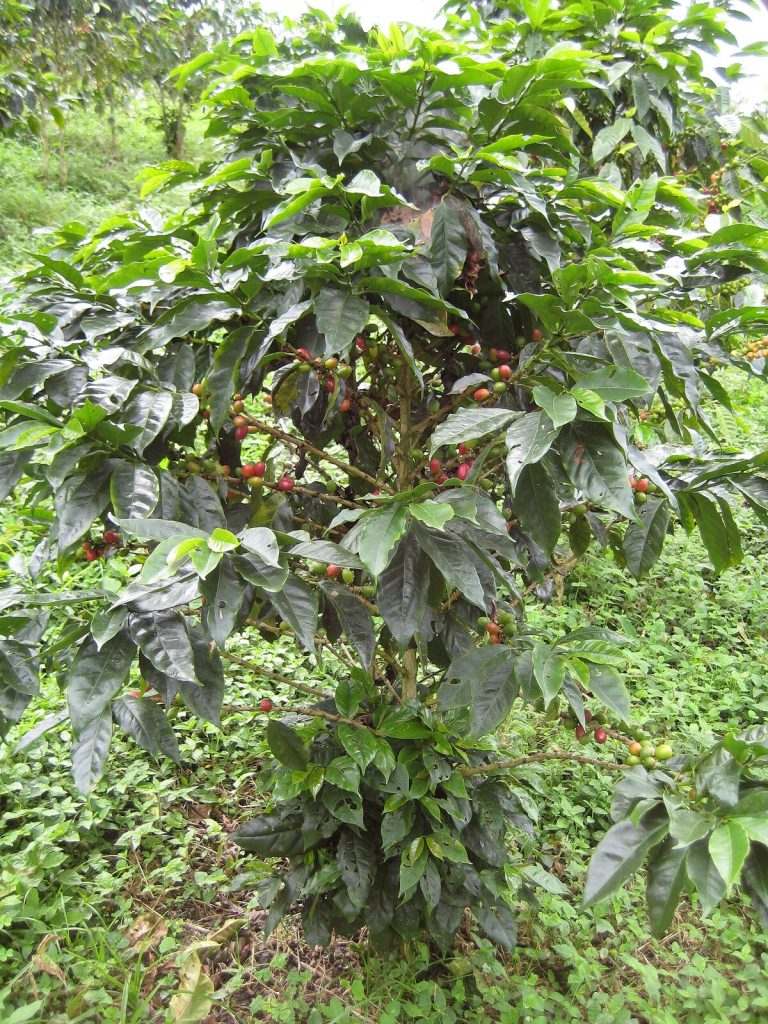
Pruning a coffee tree in Uganda is three separate jobs running on three different clocks: building the young plant into three stems in its first year, taking out spent wood after every main harvest, and cutting the whole bush back every six to seven years to renew it. Mix them up and a garden either never builds a frame or never gets renewed, which is why so many Ugandan coffee trees produce below their potential.
The renewal job is the one that decides how long the field lasts. Ugandan Robusta varieties are recorded as sustaining good yields for 40 to 50 years without replanting, and that lifespan is not a property of the tree. It is the result of cutting it back and regrowing it, repeatedly. A garden that has never been through a change of cycle is not a mature garden. It is an old one.
Most farms in the country are in that position. The national handbook states that the majority of Ugandan coffee farms are well over 50 years old and producing far below potential, which makes pruning and stumping the largest single yield opportunity available to an existing grower, ahead of anything they could plant. The main coffee growing guide sets out the rest of the crop, and the wider export crops section covers the other perennials that ask the same question of a grower.
Three Different Jobs on a Coffee Farm All Called Pruning
Keeping these separate is most of the skill, so it is worth naming them before going into any of them.
The handbooks also use pruning as a disease control measure in its own right, and that changes how you handle the cut material rather than the cut itself. Coffee wilt disease travels on a saw blade and in infected debris, so affected branches are pruned off and dealt with where the tree stands, never dragged through the garden, and tools are disinfected between trees. The disease has been recorded as destroying about 56 percent of Uganda's Robusta trees since it was detected in 1993, which is the reason that instruction is not optional.
Training and Capping Young Coffee Plants
Ugandan coffee is grown on a multiple stem system, preferably three stems, and the frame is built in the first year by one of two operations. Training means bending the young plant over and pegging it down so that dormant buds along the base break and throw suckers. Capping means cutting the growing tip off instead, which does the same job by removing the plant's leading shoot.
Bending runs like this. Bend the original seedling along the row in an east to west line, towards the sunset, and peg it down at about 45 degrees. Every plant in the field gets bent the same way, so the rows stay workable. Suckers then break at the base, and you select from as low down as possible, at about 15 cm above ground level, choosing shoots that are well positioned away from each other so they have room to grow into stems.
How many you keep depends on the mother stem. If the bent stem is still vigorous, keep it and select two suckers, for three stems in total. If it is weak, select three vigorous suckers and cut the mother stem out. The training manual puts the working range at two to four healthy suckers arising about half a foot to a foot from the base. Once the suckers are about 30 cm tall the peg comes out and the tip of the original stem turns upward again.
Capping is the alternative for anyone who would rather not peg a whole field. Newly planted coffee at four to six months old is capped by removing the tip at 15 to 30 cm above the ground, and the resulting multiple stems are selected the same way.
Timing is published three ways by three ministry sources, and they describe the same plant rather than three different ones.
| Source | Age | Height |
|---|---|---|
| Robusta handbook | 5 to 6 months | About 60 cm |
| Training manual | About 6 months | Not stated |
| Extension guidance | 6 to 9 months | About 45 cm |
| Capping variant | 4 to 6 months | Cut at 15 to 30 cm |
Read across the table and the instruction is to watch the plant. Somewhere between about 45 and 60 cm of height, which on a well fed seedling arrives between four and nine months after planting, the plant is ready. A field that grew slowly through a dry first season reaches that height later than a field that did not, and the calendar figures are describing a normal growth rate rather than setting a deadline.
Nipping Arabica Coffee Seedlings
Arabica is built the same way to the same three stems, but by a slightly different operation and on a tighter window. The handbook calls it nipping, and it is a capping cut rather than a bend: clip the tip off the growing seedling at 15 to 40 cm above the ground, which encourages two shoots to develop, and groom both as future bearing stems.
The window is narrow in two directions at once. Nipping is done between four and six months, and the handbook adds that it should happen before the seedling exceeds 30 to 40 cm. So on Arabica the height limit is a ceiling rather than a target, which is the opposite of how the Robusta instruction reads, and it is easy to miss on a fast growing highland seedling.
Bending is possible on Arabica and the handbook says it is not commonly practised. Anyone who does it chooses two suckers as near the ground as possible and grows them alongside the seedling stem, so the stump matures with three bearing stems.
One thing the Arabica handbook does not fully reconcile: the section states the system is a multiple stem one of preferably three stems, then describes nipping as producing two. The third stem has to come from selecting a low sucker, as in the bending method. If you nip and then keep only the two shoots, you have a two stem tree, which is inside the published range but at the bottom of it. The Arabica growing guide covers the rest of the highland crop.
How Many Stems to Keep on a Coffee Plant
Three is the published optimum and four the maximum. The reason given for the ceiling is simple competition: when a bush carries too many suckers it cannot feed them all, so each gets less and the whole tree produces less than a three stem bush would.
Stem count is also the lever the handbook names for surviving a severe drought. Where extreme dry spells threaten to dry the trees out, reducing the number of bearing stems per bush is recorded as a way of saving part of the expected crop rather than losing all of it, by cutting the demand the roots have to supply. That is a deliberate in season decision, not a scheduled pruning.
The number matters beyond the individual tree because it sets canopy density across the field. An acre of Robusta at about 450 trees carries roughly 1,350 bearing stems at three per bush, and an acre of Arabica at about 680 trees carries roughly 2,040. So a garden that looks correctly spaced on the ground can still be far denser inside the canopy than the plant count suggests, which is part of why de-suckering has to run through the year. Coffee spacing per acre works through the ground side of that arithmetic.
Annual Pruning After the Coffee Harvest
The published timing is the end of the main crop harvest, every year. That is deliberate: you prune when you have just seen which branches actually carried a crop and which did not, so the decisions are based on evidence from the season that has finished rather than on how the wood looks in the abstract.
What comes out, in the handbook's own terms: broken, dead, aged, diseased and pest damaged stems; any tree or branch that will not bear again or that produced only small cherries; suckers that are not well positioned; secondary and tertiary branches that are not healthy or vigorous enough to give a worthwhile crop; and the weaker, older lower primaries, keeping the vigorous upper ones. Branches close to the ground come out as a matter of course, because they are a route for pests and diseases to reach the tree from the soil.
The stated benefits are worth reading because they explain what you are aiming at rather than just what to cut. Pruning balances leaf area against crop, stops the tree spending nutrients on wood that will never bear, opens the canopy so more light gets in and more air moves through, lowers humidity inside the bush where fungal disease starts, improves tolerance of prolonged dry spells, gives a sprayer access to the canopy, reduces the dieback that follows overbearing, and keeps the tree short enough to pick. The handbook shows the result as visible on the tree six to nine months after the cut, in heavily bearing branches.
One economic point sits inside all of that: pruning reduces how much fertilizer and pesticide the tree needs, because you are no longer feeding and spraying wood that produces nothing. A pruned garden is a cheaper garden to maintain, which is the reverse of how pruning labour usually gets budgeted.
De-suckering Through the Growing Year
De-suckering is the removal of water shoots, the soft upright shoots that come off the laterals, verticals and tertiary branches. They are not future stems and the tree spends food and energy on them for nothing.
Cut them with secateurs while they are still young, tender and succulent. A shoot removed at that stage takes a moment and leaves a small wound; the same shoot left to harden becomes a saw job and a bigger cut. Frequency is not a fixed schedule: the handbook says several times during the year depending on the amount and distribution of rainfall, because suckers come with the rains. So the field tells you when, and a garden that has had a good wet season needs going over more often than one that has not.
The pest argument for de-suckering is the one that persuades most growers. Uncontrolled sucker growth closes the canopy and creates a humid microclimate inside the bush, and the regulator's own extension guidance names continuous de-suckering as the practice that prevents the conditions the black coffee twig borer favours. Pruning and de-suckering appear again in the handbooks as cultural controls for several other pests and for coffee leaf rust, all through the same mechanism of opening the canopy and cutting humidity. Coffee pest and disease control covers identification; no spray rate appears on this page.
Pruning Tools and Disinfecting Between Coffee Plants
Three tools cover everything: sharp secateurs for suckers and small wood, a pruning saw and a bow saw for stems. Keep them oiled, because disinfectants and tree sap both promote rust, and a blunt or rusty blade tears rather than cuts.
Tool hygiene is the part that carries real consequences, and the reason is named explicitly in the handbook: to avoid transferring live Fusarium spores from one tree to the next, which is coffee wilt disease moving through your garden on your own saw. Disinfect before starting, after finishing each tree and before moving to the next, and again at the end of the day's work.
Handle the cut material the same way. Prune infected branches where the tree stands rather than carrying them across the garden, because dragging diseased wood through the field spreads what you were trying to remove.
When a Coffee Plant Is Due for Stumping
Stumping cuts the elderly unproductive stems off a bush so the stump throws fresh vigorous shoots and the tree starts a new production cycle. The handbook gives four signs that a tree is due, and they are field observations rather than dates: the bearing heads have dropped to less than a metre, the tree produces less than 2 kg of cherries, the stems have grown too tall for pickers, and it is around ten years from planting.
The published ages themselves do not agree, and the spread is wide enough that you should trust the tree rather than the year.
The cut itself is specific. Take the stems off at about 15 cm, written as six inches or half a foot, on a 45 degree slant so rainwater runs off instead of standing on the cut and rotting the stump. The training manual's diagram shows the cut at a foot rather than six inches, so anywhere in that range is inside published guidance; what is not optional is the slant and a smooth cut, because a ragged horizontal cut holds water and invites mould.
Then leave one stem standing. That stem is called the breather or mother stem, and it keeps the stump alive and feeding while dormant buds open into suckers. Choose the most outward leaning stem, ideally the one pointing towards the sunset, and never one in the middle of the stump, so it can be taken out later without damaging the developed suckers. Strip its lower primary branches by cut lifting, an operation called skirt lifting, so it does not shade the suckers coming up beneath it.
Cutting every stem off with no breather is expressly not recommended, because the stump can dry out and the whole tree die. Where a bush has only one stem, the handbook's method is to cut it three quarters of the way through and bend it over, leaving it attached and feeding the stump until shoots sprout.
Three Ways to Schedule Stumping Across a Coffee Farm
Deciding how much of the garden goes at once is a cash flow decision more than an agronomic one, and the handbook sets out three patterns with the trade offs stated.
Phased. Divide the farm into blocks and work through them over one to four years depending on size. The worked example splits the garden in two around year seven of the stems, stumps half systematically, then stumps the second half once the first block starts bearing again. Labour is spread over years, which makes it affordable, and the farm keeps producing throughout.
Non phased. Stump the whole garden at once. The stand stays uniform, which makes everything afterwards simpler, and the cash flow when the suckers mature is large. The costs are equally plain: all the labour falls in one season, and the field is out of production with no coffee revenue for a year. The handbook's answer to that year is an annual intercrop, which also controls the weeds that come with a suddenly exposed soil surface.
Staggered. Cut only some non productive bushes at the end of each harvest season, picking a few at random across the garden and leaving the rest standing. It spreads labour and keeps revenue coming. It also carries the worst agronomic penalty of the three, and the handbook is blunt about it: the unstumped bushes over shade the stumped ones, so the new suckers etiolate, produce few bearing branches and yield poorly. Stems across the garden end up at every different age, which makes planning a fertilizer programme very difficult.
Choosing a Stumping Method for Your Coffee Crop
Separate from how you schedule it is how much you cut off each bush, and the handbook describes three types with a clear preference among them.
| Type | What is cut | Verdict |
|---|---|---|
| Single breather | All stems but one | Recommended |
| Multiple breather | One stem of three a year | Poor suckers |
| Full stumping | Every stem | Not recommended |
Single breather stumping cuts all stems but one, after seven or ten years, leaving one mother stem. That stem keeps the bush working through its full physiological cycle and produces some crop, so the revenue gap is narrowed rather than opened. It is removed after one to two years, once it has carried its main season crop and the induced suckers are mature enough to stand alone and already bearing. The handbook recommends this type outright, for two reasons: the suckers it produces are good quality and highly productive, and the risk of the stump drying out is minimal. It can be done across a whole garden at once by a farmer with other income, and the stumped field takes beans, groundnuts or peas, which bring in money, suppress the weeds that follow surface exposure and add nitrogen.
Multiple breather stumping takes one of three stems each year, so every bush permanently carries stems of different ages. The handbook lists three problems with it. Fertilizer planning becomes difficult because no two stems are at the same stage. The new shoots grow under heavy shade from the remaining stems, so they etiolate while stretching for light and develop very few bearing branches. And because they end up thin and tall, they bend and break in the wind.
Full stumping takes every stem, cut at 45 degrees around 15 cm above the soil. Its advantage is real: the suckers get full sunlight, so vegetative growth is intact and the future stems are highly productive. Its costs are the reason the handbook advises against it. The field is out of production for one or two years with no coffee revenue, and there is a high risk of stumps drying out during the gap before shoots re-develop, which loses the tree altogether rather than just the crop.
Managing a Stumped Coffee Crop Year by Year
The cut is the quick part. What follows is about eighteen months of sucker selection, and getting it wrong wastes the whole operation.
Start with the soil. Light tillage with a forked hoe, no deeper than 10 cm, rebalances the root system against the reduced top growth, stimulates new hair roots, breaks up years of compaction and opens the ground for a leguminous intercrop. Weed the block properly before cutting the mature stems, so the suckers get a clear run before any weeding disturbance.
Add those together and the six to seven year cycle makes sense: roughly two years building the new stems, about two more to full maturity, then about three productive years before the next cut. That is also why the staggered method damages suckers so badly. A sucker needs light for its first year, and a neighbouring unstumped bush denies it exactly when it matters.
When to Replant Old Coffee Instead of Stumping
Stumping and replanting are different operations with different names in the handbooks. Rehabilitation is pruning or stumping to rejuvenate what is there. Renovation is uprooting the old trees completely and replanting the field with new, higher yielding or disease tolerant material, usually introducing shade trees at the same time.
The age threshold given is 40 years. Trees younger than that typically do not need replanting and can be taken through several more cycles by stumping. At 40 years and above, trees produce fewer and smaller berries and the handbook says rehabilitating them is no longer economic, so fresh planting is the better use of the ground.
Three other situations call for replanting regardless of age. Where pests or disease have damaged the trees irreversibly, there is nothing left to rejuvenate. Where a superior variety has become available and the extra yield justifies the investment and its risk, replanting buys something stumping cannot. And where climate projections suggest the existing variety will no longer suit the site even under good management, replanting with a more tolerant variety is the adjustment available. The handbook also notes that a mixed answer is often right, renovating the parts of a plot that are past saving while rehabilitating the rest.
Before uprooting anything, check the age question honestly, because the handbook's own framing cuts both ways. Most Ugandan coffee farms are over 50 years old, which sounds like a case for wholesale replanting. But those trees have usually never been through a proper change of cycle, so the low yield is at least partly a management history rather than an age limit. A first stumping on a neglected 40 year old garden is far cheaper than a replant and tells you within two years how much the trees still have in them. Seedling sourcing and the fertilizer programme matter either way, because a renewed stump and a new seedling both need feeding.
Pruning Questions From Coffee Farmers
Before a first stumping, get a district extension officer or an experienced local grower to walk the garden with you and cut the first few trees alongside you, which is the handbook's own advice for anyone doing it for the first time. Then get current local quotations for pruning and stumping labour, since day rates differ by district and by season, and have secateurs, a bow saw and something to disinfect them with on hand before the first cut.