
Boreholes for agricultural irrigation in Uganda are permit controlled, expensive and, uncomfortably, speculative. The spending order cannot be rearranged: you pay for the survey, the drilling and the casing before anybody on earth can tell you how much water the hole will give. A farmer can do everything right and still end up with a hole too weak to irrigate. That risk is the first thing to understand, ahead of any technique.
What a Production Borehole for Irrigation Is, and How It Differs From a Hand Pump Borehole
The hole in the ground looks similar. Everything about how it is treated is not.
A domestic hand pump borehole serves a household or a village. It lifts modest volumes, a few hundred litres an hour is plenty, and the hand pump on top sets a natural ceiling on how hard the aquifer is worked. A production borehole for irrigation carries a motorised submersible pump and is asked to deliver tens of cubic metres a day, every day, through the dry months, which is precisely when the water table is at its lowest and every other hole nearby is also being pumped.
That difference matters legally, not just physically. In Uganda, the trigger for a groundwater abstraction permit is the use of a motorised pump to take water from a borehole, well or spring. A hand pump does not trip it. An irrigation borehole trips it by definition, because there is no such thing as an irrigation borehole without a motorised pump on it. So the moment you move from domestic supply to irrigation, you move from outside the permit system to inside it.
It matters hydrogeologically too. A hole that supplies a family perfectly well for decades may be nowhere near strong enough to water an acre, and finding that out is what test pumping is for. The two uses are not points on the same scale. They are different demands, and a hole that passes one can fail the other badly.
Borehole Permits in Uganda: What the Law Requires Before You Drill
Groundwater in Uganda sits under the Water Act, Cap. 152, and the Water Resources Regulations of 1998. The regulating authority is the Ministry of Water and Environment, whose water resources regulation arm is widely referred to as the Directorate of Water Resources Management, or DWRM. It issues permits for groundwater abstraction, surface water abstraction, borehole drilling, construction of hydraulic works, waste water discharge, easements and dam safety, and it licenses the drilling companies themselves.
| Instrument | What triggers it | Who holds it |
|---|---|---|
| Drilling permit | Being in the business of drilling boreholes | The drilling contractor, annually |
| Groundwater abstraction permit | Taking water with a motorised pump | The water user |
| Construction permit | Hydraulic works | Not confirmed for farm boreholes |
| Surface water abstraction permit | Motorised pumping, or impounding over 400 cubic metres a day | The water user |
Two practical points follow from that table. First, the drilling permit is the contractor's instrument, not yours. The Ministry licenses borehole drilling companies and requires them to hold a valid annual drilling permit before they start work, so asking a prospective driller to show you theirs is both reasonable and the cheapest piece of due diligence available to you. Second, the abstraction permit is yours, and the application is not a formality you can file in advance. It calls for a borehole completion report with the pumping test data, a certificate of water quality analysis and a siting report. You cannot produce any of those before the hole exists. That fixes the sequence for you: survey, drill, test the hole, test the water, then apply.
The Ministry states that permit processing runs within 90 days of receiving a complete application with all required attachments, and it publishes processing fees for each permit class. Build that waiting period into your planting plan rather than discovering it.
Now the honest limits of what is written above. The Water Act does give a general right to use water without a permit, for domestic use, for fighting fire and for irrigating a subsistence garden, where an occupier or resident has a natural source of water on their land. How that right interacts with the motorised pump trigger on a drilled borehole used for commercial growing is a question I could not find resolved in the Ministry's published material, and it is not one a website should answer for you. If your plan sits anywhere near that line, put it to the regulator in writing and keep the reply.
Two further gaps worth naming rather than papering over. The operative regulation numbers behind the groundwater trigger sit in Part IV of the 1998 Regulations, but the copies published on government sites are scanned documents that could not be read, so no regulation number is quoted here. And while a hydrogeological survey is sometimes described as a standalone legal requirement before drilling, what can be confirmed is narrower and almost as binding in practice: a siting report is among the documents the abstraction permit application requires, which makes skipping the survey a problem you meet later even if it were not a problem at the outset. Ask the regulator or a licensed hydrogeologist to confirm the current position for your district before you commit money.
Siting a Farm Borehole and Why the Hydrogeological Survey Is Worth Paying For
A hydrogeological survey reads the ground before the rig arrives. The surveyor works over the site with resistivity or magnetic instruments, reads the geology and soil structure, looks for fractures and weathered zones that hold and transmit water, and recommends a drilling point and a target depth. Most of Uganda sits on basement complex rock, where groundwater is not in a continuous sheet but in the weathered regolith above the bedrock and in fractures within it. Move a hundred metres and you can miss the fracture entirely.
That is the whole argument for paying for the survey. You are not buying a guarantee, because nobody can sell one. You are buying a shift in the odds on the largest unrecoverable payment in the project. Drilling on a guess, or worse on where it happens to be convenient for the rig to park, is how farms end up with dry or feeble holes.
Choose a survey by the report, not the price. A useful report names the target depth, the expected water strike zones, the geology it is predicting and what it is uncertain about. A report that gives a single coordinate and a confident number with no reasoning behind it has told you nothing you can check. And if the survey concludes the site is poor, take the answer. Paying for a survey and then drilling somewhere else because the recommended spot is awkward wastes both payments.
Drilling and Casing a Borehole on Ugandan Farmland
Drilling method follows the ground. Air drilling suits hard rock and drier formations, which covers much of Uganda's basement terrain. Mud drilling suits loose soils and places where the water table is high. A competent driller chooses on the geology, not on what is on the truck.
Boreholes in Uganda's basement complex commonly run 45 m to 70 m deep, with the water table typically 5 m to 20 m below ground and occasionally down to 45 m. In alluvial ground, where old river channels are the target, holes may go to around 60 m. Those are typical figures rather than promises, and your survey should give a site specific target.
Casing holds the hole open and keeps the wrong water out. uPVC and steel are the two families. There is a Ugandan detail worth knowing here: groundwater in the basement complex tends to be neutral to slightly acidic, and slightly acidic water corrodes ferrous casing over time. Where the water test comes back on the acidic side, that is a live argument for a casing material that will not rust away, and it is the kind of thing decided at installation or not at all.
Screening and development matter as much as the drilling. The screen has to sit against the water bearing zone the survey identified, and the hole has to be developed, meaning flushed and surged until it runs clear, before it is tested. A hole tested before it is properly developed gives a pessimistic yield. A hole never developed at all keeps pumping fines into your pump and your dripline for years.
Test Pumping and the Safe Yield Your Irrigation Can Rely On
Test pumping is the only honest answer to "how much water is in there", and it is the step most likely to be skimped when a budget has already been blown.
The work runs in phases. A step drawdown test pumps at increasing rates and watches how far the water level falls at each step. A constant rate test then holds one rate for an extended period and tracks the drawdown, which is what reveals whether the hole is being drained faster than the aquifer can refill it. A recovery test stops the pump and measures how quickly the level climbs back, which says a great deal about the aquifer's ability to resupply.
Out of that comes a safe yield: the rate the borehole can deliver over the long run without being drawn down beyond what recovers. This is the number your irrigation system gets designed around, and it is almost always lower than the rate the hole will give for an hour. That gap is where people go wrong. A driller who reports a brief peak rate and calls it the yield has handed you a figure that will fail you in the third dry month, when the water table is already low and the neighbours are pumping too.
Get the test results in writing, with the pumping rates, the drawdown readings and the recovery data. You need them for the abstraction permit application in any case, and they are the basis for every downstream decision about pump size and storage.
Ugandan Borehole Yields Against What One Acre of Irrigation Needs
| Aquifer setting | Typical borehole yield | Typical depth |
|---|---|---|
| Basement complex, weathered and fractured | 0.5 to 12 cubic metres per hour | 45 m to 70 m |
| Fissured granite and gneiss | Upper end of that range | 45 m to 70 m |
| Unconsolidated alluvial and river channel | Over 50 cubic metres per hour possible | To about 60 m |
| Volcanic and metasedimentary rocks | Very little known, few holes drilled | Not established |
Now set those against demand. Crop water use is quoted as a depth, and spreading that depth across the 4,047 square metres in an acre is what converts it into the volume a borehole has to find. Taking an illustrative dry season figure of 4 mm to 6 mm a day, that acre wants roughly 15 to 25 cubic metres of water a day. Your own crop, its growth stage and your local weather move that figure, which is why it comes out of the irrigation water requirement calculation rather than off a chart.
When the Yield Is Too Low to Irrigate, and the Money Is Already Spent
This is the outcome nobody selling a borehole discusses, and it is common enough to plan for. The hole found water. It is not dry. It simply will not give enough to irrigate, and the survey, the mobilisation, the drilling and the casing are all paid for.
What can be done is limited and worth knowing in advance. A low yielding hole can sometimes still earn its keep by pumping continuously into storage: at 1 cubic metre an hour over twenty hours you bank 20 cubic metres, which is roughly an acre's daily need, and the tank does the work the borehole cannot do on demand. That turns a weak hole into a usable one, at the cost of a much larger tank and a pump matched to a low continuous rate rather than a high intermittent one.
Where that is not enough, the realistic options are to reduce the irrigated area to what the hole supports, to switch to a crop with lower water demand or a shorter dry season exposure, to combine the borehole with harvested rainwater so the two together carry the acre, or to accept the hole as a domestic and livestock supply and abandon the irrigation plan. Whether deepening or rehabilitating the hole would help is a question for a hydrogeologist with the test data in front of them, not something to assume.
The planning lesson is blunt. Do not commit to a cropping plan, a market contract or a loan repayment schedule that only works if the borehole comes in strong. Decide in advance what you will do if it comes in weak, and make sure that version of the plan still leaves you solvent.
Water Quality: Iron, Salinity and What They Do to Drip Irrigation and Soil
A borehole can deliver plenty of water that is poor for irrigation, and the two commonest Ugandan problems both hit drip systems harder than any other method.
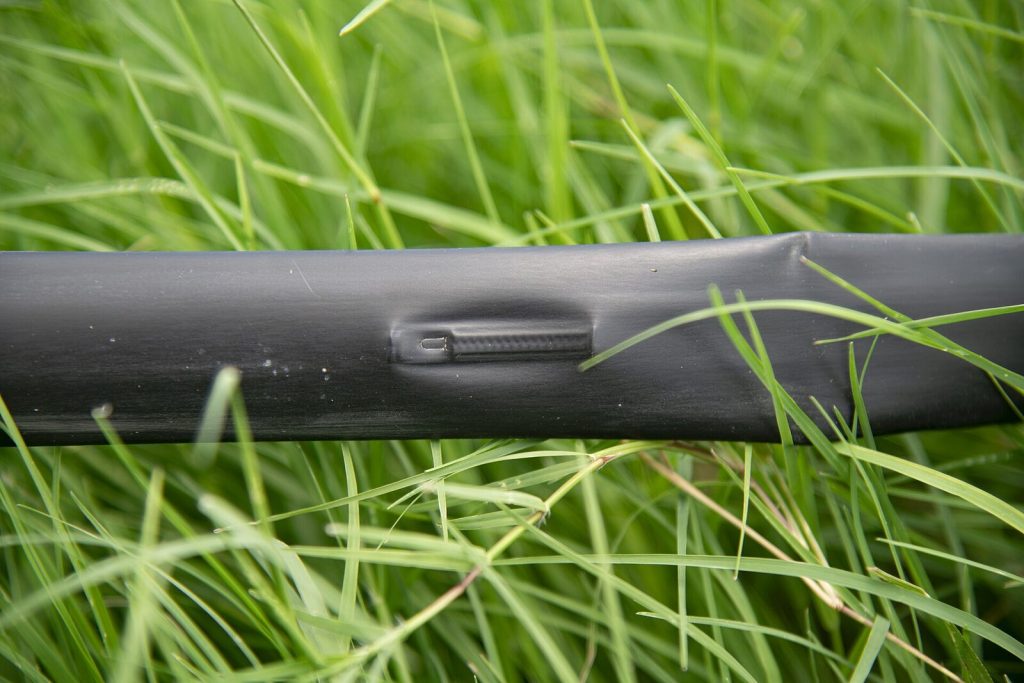
Iron is the first. Raised iron and manganese readings are common in Ugandan groundwater drawn through alumina enriched laterite. Iron comes up dissolved and invisible, then meets air inside your system and oxidises into a rusty precipitate. Iron bacteria feed on it and add a slime that binds the particles together, and the result plugs emitters from the inside. A drip system is the worst possible destination for iron rich water, because the flow paths are the narrowest in irrigation and the blockage builds where you cannot see it. The treatment is aeration and settling before the water enters the system, plus filtration and a flushing routine, and the water test result is what tells you how much of that you need.
Salinity is the second, and it damages the soil rather than the hardware. Water with a high dissolved salt load leaves those salts behind as the crop transpires. Under flood irrigation, surplus water carries some of them down out of the root zone. Under drip it does not, because drip applies close to what the plant uses and nothing extra goes through to leach. So salts concentrate at the edge of the wetted bulb, season after season, and yields drop on ground that looks perfectly healthy. Ugandan basement groundwater is usually moderate on dissolved solids, typically around 500 milligrams per litre, and alluvial groundwater usually under a thousand, but usually is not always and a laboratory result is the only way to know your own.
Test for the household too. High fluoride turns up in groundwater from igneous rocks in parts of Uganda, with Kisoro and Mbale among the areas where it has been observed. That is a drinking water question rather than an irrigation one, and it matters if the same hole will serve the home.
Do the full analysis once, properly, before you buy distribution equipment. You need the certificate for the abstraction permit anyway, and the result may change what filtration you install, what casing you would have chosen and whether drip is the right method at all. How drip irrigation works explains why the emitter is the vulnerable part.
Matching the Pump and Storage to a Borehole on a Farm
A borehole needs a submersible pump. This is physics, not preference: a surface pump relies on atmospheric pressure to push water up its suction pipe, which caps it at around six metres of lift on Ugandan land, and a borehole water level sits far below that. The pump goes down the hole and pushes. Sizing it against the tested safe yield and the total head, rather than against the hole's peak rate, is the whole job, and matching a pump to flow and head covers how.
Two protections belong on any borehole pump. A low water cutout, because a submersible that runs dry burns out quickly, since the water it moves is also what cools it. And a pump set to the tested safe rate rather than the maximum the hole will briefly give, because over pumping draws the level down onto the pump and damages both the hole and the machine.
Storage is not optional on a borehole system. A tank lets a modest hole pump steadily through the day and lets you irrigate at the rate the crop wants, which decouples the aquifer's pace from the field's. It is doubly necessary with solar pumping, which delivers only while the sun is up. Sizing farm water storage and solar water pumps for farms both feed into this decision.
Borehole Alternatives Worth Costing First on a Ugandan Farm
A page about boreholes that never suggests skipping one is a sales page. Price these before you drill, because any of them may carry your acre for a fraction of the exposure.
Surface water is the obvious first check. A stream, swamp edge, pond or river within reach and less than about six metres below your pump position needs no hole at all, and the whole permit and yield gamble disappears in favour of a surface water abstraction permit and a pump on the bank.
A hand dug and lined well reaches shallow groundwater at a small fraction of a drilled borehole's cost. It yields less and is more vulnerable in a long dry spell, but you find out what it gives far earlier and for far less.
Harvested rainwater from roofs into tanks is the cheapest water on any Ugandan farm and it pairs well with a weak borehole, since the two fill the same storage. A farm reservoir or excavated pond stores wet season runoff for dry season use and costs a great deal less than drilling, at the price of evaporation losses and land taken out of production.
And there is the option of irrigating less. Reducing the irrigated area to what a cheap source supports, and doing it well, usually beats borrowing against a hole that has not been drilled. The wider picture sits on irrigation farming in Uganda and the irrigation and greenhouse guides hub.
Boreholes for Agricultural Irrigation: Questions Farmers Ask
What does drilling a borehole cost in Uganda? A complete hole with siting survey, drilling, casing, test pumping and headworks has been running roughly UGX 20,000,000 to UGX 50,000,000, with depth, geology, access and how much equipment is included doing most of the moving. The hydrogeological survey on its own is around UGX 1,000,000, which is the cheapest insurance in the whole project. A complete installation equipped for solar pumping runs a great deal higher, into the tens of millions on top. Treat all of these as brackets to get quotes against rather than figures to budget from, and see irrigation system cost per acre for how the hole sits in the whole system.
What do the permits cost, and how long do they take? The Ministry of Water and Environment publishes processing fees by permit class, with groundwater abstraction in the region of UGX 450,000 and the drilling and construction permits around UGX 500,000 each, and a lower renewal fee for abstraction. Processing runs within 90 days of a complete application. Fees are revised from time to time, so confirm the current schedule with the Ministry rather than relying on any published figure, including this one.
Do I really need a permit to irrigate from my own borehole on my own land? Taking groundwater with a motorised pump is what triggers the abstraction permit, and an irrigation borehole always has a motorised pump. The Water Act separately allows use without a permit for domestic purposes, fighting fire and irrigating a subsistence garden from a natural source on your land, and how far that stretches to a drilled and motorised hole used commercially is not something I could find settled in the Ministry's published material. Ask the regulator and keep the answer in writing.
Can the driller handle the permits for me? The drilling permit is the contractor's own annual licence, so that part is theirs by definition and you should ask to see it. The abstraction permit is yours, and it needs the completion report, the test pumping data, the water quality certificate and the siting report, which all come from the work the contractor does. A good contractor supplies those documents as a matter of course. Ask before you sign, because chasing a completion report after final payment is a poor position to be in.
How likely is it that my borehole will fail? Nobody can give you an honest Ugandan percentage, and anybody who quotes one confidently is selling something. What is clear is the direction: drilling without a hydrogeological survey raises the chance of a dry or weak hole, and the range of yields recorded in the rock that underlies most of Uganda is wide enough that a poor result is a normal outcome rather than bad luck. Plan for it.
How long does the whole process take? Longer than most farmers allow. The survey, scheduling a rig, drilling, development, test pumping, laboratory analysis and then up to 90 days of permit processing do not compress well, and rigs are harder to book near the start of a dry season when everybody wants one. Start the season before you intend to irrigate.
Can I share a borehole with neighbours to split the cost? It works, and it changes the sizing question, because the yield now has to carry several fields and peak demand arrives on everyone's hot week at once. Settle in advance, in writing, who pumps when, who pays for fuel or electricity, who maintains the pump and what happens when the yield turns out to be lower than hoped. Shared boreholes fail on the agreement far more often than on the hydrogeology.
Is the water safe for the crops I want to grow? That is a laboratory question and the answer changes what you install. Iron is the common Ugandan problem for drip systems, salinity the common problem for soil, and neither is visible in a glass of water. Get the full analysis before you buy distribution equipment, not after.
Should I drill before or after buying the irrigation equipment? Before, always. The tested safe yield determines the pump, the tank size, the pipe diameter and how many acres you can actually plant. Buying a system first and then hoping the hole matches it is the most expensive way to run this project.
Before committing to a borehole, get the local groundwater picture from a licensed hydrogeologist, ask two or three drilling contractors to quote against the same survey report and to show their current annual drilling permit, and confirm the permit requirements and current fees with the Ministry of Water and Environment for your district. Costing the cheaper water sources in parallel is worth the effort, and irrigation equipment suppliers can quote the pump and distribution side once the tested yield is in your hand rather than before.