
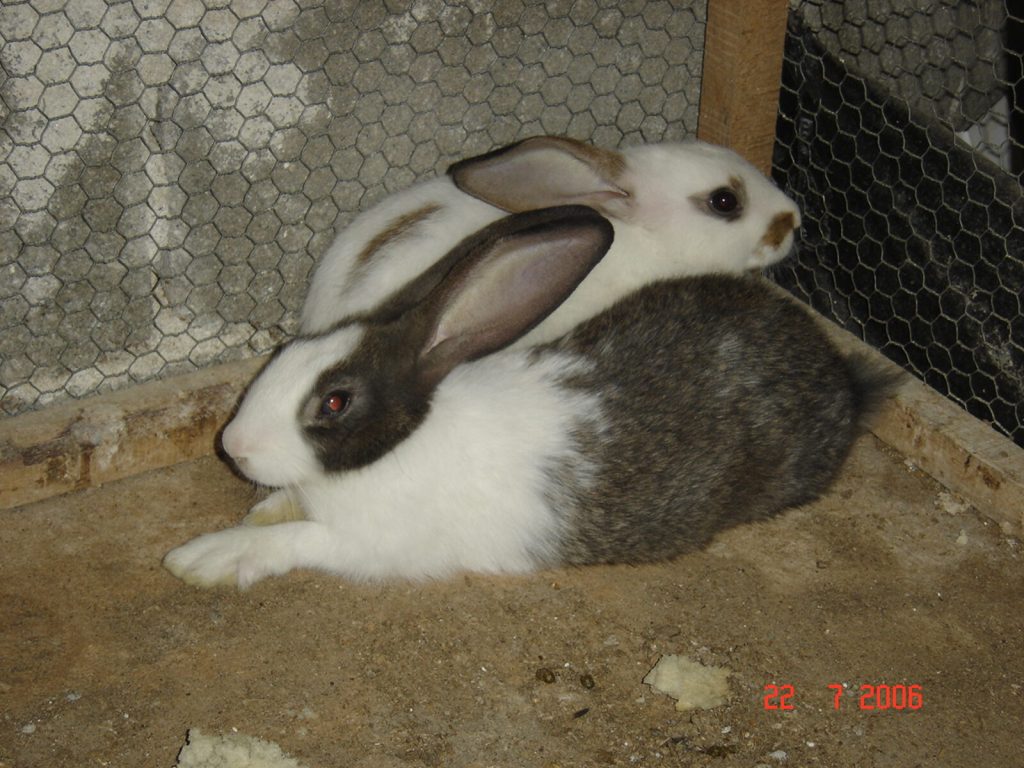
The best rabbit breeds for meat are New Zealand White and Californian, and in tropical trials the advantage they hold over a local rabbit is smaller than the sales talk suggests. Breed sets adult size, and adult size sets the weight you sell at. Almost everything else about how many rabbits reach that weight is decided by housing, heat and hygiene rather than by the animal's name.
What a Rabbit Breed Actually Is in Uganda
Uganda's national genetics centre lists the rabbit types available in the country as local rabbits, crosses of local rabbits, and imported ones including New Zealand White, California White, Chinchilla, Flemish Giant, a local population associated with Kabale, and a Kenyan white. That list is the closest thing to an official Ugandan rabbit breed register, and it is worth reading for what it does not contain: no performance figure for any of them.
Two facts change how you should read the word local. First, Uganda's only native lagomorph is a wild hare, sometimes called the Bunyoro rabbit. It is not the farmed animal and it does not interbreed with it. Every farmed rabbit in the country descends from the European rabbit brought in during the early 1900s. Second, genetic work on domesticated rabbits in neighbouring Kenya put it beyond doubt. A study of 111 rabbits sampled across eight counties in western, central and eastern Kenya, sequencing a short stretch of mitochondrial DNA, found only five distinct haplotypes and low diversity on both the measures used. The Kenyan population clustered with European rabbits, and the authors concluded a European origin, with repeated introduction of exotic breeding stock as a likely reason the diversity is so narrow.
So a local East African rabbit is a naturalised European rabbit whose ancestors were imported and then crossed repeatedly. It is a population, not a breed in the sense a pedigree society would use, and calling it indigenous overstates the case. That matters commercially, because it means the gap between a local doe and an imported one is a gap in selection history rather than in species, and selection history can be rebuilt on your own farm.
The Breed Effect, Measured in Tropical Rabbit Farming
The useful evidence is not a breed brochure. It is the small body of work that recorded several breeds side by side in hot climates, and the largest of those datasets found less breed difference than expected.
In Guadeloupe rabbitries, performance was recorded for three genetic types across a total of 2,528 does. New Zealand White does produced 7.44 total births, 6.71 live and 5.14 weaned per litter, at a 80 per cent pregnancy rate. The local Creole type produced 6.55 total, 6.21 live and 4.42 weaned, at 71 per cent. A large mixed group of other types sat between them. The source reports the breed effect as not statistically reliable on the litter size measures and reliable only on the number weaned, and the Creole group numbered just 78 does against 291 New Zealand White, so that comparison is thin.
Look instead at the mortality columns, which is where the real story is. Total mortality from birth to weaning ran 31 per cent for New Zealand White, 32 per cent for Creole and 38 per cent for the mixed group, with the whole herd averaging 37 per cent. New Zealand White actually lost more kits at birth, 10 per cent against Creole's 5, and made the difference back afterwards. Whichever breed you pick in a tropical rabbitry, roughly a third of the kits born will not reach weaning, and no breed on that list escaped it.
Why the Breed Ranking Flips Between Farms
Three separate tropical datasets rank the same breeds in three different orders, and that is the most instructive thing in the literature.
| Breed | Live births | Weaned | Setting |
|---|---|---|---|
| New Zealand White | 6.71 | 5.14 | Guadeloupe |
| Creole, local | 6.21 | 4.42 | Guadeloupe |
| New Zealand | 8.0 | 6.5 | Mexico, 1,800 m |
| Chinchilla | 8.1 | 6.0 | Mexico, 1,800 m |
| Californian | 7.2 | 5.8 | Mexico, 1,800 m |
| Rex | 6.3 | 5.1 | Mexico, 1,800 m |
| Semi giant White | 8.2 | Not given | Cuba, wet tropics |
| New Zealand White | 6.2 | Not given | Cuba, wet tropics |
In the wet Cuban trial New Zealand White came last of four on live births. At the Mexican breeding centre, which sits in a tropical zone tempered by 1,800 metres of altitude, it came top on weaned kits while Chinchilla beat it on litter size. In Guadeloupe it beat the local type. The animals carry the same names in all three places.
The reference work that publishes these tables supplies a straightforward explanation. New Zealand White and Californian rabbits are used by many researchers but they are very different strains, most authors do not specify where their animals came from, and these various populations of white rabbits may share nothing but the colour. A white rabbit sold to you as a New Zealand White in Uganda is a white rabbit. Whether it also carries the growth genetics the name implies depends entirely on the line it came from, and nobody in the chain is obliged to know.
The Cuban trial also recorded a stillbirth rate of 11.6 per cent, which its authors attributed to rearing conditions in that particular rabbitry rather than to the breeds. Altitude looks like the variable separating the Mexican results from the Cuban ones, which is directly relevant here: the Ugandan highlands around Kabale sit near 1,900 metres and are considerably cooler than the Lake Victoria basin. The same breed will perform differently in Kabale and in Kampala, and neither result tells you much about the other.
Adult Weight Decides Your Selling Weight, and the Breed Decides Adult Weight
This is the one mechanism where breed choice genuinely and predictably changes your income, and most breed guides skip it.
Rabbit tissue grows in a fixed order. Skeleton develops fastest up to about 900 g liveweight. Muscle then gains weight quickly up to roughly 2.3 to 2.6 kg, at which point the muscle growth curve falls away sharply. Fat begins accumulating fast after about 2.1 kg. The rule published from this is to slaughter at 50 to 60 per cent of the normal adult weight for that breed or population, because that is where carcass composition and feed efficiency are both at their best.
Work that rule through and the breed decision turns concrete. A medium breed maturing around 3.4 kg should be sold near 1.7 to 2.0 kg. The roughly 2 kg market rabbit recorded in Kampala decades ago was, on this rule, close to the right slaughter point for a medium breed, although it was reached under commercial pressure rather than by design. A giant breed maturing at twice that weight has a target slaughter weight twice as high, and every extra week of growth is a week of feed, a week of heat stress and a week of exposure to coccidiosis.
New Zealand White and Californian: the Two Breeds With Tropical Numbers
These are the breeds the global meat rabbit industry was built on, and they carry more tropical data than anything else on the list, which is a genuine reason to prefer them, mixed as that data is.
At the Mexican breeding centre, New Zealand does averaged 8.5 total births, 8.0 live and 6.5 weaned per litter, first mated at about 144 days and 3.49 kg, across 3,723 litters from 600 does. That is the largest tropical New Zealand dataset available and it is a good performance. Californian does at the same centre averaged 8.0 total, 7.2 live and 5.8 weaned, first mated at 140 days and 3.50 kg, across 1,090 litters from 200 does. The two mature at practically the same weight, so their slaughter weights and cycle lengths are interchangeable.
Against that, New Zealand White came bottom of the Cuban four. So the honest statement is that both breeds perform respectably in altitude tempered tropical conditions and that at least one lowland wet tropical trial found no advantage. If you can source either from a keeper whose own records show what the line does in your climate, that record is worth more than the breed name.
Chinchilla and Rex: Smaller Breeds and the Fur Income Claim
Chinchilla did well in the Mexican data, with 8.7 total births and 8.1 live, the highest litter size of the four breeds there, though it weaned 6.0 against New Zealand's 6.5. It also reached first mating earliest, at 132 days, at a slightly lower weight of 3.39 kg. In the Cuban trial it sat mid table. On the numbers it is a reasonable meat rabbit and dismissing it as a fur breed is a mistake.
Rex was the weakest of the Mexican four on every reproductive measure: 6.8 total births, 6.3 live, 5.1 weaned, first mated latest at 153 days and lightest at 3.02 kg. A lower adult weight means a lower slaughter weight, which means fewer kilogrammes per rabbit sold even before the smaller litters are counted.
Both are promoted in Uganda partly on pelt value, and this page will not price that. No verifiable Ugandan buyer, price or grading standard for rabbit pelts could be established, and a pelt income line that cannot be checked is the kind of claim that circulates between promotional pages until it looks like a fact. Treat fur as a possible bonus you have confirmed with an actual buyer, never as part of the reason to choose a breed.
The Flemish Giant Trap on a Ugandan Farm
Flemish Giant appears on Uganda's national list and it is the breed most often bought for the wrong reason, which is that a bigger rabbit looks like more meat.
Three things work against it on a smallholding here. The slaughter weight rule pushes a giant breed's selling weight far higher, so the animal eats for considerably longer before it is worth selling, and every additional week in a Ugandan hutch is a week at temperatures that suppress feed intake. Giant breeds also historically struggled on the mesh floors that keep rabbits out of their own droppings, because the pads of their feet are less suited to it, and mesh floors are the main defence against coccidiosis. Third, the reference literature notes that giant populations reported from India and Egypt cannot even be confirmed as giant breeds without knowing their adult size, which tells you how loosely the giant label travels.
There is a legitimate use for a large breed, which is crossing a large buck onto medium does to add growth to the offspring while keeping the doe's feed cost and litter size. That is a deliberate crossbreeding decision with a plan behind it. Buying a pair of giants because they look like more meat on the hoof is not.
Local and Kabale Rabbits: What the Herd Already Has
Uganda's genetics centre states that part of its rabbit programme's purpose is conserving the indigenous populations alongside supplying imported types, and it names a local population associated with Kabale. Kabale sits high and cool, which is exactly the condition under which rabbits do best, so a population that has been kept there for generations is worth taking seriously rather than upgrading away.
The measured case for a local type is modest but real. In Guadeloupe the local Creole weaned 4.42 kits per litter against New Zealand White's 5.14, a difference of about three quarters of a kit, and it lost only 5 per cent of kits at birth against the imported breed's 10 per cent. Its total mortality to weaning was within a point of the imported breed's. For a keeper buying no feed and no stock, a local doe that raises her litter without fuss on farm grown forage can be the better economic animal while remaining the worse animal on paper.
The realistic sequence for most Ugandan smallholdings is to start with what is locally available, record which does actually raise litters, and bring in an imported buck later to lift growth rate once the housing and hygiene are working. Bringing in expensive stock first is the mistake the country's earlier commercial rabbit boom was built on, as the history of that episode sets out.
What Breeding and Selection Can Actually Change
Knowing which traits respond to selection saves years, and rabbits have an awkward pattern here.
Female fertility has a heritability close to zero, meaning it barely passes from doe to daughter, so selecting your replacements on which does conceived easily achieves almost nothing. Litter size has a heritability of about 0.10, low enough that progress is slow and easily swamped by management. Weight at a fixed age is the strongest trait available, with a heritability of roughly 0.2 to 0.3, and it gets stronger as the animal grows and the mother's influence fades.
So select on weight at a fixed age, recorded with a scale, and select on how well a doe mothers, judged by kits weaned rather than kits born. Do not select on litter size at birth, which is what most keepers do, because the trait hardly inherits and the extra kits do not survive anyway.
Progress is also genuinely slow even where everything is done properly. In a French production sample followed for two decades, average live births per litter moved from 7.2 in 1974 to 7.8 in 1986 and 8.6 in 1992. That is about 1.4 kits gained over eighteen years by a professional sector with full records. No breed purchase compresses that into one season.
Buying Breeding Stock Without Buying a Story
Uganda's national genetics centre sells breeding males and females of rabbits alongside its other species, which gives a buyer at least one route that is not a private seller's word. Beyond that, this page names no dealer, no farm and no price, and you should be suspicious of any page that does.
Inspect the animal, not the paperwork. Check inside the ears for crusting and the skin for hair loss, because mange spreads on contact and travels with bought stock. Look at the feet and the hocks. Feel the body condition through the fur rather than judging it by eye, because fur hides a thin rabbit. Buy from a unit where age groups are housed separately, since mixing ages is one of the two risk factors identified for coccidiosis in regional rabbit farms, and the disease arrives with the rabbit. Quarantine anything new well away from your own animals, and read the biosecurity basics before the first delivery rather than after it.
Whichever breed you settle on, the ration decides how fast it converts into weight, and Ugandan forage feeding has its own constraints that the breed cannot overcome. Those are set out in the rabbit feeding guide. Keep kindling and weight records from the first litter using a livestock record sheet, because within two years your own records will be a better guide to breed choice than anything published, including this page. And if an animal looks wrong, get it seen rather than treating on a guess.
Frequently Asked Questions About Rabbit Breeds in Uganda
Which rabbit breed grows fastest in Uganda? No Ugandan growth trial comparing breeds exists, so the honest answer is that nobody has measured it here. In altitude tempered tropical conditions New Zealand and Californian rabbits reach first mating at 140 to 144 days and about 3.5 kg, ahead of Rex at 153 days and 3.02 kg, which is the closest available proxy. Growth rate on your farm will be slower than any imported figure because heat cuts feed intake, so weigh your own animals and stop comparing.
How much does breeding stock cost in Uganda? No current Ugandan price for rabbit breeding stock could be verified, and the one peer reviewed study of the Ugandan rabbit trade found that seedstock sellers were the main reason commercial units failed to make money. Get more than one quote, ask what the line is and see the records, and set your budget so that the hutch and the first months of feed are paid for before the stock is. Current livestock prices and supplier listings move with season and district, so check them rather than a guide.
Is a local rabbit worth keeping instead of an imported breed? Often yes, at the start. In the largest tropical comparison the local type weaned about three quarters of a kit fewer per litter than the imported breed, lost fewer kits at birth, and finished within a point of it on total mortality. On a farm buying no feed and no stock, that gap is easily smaller than the cost of closing it.
Can I cross a local doe with an imported buck? Yes, and it is the standard route into improvement because it puts the cost into one animal rather than a herd. Keep the record of which crosses actually weaned more rabbits, not which looked better. Weight at a fixed age inherits far more reliably than litter size does.
What is the biggest mistake in choosing a rabbit breed? Choosing on adult size while ignoring what adult size does to the selling date. A breed that matures at twice the weight has to be fed to twice the weight before the carcass is properly composed, and every one of those extra weeks is spent in Ugandan heat with coccidiosis in the environment.
Do any rabbit breeds resist disease better? Nothing in the tropical data supports a breed based disease claim. Total mortality to weaning ran 31 to 38 per cent across every genetic type in the largest dataset, including the local one. Coccidiosis risk tracked mixed age group housing and uncontrolled other infections, and mange spreads by contact regardless of breed.
Where can I get breeding rabbits that are not from a private seller? The national genetics centre's rabbit breeding programme sells breeding males and females, and a registered national rabbit keepers' association exists, formed with that centre's involvement. Contact both directly for what is actually available near you, since stock availability and terms change.
Prices for breeding stock vary by breed, by district and by how much record keeping sits behind the animal, so check current rates with more than one source before committing. Compare what a properly recorded doe costs against what an unrecorded one costs. The records are most of what you are paying for.