
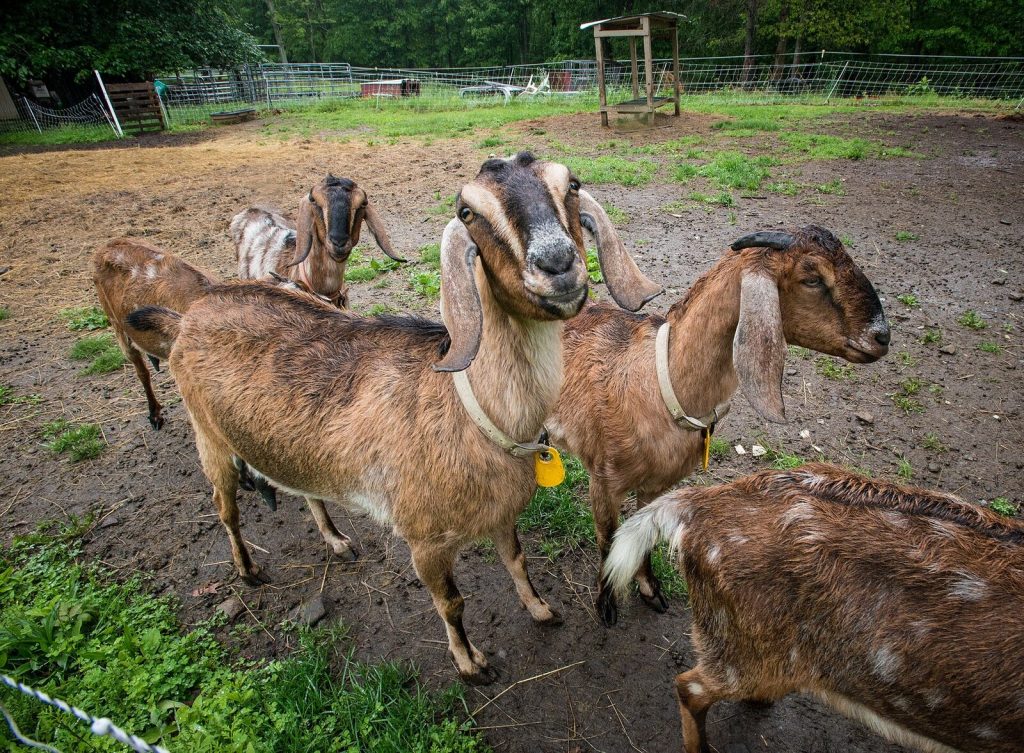
Boer goat farming in Uganda almost never means keeping a flock of pure Boers. It means buying one improved buck and crossing him onto local does, and Uganda's national genetics agency publishes a specific ladder for doing that. Get the ladder wrong at the second generation and the improvement disappears. Exotic and crossbred genetics are still only about 5 percent of the national goat herd, which tells you how rarely this is done well.
What Boer Goat Farming Actually Means in Uganda
Uganda's national animal genetics agency sorts the goats available in the country into three groups: local goats, exotic dairy goats and exotic meat goats. The Boer sits in the third group alongside the Savanna and the Kalahari Red, and the agency's merit and demerit lists are written for the group rather than for the individual breed, which matters when you read them.
The exotic meat goat's listed merits are fast growth, good meat and good body conformation. Its listed demerits are that it is susceptible to worms, suffers in wet conditions, has poor disease resistance and dries off quickly. Local goats, in the same document, are credited with tolerance to worms, good disease resistance, being suited to the local climate, fair meat conformation and high prolificacy, against demerits of very little milk, milk drying quickly and slow growth.
Read those two lists side by side and you have the whole Boer question in Uganda. You are buying growth and carcass shape, and you are paying for it in worm burden, wet season tolerance and general hardiness. Nothing about that trade is hidden and it is published by the agency that supplies the genetics.
One inconsistency in the same tables is worth noticing, because it shows these lists are rough classifications rather than measurements. Very little milk appears as a merit of exotic meat goats and as a demerit of local goats, while milk drying quickly appears as a demerit of both. A document that scores the same attribute in two directions is giving you a rule of thumb, not data, and the measured figures further down this page are the ones to plan on.
Scale sets the context. About 95 percent of Uganda's goats are indigenous, with crosses and exotics making up the remaining 5 percent or so, a split two independent Ugandan sources agree on. In one agro ecological zone the figures were 699,709 indigenous animals against 39,635 exotic. So a farmer starting Boer goat farming is not joining a mainstream practice, and the supply of genuinely improved stock is correspondingly thin.
The Crossbreeding Rule That Decides Whether Boer Genetics Pay
This is the part that gets skipped and it is the part that decides the outcome. Uganda's genetics agency publishes the rule, sourced to a donor funded breeding project, and it is blunt: crossbreeding is the quickest way to improve traits of interest, and uncontrolled it can kill the improvement programme or even the good traits already in the local population.
The mechanism is simple enough to hold in your head. Cross a Boer buck onto a local doe and you get an F1 that is half improved, and F1 animals look wonderful. Cross two of those F1 animals together, which is exactly what a farmer pleased with the results will do next, and the offspring segregate: the combination that made the F1 good comes apart and the next generation is a lottery. The agency says so in terms.
| Generation | Share improved | What to do with it |
|---|---|---|
| F1 | About 50 percent | Castrate and fatten males, or sell for slaughter |
| F1 females | About 50 percent | Cross again to an improved buck, never to an F1 male |
| F3 | About 75 percent | Keep breeding females, same rule |
| F4 | About 87 percent | Close to the improved type, and you never reach 100 |
Documented Ugandan practice runs the other way, which is why this matters. The measured problem in Ugandan goat populations is low productivity from injudicious and indiscriminate crossbreeding and inbreeding, with farmers unable to tell the breeds apart. Genomic work on Ugandan goats has found only weak differentiation between the named breeds, which is the same finding from the other direction: the boundaries farmers think they are working with are already blurred. The goat breeding guide covers mating management and the livestock record keeping template carries the parentage sheet.
Boer Weight Claims Against Measured Ugandan Goat Weights
Breed pages give the Boer as a buck of about 110 to 135 kilogrammes and a doe of about 90 to 100, and a Makerere University comparison of Boer and native Ugandan bucks puts the Boer at up to 130 kilogrammes. Those are mature weights for the breed in its own conditions and they are not a forecast for your farm.
Here is what Ugandan goats actually weigh, measured rather than described. A survey weighed 1,020 mature does of the three indigenous breeds across ten agro ecological zones on a portable scale, and the numbers vary as much by zone as by breed.
| Breed | Where measured | Mean doe weight |
|---|---|---|
| Mubende | Pastoral rangelands | 38.1 kg |
| Kigezi | Highland ranges, its home zone | 34.2 kg |
| Kigezi | South western farmlands | 33.7 kg |
| Small East African | Northwestern savannah grasslands | 23.8 kg |
Two findings inside that table are worth more than the averages. Mubende and Kigezi does in their better zones came out heavier than the reference figures in the older breed descriptions, which put a female Mubende at 31 kilogrammes. And Small East African does in the northwestern savannah grasslands came out lighter than their own reference range of 25 to 30 kilogrammes. So the measured envelope for a mature Ugandan indigenous doe runs from roughly 24 to 38 kilogrammes depending on breed and zone, which is wider than the 20 to 35 kilogramme band this site publishes elsewhere from a breed comparison study, and the reason is the zone rather than the animal. Small East African goats are also the majority of the national herd at about 53 percent, with Mubende at about 36 and Kigezi at about 11.
Now the comparison that a Boer seller will not make for you. Uganda's own research organisation ran a controlled worm infection experiment on 12 male goats of each indigenous breed at about seven months old, kept indoors and fed banana peels and Napier grass, then infected with a measured dose of stomach worm larvae and followed for twelve weeks.
| Breed | Liveweight | Carcass | Dressing |
|---|---|---|---|
| Mubende | 18.6 kg | 7.7 kg | about 41 percent |
| Kigezi | 14.6 kg | 5.8 kg | about 40 percent |
| Small East African | 11.2 kg | 4.4 kg | about 39 percent |
A seven month old Ugandan male goat, indoors and fed, weighed 11 to 19 kilogrammes. That is the baseline any claim about a five month old goat reaching 45 kilogrammes has to clear, and it does not come close. The goat farming profit calculation works through the arithmetic that rejects that particular breeder claim, and these weights are an independent Ugandan reason to reject it. The dressing percentages, which come straight out of the study's own liveweight and carcass pairs, sit at about 39 to 41 percent, at and just below the 40.7 to 45.1 percent measured across local African goats, which is what you would expect of animals carrying a worm burden.
Worms: What Ugandan Field Data Costs a Crossbred Goat
The genetics agency lists worm susceptibility as a demerit of exotic meat goats, and Ugandan field measurement puts a number on it.
A northern Ugandan study of stomach worm infection, covering hundreds of goats and sheep across two hundred and twenty smallholder households in Apac, split its results by breed. Crossbred animals came out at 82.4 percent positive against 72.4 percent for local ones, which after adjustment left the locals 53 percent less likely to be carrying the parasite. The same analysis flagged two more things a crossbreeding herd should note: the odds ran higher in young animals than in adults, and keeping goats off shared grazing with sheep and cattle cut the risk by 59 percent.
That is the demerit in numbers. A Boer cross is not merely believed to be wormier, it measurably was, on Ugandan farms, in the same paddocks, at the same time. And the same national picture makes it worse, because a Makerere survey found resistant worms on about six goat farms in ten, so the product you would reach for may not work where you farm. The deworming guide for goats carries the resistance evidence and the testing method, and no dose, product or interval appears on this page.
Cost this out before you buy the buck. A crossbred herd carries a higher parasite load in a country where the treatments are failing, which means more veterinary attention, more faecal egg counts and more management rather than less. Anyone selling improved genetics as a route to an easier herd has it backwards.
Wet Ground, Heat and Disease on a Ugandan Boer Goat Farm
Breed pages commonly claim the Boer tolerates all climates. Uganda's national genetics agency says the opposite about the group it belongs to, listing suffering in wet conditions and poor disease resistance as demerits, and the nearest regional evidence agrees.
In southern Ethiopia, researchers interviewed farmers who had kept Boer crosses distributed from a research centre alongside their own indigenous goats. Those farmers rated the crossbreds higher on coat colour, twinning rate and market preference, and rated the indigenous goats higher on heat tolerance, drought tolerance and disease tolerance. Susceptibility to disease and to drought were named as the crossbreds' drawbacks. That is farmer judgement rather than measurement, and it lines up with the Ugandan agency's own list, which is the useful part.
The practical consequence on a Ugandan farm is drainage and shelter. Wet ground is the condition the exotic meat goat handles worst, and Uganda has two rainy seasons in most of the country. A Boer cross needs a dry place to stand and lie, which means a raised or well drained floor, a roof that actually keeps rain off the bedding, and hoof attention, because wet feet on a heavy framed goat is how foot problems start. The goat housing guide covers the structure, and none of it is optional on a crossbred herd the way it can be on a tethered local flock.
What Crossing a Boer Buck Onto Local Does Actually Buys
Uganda has no published measurement of what Boer crossing does to its own goats' reproduction, so the closest evidence is the Ethiopian work above, and it should be read as regional rather than Ugandan.
There, Boer crosses reached first kidding at about 13.9 months against a longer figure for the indigenous does, first service at about 10 months, and produced an average of about 1.4 kids per doe against about 1.32 for the local goats. Those are real gains and they are small. Set the 1.4 against the kidding interval measured in Ugandan village goats of 297 days and the arithmetic on the goat farming profit calculation page, which lands on roughly one weaned kid per doe per year once measured kid mortality is applied, and a tenth of a kid per kidding does not move that conclusion.
Where the Boer genuinely earns its place is growth and carcass shape, which is what its group is listed for and what a butcher buys. So the honest case for Boer goat farming in Uganda is a terminal one: cross to produce heavier males with a better carcass for slaughter, and stop expecting the cross to breed faster, browse better or need less medicine.
One detail from the same Ethiopian programme is worth carrying. The research centre imports pure Boer stock and keeps it, and distributes only the 50 percent crossbred bucks to farmers. A publicly funded breeding programme with veterinary support has decided that pure Boers are not what a smallholder should be given. That is a considered judgement from people who have run the experiment.
Whether the Ugandan Goat Market Pays for Boer Genetics
All of the above is moot if the buyer does not pay for it, and here Uganda's own evidence is discouraging.
A Ugandan community based goat breeding programme training report records that informal markets undervalue genetic improvement. Goats in most of the country are sold by eye to a trader, in ones and twos, for cash on the day, and a trader buying by appearance is not running a weigh scale or paying a premium for conformation. Ugandan pig research found the same mechanism in a different species: price set by visual estimation, and the farmer's own investment excluded from the bargain.
None of those three is a village trader. If your only outlet is the man who walks past on market day, a Boer cross will fetch a little more because it is bigger, and it will not fetch a premium for being improved. Work out which channel you are selling into before you spend on a buck, and the guidance on how farmers should price produce and negotiating with buyers is where that decision gets made.
Buying a Boer Buck Without Buying a Breeder's Figures
The buck is the single largest genetic decision on the farm and the market for exotic Ugandan goat genetics is thin, breeder set and full of performance claims that trace back to the person selling the animal.
Ugandan national guidance on selecting initial stock gives four checks that cost nothing: avoid open markets, look at age at sexual maturity, prolificacy and litter size rather than at the animal's colour, have a veterinarian perform a breeding soundness evaluation before paying, and pay attention to the buck's own parents because the genetic relationship between a male and the daughters he produces is strong. Careless buck selection introduces undesirable traits into the whole herd, and unlike a bad doe a bad buck does it to every kid born that season.
Treat claimed weights as claims. Where a Ugandan newspaper has reported startling growth figures for an exotic meat goat, those figures have traced back to a named commercial breeder selling breeding stock, and this site has published the arithmetic rejecting one of them. Measured Ugandan seven month old males weigh 11 to 19 kilogrammes. Ask the seller instead for the animal's own birth date, its dam's kidding record and its parasite treatment history, all of which are checkable, and buy from a farm that can produce them. Where to look is covered on the Boer goat suppliers page.
Housing, Grazing and Health Management for Boer Crosses
A crossbred herd raises the management floor, and three items are not negotiable.
Grazing first. Uganda's genetics agency budgets grazing land at 0.25 of an acre per goat per year in its own enterprise calculator, which is four goats to the acre, and a bigger framed animal is not going to do better than that figure on the same ground. The cost of starting goat farming page converts that into acres by herd size. Anything claiming twenty or thirty goats to an acre is describing a plan that ends in overgrazing followed by a feed bill, and bought feed is where a goat margin dies: a controlled trial on local African goats found grazing alone gave the best gross margin per animal, with net profit negative in four of five treatments.
Health second. Everything you buy gets quarantined, and the ministry sets the terms: three weeks in isolation on arrival, a clear three metres of separation from the animals you already have, the isolation pen placed near the gate, and hooves, ticks and parasites dealt with before the animal goes in. Sharing grazing with sheep and cattle is ruled out, which the Apac breed data backs numerically. Dipping is weekly in Uganda's published goat guidance, and the wash itself gets tested periodically so that you are not relying on an acaricide the local ticks have beaten. The common goat diseases page carries the Ugandan disease picture, including the two herd diseases that matter most, and no dose, product, route or withdrawal period appears here.
Feeding third, and this is where a Boer cross costs money quietly. The agency's own feeding guidance for goats is built around timed windows rather than a constant ration, lifting feeding before and after mating, through the last weeks of pregnancy and before weaning, which is covered in the goat feed requirements work. A faster growing animal has a higher requirement and less tolerance of a bad dry season, so a crossbreeding programme and a dry season fodder plan are the same decision.
The Cheaper Genetic Gain Already Inside Uganda's Own Goat Breeds
The controlled infection experiment above was not run to compare Uganda's breeds for curiosity. Its conclusion was that the differences between Mubende, Kigezi and Small East African goats in how they handled a worm challenge were real, plausibly genetic, and could be used in breeding programmes that select indigenous goats for disease resistance. Mubende came out the least badly affected of the three and also the heaviest, with the best carcass.
That is a free improver sitting in the country. A Mubende doe measured at 38.1 kilogrammes in pastoral rangelands is not a small goat, the breed is about 36 percent of the national herd, and it carries the worm tolerance that the exotic meat breeds are listed as lacking. Selecting hard inside a local flock costs a record book and the discipline to cull, and it does not cost a million shillings for a buck.
Two honest limits. Selection inside a local flock is slower than crossbreeding, which is the agency's own reason for recommending crossbreeding as the quickest route. And Uganda's named goat breeds are not cleanly separable in practice, since genomic work finds weak differentiation and the agency itself notes that information on distinct breed identifiers is inadequate, so "buy a good Mubende buck" is harder advice to follow than it sounds. Both of those are arguments for keeping records on your own animals rather than trusting a breed label. The best goat breeds page compares the options and the goat farming guide covers the enterprise.
Who Boer Goat Farming Suits on a Ugandan Farm
Put the evidence together and the answer is narrow rather than negative.
Boer goat farming suits a farmer who has a named buyer that pays by weight or wants breeding stock, has land at four goats to the acre or better with a dry season fodder plan, has dry housing and is prepared to run a worm programme with laboratory testing, keeps parentage records well enough to follow the generation ladder, and treats the buck as a terminal sire for producing slaughter males rather than as a route to a pure Boer herd.
It suits nobody who is tethering goats behind the house, selling to whoever walks past, and hoping an expensive buck will fix a thin margin. That farmer's money goes further on a fodder plan, a faecal egg count and a record book, and the enterprise arithmetic on the goat farming profit calculation page shows why: a Ugandan goat herd clears its costs only while the cash cost per doe year stays low, and a crossbred herd raises that cost on every line.
Questions Ugandan Farmers Ask About Boer Goat Farming
Can Boer goats survive in Uganda? Yes, with management, and the qualifier is the whole answer. Uganda's national genetics agency lists the exotic meat goat group as suffering in wet conditions with poor disease resistance and susceptibility to worms, and Ugandan field data found crossbreds 53 percent more likely to be carrying the main stomach worm than local goats on the same farms. Dry housing, a worm programme and a fodder plan are the price of admission. Breed pages claiming the Boer handles all climates are not describing a Ugandan wet season.
Should I buy a pure Boer buck or a cross? For most Ugandan farms, a cross. The Ethiopian programme that has run this for years imports pure Boers, keeps them, and distributes only 50 percent crossbred bucks to farmers, which is a considered judgement from people with veterinary support and a research budget. A cross also costs less, tolerates local conditions better and still lifts the growth of your kids.
What do Boer goats cost in Uganda? The published spread is enormous and that is the finding rather than a price: this site's costing work landed on a band running from a couple of hundred thousand shillings for a good local buck up to about 1.7 million for a pure exotic male, with sources quoting 500,000 to 600,000 for a Boer billy and higher figures for other exotic meat breeds. The spread is evidence of a thin, breeder set market rather than a price to budget from. Improved does are reported nearer 150,000 to 300,000 against 100,000 to 200,000 for a local doe. Get current figures from the goat price page and from more than one seller. The buck is the one purchase where paying more is sometimes right and sometimes waste.
How many kids will a Boer cross give me a year? About one weaned kid per doe per year, the same as a local doe, and this is the expectation most often oversold. Regional measurement puts Boer crosses at about 1.4 kids per kidding against 1.32 for indigenous does, which against a Ugandan kidding interval of 297 days and measured village kid mortality does not change the conclusion that a doe yields roughly one sellable kid a year. Buy Boer genetics for the weight of the kid, not the number of them.
Will a butcher pay more for a Boer cross? More for the weight, rarely a premium for the breeding. Ugandan breeding programme research records that informal markets undervalue genetic improvement, and the documented channels that do pay for weight and consistency are private abattoirs and butcheries buying volume, restocking programmes buying breeding stock, and Gulf export demand with stricter requirements. If none of those is reachable from your farm, the premium you are counting on does not exist.
Can I breed my F1 crosses together? No, and this is the mistake that wastes the money. Uganda's genetics agency states that crossing F1 to F1 produces genetic segregation that kills the improvement. Castrate and fatten the F1 males or sell them for slaughter, and put the F1 females back to an improved buck, which takes you to about 75 percent and then about 87 percent improved across two more generations.
Is a Boer cross better than selecting inside a local flock? Faster, not automatically better. Uganda's own research organisation found real differences between Mubende, Kigezi and Small East African goats in how they handled a controlled worm challenge, concluded those differences could be used in a breeding programme, and measured Mubende as both the heaviest and the least badly affected. Selecting inside a local flock is slower and costs a record book rather than a buck. The catch is that Uganda's goat breeds are not cleanly distinguishable in practice, so the selection has to be on your own animals' measured performance rather than on a breed name.
Before committing to a buck, do two things in the same week: ask two or three abattoirs or butcheries in your nearest town whether they buy by weight and what weight they want, and get current buck and doe prices from more than one seller. Those two answers decide whether Boer goat farming is a plan or an expense. Current live goat prices are on the goat price page, stock sources under Boer goat suppliers, and the wider enterprise guidance in the livestock guides.