
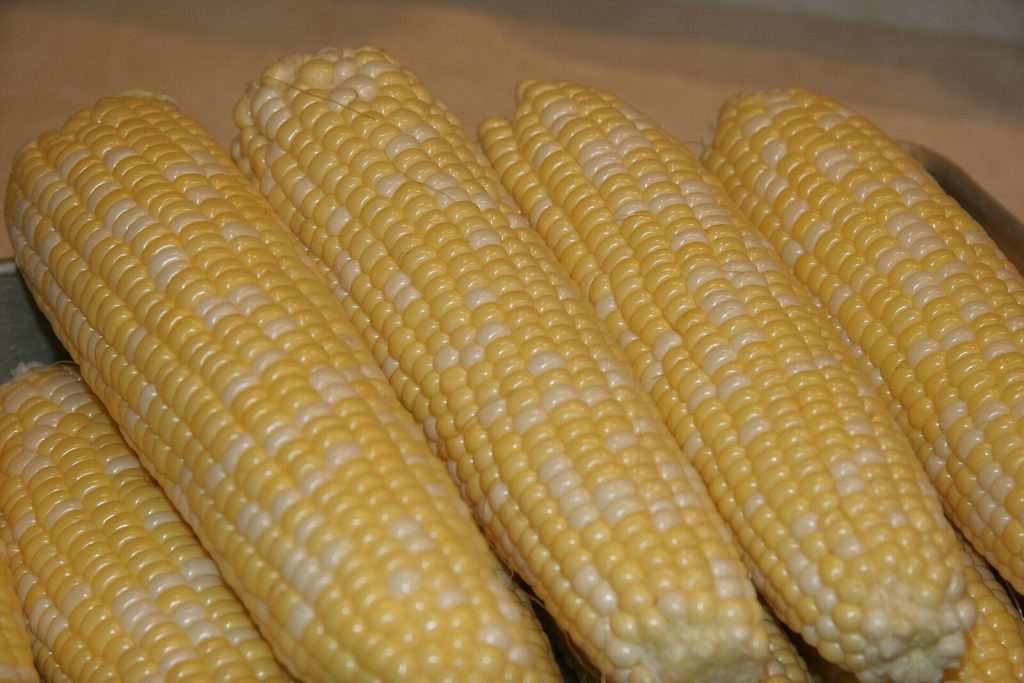
Maize farming in Uganda runs on a cycle of roughly four months in most districts, from planting at the onset of rains to lifting grain dry enough to bag. National yield sits near 2.2 tonnes per hectare while the varieties Ugandan farmers can buy are bred for three to four times that. Almost all of the gap is made of decisions taken in a fixed order.
That order is what this guide follows. Each section is one link in the chain, and the chain is only as strong as the weakest decision in it. A farmer who buys good hybrid seed and then plants it three weeks late has already spent the premium.
What an Acre of Maize Yields in Uganda
The Uganda Bureau of Statistics puts national maize yield at about 2.2 tonnes per hectare in its Annual Agricultural Survey, which works out near 890 kg per acre. The same survey recorded 1.6 tonnes per hectare the year before, so a single national figure hides a large year to year swing driven mostly by rainfall.
Sub regional figures spread much wider than the national mean. Tooro reported 3.6 tonnes per hectare and Ankole 3.5, while Karamoja and Teso both came in at 1.4. That is a factor of more than two and a half between the best and worst parts of the same country, growing the same crop, mostly from the same seed catalogue.
The Ministry of Agriculture, Animal Industry and Fisheries sets out its own yield expectation by management level in the maize training manual it issues to extension workers, and the ladder is worth reading before anything else on this page.
Two things follow from that ladder. The jump from traditional to high input is more than threefold, and it is bought rather than wished for. And the top two systems deliver the same grain, so the money saved on tillage is the only free yield on the list. The full build up of what each system spends sits on our cost of maize farming page, and the margin arithmetic on maize farming profit per acre. A deeper treatment of yield alone lives on maize yield per acre in Uganda.
Soil, Altitude and Temperature for Growing Maize
Maize tolerates a wide range of Ugandan soils and rewards a narrow one. The ministry manual names deep, warm, well drained and well aerated loams and silt loams with decent organic matter, at a soil pH of 6.0 to 7.0. Waterlogged ground, poorly aerated ground and thin sandy loams are named as poor sites, and no amount of fertilizer converts one into the other.
Temperature is where the published Ugandan guidance contradicts itself, and the contradiction matters because most of Uganda sits at altitude. One section of the ministry manual gives an optimum of 30 to 34 degrees Celsius for the crop as a whole. A later section in the same document splits the figure by maize type: 30 to 34 degrees for lowland tropical maize, 20 to 30 for temperate types, and 17 to 20 degrees for highland tropical maize. Uganda's maize belt is mid altitude to highland, so the 30 to 34 band describes a crop type most Ugandan farmers are not growing. The manual also notes that maximum temperatures now exceed 34 degrees in several maize growing zones, which makes the lowland band a ceiling rather than a target.
Below 10 degrees and above 40 degrees the plant stops growing and dies. Between those extremes, altitude is the practical proxy: seed released for 1,000 to 1,600 metres will not perform the same way at 2,000 metres, which is why the highland hybrids exist as a separate class.
On rainfall the manual states a preference for 500 to 600 mm well distributed across the growing season. Read that as a crop cycle requirement rather than an annual one, because Uganda receives far more than 600 mm a year almost everywhere. Distribution decides the crop, not the total.
Choosing a Maize Variety by Days to Maturity
Uganda splits maize seed into open pollinated varieties and hybrids, and the practical difference between them is how often you pay. A hybrid is a purchase you repeat every season, since grain kept back from a hybrid crop gives away the yield advantage that justified buying it. An improved open pollinated variety holds its performance through two further replantings, so one purchase carries three crops. Hybrids beat open pollinated material where the rest of the season is managed well, and nowhere else.
The number that decides which variety fits your field is days to maturity, not yield potential. The National Agricultural Research Organisation publishes maturity and yield for the varieties it has released, and the spread across them is wide enough to change which season a farmer can plant into.
| Variety | Days to maturity | Yield potential | Released |
|---|---|---|---|
| Longe 10H | 120 | 8 to 10 t/ha | 2008 |
| Bazooka, UH5354 | Not published | 9.5 t/ha | 2013 |
| UH5355 | 130 to 135 | 9.0 t/ha | 2013 |
| NAROMAIZE 60 IR | 130 | 6.7 t/ha | 2017 |
| NAROMAIZE 62 | 120 to 130 | 7 to 9 t/ha | 2019 |
| NAROMAIZE 63VitA | 110 to 120 | 7.7 t/ha | 2023 |
| NAROMAIZE 64StR | 110 to 115 | 7.2 t/ha | 2023 |
Older released material stretches the range further in both directions. The ministry's own variety annex lists Longe 4 at 100 to 105 days as an early open pollinated type, and the highland hybrids at 200 to 210 days for the 1,400 to 2,400 metre band. A 210 day maize crop cannot be squeezed into a bimodal season, which is the whole reason the south west grows one long crop a year instead of two.
Yield potential on a research station is not what you will harvest. Treat these figures as the ceiling the breeder measured under trial management, and set your own expectation from the yield ladder above. Variety by variety detail, including what is actually stocked, belongs on best maize seeds in Uganda, and the saving against buying question on hybrid and open pollinated seed.
Buying Maize Seed and Testing It Before Planting
Seed is the one input where a bad batch costs you the entire season rather than a slice of the yield. The ministry tells extension workers to check the label for source, variety name, packing date, expiry date and stated germination percentage, and notes that some packs now carry a code or serial number that can be verified by phone. Seed should be clean, unbroken, free of mould and insect damage, with non conformity no higher than 2 percent.
Then test it yourself, a week before you plant. The published Ugandan procedure is simple enough to do on a verandah.
Skipping this is the commonest way a good season gets decided badly, because a gappy stand cannot be repaired by the time it is visible from the road. Recourse against a bad batch also runs on a deadline, and the deadline is short. Method detail sits on how to test seed germination, what to check at the counter on how to choose quality seed, and what to do at each test result on maize seed rate per acre.
Land Preparation for Maize Before the Rains
Land preparation is a deadline, not a task. The ministry's instruction is to start either at the end of the previous harvest or at least three weeks ahead of planting, so that residues have time to break down. Plough at least twice for a decent seedbed, and stop short of overworking the soil, because excessive tillage builds clods and clods cost you seedlings.
Do not burn residues. Ploughing them in holds moisture and feeds the soil, and burning throws away the one soil amendment on the farm that costs nothing. Where vegetation is dense, slash first and leave the trash on the surface.
Conservation tillage is a different system rather than a cheaper version of the same one. In the ministry's costing it drops the second ploughing, substitutes a herbicide pass, and reaches the same 2,500 kg per acre. It is not the hand hoe method, and calling hand digging conservation agriculture confuses two things that sit in separate columns of the ministry's own table.
The reason all of this happens before the rain is that the rain will not wait. Ugandan rainfall records held by the Meteorological Department and analysed by researchers at the National Agricultural Research Laboratories show that the onset of the first rains varies by a month or more while the end of the season barely moves. Land cleared after the first storm is land planted late, and late has a fixed price.
Maize Spacing, Seed Rate and Plant Population
The Ugandan target stand is about 21,000 plants per acre, on 10 kg of seed per acre. Two spacings are published against that target: 75 cm between rows with 25 cm between stations and one seed per hole, or 75 cm between rows with 60 cm between stations and two seeds per hole.
Only one of those pairings reaches 21,000, and checking which one matters because the stand is settled on planting day and nothing later recovers it. The close setting, 25 cm stations at one seed, lands on about 21,600 plants. The wider setting at two seeds comes out near 18,000, and so does the 75 by 30 cm pairing an earlier edition of the manual prints against the same 21,000 figure. That is about a seventh of the crop. Choose on that basis: take the close setting for the full population, and if you take a wider one, budget the yield against 18,000.
Seed rate rises with poor germination, not with ambition. At 85 percent germination the published adjustment is 10 multiplied by 100 and divided by 85, which the manual rounds to 12 kg per acre. Depth depends on moisture: 2 to 3 cm into moist soil, and 5 to 10 cm for dry planting so the seed only germinates once real rain arrives.
Both of these get full treatment elsewhere, because both hide arithmetic that catches people out. See maize spacing for the row and station geometry and maize seed rate per acre for how the kilogram figure is built. If you are planting mechanically, maize planters covers what the machine has to hit.
Weeding Maize and Dealing With Striga
Maize is a poor competitor in its first month and a strong one afterwards, so weeding timing matters more than weeding effort. Ugandan practice is two rounds, the first well before the crop reaches knee height and the second before the canopy closes. After that the maize shades out most of what is left.
Striga is the exception, and it is not an ordinary weed. The parasitic witch weed attaches to maize roots and draws nutrients out of the plant, and the ministry puts potential yield loss at up to 100 percent in infested fields. Nothing you spray on the leaves touches it, because the damage is underground and already done by the time the purple flowers show.
What the ministry recommends against striga is a package, and the parts only work together. Scout and pull striga plants before they flower, and do it across the whole neighbourhood rather than one field, since the seed moves. Plant resistant material: NAROMAIZE 64StR carries natural tolerance, and NAROMAIZE 60 IR is the imazapyr resistant option, which the research organisation credits with a yield advantage of up to 70 percent over non resistant varieties in striga infested ground. Intercrop or strip crop with legumes, which trigger striga seed to germinate on a host it cannot feed on. Clean implements between fields. Rotate. And feed the crop, because a well fed maize plant resists the parasite better than a starved one.
Herbicide choice, rates and timing belong on the product label and with your district extension officer, and that is where this page leaves them. There is no rate on this page for any chemical.
Feeding the Maize Crop With Manure and Fertilizer
Maize is a hungry crop and Ugandan soils in the maize belt have been cropped for a long time. The ministry manual lists nitrogen, phosphorus, potassium and zinc deficiencies with the leaf symptoms for each: a yellow midrib on lower leaves and a pale green plant for nitrogen, yellow and brown leaf margins on older leaves for potassium, purple margins on older leaves for phosphorus, and white striping from the leaf base for zinc.
Scouting for those symptoms is free and it tells you something a fertilizer bag cannot. What it does not tell you is how much to apply, and that is a soil test question. The manual sends farmers to a laboratory or to the nearest zonal research institute, which is the right answer, because a rate set without a test is a rate set by guesswork.
This page does not print application rates, for one specific reason: the ministry manual contradicts itself on them, giving a manure rate of 1,000 kg per hectare in one row of its nutrient table and 12.5 tonnes per hectare in the next, a difference of more than twelvefold. Where a source disagrees with itself that sharply, the honest move is to publish the disagreement and send you to a test. Our maize fertilizer application guide handles the nutrient decision in detail, and soil testing before fertilizer application covers how to get a sample analysed.
Legume intercropping does real nutritional work alongside the weed suppression. Maize with groundnut, bean, soybean or pigeon pea is named in the ministry guidance as a yield improving combination, and it is the same practice that breaks the striga seed bank.
Maize Pests in the Field
Six field pests carry the ministry's maize list: fall armyworm, stem borers, cutworms, termites, aphids and the maize weevil. The cultural controls it recommends are unglamorous and they are mostly about timing and hygiene. Plant early. Clear crop residues straight after harvest, or use maize stalks as mulch in banana or coffee gardens rather than leaving them as a nursery in the field. Plough deep to bury larvae and pupae. Uproot infected plants. Rotate.
Stem borers announce themselves by boring into leaves, stems and cobs, leaving retarded growth and thinner yields. Cutworms are greasy grey caterpillars up to about 40 mm long that curl into a C shape when disturbed and feed on green material. Termites can attack any part of the plant and fell it outright. Aphids respond to early planting, decent nutrition and weed control, and to natural enemies such as lady beetles and parasitoid wasps.
Fall armyworm deserves its own page rather than a paragraph, and it has one: fall armyworm control in maize. Worth knowing that the ministry's own pest table is mislabelled, listing maize smut, a fungal disease, in a table headed as insect pests. Check what you are actually looking at before you buy anything to spray on it.
Maize Diseases and What Variety Resistance Buys
The Ugandan maize disease list is short and the names repeat across every variety description you will read: maize streak virus, northern or Turcicum leaf blight, grey leaf spot, common rust, maize smut, ear rot and maize lethal necrosis. Almost every released variety in the table above is sold on tolerance to some subset of them.
That is the real argument for buying certified seed rather than recycling grain. Resistance is a trait you buy once and it works every day of the season without a spray round. Longe 10H, NAROMAIZE 62, NAROMAIZE 63VitA and NAROMAIZE 64StR all carry tolerance to grey leaf spot, Turcicum leaf blight, streak virus and rust. Bazooka and UH5355 add maize lethal necrosis tolerance, which is the trait that matters most if the disease reaches your district.
The ministry's disease management column is thin by design: field hygiene, uprooting and destroying infected plants, resistant varieties, crop rotation, deep ploughing of infested debris, and timely harvesting for ear rot. Its symptom illustrations are photographs rather than text, so a farmer identifying a disease from the manual is matching a picture. Where a description is what you need, work from maize diseases and their control.
Harvesting Maize at the Right Moisture
Harvest when the crop is physiologically mature, which in most Ugandan varieties is somewhere past 110 days and is signalled by drying husks and, in some varieties, cobs that droop and turn to face the ground. Neither early nor late harvesting is safe. Early costs you filled grain. Late invites pests into the standing crop and fungal infection into the cob, and ear rot is on the ministry's list with timely harvesting as its main control.
Keep the cobs off bare ground from the moment they leave the plant. Clean mats, tarpaulins or a cemented floor all work, and the reason is soil borne fungal infection rather than tidiness. Throwing cobs on the ground and using dirty containers at harvest is named in the ministry guidance as an aflatoxin risk.
Shelling has its own moisture threshold, lower than the one for harvest and higher than the one for storage: shell at 16 percent moisture or below, and do not beat the cobs. Beaten cobs give broken grain, broken grain admits fungal infection and insects, and broken kernels are also a graded defect that will cost you at the scale. Machine options are covered on maize shelling machines.
Drying, Shelling and Grading Maize Grain
Dry the grain to 13 percent moisture or below before it goes into a bag. That is the ministry's instruction in prose, and it also clears the published grain standard, which is the safer direction to err in. The standard table in the current ministry manual gives 13.5 percent as the maximum across all three grades, while other published editions of the same East African standard give 13.0. Drying to 13.0 satisfies every version and leaves less room for mould.
Three methods of checking are named: a moisture meter, the salt in a bottle method, and biting a grain. Only the first gives you a number you can argue with a buyer about. Full method detail sits on maize drying and grain moisture management.
Grading is where the drying and the handling get priced. These are the maximum limits the ministry publishes for maize grain, by grade.
| Characteristic, percent by mass | Grade 1 | Grade 2 | Grade 3 |
|---|---|---|---|
| Foreign matter | 0.5 | 1.0 | 1.5 |
| Inorganic matter | 0.25 | 0.5 | 0.75 |
| Pest damaged grains | 1.0 | 3.0 | 5.0 |
| Rotten and diseased | 1 | 2 | 3 |
| Discoloured grains | 1.5 | 2.0 | 2.5 |
| Immature and shrivelled | 1.0 | 2.0 | 3.0 |
| Total defective grains | 5 | 9 | 14 |
| Broken kernels | 2.0 | 4.0 | 6.0 |
One caution on that table, because it affects anyone reading the source directly. In the older edition of the ministry manual the identical table carries the heading "Specific requirements for dry beans" while sitting in a maize grain standards module. The values are genuinely maize, and the current edition has corrected the heading. If you are working from an older copy, the heading is the error, not the numbers.
Worth saying plainly that grading does not always pay on Ugandan maize. Ugandan market studies have found a clear price gap between bean grades and no quality premium on maize at all in the same districts. Grading protects you from rejection rather than earning you a bonus, and rejection is the larger risk.
Storing Maize and Choosing When to Sell
Storage is the last agronomic decision and the first marketing one. Three storage pests carry the Ugandan list: the maize weevil, the Angoumois grain moth and the larger grain borer. All three multiply faster in warm, damp grain, which is why the drying target and the storage decision are the same decision.
The ministry's storage guidance is sanitation first: clean the store, remove residues from the previous harvest, keep bags off the floor with space around them for inspection, and use structures that actually exclude pests. Airtight containers are named as protective. Dried grain must stay dry, so cover it before rain rather than after.
Timing the sale is the one lever on a maize crop that costs nothing but nerve. Ugandan grain prices fall hardest in the weeks when everybody harvests and recover through the lean months, and monitored Ugandan markets have shown seasonal rises of 6 to 36 percent as cereal stocks run down. Against that sits the storage loss you will actually suffer, which depends on moisture at loading and on what you store the grain in. Work both numbers on your own tonnage. Detail sits on maize storage, hermetic grain storage bags and preventing weevils in stored grain. Buyer routes are on where to sell maize in Uganda.
Frequently Asked Questions
How many bags of maize does an acre give in Uganda? At the national average yield of about 890 kg per acre, roughly nine bags of 100 kg. The ministry's four production systems run from about seven bags on a traditional no input acre to about twenty five bags on a high input one. Note that traded bags in Ugandan markets have been measured averaging around 122 kg rather than 100, with no premium paid for the extra weight, so count kilogrammes rather than bags when you are pricing a crop.
What does it cost to grow an acre of maize? The ministry's own per acre totals span roughly 453,000 UGX for a traditional no input acre to about 1.4 million UGX for a high input conventional one, with conservation tillage nearer 1.0 million. Those convert to a cost of production of 411 to 647 UGX per kilogramme across the two editions of the manual, against a harvest farm gate that has ranged from about 400 to 1,000 UGX per kilogramme. The cheapest acre is often the one that loses money. Current figures and the item by item build up are on cost of maize farming and maize price in Uganda today.
Can I plant maize twice in one year? In the bimodal south, east and centre, yes, and most households do. The Annual Agricultural Survey found 52 percent of agricultural households growing maize in the first season and 57 percent in the second. In the unimodal north and in the south western highlands there is one planting window a year, and in the highlands the crop itself takes 150 days or more. Region by region windows are on maize planting seasons in Uganda.
Is hybrid seed worth buying instead of saving my own? Hybrid outyields open pollinated seed under good management, and it must be bought every season because recycling it loses the yield you paid for. Improved open pollinated seed can be saved for two years without a yield penalty, which makes it the cheaper choice on a low input acre. If you are not going to fertilize and weed on time, hybrid seed will not rescue the crop.
How do I know when maize is dry enough to store? By measurement, at 13 percent moisture or below. A meter gives you a number; the salt bottle method and the bite test give you an impression. If you are selling to a buyer who tests, the impression is worth nothing at the scale, and a shared meter between several farmers is cheap next to one rejected load.
Does maize do well in Karamoja or Kigezi? Both are at the bottom of the national production table, for different reasons. Karamoja recorded the lowest sub regional yield at 1.4 tonnes per hectare and its annual rainfall has fallen by roughly 15 to 20 percent since the 1960s. Kigezi has the smallest total production, and its altitude pushes the crop cycle out to 150 days or more, so maize competes there against crops that turn round faster.
What can I do about striga without buying anything? Pull the plants before they flower, every time you walk the field, and get your neighbours doing the same, since the seed does not respect boundaries. Intercrop with a legume. Clean your hoe and any hired implement before it enters the field. Rotate the plot out of maize. None of that costs money and all of it reduces the seed bank you are fighting next season.
Maize prices move weekly and by district, and seed and fertilizer prices move with the season and the supplier, so check the current numbers before you commit a season's spend. Our maize price page tracks what grain is fetching, where to buy maize seed in Uganda covers sourcing, and the wider crop cluster starts at our crop growing guides hub. Ask for quotes on a named variety and a stated quantity, and ask your district extension officer what has been released for your altitude before you settle on seed.