
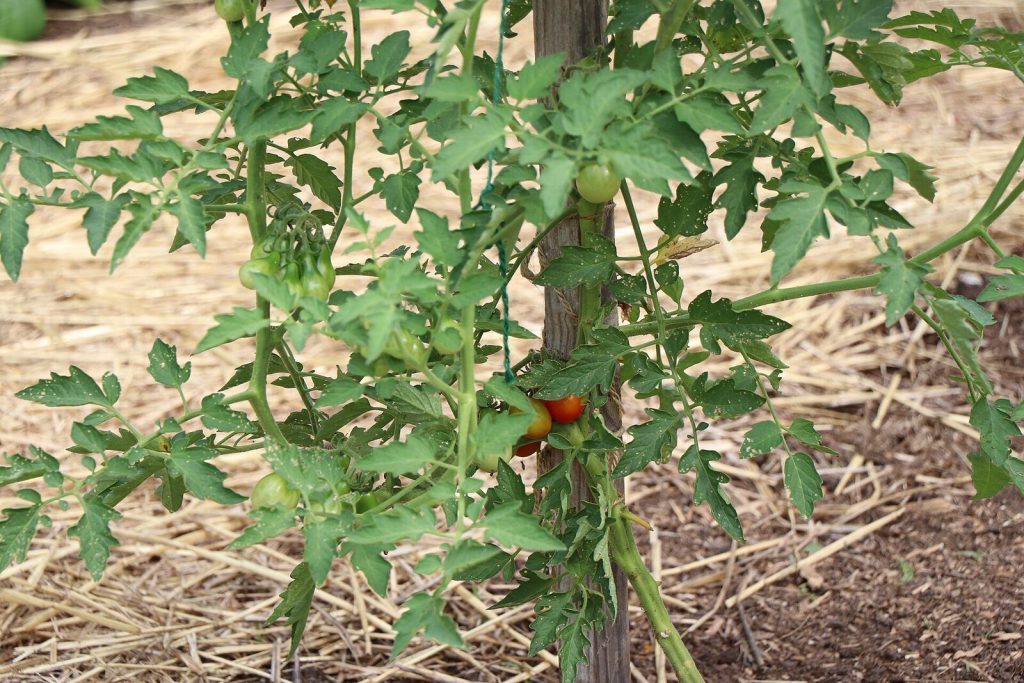
Ugandan tomato growers plant at anything from 30 by 45 cm to 100 by 100 cm, and a NARO survey of 240 farmers found all six of those spacings in use. That range puts between roughly 4,050 and 29,980 plants on an acre. The same survey names 60 by 60 cm as the spacing that gives optimum yield under field conditions, which works out at about 11,240 planting positions.
Seven times is the gap between the widest and closest spacing in real Ugandan practice, measured on the same crop in the same eight districts. Everything costed per plant moves with it: seedlings, stakes, twine, the per hole fertilizer dose, picking labour. Two neighbours can follow the same growing guide and end up with budgets that differ by a factor of seven, without either of them noticing which line caused it.
The Spacings Ugandan Tomato Farmers Actually Use
The survey, run by scientists at NARO's National Crops Resources Research Institute across eight districts in five agro ecological zones, recorded 90.5 percent of growers planting in lines and 9.5 percent planting staggered. Among those planting in lines the spacings reported were 30 by 45 cm, 45 by 45, 60 by 60, 75 by 75, 90 by 90 and 100 by 100.
Read that list as evidence of what is actually happening rather than as a menu. The paper's own comment is that those spacings "could not provide them optimum yield except for the (60 x 60) cm". So five of the six spacings Ugandan farmers use are, on the survey's assessment, costing yield, and the spread is not a matter of regional preference or variety choice. It is a spacing decision being made without a figure to work from.
One spacing missing from the survey list is worth adding, because it is the one most often printed for Ugandan readers: 45 by 60 cm, which appears in newspaper growing guides and in the existing content on this site. It sits between two of the survey's spacings and puts about a third more plants on the acre than 60 by 60.
Plant Population Per Acre at Each Tomato Spacing
An acre is 4,047 square metres. Divide that by the area each plant occupies and you have the planting positions. The arithmetic below is ours, done on that figure, and it is the number that should drive every per plant input decision you make afterwards.
| Spacing | Area per plant | Plants per acre |
|---|---|---|
| 30 by 45 cm | 0.135 sq m | about 29,980 |
| 45 by 45 cm | 0.203 sq m | about 19,980 |
| 45 by 60 cm | 0.270 sq m | about 14,990 |
| 60 by 60 cm | 0.360 sq m | about 11,240 |
| 75 by 75 cm | 0.563 sq m | about 7,190 |
| 90 by 90 cm | 0.810 sq m | about 5,000 |
| 100 by 100 cm | 1.000 sq m | about 4,050 |
Two things in that table deserve a second look. The step from 60 by 60 to 45 by 60 adds a third more plants for a 25 percent reduction in one dimension, because population responds to the product of both spacings rather than to either one. And the jump from 60 by 60 down to 30 by 45 nearly triples the population, which is why a grower who narrows both dimensions by eye ends up somewhere they did not intend. If you want to check a layout that is not in the table, there is a plant population calculator for it.
Those are geometric maximums, and a field never quite reaches them. Published Ugandan one acre budgets plan on 10,000 to 11,200 positions at 60 by 60 cm rather than the arithmetic 11,240, because access paths, gaps around obstacles and the plants you skip on bad ground all take a share. Use the table to compare spacings against each other, and use your own counted population for buying inputs. The counting method is at the end of this page.
Where the 60 by 60 cm Tomato Spacing Recommendation Comes From
This is worth tracing, because 60 by 60 cm is repeated across Ugandan extension material as settled fact and the evidence behind it is thinner than that treatment implies.
The NARO survey states that 60 by 60 cm provides optimum yield under field conditions and attaches a citation. Read the reference list and that citation is a 1990 paper in the Canadian Journal of Plant Science titled "Plant spacing effects on yield of the green house tomato". So the authority for a Ugandan open field spacing is a plant spacing study on greenhouse tomato from a temperate country, published over three decades ago.
That does not make 60 by 60 wrong, and it is worth being clear about what the finding is and is not. What it is: there is no Ugandan open field spacing trial published behind the figure that Ugandan growers are given. What it is not: a reason to plant something else. Two things support 60 by 60 independently of that citation. The survey measured what growers at other spacings achieved and found them worse. And NARO's own field trial on cherry tomato at Namulonge, a separate study, planted at 60 cm between rows and 60 cm between plants, so NARO's field practice matches the figure it recommends.
Use 60 by 60 as the default. Understand that it is a default rather than an optimum derived from Ugandan trials, which matters if your variety, your soil or your irrigation differ from the average, and it means the honest answer to "what is the best spacing for this hybrid in Mbale" is that nobody has measured it.
How Growth Habit Changes the Spacing a Tomato Crop Needs
Determinate and indeterminate varieties are different plants occupying different volumes, and a single spacing figure cannot serve both. Determinate types stop extending once fruit sets on the top bud, reach around a metre and hold themselves up. Indeterminate types keep extending to about two metres and keep flowering and setting through the season, which means real support.
A determinate bush at 60 by 60 cm closes canopy and then stops. An indeterminate vine at 60 by 60 cm, staked and pruned to one or two stems, occupies a narrow column and can take that spacing comfortably. The same indeterminate vine at 60 by 60 cm with no stakes sprawls across the row and its neighbours, and that is the combination that goes wrong in Uganda most often.
The variety names in widest use tell you which problem you have. Riogrande is a determinate type. Moneymaker is indeterminate. Several of the hybrids Ugandan growers plant are determinate, and the packet or the seller should tell you, though the codes are not always legible. Our tomato seed guide explains what to look for and why growth habit matters more than the yield figure on the front of the packet.
Spacing, Staking and Mulching Are One Decision
The NARO survey recorded 73.3 percent of Ugandan tomato growers mulching, and it records why: mulch substitutes for staking, giving fruit somewhere clean to lie before picking, and it holds soil moisture through dry spells. That is a sound practice on a determinate bush and it is an admission about cash. Stakes, twine and the labour of tying cost money that mulch does not.
Once you understand mulching as the alternative to staking rather than an addition to it, the spacing decision reorganises itself. A mulched, unstaked crop needs enough width that plants are not lying on each other, because fruit resting on a neighbour's wet leaf rots. A staked crop can be closer because it grows vertically. Choosing your spacing before you have decided which of those two you are doing is how a grower ends up with an unworkable field.
Staking also costs labour that scales with population, which is the part that gets missed. At 60 by 60 cm an indeterminate acre needs about 11,240 stakes driven, tied and re tied as the plant grows. At 90 by 90 cm it needs about 5,000. The staking line in Ugandan tomato budgets is among the larger ones, and it is set by the spacing decision rather than by the price of a pole.
What Close Spacing Does to Blight and Bacterial Wilt
Uganda's two biggest tomato disease problems both respond to plant spacing, in opposite ways that a grower can use.
Early and late blight are fungal, they need leaf wetness, and the survey found them heaviest in the central districts where hot humid conditions favour them. Anything that keeps a canopy wet longer makes them worse, and canopy density is the main thing a grower controls. A closed canopy at 45 by 45 cm holds dew until mid morning. A 60 by 60 cm crop with the rows running so that air moves along them dries earlier. That difference is free and it works every day of the season, which is more than can be said for a spray programme at 62.1 percent of farmers spraying weekly.
Bacterial wilt is soil borne and it moves in water and in soil. It was reported in all eight surveyed districts and ranked as the first disease. Close spacing works against you twice here: infected roots sit nearer to healthy ones, and irrigation water running down a tight row carries the bacterium along it. Roguing, which 12.1 percent of surveyed farmers practised, means walking in and removing infected plants, and you cannot rogue a block you cannot walk through without brushing every plant on the way. Detail on both diseases sits in tomato diseases and their treatment.
Spacing Sets the Seed, Fertilizer and Stake Bill Per Acre
Here is where a spacing error becomes a cash error, and it shows up in published Ugandan guidance rather than only in theory.
A widely circulated open field guide for Ugandan readers instructs growers to put 10 g of a phosphate fertilizer into each planting hole, and then states that this comes to about 80 kg an acre. The same guide gives a spacing of 45 by 60 cm. At 45 by 60 cm an acre holds about 14,990 plants, so 10 g each is about 150 kg, not 80. Even at 60 by 60 cm it is about 112 kg. The figure of 80 kg implies roughly 8,000 plants an acre, which corresponds to a spacing of about 71 by 71 cm, a spacing the guide does not mention. A grower who buys 80 kg on that advice and then doses 10 g a hole runs out somewhere around half the field.
The reverse error is just as common in the other direction. Regional input trade guidance for tomato gives a top dressing of about 100 kg an acre or about 10 g a plant, which implies about 10,000 plants and reconciles fine with 60 by 60 cm. So the arithmetic is not hard and it is not mysterious; it is just skipped. Whenever a recommendation gives you both a per plant dose and a per acre total, multiply one by your own population and check that you get the other. If they disagree, your population is the number you can trust, because you measured it.
Published seed rates are given per acre of field, not per plant, so they assume a normal population. Plant at 30 by 45 cm and the standard 50 to 100 g an acre will not raise the nearly 30,000 seedlings you now need. There is a seed rate calculator and a fertilizer requirement calculator if you want to work your own figures, and the full nutrient programme is in the tomato fertilizer schedule.
Bed Width, Path Width and Getting Through the Crop
A spacing plan that fills every square metre of the acre looks efficient on paper and defeats the person who has to work in it. At 62.1 percent of Ugandan tomato growers spraying weekly, somebody is walking through that block a dozen times a season with a knapsack, and more often again for tying, pruning, roguing and picking.
Leave a path. A wider gap every few rows, or a layout in paired rows with a working strip between the pairs, costs a small share of the population and buys three things: even spray coverage on the middle of the block instead of on the outer rows only, less physical damage to plants from being pushed past, and a genuine chance of removing a wilted plant without walking bacterial wilt down the row on your boots. None of that appears in a yield table and all of it appears in the harvest.
Row direction is worth a moment too. Rows running with the prevailing wind dry faster after rain and after dew, which is a free reduction in blight pressure. Rows running across a slope slow water and soil moving downhill, which matters more on the steeper ground in the south western highlands and around Elgon. Where those two pull in different directions, the slope usually wins, since erosion takes soil you cannot replace.
Why Imported Tomato Spacing Figures Do Not Transfer to Uganda
Search for a tomato spacing guide and the results are mostly American and Indian, and their numbers are a long way from Ugandan practice. Commercial determinate production on plastic mulch in the United States uses a minimum of five feet between rows with 18 to 24 inches in the row, giving about 4,760 to 4,840 plants an acre. Transplanted vegetables there are described as running 7,000 to 10,000 plants an acre across the board.
Against Uganda's 60 by 60 cm and 11,240 plants, that American figure is less than half. The reasons are structural rather than agronomic. Those row widths are set by tractor wheel spacing and by the machinery that lays plastic and drip line. The crop is irrigated to a schedule and fertigated. The varieties are bred for that system. None of it describes a hand hoed plot averaging 0.68 of an acre, weeded three times with a hoe and watered by hand by two thirds of the growers who irrigate at all.
So take the method from those sources and leave the numbers. The method is that spacing is set by how you will move through the crop and how the plant is supported. In a fully mechanised system the tractor sets it. On a Ugandan smallholding the person with the knapsack sets it, and that person needs a narrower path than a tractor does.
Marking Out Plant Spacing in a Field Without a Tape Measure
Nine in ten Ugandan tomato growers plant in lines, so most of the work is already being done. What goes wrong is drift: rows that start at 60 cm and finish at 45 because they were paced rather than measured.
Cut a stick to your row spacing and use it as the gauge for every row, not just the first. A length of string with knots tied at the in row spacing does the same job along the row and is quicker for two people working together. Mark the two end rows first, run a string between them, and plant to the string. Any of those beats pacing, and all of them are free.
Check yourself once the field is planted, because it is the only time you can. Count the plants in a measured ten metres of row and count the rows across a measured ten metres, and you have your real population per square metre. Multiply by 4,047 and you have your actual plants per acre, which is the number to use for every input decision from that day on. If it does not match what you intended, you want to know before you buy fertilizer, not after. The rest of the crop's sequence is covered in tomato farming in Uganda, and the seedling count you need comes out of tomato nursery management.
Questions About Tomato Spacing and Plant Population
What is the best spacing for tomatoes in Uganda? Use 60 by 60 cm as the default, giving about 11,240 plants an acre. That is the spacing NARO's survey of 240 growers names as giving optimum yield under field conditions, and it is the spacing NARO used in its own field trial at Namulonge. Be aware that no published Ugandan open field spacing trial sits behind the figure, so treat it as a sound default rather than a measured optimum for your variety.
How many tomato plants fit in one acre? Between about 4,050 and 29,980, depending entirely on spacing. At 100 by 100 cm you get about 4,050; at 60 by 60 cm about 11,240; at 45 by 60 cm about 14,990; at 30 by 45 cm about 29,980. All six of the wider spacings in that range were found in use by Ugandan growers in the same survey.
Should I plant closer to get more yield per acre? Up to a point more plants means more yield, and past that point they compete for light, water and nutrients while holding the canopy wet for longer. The survey found the spacings closer than 60 by 60 cm among those giving less than optimum yield. Closer planting also multiplies every per plant cost you have, so it raises your break even yield at the same time as it raises your risk of blight.
Does spacing differ for determinate and indeterminate tomatoes? Yes, though less than you would expect, because support changes the answer more than variety does. A staked and pruned indeterminate vine grows upward and takes 60 by 60 cm comfortably. The same vine unstaked sprawls and needs 75 by 75 cm or wider. A determinate bush works at 60 by 60 cm either way. The combination to avoid is an indeterminate variety planted close with no stakes.
How does spacing change what I spend on an acre? Every cost tied to a plant moves with it: seedlings, per hole fertilizer, stakes, twine, tying and pruning labour. Costs tied to the land, such as ploughing and land rent, do not. A guide that hands you both a per plant dose and a per acre total is worth checking, because at least one widely circulated Ugandan guide gives figures that disagree by nearly half at its own stated spacing. Our cost of tomato farming per acre page works the stack through.
Can I use the spacing from an American or Indian tomato guide? Not the numbers. American commercial determinate spacing gives about 4,760 to 4,840 plants an acre because row width is set by tractors and plastic laying machinery. On a Ugandan plot averaging 0.68 of an acre, worked by hand, those row widths give away yield for access nobody needs. Take the reasoning and use the Ugandan figure.
Do I need to leave paths through the block? Yes, and the reason is the knapsack rather than the plants. With most growers spraying weekly, somebody walks that block a dozen times a season, plus tying, pruning, roguing and picking. A working strip every few rows buys even spray coverage, less damage to plants, and the ability to remove a wilted plant without carrying soil borne bacteria along the row.
How do I check I planted at the spacing I intended? Count plants along a measured ten metres of row, count rows across a measured ten metres, and work out plants per square metre. Multiply by 4,047 for plants per acre. Do it before you buy fertilizer, because that count is what every per plant input figure should be multiplied by, and paced rows drift narrower than you think.
Settle your spacing before you sow the nursery and before you buy inputs, then check current input prices and seedling availability with a registered agro dealer near you. Our vegetable farming hub carries the rest of the tomato cluster, and tomato yield per acre shows what population actually translates into at harvest. Every figure here is a planning band; confirm local prices and product availability yourself before committing cash.