
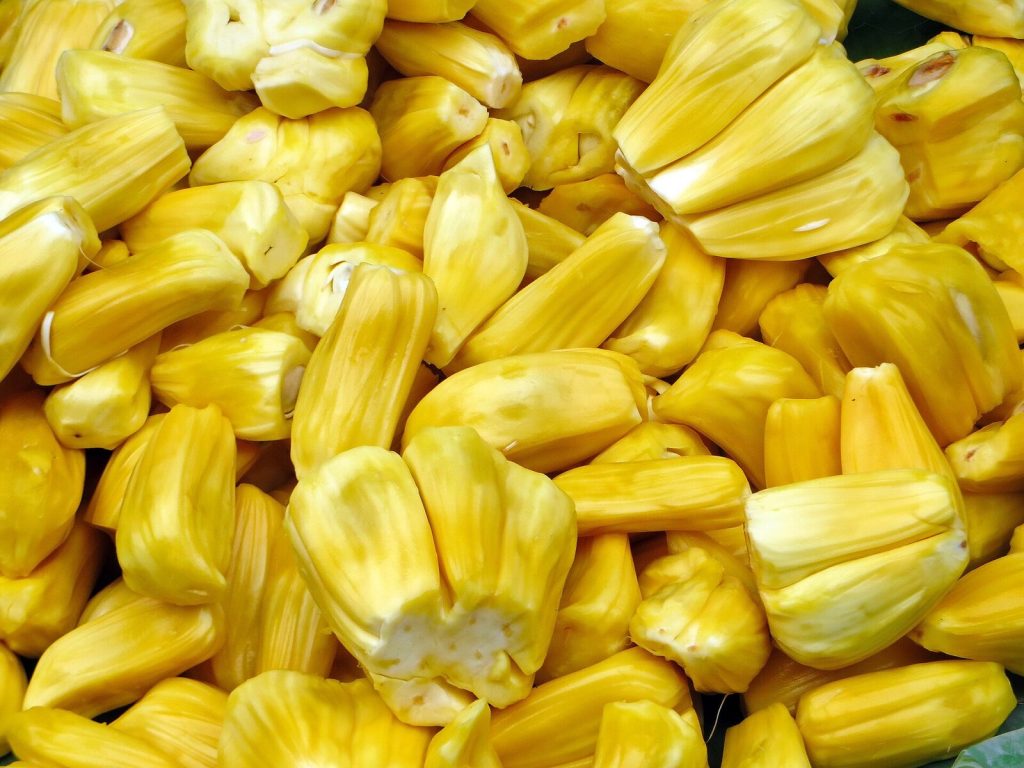
Jackfruit farming in Uganda is almost entirely a homestead activity, built on seedling trees that nobody selected, growing mostly in the central and eastern districts. A grafted tree can fruit in two to four years against two to eight from seed. The figures circulating for what one tree produces are wrong by two orders of magnitude, and correcting them changes what the crop is worth planting for.
What a Jackfruit Tree Actually Yields Per Year
Start here, because every plan built on the wrong figure fails at the same point. A peer reviewed Ugandan study on jackfruit repeats a widely quoted claim that the tree produces 700 fruits a year weighing between 2 and 50 kg each. Multiply it out: that is 1,400 kg at the low end and 35,000 kg at the high end, from a single tree, every year.
The standard regional monograph on the species does the same arithmetic on its own station data and rejects it in print. It gives potential yield estimates from experimental stations as roughly 100 to 200 fruits a tree, with extremes of 20 and 500, at 20 to 30 kg a fruit with extremes of 10 and 50. It then says those figures would add up to 2,000 to 4,000 kg a tree a year, calls them unrealistic, and gives the actual average as 70 to 100 kg a tree a year in Malaysia and the Philippines.
| Figure | Per tree per year | Status |
|---|---|---|
| 700 fruits at 2 to 50 kg | 1,400 to 35,000 kg | Circulating claim, not credible |
| Station potential estimates | 2,000 to 4,000 kg | Rejected by the source that prints it |
| Measured orchard average | 70 to 100 kg | The figure to plan from |
At 70 to 100 kg a tree and a 20 kg fruit, a mature jackfruit tree is producing roughly three to five fruits a year, not seven hundred. Put that through an orchard population and the numbers come out modest but real. At the monograph's spacing of 100 to 120 trees a hectare, which is about 40 to 49 trees an acre, the measured per tree figure gives roughly 2.8 to 4.9 tonnes of whole fruit an acre a year. Edible flakes are 25 to 40 percent of fruit weight, so that is somewhere between about 0.7 and 2.0 tonnes of saleable pulp an acre. Everything else is rind, core, latex and seed, and the seed has its own uses.
Nobody should plan a jackfruit block on 700 fruits. Plan it on three to five.
Uganda Publishes No Jackfruit Production Figure At All
There is a reason the inflated figure circulates unchallenged: there is nothing official to check it against. This is not a case of a figure being hard to find. The crop is not in the classification.
FAO's crop production dataset has no jackfruit item. Walking the item code list for the African file returns Bananas, Plantains and cooking bananas, Papayas, Mangoes with guavas and mangosteens, and residual lines, with no entry for jackfruit anywhere. The nearest home for it would be Other tropical fruits, n.e.c., and Uganda files no row under that item while 20 African countries report production under it. The only Ugandan fruit line outside bananas is a single residual, Other fruits, n.e.c., and it is worth looking at closely.
That residual line puts Ugandan production at between 52,415 and 52,532 tonnes on an area of between 7,901 and 7,913 hectares across six years. Every production and area value in it is flagged as imputed by a receiving agency and every yield value as estimated. Look at how little those numbers move: area varies by 12 hectares in six years and production by 117 tonnes. A series that holds that still is a model being carried forward, not a crop being counted.
Before treating that as a finding it has to survive a control, because a blank can just as easily mean the search failed. It survives. Walk the same file for Uganda's plantains and cooking bananas and the production values carry the official figure flag in three of the last four years. Uganda does file detailed numbers into this dataset when it has counted something. It has not counted jackfruit.
Trade data is the same story from a different angle. Jackfruit has no six digit tariff code of its own. It falls into the residual line for other fruit, fresh, which is coded 081090, and in the year checked Uganda's declared rows under that code carried about 2.5 million kg of imports and about 211,000 kg of exports. None of that can be attributed to jackfruit, because the code does not separate it. So there is no trade figure for the crop either, and anyone quoting one has invented it.
Against that, the one estimate the Ugandan literature does carry, relayed from a cited source, is that 0.3 million tonnes are produced per year per district in some of the higher producing regions. Test it. Uganda's entire imputed residual fruit line is about 52,000 tonnes. A single district at 0.3 million tonnes would be nearly six times the national residual, and a handful of such districts would make jackfruit one of the country's largest crops by tonnage. That claim does not survive contact with the only national numbers that exist, and this page does not use it.
Where Jackfruit Grows in Uganda and What the Trees Look Like
Jackfruit is grown in the eastern, central and western regions, with scattered trees in homestead gardens elsewhere. The two districts studied most closely are Kayunga and Luwero, both in the Lake Victoria basin of central Uganda, and both named in the Ugandan research record as major producing districts. Historically the tree went in as a shade tree around homesteads and in plantations rather than as an orchard crop, and that is still overwhelmingly how it sits on Ugandan farms.
A study of 100 trees across those two districts, sampled at least 30 m apart and restricted to trees their owners said had been bearing for seven years or more, gives the only detailed Ugandan description of the population. Tree height averaged 12.6 m in Kayunga and 12.2 m in Luwero, ranging from 7 m to 20 m. Variability was lowest in height, at a coefficient of variation around 20 percent, higher in crown diameter at 33 percent, and highest in trunk diameter at breast height at 41 percent.
The qualitative variation is wider still: tree vigour, trunk surface, branching density, growth habit, crown shape, leaf shape, fruit shape, fruit surface, flake shape, flake colour, flake flavour and pulp texture all varied. Oblong crowns, obovate leaves and irregular fruit shapes turned up only in Luwero. Most Kayunga fruits were strongly flavoured while Luwero's were intermediate. A separate study by forestry researchers describes Ugandan jackfruit in terms of four local types recognised by growers, soft, firm yellow, firm red and firm white, plus a further colour variant.
Every Ugandan Jackfruit Tree Is Genetically Its Own Variety
The genetic result from that study is the most useful finding on this page, and it is not obvious. An analysis of molecular variance across microsatellite markers found 81 percent of the variation within individual trees, 19 percent among trees within a population, and 0 percent between the two districts.
Zero between districts. Kayunga's trees and Luwero's trees are not distinct populations. What that says is that the whole Ugandan jackfruit population has been raised from seed and moved around freely, so no district holds a distinct type, and geography is not a guide to quality.
Two things follow, and they point in opposite directions from what a grower might expect.
Climate and Soil: Where Jackfruit Suits Uganda and Where It Does Not
Two reputable sources describe this tree's needs in ways that flatly disagree, and a grower deserves both rather than the convenient one.
The Ugandan characterisation study calls jackfruit a hardy, drought resistant tree that adapts to a wide range of agroclimatic conditions and survives in the poorest soils. The regional species monograph says the tree has poor cold, drought and flooding tolerance, with moderate wind and salinity tolerance, and performs best on deep, well drained, alluvial, sandy or clay loam soils at pH 6.0 to 7.5. Both are published. The reconciliation that fits the evidence is that jackfruit survives conditions it does not produce in, which is exactly why a neglected homestead tree stays alive while yielding three fruits.
On altitude the monograph is specific: the species was found mainly in evergreen forest between 400 and 1,200 m, and thrives in warm humid conditions below 1,000 m. Uganda's lowest point anywhere is 614 m, and most Ugandan cropland sits well above 1,000 m. Research stations in the central banana belt measure at around 1,156 to 1,210 m and one south western station at 1,405 m. So Ugandan jackfruit is growing inside the species' outer band and above its optimum, and the monograph names the consequence: fruit takes three months or more from fertilisation to maturity, and up to six months at higher altitude. Expect the long end here.
On rainfall the monograph asks for 1,500 mm or more annually with no prominent dry season. Uganda's national annual mean is 1,576.67 mm on the ERA5 reanalysis, which clears that threshold narrowly, and a second reading of 1,282.74 mm from a different gridded dataset, which does not. So the verdict on the total depends on which dataset you believe, and this page will not pick one. What both datasets agree on is the distribution, and the distribution is where the problem actually sits: December, January and February together carry about 14 percent of Uganda's annual rain in 25 percent of the year. That is a prominent dry season by this tree's standards.
The practical answer is not to abandon the crop but to water it while it is young. The monograph is explicit that additional watering may be needed during the first two years, and mulching helps conserve moisture through the dry season. A tree that gets through its first two dry seasons without a check is a different tree afterwards.
Raising Jackfruit Seedlings From Seed
Jackfruit is normally propagated by seed because vegetative propagation is difficult, and the seed has an awkward habit that kills most casual attempts: it must not dry out.
Take seed only from an outstanding mother tree and use the large seeds. Wash off the slimy coating thoroughly and remove the horny part of the pericarp, which improves germination. Sow fresh. If seed has to be held briefly, it keeps about three months at roughly 40 percent of its original moisture in an airtight container at around 20 C, and no longer. Lay the seed flat or with the hilum facing down. Germination starts within about 10 days and runs to 80 to 100 percent within 35 to 40 days.
Raise the seedlings under shade at 50 to 70 percent of full light. Then the part that most often goes wrong: pot them at the latest when they have four leaves, because older seedlings are hard to transplant, and the cleanest way around it is to sow one or two seeds directly into the container. Plant out while still young, usually under a year old, before the roots grow through the bottom of the pot. Disturbing the roots can kill the plant outright. At planting, provide shade and halve the leaves to cut water loss. Nursery practice in general is on the seedling nursery page.
Grafted Jackfruit Planting Material and the Years It Saves
This is where the establishment period, which is the whole shape of a perennial's budget, is actually decided.
Grafting jackfruit is possible and unreliable. Cuttings from forced etiolated shoots, air layering, patch and modified Forkert budding, and cleft and wedge grafting have all been used with variable results. Wedge grafting onto young vigorous rootstocks inside a high humidity chamber gives good results in Australia. The one method applied routinely at scale anywhere is suckle grafting, a form of inarching used in Thailand, where a decapitated potted seedling rootstock is inserted into a twig of a selected mother tree; take is high and it can be done at any time of year. Related species including chempedak and breadfruit also work as rootstocks.
Two Ugandan realities sit on top of that. The first is that there is no scheme to buy into. Look at what the ministry actually certifies and the answer is a short list of field crops, with fruit nowhere in it; regional plant health work reports the same blank across Eastern and Central Africa; and Ugandan researchers writing about this very crop end by recommending that nurseries be set up and certified. So no nursery here can show you a certificate for a jackfruit tree, and this page names none. The second is the gap the Ugandan research record identifies directly: growers want to plant the tree and lack elite germplasm. Grafting from a good local tree is, for now, how that gap gets closed on a Ugandan farm.
Spacing and Tree Population Per Acre for a Jackfruit Orchard
Orchard spacing is 8 to 12 m in square or hexagonal patterns, giving the usual density of 100 to 120 trees a hectare, which is about 40 to 49 an acre. Plant at the onset of the rains.
Those are wide spacings and the gap is usable. Jackfruit is planted as an intercrop and as a shade tree elsewhere in the tropics: in coconut groves in the Philippines, among durian in Malaysia, with mango and citrus in India, and as shade for coffee and black pepper. Young jackfruit orchards are intercropped with annual crops including banana, sweet corn and groundnut. Closely planted rows work as a windbreak. For a Ugandan smallholder the honest framing is that jackfruit is a tree you fit around an existing system rather than a block crop you clear land for, and the spacing is what makes that possible. Working the population out for a particular plot is on the plant population calculator page.
Feeding, Mulching and Pruning a Jackfruit Tree
Mulch conserves moisture through the dry season and that is the highest value input on a young tree. Fertilizer goes on twice a year, at the onset of the rains and before they end.
The rates in the monograph are foreign recommendations and are given here as such: from 1 kg of compound fertilizer per tree per application in Peninsular Malaysia to 2 to 3 kg in the Philippines. No Ugandan fertilizer recommendation for jackfruit could be found, and rather than invent one, the sensible course is to treat those figures as a bracket, start at the low end, and get a soil test before spending more. Soil testing is covered on the soil testing page, and farm made alternatives on the compost making guide.
Pruning is light. Thin the shoots when the tree is planted, then clear bearing branches enough to reach the fruit for bagging and harvesting. There is no training system to maintain, which is part of why the tree survives neglect. Extension growth on a mature tree is slow, around 3 to 5 cm a month, but close to continuous.
Bagging or weaving a coat around individual fruits, using palm leaflets for instance, deters rodents and fruit bats and draws ants that keep other insects off. On a tree carrying three to five fruits, bagging every one of them is a realistic afternoon's work and it protects a large share of the crop.
Jackfruit Pests and Diseases, and the Fruit Fly Link to Mango
Crop protection is not the main constraint on this species and few of its problems are specific to it. The ones worth recognising:
Bacterial dieback, caused by Erwinia carotovora, starts in growing shoots and moves downward until it kills the tree, and it is recorded as causing rising losses. Blossom rot, also called fruit rot, caused by Rhizopus artocarpi, blackens and rots the inflorescences and is put at 15 to 30 percent crop loss in Assam, with ants implicated in carrying the spores. Pink disease, Corticium salmonicolor, is prominent on jackfruit and the standard response is thorough removal of affected parts so the rainy season starts with low infection pressure. Various leaf spots occur.
Among insects, borers do the most damage: the shoot borer Diaphania caesalis tunnels into buds, shoots and fruit, and because the caterpillar pupates inside the tunnel, removing affected parts breaks the cycle. Bark borers are controlled by treating the holes. The brown bud weevil Ochyromera artocarpi is specific to jackfruit, with grubs in tender buds and fruit and adults feeding on leaves.
Then the one that matters most in a Ugandan setting. Fruit fly maggots infest jackfruit, and the species named in the monograph includes the fly now more usually written as Bactrocera dorsalis. That is the invasive fly which dominates Ugandan mango infestations: in Ugandan mango work, the invasive Bactrocera accounted for the large majority of flies recovered. A jackfruit tree standing in or near a mango orchard is another host for the same population, and that is a cost your neighbour pays alongside you. The control measures are the same ones the mango literature gives: bag the fruit, and never leave ripe or fallen fruit lying, because burying it deeply breaks the cycle. The Ugandan fruit fly picture is set out on the mango farming guide and the mango orchard management guide.
Harvesting a Fruit That Can Weigh Thirty Kilogrammes
Jackfruit gives four maturity signals and a grower should use more than one. A dull, hollow sound when tapped. A skin colour change from pale green to greenish or brownish yellow. A characteristic odour. And flattening of the spines with widening of the gaps between them. Cut the stalk with a sharp knife and lower the fruit carefully to the ground rather than dropping it, because a 20 kg fruit dropped from a 12 m tree is damaged fruit.
Shelf life is short and Ugandan growers already respond to it. The Ugandan literature records farmers making dried chips and wine to add value to a fruit that does not keep, and describes a wide gap between what is produced and what is marketed. Where supply runs ahead of demand elsewhere in the tropics, the flesh is separated from the seeds, washed, pressed and sun dried, with or without added sugar or syrup, and sold as dried candy.
Very little of the fruit is wasted if you plan for it. Edible pulp is 25 to 40 percent by weight. Seeds are numerous, up to about 500 in a well developed fruit at 3 to 6 g each, and are eaten boiled or roasted or ground into flour blended with wheat flour. Ugandan work reports the seeds being used as a nutrient source in poultry feeding and the young leaves being readily eaten by cattle and other livestock. The non edible portion is rich in pectin and suits jam making. Processing routes are on the dried fruit production page and the fruit juice processing page.
On composition, Ugandan forestry researchers report the country's jackfruit carrying high magnesium and calcium, with variation between the local types in vitamin C and other constituents. That is a statement about what is in the fruit and nothing more; this page makes no claim about what eating it does.
Why Jackfruit Stays a Homestead Tree on Most Ugandan Farms
The honest verdict, and it is the monograph's own rather than this page's invention, is that the prospects for jackfruit as a commercial crop at scale are poor where it has been tried at scale. The reasons listed are unpredictable yield in both quantity and timing, crop losses to pests and diseases, the strong odour, and a fruit so large it has little export potential. The same source puts jackfruit's financial return below carambola, durian and guava.
What it also says is that the gap between potential and actual yield is wide, and that closing it turns on one thing: general use of clonal planting material instead of seedlings, so that trees in a block behave the same way and a grower can time operations against a known phenology. That is exactly what Uganda does not have, and it is the same gap the Ugandan research record names when it says farmers want to plant the tree but lack elite germplasm.
So the realistic case for jackfruit on a Ugandan farm is not a plantation. It is a handful of selected trees, grafted from local material whose fruit you have tasted, fitted into an existing system where their shade and their wide spacing cost you little, bagged against fruit flies and bats, with the surplus dried or fermented rather than sold fresh into a market that cannot absorb a glut. On those terms it is a sound tree for sixty years. On plantation terms, with a yield figure of 700 fruits, it is a trap.
Frequently Asked Questions
How many fruits will one jackfruit tree give me a year? Roughly three to five, on the measured average of 70 to 100 kg a tree a year and a typical 20 kg fruit. The widely repeated claim of 700 fruits a tree is not credible: it would mean between 1,400 and 35,000 kg from one tree, and the standard monograph on the species rejects even its own station estimates of 2,000 to 4,000 kg as unrealistic. Plan on three to five.
How long before a jackfruit tree starts bearing? Two to four years from a grafted or otherwise clonally propagated tree, two to eight years from seed, and full production at eight to fifteen years. The wide seedling range is not vagueness, it is the actual spread you get when every tree in the block is a different genotype. The tree then lives sixty to seventy years.
Is jackfruit drought resistant in Uganda? Published sources disagree and both are given on this page. A Ugandan study calls it hardy and drought resistant; the regional monograph records poor drought tolerance and asks for 1,500 mm of rain a year with no prominent dry season. Uganda's December to February quarter carries only about 14 percent of annual rain, so the dry season is prominent by that standard. Treat the tree as one that survives drought and does not crop well through it, and water it through its first two dry seasons.
Where can I buy grafted jackfruit seedlings in Uganda? This page names no nursery and cannot, because Uganda operates no certified fruit nursery scheme. What the research record does say is that Ugandan growers want to plant the tree and lack elite germplasm. In practice that means identifying a local mother tree whose fruit you have eaten and having material grafted from it, rather than buying unknown seedlings.
What is jackfruit worth in Uganda, and can I plan a budget around it? No verified Ugandan farm gate price for jackfruit could be found, and there is a structural reason: the crop appears in no national production series and has no tariff code of its own, so no official price or volume exists to quote. What can be said is the shape of the budget. There is no income at all for the first two to four years on grafted trees and up to eight on seedlings, the holding costs through that period are weeding, watering, mulch and fencing, and the first saleable crop is partial. Price the fruit locally at the nearest market before planting, and check the prices section for related fruit as a guide. Any budget that shows jackfruit income in year one is wrong on the face of it.
Can I plant jackfruit among other crops? Yes, and it is the use that suits Ugandan farms best. Spacings of 8 to 12 m leave real room, and the species is used elsewhere as a shade tree for coffee and black pepper, as an intercrop in coconut and durian, and alongside mango and citrus. Young blocks are intercropped with banana, maize and groundnut. One caution: a jackfruit tree beside a mango orchard is another host for the same invasive fruit fly, so bag the fruit and clear fallen fruit.
Why do my jackfruit seedlings die when I transplant them? Almost certainly root disturbance, which the literature describes as potentially fatal for this species. Pot the seedling no later than the four leaf stage, or better, sow one or two seeds straight into the container. Plant out while the tree is under a year old, before roots grow out of the pot, and shade it and halve its leaves at planting.
Does Uganda have named jackfruit varieties? Not in any register. Growers recognise local types by pulp texture and colour, described in Ugandan research as soft, firm yellow, firm red and firm white plus a further colour variant, and those types do differ measurably in composition. But there is no Ugandan release record for the crop, no core collection in the country, and genetic work found no differentiation at all between the two main producing districts, so a name attached to Ugandan jackfruit describes a local type rather than a registered variety.
Current fruit prices move with the season and the district, so check the prices section before committing, and the suppliers section when you are looking for grafting material or nursery inputs. Other tree fruit options for the same ground are compared across the fruit farming hub, including guava, which the same monograph rates above jackfruit on returns.