
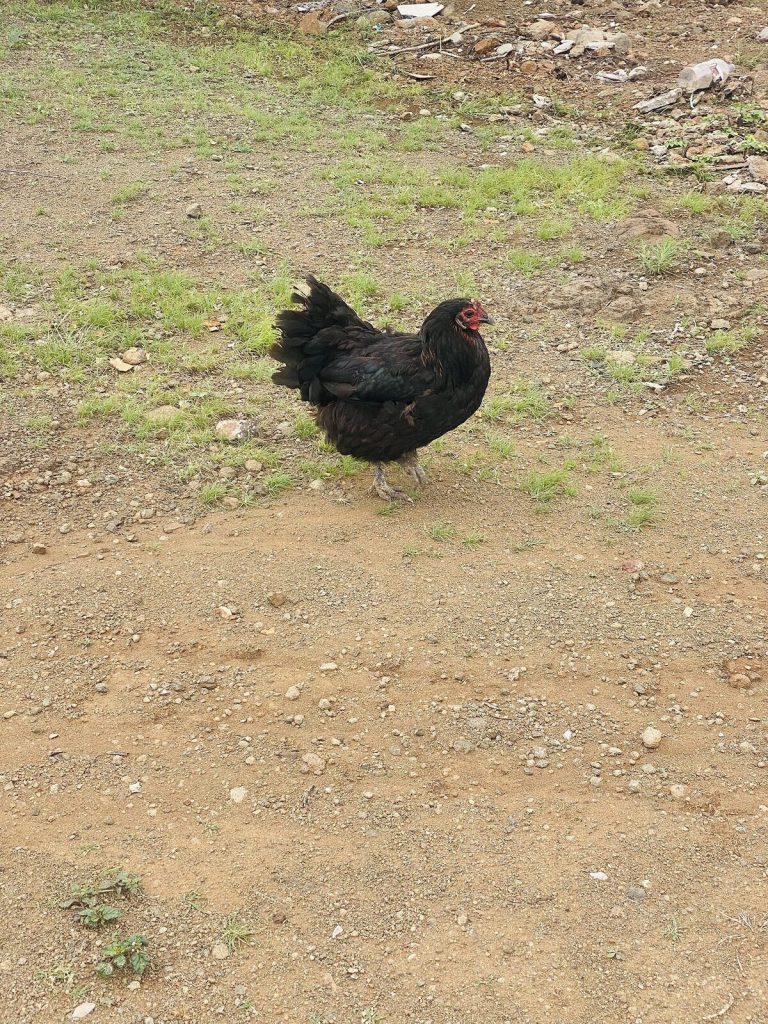
Kuroiler chicken farming raises a crossbred dual purpose bird for both meat and eggs, on management that sits between free range local chickens and fully confined broilers. Chicks have to be bought in from a hatchery for every cycle, because the bird is a first generation cross. The Kuroiler was bred by Keggfarms in India and came into Uganda through government and project distribution.
What the Kuroiler Breed Is, and Where Uganda's Chicks Come From
The Kuroiler is a hybrid, produced by crossing coloured broiler males onto Rhode Island Red females, or White Leghorn males onto Rhode Island Red females. Vinod Kapur developed it at Keggfarms in India and it went on sale in the early 1990s. The name is a contraction of Kegg and broiler. It was selected to look like the village chicken Indian farmers already kept, while gaining weight faster and laying more.
Uganda's route in ran through the state. Fertile Kuroiler eggs were flown from Keggfarms to Entebbe and hatched at the National Animal Genetic Resources Centre and Data Bank, which a Makerere University study on Kuroiler farming later described as the only Ugandan source of the true cross. From there the birds went out to households in trial districts, then into the wider chick trade. A farmer buying Kuroiler chicks in Uganda today is buying from a hatchery whose own parent stock traces back to that line.
Plumage varies a lot. Some birds come out barred and speckled, some reddish brown, some nearly black, and that variation is normal in a cross rather than a sign the hatchery sold you something else.
Why Kuroiler Farming Means Buying Chicks Every Cycle
This is the part most Kuroiler articles skip, and it decides your whole budget. A Kuroiler does not breed true. The field trial that introduced the bird to Ugandan villages, published in Livestock Research for Rural Development, put it bluntly: only the first generation performs, and in the generations after it, both egg output and weight gain fall away.
Set a Kuroiler cock over Kuroiler hens, hatch the eggs, and you get chickens. They will grow. What you will not get is Kuroilers, because the performance came from crossing two uniform parent lines and that combination is gone the moment the birds breed among themselves. The second generation drifts back toward something closer to an ordinary mixed flock, unevenly, bird by bird.
So the enterprise has a recurring input that local chicken farming does not have. Every meat batch, and every replacement laying flock, starts with a chick purchase. Growers who plan for that do fine. Growers who assumed they were buying breeding stock once are the ones who report, two years in, that their Kuroilers stopped performing.
Choosing Your Production Goal Before You Order Chicks
Dual purpose sounds like it removes a decision. It does not. You still have to pick what the flock is for, because the cock and hen sides of a straight run batch pull in different directions and the feeding follows from your answer.
Order a straight run batch and roughly half will be cockerels. Nobody will sex Kuroiler chicks for you reliably at the hatchery, so plan for both halves rather than hoping for pullets.
Brooding Kuroiler Chicks Through the First Weeks
Brooding is the same job for Kuroilers as for any chick, and the first three weeks carry most of the risk. The Makerere trial brooded its Kuroiler chicks artificially for three weeks over a charcoal stove, on wood shavings litter, with drinking water always available, and fed a commercial chick mash bought from a feed mill in Gulu that carried 20% crude protein, 3,000 kcal per kg of metabolisable energy and 1% calcium. That specification is worth holding onto because it is the only chick ration figure in the Ugandan Kuroiler research that can be traced to a named trial.
Heat first. Chicks cannot hold their own temperature, and a huddled pile under the lamp means they are cold while birds pressed against the walls mean they are too hot. Read the spread of the birds rather than a thermometer alone. Charcoal brooding works and it is what most Ugandan smallholders use, but it needs ventilation, because a closed brooder room on charcoal kills chicks quietly overnight.
Litter stays dry. Rake it. Caked litter under the drinkers is where coccidiosis starts, and a wet patch spreads faster in our humidity than most new growers expect. Our step by step guide to brooding chicks goes into the equipment and the temperature drop week by week.
Housing and Space for a Kuroiler Flock
Kuroilers carry more weight than local birds and move around more than broilers, which puts their space needs between the two. The Makerere trial ran its confined pens at three birds per square metre in open sided houses with wood shavings or groundnut husk litter. That is a research stocking rate rather than a commercial ceiling, and it is a sensible place for a smallholder to start.
Open sided housing suits the climate. What matters more than the wall material is that the roof does not leak onto the litter, the birds are shut in at night against predators and thieves, and there are perches, because Kuroilers will use them. Village households in the Uganda trial mostly gave night shelter and let the birds out in the morning, and in one northern district a chunk of farmers simply let their chickens roost in trees. That works until it does not.
Feeder and drinker space beats floor space for causing trouble. Too few feeders and the biggest cockerels eat first and the flock spreads out into a wide range of weights. Sizing the house properly is covered in our notes on house size against bird numbers.
Feeding Kuroilers: What Scavenging Can and Cannot Do
The Kuroiler was sold into Africa as a bird that would perform on very little, and that claim is why a lot of Ugandan farmers end up disappointed. The honest version is narrower. Scavenging keeps Kuroilers alive, and it lets them outgrow local chickens on the same nothing, which is a real gain for a household flock. Scavenging does not deliver the growth rates the promotional material quotes.
The Makerere on farm trial ran the two systems side by side in Gulu and Kiryandongo. Confined Kuroilers with feed and water always in front of them reached about 2,378 g at week 20. Free range Kuroilers on the same farms, fed whatever the household provided, reached about 1,829 g. Both beat the local birds in the same trial comfortably. The difference between them is your feed bill, and that is the trade you are making.
Maize bran is the backbone of smallholder poultry feeding in Uganda, and it is also the ingredient a national poultry feed survey found most contaminated with aflatoxin, averaging well above the 20 ppb guidance limit that survey measured against. Buy bran fresh, keep it off the floor, keep it dry, and do not use a musty bag on chicks. Full detail sits in the Kuroiler feeding guide and in our notes on using maize bran in animal feeding.
Kuroiler Growth and Egg Production Under Ugandan Farm Conditions
Two Ugandan studies give the growth picture, and neither matches the hatchery leaflets exactly.
Eggs are where the evidence thins. The Uganda field trial deliberately did not count Kuroiler eggs, because the trial flocks held Kuroilers and local hens together and the eggs could not always be told apart. The 150 to 200 eggs per cycle figure that appears on nearly every Kuroiler page traces back to breeder and programme material about the bird in India. Nigerian on station work under the African Chicken Genetic Gains programme did count them, across six dual purpose breeds at two test stations: Kuroiler hens laid their first egg at about day 120, averaged 54 g eggs, and produced 127 eggs per hen housed over 364 days. The same trial rated Kuroiler better cast as a meat bird than as a true dual purpose one, because three of the five breeds it was tested against laid more.
Now the part that should stop anyone planning on a number. On the Kuroiler against Sasso comparison, two African trials point opposite ways. A Tanzanian study from its national livestock research institute and Sokoine University put Kuroilers behind Sasso on egg numbers while ahead on survival. The Nigerian on station trial found the reverse and by a wide margin, 127 eggs for Kuroiler against 75 for Sasso, with Sasso the weakest layer of the six breeds tested at 7.6 kg of feed per dozen eggs against 2.9 kg for the best of them.
Two trials, two countries, opposite directions on the same question. That is not a contradiction waiting to be resolved, it is the finding: this comparison depends on conditions, and the Nigerian authors said as much, reporting that the interaction between breed and environment mattered for every trait they measured except egg weight. Neither result transfers cleanly to a Ugandan village, because one is a Nigerian research pen and the other is a Tanzanian trial on Tanzanian management. Anyone picking between these birds on published egg numbers is deciding on evidence that does not replicate, and the only figure that settles it is what the birds do on your own farm.
Worth knowing that the same Nigerian programme also ran the breeds on farm, with 2,100 smallholders keeping about thirty birds each under backyard scavenging. There, Kuroiler sat among the top three of six breeds on hen day egg production, yet came out below Sasso and most of the locally bred breeds once growth, laying and survival were ranked together. Same programme, same country, a different answer under scavenging than in a pen.
None of that makes the Kuroiler a bad layer for a household. It does mean you should budget on meat and treat the egg number as an upside rather than a plan. Our week by week Kuroiler weight figures set out the full table and what management level it assumes.
Disease Risk and Flock Health on Ugandan Kuroiler Farms
Kuroilers are not disease resistant. They tolerate rough conditions, which is a different property. In the Uganda village trial every death recorded was put down to management rather than an outbreak, and the reason there was no outbreak is that every bird in the trial had been vaccinated before it went to a household. Farmer surveys in northern Uganda name Newcastle disease as the main killer of village chickens, and chicks as the age group that dies most.
Vaccination is the part worth getting right and the part worth getting help with. Ask the hatchery exactly what your chicks were given before delivery and on what days, because that determines what you still owe them. Never guess a dose, a route or an interval from a web page. The schedule, the product label and a veterinary officer who knows your area settle it between them. Our Kuroiler vaccination schedule sets out the standard Ugandan programme, A district veterinary officer is the right person to settle it.
Biosecurity does more for a smallholder flock than any drug. Keep new birds away from the flock for a fortnight. Keep visitors out of the house. Do not carry feed sacks that sat in another farmer's poultry house. Losses and their causes are broken down in our guide to poultry mortality and how to prevent it.
Selling Kuroiler Meat and Eggs: Who the Buyers Are
The Kuroiler sells into the local chicken market, not the broiler market, and that is the single most useful thing to know before you stock. Buyers who want a firm textured bird for a slow cooked dish will pay a premium over a broiler and will accept a Kuroiler, because it looks like a village chicken and eats like one. Village farmers in the Uganda trial were asked to compare: about 79% said Kuroiler meat tasted better than local chicken meat, 75% said it was softer, and 91% preferred its meat to bone ratio.
Softer is worth noticing. Some buyers want the firmer local bird, and a trader who resells to that customer may argue about your Kuroilers. Test one small batch with your intended buyer before you scale.
Eggs from Kuroilers are larger than local eggs, which 92% of trial farmers observed, and they sell through the same channels as any other egg. Live bird sales at the farm gate, local butchers, hotels and restaurants, and weekly markets all take Kuroilers. Farm gate and retail are different numbers, and the gap widens the further your buyer sits from the farm.
Common Mistakes in Kuroiler Farming in Uganda
The mistakes repeat, and none of them are exotic.
Believing the free range promise and then blaming the bird. A Kuroiler on scavenging alone grows like a good local chicken, not like the leaflet. Feed it or accept the slower timeline, but do not expect both.
Planning to breed replacements. Covered above, and it is the expensive one.
Buying chicks from whoever is cheapest. The performance you are paying for is genetic, and a seller who cannot say where the parent stock came from cannot say what you bought. Our directory of where to buy Kuroiler chicks is the place to start comparing.
Skipping vaccination because the birds look healthy. Newcastle does not announce itself.
Feeding stale maize bran. Aflatoxin depresses growth long before it kills anything, and the flock that "just never did well" is often a feed store problem. Storing feed off the floor, dry and in rotation is cheaper than replacing a flock.
Starting at 500 birds. Run 50 first. Learn where your own losses come from. Kuroiler farming sits inside the wider picture our poultry farming hub covers, and the comparison that decides most first orders is set out in Kuroiler against local chicken and Kuroiler against broilers.
Kuroiler Chicken Farming in Uganda: Frequently Asked Questions
Can I hatch my own Kuroiler chicks from my flock? You can hatch chicks, but they will not be Kuroilers. The bird is a first generation cross between two uniform parent lines, and that performance does not pass on. The Uganda field trial found output declining generation by generation. Replacement chicks come from a hatchery each time.
How long before a Kuroiler is ready to sell for meat? Ugandan on farm research puts confined Kuroilers near 2.4 kg at week 20 and free range birds near 1.8 kg. Most growers sell cockerels somewhere between week 16 and week 22, and the date you pick depends on feed budget and what your buyer wants rather than on a fixed cycle.
How many eggs will a Kuroiler hen lay? Breeder and distribution programme material quotes 150 to 200 per laying cycle. No Ugandan trial has ever counted them. The one independent African count found, from Nigerian on station work, recorded 127 per hen housed over 364 days in research pens, which is below the promoted figure and above what most Ugandan backyard flocks will see. Laying starts around week 25. Plan on meat income and treat eggs as a bonus.
Do Kuroilers really survive on kitchen waste? They survive, and they outgrow local chickens on the same scavenging, which is the genuine finding from the Uganda village trial. They do not reach the promoted weights that way. The Makerere trial measured roughly 550 g less at week 20 for free range birds against confined ones.
What does it cost to start a Kuroiler flock in Uganda? Chick, feed and equipment prices move with the season, the supplier and how far the feed has travelled, so there is no one figure worth quoting. Current numbers sit on our Kuroiler chick price page and poultry feed price page, and a worked budget for a larger flock is in the cost of raising 500 Kuroilers.
Are Kuroilers more profitable than local chickens? Usually yes on meat, because they reach a sellable weight sooner on the same management, and the trade off is the recurring chick cost and a heavier feed demand. Whether that nets out depends on your feed price and your buyer. The poultry feed requirement calculator and our poultry profit calculation walkthrough let you run your own numbers rather than borrow someone else's.
Are Kuroilers resistant to Newcastle disease? No. Nothing in the research supports that, and the Uganda trial avoided outbreaks by vaccinating every bird beforehand. Newcastle is the disease Ugandan village poultry farmers name most often as the cause of death. Your vaccination plan comes from the hatchery, the vaccine label and a vet, never from a general article.
Can Kuroilers be mixed with local chickens in one flock? They were, throughout the Uganda field trial, and it worked. The practical snag is telling the eggs apart and knowing which birds are eating the feed you bought. Separate them if you want to measure anything.
Before you order, get a current chick price and a current feed price from more than one supplier in your own district, and ask each hatchery where its Kuroiler parent stock comes from and what vaccinations the chicks leave with. Our supplier and price pages are updated as new figures come in, and a district veterinary or extension officer will confirm what the local disease picture asks of your flock.