
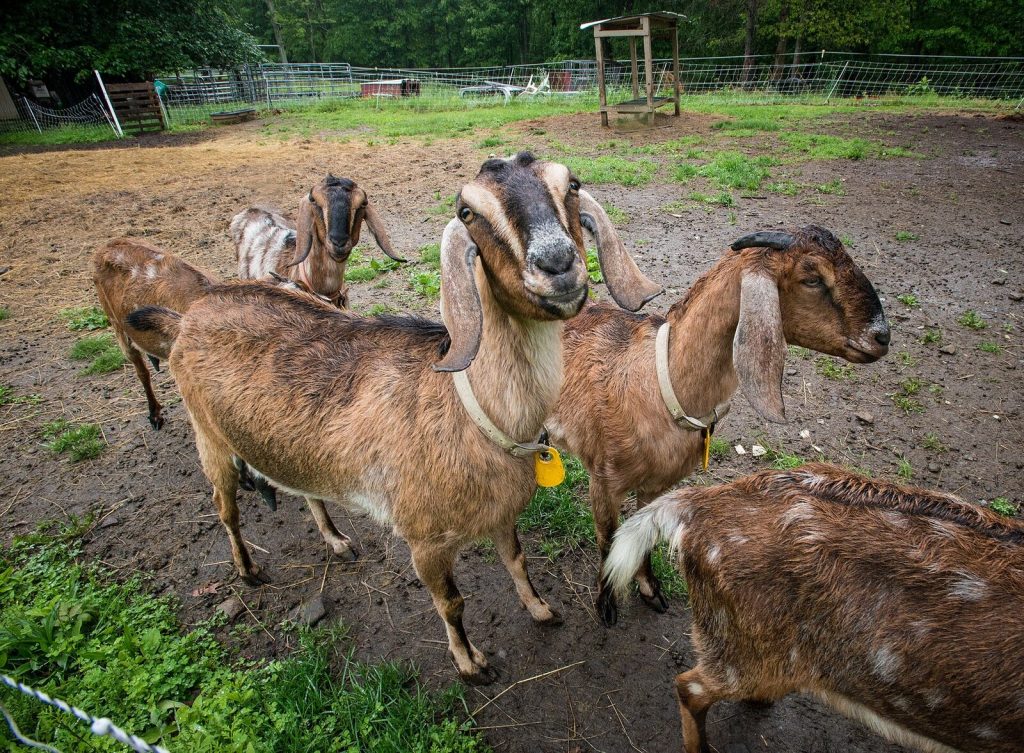
A Ugandan doe weans roughly one kid a year. Most published goat farming advice in Uganda assumes twice that, and a plan built on the higher figure overstates what the herd will produce by about sixty per cent. Goat keeping still works here, on browse the farm already has and with very little cash going out, but it works as a slow growing asset rather than as a fast one.
What a Ugandan Goat Herd Actually Produces in a Year
The number that decides everything else is kids weaned per doe per year, and Ugandan measurement puts it at about one. Mubende goats in village systems were recorded with a parturition interval of 297 days, which is about 1.23 kiddings a year rather than two, and kid losses before weaning in village flocks across African studies run from roughly a fifth to over two fifths. Work those together and a doe produces somewhere between 0.85 and 1.35 weaned kids a year. The arithmetic behind that band, and what it does to a margin, is set out on the goat farming profit calculation.
Two kiddings a year would need a kidding interval of 182 days or less. Nothing in Ugandan data supports it, and any guide that promises it is describing an animal that has not been measured here. Uganda's own national genetics agency lists a fast flock build up among the reasons to keep goats, on the grounds of a short generation interval, a short kidding interval and a litter size above one, and all three of those are true relative to cattle. Relative to the other small livestock enterprise a Ugandan farmer chooses between, they are not: a sow is reported at 16 to 20 piglets a year against a doe's one weaned kid.
That is not an argument against goats. It is an argument about what kind of enterprise this is. A goat herd is cheap to open, costs almost nothing in cash to run on browse, and grows in value as animals rather than in income as sales. Whether that suits you depends on whether you need money this year or a herd in five, and the cost of starting goat farming works through what the opening looks like at three herd sizes.
Uganda's Indigenous Goat Breeds, Measured Against Each Other
Uganda has three indigenous goat types that appear in its own research: the Small East African, the Mubende and the Kigezi. A controlled trial run at a Ugandan zonal research institute compared twelve males of each, bought from smallholder farmers in Arua, Mubende and Kabale at about seven months old, and it is the only Ugandan dataset that puts the three side by side on weight and on worm resistance at the same time.
On size, the order was clear. Mubende goats reached the highest live body weight at about 18.6 kg and the highest carcass weight at about 7.7 kg. Kigezi came next at roughly 14.6 kg live and 5.8 kg carcass. Small East African goats were lightest at about 11.2 kg live and 4.4 kg carcass. All three differed from each other by enough to matter.
| Indigenous breed | Live weight | Carcass weight |
|---|---|---|
| Mubende | About 18.6 kg | About 7.7 kg |
| Kigezi | About 14.6 kg | About 5.8 kg |
| Small East African | About 11.2 kg | About 4.4 kg |
Those figures let you check something worth checking. Dividing carcass weight by live weight gives a dressing percentage of about 39 to 41 per cent across the three Ugandan breeds, which sits at or just below the bottom of the 40.7 to 45.1 per cent range measured across local African goats. It is a useful anchor, because breeder claims of a goat yielding 35 kg of carcass from 45 kg of live weight imply a dressing percentage of 78, and no goat dresses at that. The profit calculation page works through why that particular claim fails on three separate grounds.
On worms the result is the one that should change a buying decision. Every one of the three breeds lost weight under an experimental challenge with Haemonchus contortus, which the paper names as the most prevalent gastrointestinal nematode in Uganda. Mubende lost the least and held the highest packed cell volume, which is the blood measure that tracks how well a goat tolerates a blood feeding parasite, so Mubende came out as the most resilient of the three. Kigezi lost the most weight and carried the highest worm egg counts. Small East African had the lowest packed cell volume.
Read that carefully, because it says something different from what is usually claimed. No Ugandan indigenous breed is worm proof. The best of the three merely loses ground more slowly. A guide describing a local breed as thriving in the harshest conditions is describing hardiness that is relative, not absolute, and the breed with the reputation for coping in rough mountain country was the one that coped worst with the country's commonest worm. Breed by breed detail belongs on best goat breeds in Uganda.
Exotic and Crossbred Goats, and the Backcross Rule That Protects the Herd
Uganda's national genetics agency groups the goats available here into local goats, exotic dairy goats and exotic meat goats, and publishes merits and demerits for each rather than selling any of them. Local goats are credited with tolerance to worms, good disease resistance, adaptation to the local climate, fair meat conformation and high prolificacy, against very little milk that dries quickly and slow growth. The exotic dairy types it names are Toggenburg, German Alpine, Anglo Nubian and Saanen, credited with fast growth and two to four litres of milk a day lasting many months, and marked down for worms, weak disease resistance, distress in heat, and thin condition. The exotic meat types are Boer, Savanna and Kalahari Red, credited with fast growth, good meat and good conformation, and marked down for worms, for doing badly on wet ground, for weak disease resistance, and for milk that stops early.
Note what the agency that supplies improved genetics says about them: three of the four demerits on both exotic groups are about disease and weather. That is the honest basis for a crossbreeding decision, and the Boer goat farming page goes into what a Boer type actually needs.
Crossbreeding is described as the quickest route to improving a trait, and it comes with one rule that is easy to get wrong and expensive to undo. Do not cross two first generation crosses together. Mating an animal that is half improved with another that is half improved produces genetic segregation, and the improvement falls apart in the next generation, which the agency notes is exactly what many farmers do because the first crosses look so good. The route that works is a backcross ladder: a first cross male is castrated and fattened or sold for slaughter, a first cross female is bred back to an improved sire, and each backcross halves the local fraction that remains. That gives roughly 50 per cent, then 75, then about 87 or 88, then about 94 per cent of the improver breed, never quite reaching 100.
Count the crosses rather than trusting a generation label. The agency's own document gives the same ladder of percentages but labels the generations inconsistently, so a written record of who was bred to whom is the only reliable way to know where an animal sits. That record is also what a buyer of breeding stock is paying for.
Why Goats in Uganda Breed All Year Round
Here is an advantage of Ugandan goat farming that almost no guide mentions, and it comes from geography. Uganda sits on the Equator, so there is no meaningful change in day length through the year. Uganda's national genetics agency draws the conclusion explicitly: non seasonal goat breeds exist and photoperiod does not gate breeding here.
Temperate goat literature is full of seasonal breeding, autumn mating and spring kidding, because day length triggers the cycle in those latitudes. None of that constrains a Ugandan farmer. What does constrain you is feed supply and market timing, and both are controllable. If you want kids on the ground when browse is plentiful, or goats finished for a particular festival, you can plan the mating date rather than waiting for a season. That is what makes the synchronisation method below worth the trouble.
It also means that a run of failed conceptions in a Ugandan herd is not seasonality. It is body condition, a buck problem, or disease, and each of those has a different fix.
Buying Foundation Goats, and Why Not From an Open Market
Uganda's national genetics agency officer for small ruminants gives one piece of buying advice above all others: get your foundation breeding stock from a known breeder and not from an open market. The reasoning is blunt. Goats in open markets are on their way to slaughter, which means the seller has picked out the animals he wants rid of: does with reproductive problems, animals with repeated health trouble, difficult ones, old ones. Buy a starting flock there and you have bought somebody else's problems and paid for the privilege.
What to look at during selection, on the same guidance: age at sexual maturity, prolificacy, litter size, and the economically useful traits for whatever you are producing. Does and bucks should both be examined before the breeding season, and a breeding soundness evaluation by a veterinarian is advised before you pay for any buck. Poor general health causes loss of libido and infertility, so an animal in visibly poor condition is not a bargain waiting for better feeding.
The sire matters more than most buyers assume, because there is a strong genetic relationship between a buck and the daughters he produces, and a careless buck purchase introduces faults across the whole herd at once. Price bands for local does, crossbred does and exotic bucks, and what moves them, are handled on the cost of starting goat farming page and the living goat price page. New arrivals of any kind should be screened and kept apart before they mix with the flock.
Land, Browse and the Stocking Rate Per Acre
Land is the largest capital item in a browsing goat enterprise, and the stocking figure is where Ugandan advice goes most badly wrong. Start from the number the state itself plans with. In its enterprise calculator, Uganda's national animal genetics agency treats grazing as a capital expense of 0.25 acre for each goat each year. Four goats to the acre, in other words. Guidance circulating here that puts twenty to thirty goats on that same acre is asking the land to carry five to seven times what the agency budgets for, and the sequence that follows is predictable: the browse is stripped, the goats get thin, and the keeper starts buying feed. Bought feed is where goat margins die.
Very few Ugandan goats are on fenced grazing in any case. The rope dominates: official figures put tethering at 60 per cent of goat keeping nationally, and a study in Buyende district found it at 90 per cent of households, with the full four way breakdown by system set out on the startup cost page. Each system puts the money somewhere different. A tether costs almost nothing to buy and a labour hour every day forever. A fence costs a lot once and gives that labour back. Zero grazing converts the whole enterprise into a feed bill. Pick the system before you count the goats, because that choice moves your budget further than herd size does.
Land pays for itself in a browsing enterprise only if the browse is there. Ugandan goats were recorded using 48 plant species, dominated by trees and shrubs rather than grasses, and an ecological survey of the same area found that the species farmers named as most preferred were among the least abundant on the ground. The feed the enterprise depends on is the feed that is running out. Planting fodder trees is land improvement rather than a feeding tactic, and the rent or buy decision is taken apart on how much land a farm needs and on renting land against buying it.
Goat Housing and the Space Each Class of the Herd Needs
A goat house protects against weather, predators and theft, and Ugandan guidance asks for it to be well ventilated, well lit, easy to clean, draught free at the level of the animals, and drained so the floor stays dry, with a waterproof roof and an exercise yard attached. Space per animal is published by class: kids 0.5, non pregnant nanny 1.5, pregnant nanny 1.9 and buck 2.8 square metres, with an exercise yard of 2 by 5 metres for bucks and 1.5 by 4 metres for nannies.
Two things follow from those figures that guidance elsewhere gets wrong. First, a single blanket figure per goat cannot be right, because a buck needs almost six times what a kid needs. Advice that gives one number, or that gives two different numbers in different sections of the same article, has not been costed against a real herd. Second, a herd does need divisions. Bucks, pregnant does, dry does and kids go in separate spaces, and the reason is not tidiness: Ugandan guidance says to wean male kids earlier than females because the males mature early, and an undivided pen is how a herd inbreeds itself.
The maintenance instruction is the one most often skipped. The goat house must be cleaned daily, immediately after the animals go out into the exercise yard, because accumulated droppings and urine predispose goats to respiratory infection. That is the mechanism, and it means a raised or well drained floor is a help rather than a substitute for the shovel. Construction detail and materials sit with the goat housing guide.
Feeding Goats on Browse, and the Hours That Set Intake on a Farm
A goat on browse is not eating a ration, it is eating for a number of hours, and Ugandan guidance expresses the requirement both ways. For a stall fed animal, dry matter intake is put at 3 per cent of live body weight. For animals in extensive rearing, one national genetics agency document asks for effective browsing of six hours or more each day, while another from the same agency puts feeding on shrubs at about four to six hours, with the hours increased where the grazing area is mostly short grass. Take the longer figure and you clear both.
The agency adds a proportion that is more useful than either: in normal conditions goats should browse for at least 60 per cent of their feeding time. That converts a vague instruction into something you can watch. A goat spending most of its day on short grass is a goat being fed the wrong thing, whatever the hours say, because browse carries more protein and less fibre than grass or crop residues.
There is also a timing rule that costs nothing and is easy to get wrong. Take adult goats out to graze after the dew has gone, which in most parts of Uganda means between about eleven in the morning and one in the afternoon, both to cut worm pick up and to avoid lesions on the muzzle. Leave kids behind in the shelter or in a clean paddock kept for them while the flock is out, because their immune systems cannot handle contaminated pasture; they can start nibbling grass at about three weeks. Quantities, seasonal supply, the by products that are dangerous in quantity and why bought concentrate usually loses money are all covered on goat feed requirements and the goat feeding guide.
Mating, Synchronisation and the Buck to Doe Ratio in a Breeding Herd
Do not rush young goats into breeding. Ugandan guidance puts sexual maturity for a well fed female at at least eight months to a year and for a male at about a year, and it separates that from readiness: a herd categorisation used on Ugandan breeding farms treats females of 8 to 14 months as nannies mature enough to be mated, with does being those that have kidded at least once from 14 months on. Set that against what regional work actually measured, an age at first kidding of roughly 549 to 663 days for indigenous and crossbred does and you can see the gap between the plan and the outcome. The official categories assume a first kidding at around thirteen to nineteen months; the measured figure is eighteen to twenty two. The difference is feeding and management, not biology.
Most Ugandan breeding farms run an assortative mating scheme, and it is worth copying because it concentrates the work. Breeding females are selected at the start of the year, flushed, and a chosen buck runs with that group for about 45 days, which is long enough for nearly every female to be served including the ones that repeat. The buck is then withdrawn and the pregnant group is managed separately. The stated ratio is one buck to 25 to 35 females, and higher for an experienced mature buck.
Feed the buck for about eight weeks before you use him, because sperm production and maturation take more than 56 days, so a buck put to work straight off poor grazing is working with sperm formed while he was underfed. On the female side, lift feeding roughly two weeks before mating and keep it up for at least two weeks after, which raises ovulation and reduces early embryo loss. Then supplement again in the last six weeks of pregnancy. Mating management in detail belongs on the goat breeding guide.
One warning that sits underneath all of it. A doe underfed during pregnancy gives birth to a female kid at risk of a non functional reproductive tract and a male kid with fewer muscle cells, and no amount of feeding afterwards recovers either. Pregnancy feeding is building the next generation's capacity, not just this kid's weight.
Kidding and Kid Survival in the First Four Months on the Farm
Kid mortality is where a Ugandan goat herd loses its growth. Village flock losses before weaning across African studies run from about a fifth to over two fifths, against the 10 per cent that Uganda's own enterprise calculator assumes, and that gap is the difference between a herd that compounds and one that stands still.
The routine Ugandan breeding farms use is specific and most of it is free. Someone opens the house between six and seven in the morning and checks that every kid in the flock has suckled enough, because one of the leading causes of kid death is low blood sugar from simple starvation when a kid has not fed. A rejected kid is put on a surrogate mother, or bottle fed on cow milk if no surrogate can be found. Kids born overnight are weighed, and the afterbirth is disposed of properly. New mothers stay close to their kids for at least the first 24 to 48 hours, with a nearby paddock or cut feed brought to them for three or four days after kidding so they do not have to leave.
Weighing at birth is not paperwork. It is the basis on which future breeding bucks are selected, and Ugandan guidance sets a hard threshold: a male kid weighing under 2 kg at birth should not be used for breeding and is a candidate for castration later. Breeding bucks are then weighed every two weeks for the first three months and monthly for at least a year, so that selection runs on measured daily gain rather than on looks.
Feeding the kid follows a sequence. Introduce good feeds and concentrates in the third week, with clean water always available. At about two and a half months halve the daily intake, and wean two to four weeks after that. Does can be vaccinated against clostridial infection somewhere between three and six weeks before kidding to raise kid survival, and the interval differs between two documents from the same agency, so confirm it with your vet. Where many does kid at once, watch that every kid gets enough milk.
Goat Herd Health: Worms First, and a Vaccination Calendar That Disagrees With Itself
Worms come before everything else in a Ugandan goat herd. Haemonchus contortus is named as the most prevalent gastrointestinal nematode in the country, the Ugandan breed trial showed every indigenous breed losing weight under challenge from it, and helminthiasis is named among the main causes of poor goat productivity here. The grazing system is the exposure: tethered and free ranging goats pick worms off contaminated ground, which is why the instruction to graze after the dew has gone earns its place.
The routine treatments Ugandan guidance sets out are frequencies rather than prescriptions, and they are published here as frequencies only. Deworming every three months. Tick control by spraying or dipping at least weekly. Hoof care by trimming, with immersion in copper sulphate or formalin depending on what is available. Coccidiosis is named as the cause of most diarrhoea in kids and is treated in goats between one and six months of age, with the dose set by the area veterinarian rather than by any document. Breeding animals are screened annually against diseases that cause abortion and reproductive failure, and new entries are screened and isolated before mixing.
Two of those instructions carry a resistance logic worth learning, because it is the difference between a treatment that keeps working and one that stops. Faecal egg counts are used to decide which dewormer to use at a given moment, and regular analysis of the dip wash is used to decide which acaricide, precisely to avoid resistance building up. Rotating blindly is not the same thing as testing.
Peste des petits ruminants deserves its own note, because Ugandan exposure to it is uneven in a way that carries a lesson. Blood sampling of unvaccinated flocks along the cattle corridor found the pastoral system several times more exposed than the mixed crop and livestock system. So movement and mixing raise the risk rather than reducing it, and any advice built on the opposite has the evidence upside down. That matters because the claim is nearly always offered as a reason to spend nothing at all on housing or health. Treatment, signs and the calendar itself belong on common goat diseases, deworming goats and the when to call a veterinarian, with the schedule itself on the livestock vaccination calendar. Mineral licks should be available at all times, which is covered under mineral supplements for livestock.
One last item that Ugandan guidance includes and most goat articles omit entirely: the people. Stockmen should be screened and treated for tuberculosis and other zoonotic disease at the point of hire, and a herd health plan is expected to carry safety precautions for staff against brucellosis and tuberculosis. A goat enterprise has a human health dimension and it runs in both directions.
Farm Records, Identification and Selecting the Next Goat Generation
Ugandan guidance treats records as the backbone of a breeding herd rather than as administration, because selecting the parents of the next generation depends on knowing what this generation did. Identification comes first, and the recommendation is printed ear tags with permanent ink set in a groove rather than hand written ones, with a numbering system that carries information. The worked example is a five digit tag combining year of birth, a digit for sex, and the order of birth in the whole flock, so a male born in a given year as the twenty third kid reads as that year, a one, and twenty three. A breeding farm also needs codes for breeds and blood percentages, which is what makes the backcross ladder traceable.
Herd categorisation is the other half, and it is a labour organisation tool as much as a breeding one. Ugandan breeding farms divide the flock into kids from birth to four months, growers from four to eight months with females separated from males and unwanted males castrated for later fattening, nannies from 8 to 14 months, does from 14 months and beyond, a buck stud, and a sick bay. The kid group is described as the most important, because the future breeding animals come from it, and some farms give it a dedicated attendant.
On staffing, one figure is published and it is useful for anyone thinking about scale: one stockman should look after no more than 100 goats. Hire someone who can read and write, because the records they keep are what the breeder makes decisions from, and set out the daily routine at the point of hire so performance can be judged against it. Uganda's national genetics agency can register goats and enter them in the national stud book, which is the formal end of the same discipline. Templates are on the livestock record keeping template and the habit is covered in the farm record keeping guide.
Selling Ugandan Goats: Farm Gate, Traders and a Pilot Export Zone
The Ugandan goat market is informal and middlemen dominate it. Market information is scarce, and for most producers sales happen at the farm gate, which means the farmer is usually a price taker negotiating alone against someone who trades every week. Four channels are named in Ugandan guidance: individual traders buying for resale in urban markets, private abattoirs and butcheries wanting volume and consistent quality on time, government and non government restocking programmes buying breeding stock and paying competitive prices, and export demand in the Gulf states and other African countries with stricter requirements attached.
On export, it is worth being precise about what exists. Uganda's agriculture ministry runs a goat export project whose stated objectives are to supply improved indigenous and exotic germplasm to farmers in a project area as a springboard for establishing a pilot goat export zone, to set up open nucleus breeding herds with a systematic crossbreeding programme producing meat goat types for fattening, and to improve management so that quality goats are available for internal and export markets. A pilot export zone is an intention, not a market you can sell into next month. Treat export demand as a reason the ministry is investing in genetics rather than as a buyer waiting at your gate.
The three channels that do pay for weight and consistency are the abattoirs, the restocking programmes and export, and all three reward the same thing: animals that arrive in predictable numbers at predictable weights with records behind them. That is where collective marketing earns its keep, because a group can fill an order one smallholder cannot, can hold members to a standard, and can buy inputs at a better rate. How that works in practice is on how agricultural cooperatives work and how farmers should price produce. Finishing bought in goats for these buyers is a different enterprise from breeding and is covered on goat fattening business.
Goat milk is the revenue line to be most careful about, and the reason is cultural before it is agricultural. A review of goat production across this region records that cheese and butter have never been made from goat milk here as a matter of custom, so there is no established processing chain and no habit of buying the product. Ugandan reporting puts the market side plainly: goat milk has no real market here yet, which is itself the reason hardly anyone keeps dairy breeds. A budget resting on yoghurt and cheese sales is resting on demand nobody has demonstrated in Uganda, whatever is happening in other countries.
Goat Farming Questions Ugandan Farmers Ask
What land does a goat herd need in Uganda? Budget it the way the national genetics agency does, at a quarter of an acre for each goat each year, which comes to roughly four goats an acre once the kids are counted in. Acreage at three herd sizes is tabulated on the cost of starting goat farming.
How much money does it take to start? Less than an equivalent pig unit, because the feed bill that sinks a pig enterprise barely exists on browse, and the two large items are land and the breeding females. The startup page derives opening bands at five, ten and twenty does and refuses to price land or fencing, which vary by district by an order of magnitude. Prices for does, bucks and building materials move by season and by district, so get local quotes rather than working from any published total.
Which goat breed is best for Uganda? For meat off browse with low inputs, the Ugandan trial data favours Mubende among the indigenous types, on both weight and resilience to the country's commonest worm. Exotic meat breeds grow faster, and the state genetics agency marks them down on three counts that all bite hardest on a tethered animal: worms, wet ground and weak resistance to disease. They suit a managed unit. There is no worm proof breed.
How many does per buck? One buck to 25 to 35 females, and more for an experienced mature buck. Have a vet do a breeding soundness evaluation before you pay for him.
Is there a market for goat milk in Uganda? Not a reliable one at present. Ugandan reporting says goat milk is not yet marketable here and few farmers keep dairy breeds for that reason. Plan on meat and breeding stock, and treat any milk as household nutrition rather than income.
How fast will my herd grow? Slower than the compounding figures you will see. At about one weaned kid per doe per year, and with every retained female kid being a sale you did not make, herd growth and cash income are in direct competition. The five year projection under a stated retention policy is on the goat farming profit calculation.
Why do my kids keep dying? Check suckling first. Ugandan guidance names low blood sugar from a kid simply not feeding enough as a leading cause, which is why the morning routine on a breeding farm starts with confirming every kid has fed and finding surrogate mothers for the rejected ones. After that, look at worms, at coccidiosis in kids between one and six months, and at whether kids are going out onto contaminated pasture before three weeks old.
Is goat farming profitable in Uganda? In herd asset terms, usually. In cash terms, only where the cash cost per doe year stays low, which is the arithmetic reason most Ugandan goats are tethered by households spending almost nothing on them. A controlled trial on local African goats found grazing alone gave the best gross margin per animal and net profit negative in four of five treatments, so buying feed is where goat margins go to die. The full working is on the profit calculation page.
When you are ready to start, get quotes from two or three known breeders rather than from a market, ask for written kidding and weight records before you pay, and check the current going rates for does and bucks in your own district, since prices move with season and with whether an animal is proven. The livestock hub holds the rest of this cluster, and the goat price page tracks what animals are fetching now.