
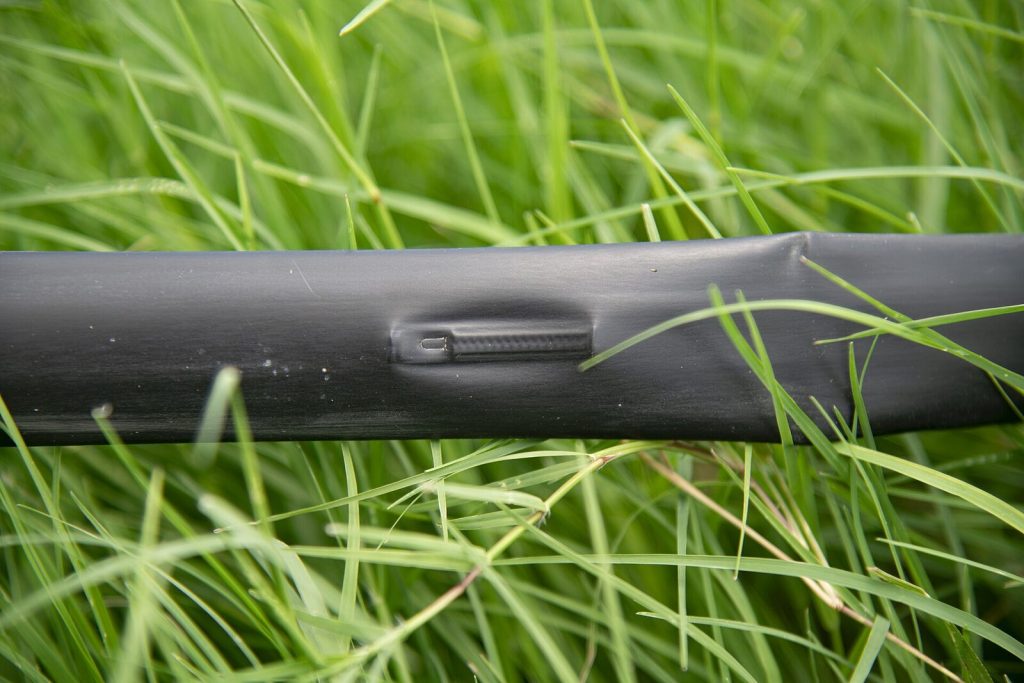
Choosing between drip and sprinkler irrigation comes down to how your crop is spaced and whether you will maintain a filter. Widely spaced high value crops such as tomato, pepper and fruit go to drip; close spaced and broadcast crops such as onions, maize, beans and fodder go to sprinkler. Both are in use on Ugandan farms, and the wrong pick wastes money in ways that only surface a season later.
This page assumes you know roughly what each method does. If you do not, the mechanisms are in drip irrigation explained and sprinkler irrigation explained. What follows is the argument for choosing, including the cases where the obvious answer is wrong.
Drip or Sprinkler: the Short Verdict for Ugandan Farms
Two rules settle the large majority of cases on a Ugandan smallholding.
Rule one: crop spacing decides it. If your plants sit in defined stations with bare ground between them, drip is the better tool, because you can water the plant instead of the field. If your crop covers the ground, or is planted densely enough that wetting the whole surface is the requirement rather than the waste, sprinkler is the better tool. Spacing settles this before efficiency, cost or anything else is considered.
Rule two: the filter habit is the tie breaker. Where spacing points to drip but nobody on the farm will realistically clean a filter and flush lines week after week, sprinkler is the safer buy. Not because drip is fragile in theory, but because drip punishes neglect silently and sprinkler complains loudly, and a farm that cannot service equipment should own the equipment that tells it when something is wrong.
Where those two rules pull against each other, follow rule two. A working sprinkler beats a blocked drip line in every season that has ever been farmed.
Three factors tune the answer without usually overturning it: what a litre of water actually costs you to deliver, how much leaf disease threatens the crop you plan to sell, and the shape of the plot. Cost cuts both ways, since drip usually costs more to install per acre while sprinkler costs more to run for as long as you own it.
Crop Spacing Decides Most Irrigation Choices
Spacing dominates because the two methods bill you on different meters. Drip charges per plant. Sprinkler charges per area.
On tomato at roughly 60 cm by 60 cm, one emitter serves one plant and the strip between rows is never watered. Your hardware bill tracks your plant count, and nothing is spent on ground that will not produce. Tighten the crop to 30 cm by 60 cm and the emitter interval tightens with it, so the bill climbs in step.
Now apply that to onions in a solid bed, or to fodder grass. Every part of the surface has a plant on it, so the only way drip serves that crop is enough emitters to wet all of it, and at that point you have bought an expensive route to what a sprinkler does with one nozzle. The advantage you were paying for was not watering the gaps. There are no gaps.
Sprinkler has the mirror flaw. It wets everything inside its circle whether a plant is standing there or not, which on a widely spaced crop means watering bare soil, raising weeds in the interrows and handing a share to the air. On a crop that closes over the ground, none of that is waste.
The test needs no arithmetic. Stand in the field and look down. Bare soil between plants that will still be bare at harvest means drip. A canopy that closes means sprinkler.
What the Efficiency Gap Is Actually Worth on Your Farm
Application efficiency is the most quoted figure in this comparison and the least decisive. FAO's irrigation training material puts typical field application efficiency at about 90 percent for drip and about 75 percent for sprinkler, with surface methods near 60 percent. Fifteen points looks like an argument. Whether it is one depends on what a litre costs you to put on the field.
Work it from the cost side. If water arrives by fuel, every litre saved is fuel not burned, and the gap converts straight into money that recurs every season. If water is carried by hand, the saving is labour, which on most smallholdings is the scarcer resource of the two. But if the farm sits beside a lake with a solar pump and no volume limit, the same fifteen points buys almost nothing, because the water was not the constraint and nothing downstream of it changes. Same figure, three different verdicts.
The gap also has to be earned. FAO's own table carries a warning that slack management pulls all three figures down, and studies of working installations keep finding neglected drip performing down at the level of furrow irrigation. Buying drip does not buy you 90 percent. It buys you access to 90 percent, on condition that somebody maintains it, which is the argument of the next section.
One asymmetry is worth knowing because it changes how you manage each system. Drip loses water downward, past the roots, when a run goes on too long, so its losses are a scheduling error you correct with a watch and a spade. Sprinkler loses water sideways and upward: research puts combined wind drift and evaporation at 10 to 25 percent of what is applied under ordinary conditions, and above 50 percent when the air is hot and dry and the wind is up, with evaporation taking roughly 30 to 50 percent of that loss and drift carrying off the balance. Those are corrected by the hour of the day you irrigate, which costs nothing.
| Factor | Drip | Sprinkler |
|---|---|---|
| Application efficiency | About 90% | About 75% |
| Loss direction | Downward | Sideways, upward |
| Fix the loss by | Run length | Hour of day |
| Wets between plants | No | Yes |
| Weeds in the gaps | Fewer | More |
That last row earns less attention than it deserves. Dry interrows under drip mean fewer weeds germinating all season, which is labour saved every fortnight rather than water saved once. On a hand weeded Ugandan smallholding that can matter more than the efficiency line above it.
The Irrigation Maintenance Question That Decides More Than Water Quality
Ask a supplier about drip and water quality and you will get a discussion of filters. That discussion is correct and it is covered properly in drip irrigation explained. It is also not the question that decides the purchase.
The question that decides it is who cleans the filter in week nine of a busy season, when the maize needs weeding and a buyer is waiting and the tomatoes look fine from the road.
Both systems degrade. They degrade differently, and the difference is the whole argument. A sprinkler that needs attention announces it: a head stops turning, a strip goes dry, you can see the fault from the edge of the plot while the system is running. Drip conceals it. Emitters block a few at a time, scattered through the field, and the plants above them fall behind slowly while the rest of the crop looks healthy. By the time a pattern is visible the yield is already gone, and because you cannot see inside the tube, farmers regularly blame the seed, the fertiliser or the pump.
So the honest way to weigh water quality is not to ask whether your source is dirty. It is to ask whether the chain that keeps it clean will actually be run, indefinitely, by the people on this farm. Dirty water with a settling tank and a disciplined weekly routine is fine for drip. Clean water with nobody watching the gauge will still end in blocked emitters eventually.
None of this says avoid drip. It says be honest about your farm before you buy the system that requires a habit, because the habit is not optional and the sales conversation will not test you on it.
Why the Pump, Not the Pipe, Sets Your Irrigation Running Cost
Farmers price these systems by comparing pipe and emitters against pipe and sprinklers, and then the pump quietly decides the actual cost of ownership.
Sprinklers need more pressure than drip, because sending a jet across a circle and breaking it into droplets is harder work than easing water out of a hole. The consequence is not really the sprinkler's price. It is that the pump has to be bigger for the same volume, and a bigger pump costs more to buy, burns more fuel every hour it runs, and needs more solar panel if you go that route. Choose the irrigation method and you have chosen a pump class and a fuel bill along with it.
Drip's low pressure requirement buys something sprinkler cannot offer at all, and it is worth more than the efficiency figures on most small plots. Below a certain pressure you can stop buying pressure. A tank raised above the beds will run low pressure drip lines on height alone, with no engine, no fuel and no solar array, which removes a whole cost category rather than shrinking it. The arithmetic of tank height against pressure sits in drip irrigation explained. What matters for the decision is that no tank stand you would build on a smallholding will drive impact sprinklers, so this escape route exists on one side of the comparison only.
Two practical consequences. If you are choosing between systems on a tight budget and a small plot, gravity drip is often the cheapest working irrigation available to you, and comparing it against a sprinkler set plus a pump is not the same comparison as drip hardware against sprinkler hardware. And if you do need a pump, size it for the higher pressure demand before you commit to a method, because discovering the pump cost afterwards has reversed plenty of decisions. Pump selection itself is covered in the irrigation pump buying guide.
| Item | Drip | Sprinkler |
|---|---|---|
| Install per acre | Usually higher | Usually lower |
| Pump class | Smaller | Larger |
| Fuel or solar | Lower | Higher |
| Can skip the pump | Sometimes | No |
| Daily labour | Lower | Higher |
| Attention needed | Higher | Lower |
Read the pattern rather than the rows. Drip front loads money and demands attention forever after. Sprinkler is easier to buy and keeps charging you for fuel and hours. Which of those two your farm can carry is a question about your cash flow and your labour, not about irrigation.
What Dry Foliage Is Worth on a Vegetable Crop, and When It Is Worth Nothing
Drip keeps the canopy dry and sprinkler wets it. Both other pages explain why that matters for disease. The decision question is narrower: what is dry foliage worth to you in money, and when is the answer zero?
It is worth most on a high value spaced vegetable grown through the dry months for a thin market. Tomato is the clearest case. The value shows up as protective spray rounds you did not have to make, product you did not have to buy, labour you did not have to pay and residue risk you did not have to carry into the weeks before picking. On a crop where a disease outbreak in the last month would take the harvest you built the whole season around, that is real money and it can exceed the water saving.
It is worth nothing, or close to it, in four situations. Where the main problem is powdery mildew, overhead water actively helps, so wetting the canopy is a benefit rather than a cost. Where the threat is soil borne, such as bacterial wilt, the irrigation method is beside the point. Where the crop simply does not carry much leaf disease pressure, there is no premium to collect. And where the crop is a staple grown to cover a dry spell, the exposure is too short to matter.
There is also a cheap partial fix on the sprinkler side that most comparisons leave out, and leaving it out overstates drip's advantage. Irrigating in the early morning lets the sun dry the canopy within a few hours instead of leaving it wet overnight, which recovers a good part of the gap for the price of scheduling your labour differently. A sprinkler farm that waters at dawn is in a much better position than one that waters at dusk, and both look identical on a specification sheet.
So weigh this factor by crop and by habit rather than treating it as a fixed advantage. For tomato and pepper it can decide the purchase. For maize it is noise. Spray programmes, intervals, withdrawal periods and pre harvest intervals come from the product label and an extension officer in either case, and background sits in tomato diseases and their treatment.
Field Shape, Slope and Soil on Irrigated Plots
Geometry settles the cases the first four factors leave open.
Drip wants regular blocks of straight beds, because laterals are cut to length and every irregular edge wastes pipe. It takes slope well, since water goes on slowly enough not to run anywhere, and emitters that hold a steady discharge under changing pressure keep a downhill line even.
Sprinkler is more forgiving of awkward ground, needing no levelling and no channels, and a pattern can be walked around a corner that drip laterals would have to be cut to fit. Slope is a mixed blessing here: nothing to wash out, yet water applied faster than the soil drinks it will run downhill and take topsoil along, which on a sloping Ugandan plot is an erosion problem rather than a waste problem.
Soil affects how you run either system more than which you pick. Sand takes water fast and holds little, so it wants short frequent applications under either method. Clay takes it slowly, which under sprinkler means watching for ponding and surface sealing, and under drip means fewer, longer runs.
Plot size cuts against drip at the very small end for a reason that catches people out. The fixed cost at the head of a drip system does not shrink with the area it serves, so on a tiny patch it dominates the bill. A quarter acre of tomatoes still carries it comfortably. A few beds do not, and a hose or a can is the honest answer there.
Which Irrigation Method Suits Which Ugandan Crop
Applying the two rules to the crops Ugandan farmers actually grow leaves few genuine arguments.
| Crop group | Better method | Why |
|---|---|---|
| Tomato, pepper | Drip | Spaced, disease prone |
| Cabbage, eggplant | Drip | Spaced stations |
| Watermelon, cucumber | Drip | Wide spacing |
| Banana, passion fruit | Drip | Fixed tree stations |
| Coffee, citrus | Drip | Spaced perennials |
| Onions, leafy greens | Sprinkler | Solid beds |
| Carrots | Sprinkler | Drilled close |
| Maize, beans | Sprinkler | Cheap water wins |
| Fodder grasses | Sprinkler | Full ground cover |
| Nurseries, seedbeds | Micro sprinkler | Gentle even wetting |
Onions sit on the sprinkler side purely on spacing, for all that they are a valuable dry season crop, because a solid bed leaves emitters nothing to aim at. Seedbeds go to fine micro sprinklers or a rain hose rather than to either main system, since what a nursery needs is soft even surface wetting, which is a third answer rather than a compromise between the first two.
Staples deserve the blunt version. Irrigating Ugandan maize right through a dry season rarely repays the fuel, because the crop is worth too little against the water it drinks. The real question for maize and beans is whether you can carry them through a rainless fortnight at flowering, and for that narrow job a sprinkler wetting a lot of ground in one move is the sensible tool. Yield context sits in maize yield per acre.
Five Cases Where the Obvious Irrigation Answer Is Wrong
The rules above are reliable enough to follow. These five are where they mislead, and they are the reason this comparison is worth more than a table.
Notice what the five have in common. Every one turns on something about the farm rather than something about the method, which is why a specification sheet cannot answer this question for you.
Running Drip and Sprinkler Irrigation Together on One Farm
Most Ugandan farms that irrigate seriously end up with both, and planning for that from the start is cheaper than arriving at it by accident.
The common arrangement puts a fine spray over nurseries and seedbeds, drip on the spaced vegetable and fruit blocks, and keeps a sprinkler set for staples and fodder when a dry spell threatens. One source and one mainline can serve all of it, provided the zones are valved separately and the pump was sized for the thirstiest of them.
Two design points if this is your plan. Fit the filter at the outset, sized for the drip zone, since it protects sprinkler nozzles from wear too and retrofitting costs more than fitting. And do not run a drip zone and a sprinkler zone at once off a single pump unless the installer designed for exactly that, because their pressure appetites differ enough that one will starve the other.
Say all of this at the quoting stage. A system quoted for drip alone often cannot be grown into sprinkler later without replacing the pump, which is the expensive part.
How to Decide for Your Own Farm
Six questions in this order will produce the decision. Most farms have it by question two.
Write your six answers on one sheet before you talk to anybody selling equipment. A salesman quoting from stock is not working from your answers, and that sheet is how the conversation stays about your farm.
Frequently Asked Questions About Drip and Sprinkler Irrigation
Which is cheaper overall? Neither, and the answer depends on which cost you are counting. Drip asks for more at installation because you buy hardware per plant plus a filter and head assembly. Sprinkler asks for more every season, because its pressure demand means a larger pump and more fuel or solar capacity for the same volume delivered. A farm short of capital but with cheap labour often does better with sprinkler; a farm that can fund the purchase and wants low running costs does better with drip. Ugandan equipment has been running 30 to 50 percent above Kenyan prices on low sales volumes, duties and freight, so compare real quotes against the irrigation system cost per acre guide rather than any headline figure.
Will drip really use less water than my sprinkler? It can, and it will not do it by itself. The design figures are about 90 percent application efficiency for drip against 75 percent for sprinkler, and FAO attaches a caution that poor management drags all such figures down. Installations left unflushed and unfiltered have been measured performing no better than furrow irrigation. Treat the number as a ceiling that maintenance unlocks.
Can one farm run both systems? Yes, and a mixed farm probably should. Fine spray over nurseries, drip on spaced vegetables and fruit, a sprinkler set held for staples and fodder during dry spells. Build it as separately valved zones from one source, size the pump for the highest pressure demand, and install the filter at the start. Never run a drip zone and a sprinkler zone simultaneously off one pump unless it was designed that way.
Can I convert an existing sprinkler system to drip? Partly, and cheaper than starting again. Source, pump and mainline usually carry over; you add filtration, a pressure regulator and laterals. Two traps: the existing pump is often larger than drip needs, so you end up running oversized equipment inefficiently, and there may be no filter at all, which is the one component drip cannot manage without. Ask whether the pump can be throttled sensibly or ought to be swapped.
Why not put drip on maize, since it saves water? Because maize cannot pay for it. The crop is worth too little against the water it uses, and it stands too thickly for emitters to serve individual plants without wetting most of the surface anyway. Sprinkler or furrow irrigation covers maize adequately, and the sensible goal with a staple is bridging a dry spell rather than farming a full dry season.
Which pays back sooner? That turns on the crop, the market and how well the system is run, so any payback period quoted at you deserves a question about its assumptions. What holds across most farms is that drip's case is strongest on high value crops sold into the thin dry season market, where water is expensive to deliver and leaf disease is a threat, while sprinkler's lower entry cost usually wins on staples and fodder. Run your own figures through the farm profit calculation.
My water is very silty. Is drip out? Not necessarily. Let the water stand somewhere before it reaches the filter and a surprising number of muddy sources become workable, which is the cheapest useful thing you can build. If settling plus filtration still cannot keep it clean, or if running that chain weekly is not realistic here, choose sprinkler and accept the wind and evaporation losses with open eyes.
Take your six answers to two or three suppliers and ask each to quote against them, with the filter, the rated operating pressure, the recommended spacing and the pump shown as separate lines. Read the component lists against each other rather than the totals, because a quote can look cheap by leaving out filtration or by specifying a pump that cannot hold pressure across the field. Equipment prices move, so confirm them near the point of purchase, and the wider irrigation, greenhouses and water guides cover the water source and storage decisions that sit behind whichever method you choose. For where both methods fit among the others used in Uganda, see irrigation farming in Uganda.