
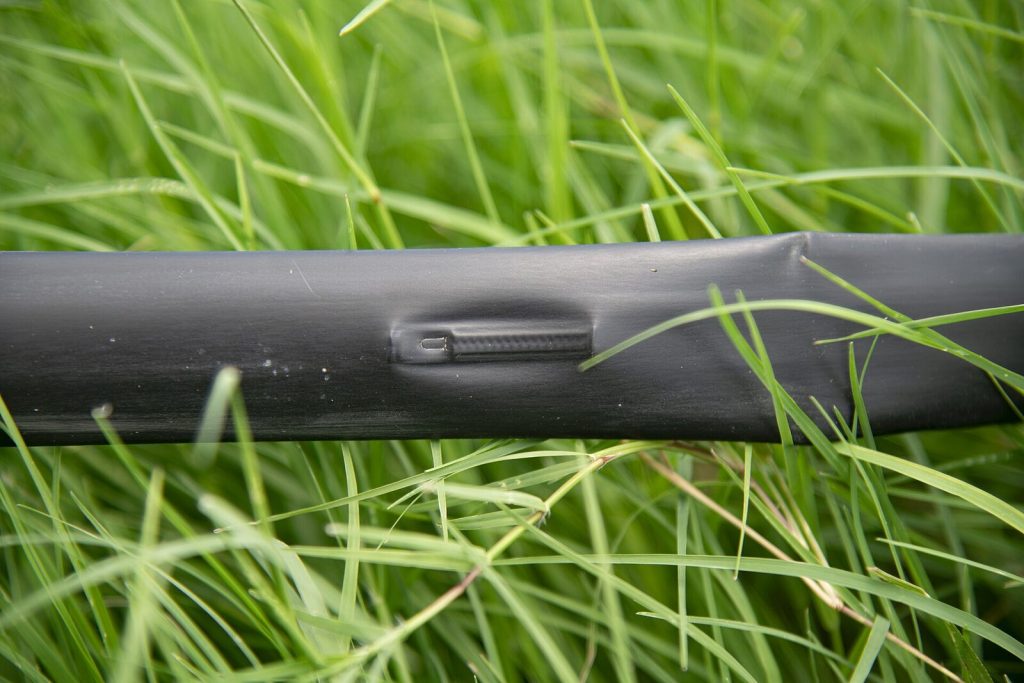
Sprinkler irrigation throws water through the air over a whole field, wetting the crop and the soil between plants much as rain does. Systems run from a single hose sprinkler on a vegetable plot to impact sprinklers covering several acres. It is the method of choice for close spaced and broadcast crops where drip lines make no sense, and its costs are wind loss, evaporation and wet leaves.
Everything a sprinkler does well and everything it does badly comes from the same fact: it waters the whole surface rather than the plant.
How Sprinkler Irrigation Wets the Whole Field
Water arrives at the sprinkler head under pressure and leaves through a nozzle as a jet. The jet breaks into droplets in the air, and the head either rotates or is fixed so that the droplets land across a circle or a sector of ground. Space several heads so their circles overlap, and the overlapping pattern is what gives you even coverage across a field.
That overlap is the whole design problem in sprinkler irrigation. A single sprinkler does not water its circle evenly, because it throws more water near the head than at the outer edge of its reach. Set the heads far apart and you get dry rings between them; set them closer so the weak outer edges of each pattern fall on top of each other, and the sum is roughly uniform. The spacing that achieves this is a fraction of the wetted diameter, and the figure for your nozzle is on the manufacturer's chart.
Because the water lands on the soil surface across the whole field, sprinkler irrigation behaves like rainfall. It wets the topsoil uniformly, which germinates a broadcast crop evenly and suits shallow rooted vegetables. It also means the soil between plants is wet, so weeds grow there, and the crop canopy is wet, which matters for disease.
FAO's irrigation training material puts typical field application efficiency for sprinkler at about 75 percent, against roughly 90 percent for drip and 60 percent for surface methods, with a warning attached to all three that slack management pulls the figures down. Sprinkler sits in the middle for a reason: it avoids the runoff and deep seepage that plague furrow irrigation, yet it loses to the air what drip never exposes.
Crops and Field Layouts Suited to Sprinkler Irrigation
Start with the crops, because this is the honest case for buying a sprinkler rather than a drip kit.
Broadcast and densely planted crops have no row geometry for an emitter to serve. Wheat, rice nurseries, pasture and fodder grasses, groundnuts and closely drilled beans cover the ground rather than sitting in spaced stations, so watering the whole surface is not waste, it is the requirement. Putting enough drip emitters into such a crop to wet the whole surface would cost more than the crop is worth.
Close spaced vegetables sit in the same category for practical purposes. Onions, leafy vegetables such as spinach and nakati, carrots and other crops grown in dense beds are watered more sensibly from above than by trying to place an emitter beside every plant. Onion growers in particular tend to sprinkle.
Maize and beans on a smallholding usually fall to sprinkler too, though for a different reason. Nobody irrigates a Ugandan maize crop all dry season, because the value per litre of water is too low. What a farmer wants is to carry maize or beans through a ten day dry spell inside the rains, and a sprinkler that covers a wide area quickly does that job at less outlay than drip lines that would then sit unused. The same logic applies to seedbeds and to napier grass and other fodder.
Field shape is the other half of the suitability question. Sprinkler handles irregular and sloping ground better than furrow irrigation, since it needs no land levelling and creates no channels to wash out. Where a plot is odd in shape, a sprinkler pattern can be walked around it in a way that a fixed grid of drip laterals cannot be cut to fit without waste.
Sprinkler Types Used on Ugandan Farms
Four kinds cover almost everything a Ugandan farmer will be offered, and they differ in pressure demand, area covered and how much labour they need.
Two practical notes on choosing. A big impact sprinkler covering more ground per position sounds like less work, and it is, but it demands more pressure, which means a larger pump and more fuel, and its coarser droplets hit soil harder. Several smaller heads cost more in pipe and fittings while running gentler and at lower pressure. Which trade suits you depends on your crop and your pump more than on your acreage.
The other note is about quality. Research on Ugandan irrigation uptake flags a market carrying a lot of cheap low quality equipment that looks attractive and fails early, alongside prices that have run 30 to 50 percent above the same items in Kenya because of low sales volumes, duties and freight. A sprinkler head with a worn or badly made nozzle waters unevenly from the day you buy it.
Overhead Sprinklers Against Micro Sprinklers on Vegetable Beds
On a vegetable plot these two options behave very differently and the choice is worth thinking through rather than defaulting.
Overhead impact sprinklers sit high on risers and throw over the canopy. One head covers a lot of bed, so the pipework is simple and the labour low. The droplets travel far and arrive with force, which can beat down young seedlings, splash soil onto lower leaves and compact the surface over time. Losing water to wind is worse from a high nozzle, because the droplets spend longer in the air.
Micro sprinklers sit low, wet a smaller circle each, and put water down as a fine gentle spray. Seedlings survive them, splash is reduced, and pressure demand is low enough that the same source running a drip system can often run them. The cost is more heads, more risers, more fittings and more to go wrong, and a smaller area covered per shilling of hardware.
The practical split most Ugandan vegetable growers land on: micro sprinklers or a fine rain hose over nurseries and seedbeds where droplet force matters, and impact sprinklers on established field blocks where it does not. Nursery raising is covered in tomato nursery management and onion nursery management, and both are places where a hard droplet does real damage.
Pressure and Pump Requirements for Sprinkler Farming
Sprinkler irrigation needs more pressure than drip, and this is the practical consequence that surprises farmers who have priced a drip kit first.
The reason is physical. Drip only has to push water along a tube and out of a hole. A sprinkler has to fire a jet far enough to cover a circle and break it into droplets on the way, and throwing water sideways through the air costs pressure. Impact sprinklers ask the most, micro sprinklers considerably less, and drip less again. The exact requirement is printed on the sprinkler's specification, and any figure quoted without naming the model is guesswork.
Three consequences for a Ugandan farm.
You need a pump. Gravity from a raised tank can run low pressure micro sprinklers if the tank is high enough, yet no realistic tank height on a smallholding will run impact sprinklers, so a sprinkler system usually means an engine or solar pump and a running cost. Compare the options in choosing an irrigation pump and solar water pumps for farms.
Fuel scales with pressure. Higher pressure means a harder working pump for the same volume delivered, so the pressure demand of the sprinkler you choose is a running cost decision, not just a purchase decision. This is the hidden reason solar sizing gets expensive on sprinkler systems.
Pressure has to be right, not just present. Too little and the jet falls short, the pattern shrinks and the overlap you designed for disappears, leaving dry rings between heads. Too much and the jet shatters into very fine droplets that blow away. A pressure gauge at the head of the system is a cheap instrument that tells you which problem you have.
Wind Drift and Evaporation Losses in Sprinkler Irrigation
This is the loss drip does not suffer, and it is larger than most farmers expect.
Water in the air is exposed. Some of each droplet evaporates before it lands, and wind carries the smallest droplets off the field entirely. Research on sprinkler performance puts combined wind drift and evaporation losses typically in the range of 10 to 25 percent of the water applied, and under hot, dry, windy conditions the loss can exceed 50 percent. Of that loss, evaporation accounts for roughly 30 to 50 percent and wind drift carries away the rest.
Droplet size drives it. The finest droplets, below about a millimetre across, suffer the heaviest losses, because a small droplet has a lot of surface for its volume and almost no mass to resist being pushed sideways. That is why over pressuring a sprinkler is counterproductive: it makes a finer spray that looks gentler and loses more.
| Condition | Effect on loss | What to do |
|---|---|---|
| Strong wind | Much higher | Water early or late |
| Hot dry air | Higher | Avoid midday |
| Very fine droplets | Higher | Check pressure |
| High nozzle | Higher | Lower the riser |
| Calm cool morning | Lowest | Preferred window |
The table is a work schedule, not trivia. Watering in the early morning or the evening, when air is cooler and wind usually lighter, is the single cheapest efficiency gain available on a sprinkler system, and it costs nothing but the timing of your labour. Midday sprinkling in the Ugandan dry season, with heat and afternoon wind together, is where the worst losses happen.
Evening watering carries one caveat that belongs in the next section: leaves that go into the night wet stay wet for many hours.
Wetting Foliage and Crop Disease Risk
Sprinkler irrigation wets the whole canopy, and wet leaves are how most fungal and bacterial leaf diseases start.
Plant pathologists describe this as the leaf wetness period. A film of free water on the leaf surface is what a fungal spore needs to germinate and push into the tissue, and the longer that film lasts, the more likely infection becomes. Overhead irrigation supplies exactly that film, and it supplies it in the dry season when the crop would otherwise have had dry leaves and low disease pressure.
For Ugandan vegetable growers this is not a theoretical risk. Tomato under a sprinkler in the dry season faces late blight and early blight pressure it would not face under drip, and splash from wet soil also moves soil borne bacteria and fungal spores up onto lower leaves. Onions, beans and cucurbits all carry leaf diseases that free water encourages.
What to do about it, in order of usefulness. Water in the morning rather than the evening, so the sun dries the canopy within a few hours instead of leaving it wet all night. Avoid watering more often than the crop needs, since frequency of wetting matters as much as volume. Keep the spray under the canopy where the crop's structure allows it, which is what micro sprinklers on low risers achieve. And where leaf disease is the main threat to a high value crop, accept that drip is the better tool and price it properly, using the comparison of drip against sprinkler.
One genuine exception, because it cuts the other way. Powdery mildew is suppressed by overhead water, since the impact of droplets physically damages the fungal growth sitting on the leaf surface. A crop whose main problem is powdery mildew is a crop sprinkler irrigation actively helps.
A spray programme has to account for the irrigation method. More wet leaf hours means more protective spraying, and the interval and product belong on a label and an extension officer's advice rather than in an article. Withdrawal periods and pre harvest intervals apply to every product that touches a food crop and must be observed. Background sits in fungicides explained and safe pesticide application.
Application Rate, Soil Infiltration and Runoff
A sprinkler applies water at a rate, usually expressed in millimetres per hour, set by the nozzle, the pressure and how far apart the heads are. The soil accepts water at a rate of its own. When the first number is larger than the second, the difference sits on the surface, and then it ponds, runs off or seals the soil.
Soils order themselves predictably. Sands take water fast, loams in the middle, clays slowest, and compaction, surface crusting and slope all reduce the rate further. That means the same sprinkler set that works on a sandy plot may cause runoff on a clay one with no change to the equipment at all.
You do not need a laboratory to find your limit. Run the system and watch the ground. Water standing in puddles, water moving downhill between beds, or a smooth sealed crust forming on the surface all mean the application rate is beating the infiltration rate. The fix is to apply less per hour, by choosing a smaller nozzle, or to apply in shorter bursts with pauses between so the surface can drain.
Slope makes this sharper. On sloping Ugandan plots, runoff carries topsoil with it, so an over rated sprinkler is a soil erosion problem rather than only a water waste problem. Contour beds, mulch and a lower application rate all help.
Testing Sprinkler Uniformity on Your Own Field
Uniformity is the one thing about a sprinkler system you cannot judge by eye, and it is easy to measure.
Do this once when the system is installed, and again if the crop starts showing uneven growth in a pattern rather than in patches. Uneven watering shows up in the field as strips of smaller plants, and farmers regularly diagnose that as a soil or fertiliser problem when it is a sprinkler spacing problem.
The same containers measure your application rate. Depth collected divided by hours run is millimetres per hour, which is the number the previous section asked you to compare against your soil.
Nozzle Wear, Water Quality and Sprinkler Maintenance
Sprinklers tolerate dirtier water than drip emitters do, which is a real advantage where the only source is a silty river. Tolerate is not the same as ignore.
Sand and grit passing through a nozzle wear the opening larger over time. A worn nozzle discharges more water at lower pressure, which shrinks its throw, breaks the overlap with its neighbours and quietly ruins the uniformity you tested for. The wear is gradual and invisible, so the catch can test is how you find it. A basic screen filter at the pump protects the nozzles and costs very little.
Rotating heads need the moving parts to keep moving. A stuck impact arm leaves a sprinkler watering one sector heavily and the rest not at all, which is obvious once you look and easy to miss if you set the system running and walk away. Walk the field while it is running.
The rest is unglamorous and short. Flush the mainline occasionally, check for leaks at fittings and risers, keep the pump serviced, and store heads out of the sun between seasons. Guidance on the machinery side sits in farm equipment maintenance.
When Sprinkler Irrigation Is the Wrong Choice
Three situations where a sprinkler is the wrong buy.
Widely spaced high value crops with leaf disease pressure. Tomato, green pepper and eggplant grown for the dry season market are the classic case: the plants are spaced far enough apart that wetting the whole surface is waste, and the disease cost of wet foliage falls directly on the crop you were counting on. Drip wins here and the margin is large enough to pay for it.
Water so scarce or so expensive to lift that a quarter of it cannot be given to the air. Where every litre comes up a shallow well by hand or costs fuel from a distant river, a method that loses 10 to 25 percent before it lands, and more on a hot windy afternoon, is the wrong method.
Windy exposed sites. If your plot sits open to a steady wind through the dry months, sprinkler uniformity and losses will both be worse than the specification sheet suggests, and no amount of scheduling fully fixes it.
For the full head to head, including crop by crop recommendations, see drip against sprinkler irrigation. For where sprinkler fits among the other methods available in Uganda, and the water sources that feed them, see irrigation farming in Uganda. The mechanism of the alternative is in drip irrigation explained.
Frequently Asked Questions About Sprinkler Irrigation
What time of day should I run sprinklers? Early morning is usually the best compromise. Air is cool and wind light, so wind drift and evaporation losses are at their lowest, and the sun then dries the canopy within a few hours, which limits the leaf wetness period that leaf diseases need. Evening watering is nearly as good on water loss and considerably worse on disease, because leaves stay wet all night. Midday in the dry season is the worst of both, with heat and afternoon wind together.
How much water do sprinklers actually lose to wind and evaporation? Typically 10 to 25 percent of what is applied, and more than 50 percent under hot, dry and windy conditions. Evaporation is roughly 30 to 50 percent of that loss with wind drift carrying off the balance. The finest droplets lose the most, so a sprinkler running above its rated pressure loses more than one running correctly, which is a reason to fit a pressure gauge.
Do sprinklers cause crop disease? They raise the risk of leaf diseases rather than causing disease outright. Free water on a leaf is what most fungal and bacterial leaf pathogens need to establish, and overhead irrigation supplies it in weeks when the canopy would otherwise be dry. Morning watering, sensible frequency and low micro sprinklers under the canopy all reduce it. Powdery mildew is the exception and is actually suppressed by overhead water.
Can I run sprinklers from a raised tank without a pump? Low pressure micro sprinklers, sometimes, if the tank is high enough, since roughly 0.1 bar comes from each metre of height. Impact sprinklers, realistically no, because the pressure they need to throw a jet across a wide circle is beyond any tank stand you would build on a smallholding. Check the rated pressure on the sprinkler specification against the head your tank gives before buying anything.
What does a sprinkler system cost in Uganda? It turns on the area, the sprinkler type, the pressure required and the pump that follows from it, plus pipe runs and fittings, so no single figure is meaningful. Ugandan irrigation equipment has been running 30 to 50 percent above Kenyan prices because of low sales volumes, duties and freight, and the gap moves with the shilling. The number to chase is not the price of the heads but the pump they oblige you to buy, so ask every supplier what pressure their sprinklers need and what pump delivers it. That is the line where sprinkler quotations differ most, and the irrigation system cost per acre guide sets out the components.
Is it worth sprinkling maize or beans? Usually only to cover a dry spell, not to grow a full dry season crop. The value of a staple crop per litre of water applied is low, so irrigating maize all dry season rarely repays the fuel. Carrying a crop through ten rainless days at flowering or tasselling is a different calculation and often worth it, and a sprinkler that covers a wide area quickly is the right tool for that job.
How do I know if my sprinklers are watering evenly? Run the catch can test. Put identical containers in a grid across the wetted area, run the system as you normally would, then measure the depth in each one. Containers well below the average map your dry spots, and where they sit tells you whether the cause is spacing, pressure or a worn nozzle. Repeat it when growth starts looking uneven in strips, and use the same readings to work out your application rate in millimetres per hour.
Ask for three documents before you buy: the nozzle chart, the rated operating pressure and the recommended head spacing. Those are what turn a sprinkler purchase from a guess into a design, they are what you will use to run the catch can test against a target, and a supplier unwilling to hand them over has told you something useful about the equipment. Prices shift, so confirm them near the point of purchase. The irrigation, greenhouses and water guides cover the pump, storage and source decisions that sit behind the sprinklers themselves.