
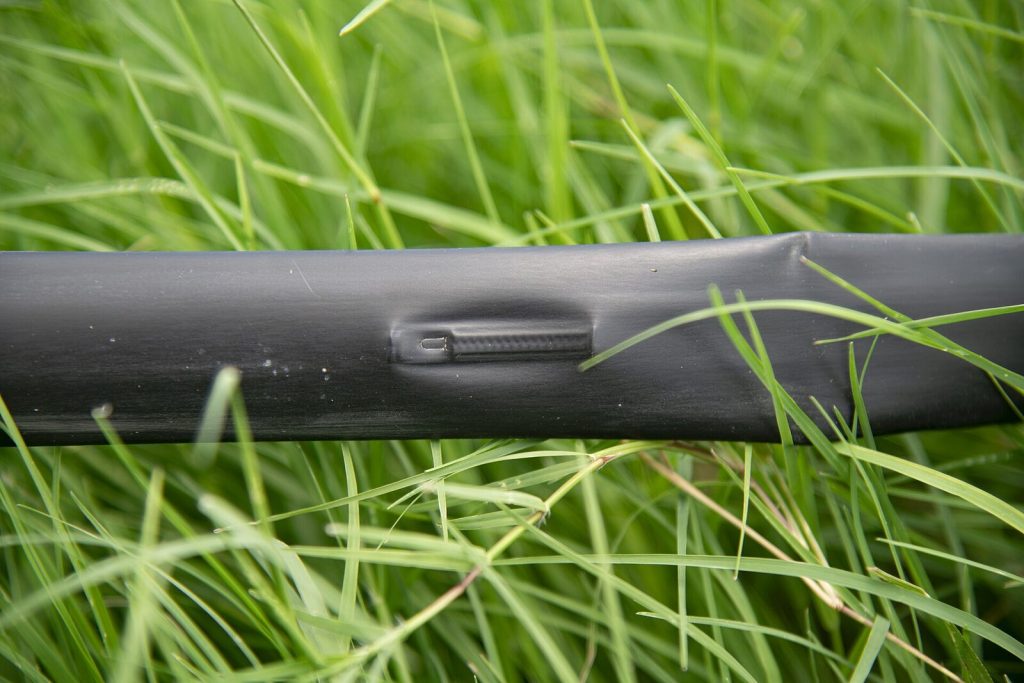
The irrigation system cost per acre in Uganda is not one number, and any page that gives you one is guessing. It splits into four tiers that differ by an order of magnitude, and the thing that separates them is not the pipe or the dripline. It is where your water already sits. A gravity fed kit on a quarter acre and a pumped acre drawing off a new borehole are different projects wearing the same name.
Why the Cost Per Acre Question Cannot Be Answered Until You Name Your Water Source
Farmers ask what an irrigation system costs per acre expecting a figure somewhere in the low millions. For the equipment, that is often right. For the project, it can be wrong by a factor of ten, because the water source is a separate build and it is usually the largest line in the whole stack.
Work it through. Two neighbours grow the same acre of tomatoes. One has a stream running along the bottom of the plot, four metres below the field, and can put a suction pipe in it. The other has no surface water at all and needs a drilled hole. The dripline, the filter, the fittings and the labour are nearly identical for both. The first spends a few million shillings. The second spends tens of millions before a single emitter drips, and may find the hole does not yield enough to irrigate anyway.
So the honest sequence is: establish the source first, price the distribution second. Everything below follows that order, and the tiers exist because the source is what moves you between them. If you have not yet worked out how much water the crop actually needs, the water requirement calculation for your crop and acreage comes before any of this, because it sets the flow rate that sizes the pump and the pipe.
Headline Irrigation Cost Per Acre by System Tier
These are installed project ranges for one acre under open field conditions, covering equipment, fittings and labour. Read them as bands that your site pushes up or down, never as quotes.
| System tier | Area | Installed cost |
|---|---|---|
| Gravity fed drip, tank already in place | Quarter acre | UGX 700,000 to 2,500,000 |
| Gravity fed drip, tank already in place | One acre | UGX 2,000,000 to 6,000,000 |
| Petrol pumped drip, surface water near | One acre | UGX 4,000,000 to 9,000,000 |
| Solar pumped drip, tank buffered | One acre | UGX 8,000,000 to 20,000,000 |
| Same system on a new borehole | One acre | UGX 30,000,000 upward |
There is a useful independent check on the middle of that range. Under the Ministry of Agriculture, Animal Industry and Fisheries micro scale irrigation programme, government pays a share of a farmer's system and caps its own contribution at UGX 7,200,000 per acre, with support limited to 2.5 acres. At the top government share of 75%, that cap corresponds to a full system near UGX 9,600,000 per acre. The share is worth reading carefully, because it is not a discretionary band. It is a technology split: 75 percent for solar, capped at UGX 18,000,000 per 2.5 acres, and 25 percent for petrol or diesel, capped at UGX 5,000,000, and both reconcile to the published per acre caps. The consequence is worth knowing before you choose a pump. A solar system can cost roughly three times a petrol one and still leave the farmer paying about the same, so the cheaper system is not the cheaper decision once the subsidy is in the arithmetic. A national programme designing around that figure and a component stack built from Ugandan retail prices landing in the same place is about as much corroboration as this market offers.
Component Cost Stack Per Acre, Walked in Build Order
This is the table most cost pages skip. Each row is a real purchase, priced from Ugandan retail and marketplace listings, across the three tiers a smallholder realistically builds.
| Component | Quarter acre gravity | One acre petrol | One acre solar |
|---|---|---|---|
| Water source works | Nil to 300,000 | Nil to 800,000 | Nil to 800,000 |
| Pump and drive | Nil | 330,000 to 1,400,000 | 2,500,000 to 8,000,000 |
| Filtration | 50,000 to 200,000 | 200,000 to 700,000 | 200,000 to 700,000 |
| Mainline and submain | 100,000 to 400,000 | 600,000 to 2,500,000 | 600,000 to 2,500,000 |
| Driplines | 270,000 to 1,200,000 | 1,100,000 to 4,900,000 | 1,100,000 to 4,900,000 |
| Fittings and valves | 40,000 to 250,000 | 200,000 to 1,000,000 | 200,000 to 1,000,000 |
| Tank and stand | 280,000 to 1,300,000 | Optional | 1,200,000 to 4,000,000 |
| Installation labour | 80,000 to 400,000 | 400,000 to 1,800,000 | 600,000 to 2,500,000 |
All figures in Uganda shillings. Ranges move with site, brand, crop spacing and how much of the work you do yourself.
Water Source Development: The Line That Decides Your Whole Per Acre Cost
An existing stream or pond is close to free. You need an intake, a small sump so the suction pipe is not drawing silt off the bed, a strainer and a foot valve. A two inch foot valve retails around UGX 65,000. Call the whole intake nil to UGX 800,000 depending on whether you concrete anything.
A hand dug well, lined, sits next. It is usually the cheapest source a farm can own outright, and it runs into low single digit millions, with depth and whether you line the shaft doing most of the moving. It is also the source most likely to run short in a long dry spell, which is the season you built the system for.
A drilled borehole is a different order. A complete production hole with siting survey, drilling, casing, test pumping and headworks runs from roughly UGX 20,000,000 to UGX 50,000,000 in Uganda, and the siting survey alone is around UGX 1,000,000. What makes this line dangerous on a cost sheet is not the size of it. It is the sequence: you pay for the hole before anybody can tell you what it yields, and a hole that serves a household hand pump perfectly well may be far too weak to irrigate an acre. That risk, and the permitting that goes with it, is covered in full on boreholes drilled for agricultural irrigation. If you have roof area, harvesting rainwater into farm storage is worth costing in the same breath, because it feeds the same tank.
Pump Cost Per Acre: Petrol, Solar and Grid Electricity Compared
Petrol engine pumps are the cheapest entry into pumped irrigation anywhere in Uganda. Two inch units list from about UGX 330,000 to UGX 500,000, three inch units around UGX 650,000. Pay attention to the jump above that. Units genuinely built for high head, the ones quoting 80 m to 200 m, sit at UGX 880,000 to UGX 1,400,000, and a heavy 15 HP unit reaches UGX 3,800,000. Buying the UGX 330,000 pump for a field that needs 60 m of head is the most common expensive mistake in this whole stack, and matching a pump to your flow and head is where to sort that out before you spend anything.
Solar pumping has moved from novelty to a normal choice on Ugandan farms. A 1 HP class system rated for one to two acres and lifting to around 20 m starts near UGX 2,500,000. Small surface solar sets run UGX 2,000,000 to 5,000,000. Submersible solar pump units alone list at UGX 1,900,000 to 3,200,000 before panels and controller. Complete farm systems reach UGX 15,000,000 to 18,000,000. Some suppliers now sell small one acre solar kits on mobile money instalments, which changes the cash flow problem without changing the total. The trade is straightforward: you pay roughly three to six times the petrol capital and you stop buying fuel. More on that in the solar pumping guide for farms.
Grid electricity is the cheapest per unit of water moved where a three phase or even a decent single phase supply already reaches the pump house. The catch is connection cost and reliability. If the line stops at the trading centre a kilometre away, the extension quote alone can exceed the entire irrigation system, and an acre of wilting tomatoes does not care why the supply went down.
Filtration, Mainline and Dripline Costs for One Acre
Filtration is a small line item and the one that decides whether the system is alive in two seasons. A farm scale screen or disc filter is a few hundred thousand shillings. Sand media filtration, which is what open surface water full of algae and silt actually needs, costs several times that. Skipping it to save UGX 400,000 on a system carrying UGX 3,000,000 of dripline is how people end up replacing the dripline.
Mainline and submain depend on diameter, wall thickness, pressure rating, material and how far the field sits from the water. As a feel for Ugandan pricing, two inch lay flat hose runs about UGX 2,450 per metre and two inch reinforced hose around UGX 6,000 per metre. For one acre, budget UGX 600,000 to UGX 2,500,000 for the buried and surface pipe together. Undersizing here is a false economy that shows up as a pump that cannot deliver, because a pipe too narrow for the flow throttles the whole system and the pump burns fuel fighting its own plumbing.
Driplines are the one line you can calculate rather than guess, and it is worth doing. Bed spacing is what turns an acre's 4,047 square metres of ground into a length of pipe you have to pay for. At 0.75 m bed spacing you need roughly 5,400 m of line, at 1.0 m roughly 4,050 m, and at 1.5 m for coffee or widely spaced fruit roughly 2,700 m. Drip tape in Uganda sells from around UGX 450 per metre, with a working band of UGX 400 to 900 depending on wall thickness and emitter spacing. Multiply it out and the dripline for one acre is UGX 1,100,000 to UGX 4,900,000. Crop spacing, not brand, is what moves that figure most. Densely planted vegetables cost roughly twice what coffee does on the same acre, which is why a supplied and installed one acre drip system for coffee or matooke has been quoted in Uganda around UGX 3,000,000 while a one acre vegetable kit starts nearer UGX 1,800,000 for equipment alone and climbs from there. Whether drip is even the right method for your crop is the subject of the drip against sprinkler comparison; sprinkler sets in Uganda list at UGX 500,000 for a 40 m set with tripod and UGX 1,000,000 to 1,300,000 for 100 m sets, so sprinkler capital per acre can undercut drip while running cost goes the other way.
Tank, Stand and Fittings on a One Acre Irrigation Layout
Tanks are priced plainly in Uganda and worth knowing before a quote arrives.
| Tank size | Tank only | Supplied on a 6 m tower |
|---|---|---|
| 1,000 litres | 280,000 to 358,000 | Around 4,000,000 |
| 2,000 litres | 500,000 to 600,000 | Around 5,500,000 |
| 5,000 litres | 1,200,000 to 1,300,000 | Around 12,500,000 |
| 10,000 litres | 2,400,000 to 2,700,000 | Around 18,000,000 |
Read that second column twice. A 5,000 litre tank costs UGX 1,300,000 and a supplied, professionally installed six metre steel tower for it has been quoted around UGX 12,500,000. The tank is not the cost. The height is. A farm built timber or welded stand two to three metres high gets you gravity pressure for a fraction of that, which is exactly what a drip system needs, since drip runs on very low pressure. Solar systems need the tank more than petrol systems do, because the pump delivers when the sun is up and the crop drinks on its own schedule. Sizing farm water storage deserves its own look.
Fittings, valves, connectors, end caps, pressure regulators and takeoffs are individually trivial and collectively not. Budget 10% to 20% on top of your pipe and dripline spend as a planning allowance. Quotes that omit this line are quoting you an incomplete system, and you will discover the gap on installation day.
Installation Labour and What Farm Quotes Leave Out
Trenching, laying, assembling headworks, mounting the pump and commissioning runs roughly 10% to 25% of equipment cost on a one acre system. You can read that spread straight off the Ugandan market: a one acre drip kit from about UGX 1,800,000 against a designed, supplied and installed one acre system at about UGX 3,000,000. The gap is design, delivery and labour, and the design half of it is usually money well spent, because a system laid out without a head calculation tends to water the near end and starve the far end.
Capital Cost Against Running Cost Per Acre
This is the split that decides whether your system is still working in three years. Capital buys the system. Running cost keeps it alive, and it is where irrigation projects quietly die: the equipment is intact, the farmer simply stopped being able to afford to switch it on.
| Running item | Petrol pumped acre | Solar pumped acre |
|---|---|---|
| Fuel per dry season | 540,000 to 2,100,000 | Nil |
| Engine service and oil | 100,000 to 400,000 | Nil |
| Dripline replacement | 300,000 to 1,500,000 | 300,000 to 1,500,000 |
| Filter elements and flushing | 50,000 to 300,000 | 50,000 to 300,000 |
| Controller or pump end repair | Occasional | Occasional, higher unit cost |
Figures in Uganda shillings per acre. The dripline line is the one farmers do not expect: thin wall drip tape is a consumable, lasting one to three seasons, while thicker wall dripline lasts several years at a higher purchase price. Buying the thinnest tape available makes the capital table look good and turns your dripline into an annual expense.
How the Micro Scale Irrigation Grant Changes the Cost Per Acre
Uganda runs a matching grant for smallholder irrigation through the Ministry of Agriculture, Animal Industry and Fisheries, delivered at district level. The farmer pays a share and government pays the rest, with the government contribution capped at UGX 7,200,000 per acre and total support capped at 2.5 acres. The farmer share has drawn criticism in Parliament as too steep for many smallholders, and uptake has lagged applications by a wide margin, so treat it as a real option rather than a solved problem.
What it changes arithmetically is which tier you can reach. A farmer who could self fund a petrol pumped acre can, with the grant, reach a solar pumped acre with storage, and the solar tier is the one whose running cost does not scale with fuel prices. That is the most useful thing the grant does. Apply through the district production office rather than through an equipment supplier, and confirm current terms locally, because the co payment share and the technology list have both been revised.
Irrigation Cost Per Acre Mistakes That Kill Systems
The first is pricing the kit and not the project. A UGX 1,800,000 dripline kit on a farm with no water source is a UGX 1,800,000 ornament.
Second, buying pump on price rather than on head. A pump that cannot lift to your field height will move water beautifully at the bank and deliver nothing at the far end of the plot.
Third, cutting filtration. It is the smallest line in the stack and it protects the largest.
Fourth, sizing for the wet season. Your system has to carry the crop through the dry months, which means the flow rate and the tank get sized against peak demand, not average demand.
Fifth, ignoring the running cost column entirely, which is the mistake that turns a working system into a stored one. Plenty of Ugandan farms have complete irrigation kit sitting under a tarpaulin because nobody budgeted for fuel. If you are new to all of this, the wider picture on irrigation farming in Uganda and the irrigation and greenhouse guides hub set the context this page assumes. Greenhouse capital is a separate calculation with its own drivers, covered under greenhouse cost in Uganda.
Irrigation System Cost Per Acre: Questions Farmers Ask
Can I irrigate one acre for under UGX 2,000,000? Only in the gravity fed tier, and only if the water is already sitting above the field or in a tank you already own. Add a pump and the floor moves to roughly UGX 4,000,000 for one acre. Anyone quoting a pumped acre below that is leaving components out.
Does a smaller plot cost less per acre or more? More per acre, almost always. Filtration, the pump and the headworks do not shrink with the plot, so a quarter acre carries the same fixed equipment across a quarter of the area. Cost per acre falls as you scale up, which is why the cheapest thing you can do on a small plot is avoid needing a pump.
How long before an irrigation system pays for itself? That depends on what you grow, not on the system. Irrigation earns its keep by letting you produce in the dry months when prices are highest, so the return sits in the price gap between wet season and dry season for your crop, multiplied by the yield you keep alive. Vegetables with a steep seasonal price swing pay back fastest. A crop that sells flat all year may never justify pumped irrigation at all. Run your own figures through the farm profit calculation before committing.
Will a solar pump actually move enough water for a full acre? A 1 HP class solar system is commonly rated for one to two acres, so yes, within its head limit. What differs is the shape of the day. Solar delivers while the sun is up and tails off under heavy cloud, so output is a daily total rather than a tap you open on demand. That is what the storage tank is for. On a rented plot you may not hold next season, a petrol pump you can carry away keeps your exposure smaller.
How much water does one acre need in a Ugandan dry season? It depends on the crop, the stage it is at and how hot and windy the site is, which is why the flow rate comes out of a calculation rather than a rule of thumb. Get that number first, because it sizes the pump, the pipe diameter and the tank, and every one of those is expensive to redo. The irrigation water requirement calculation walks it through.
What fails first on a new irrigation system? Emitters blocking, almost always, and behind that a filter that was undersized, fitted wrong or never cleaned. After that, fittings weeping at joints that were not properly seated, then the pump impeller on anybody drawing silty water without a strainer. Very little of it is the dripline itself failing on its own.
What should I ask a supplier for so I can compare quotes? An itemised quote with the flow rate in cubic metres per hour and the total head in metres the system is designed for, component by component, with fittings and labour as named lines rather than folded into a lump sum. Two quotes for the same acre are only comparable if both state the flow and head they are sizing to. Ask what happens to your dripline warranty if you run without the specified filter.
Do I need any permission to irrigate from a stream or borehole? Water abstraction in Uganda is regulated, and taking water with a motorised pump puts you in permit territory rather than outside it. Sort that out before the equipment arrives, not after.
Can I build it in stages? Yes, and on a tight budget it is the sensible route. Get the source and the pump right first, since those are the parts you cannot cheaply redo, then extend dripline block by block across seasons. Oversize the mainline slightly at the start so the second block does not force you to dig the first one up again.
Prices in this guide move with the exchange rate, fuel, freight and season, so treat every range as a bracket to negotiate inside rather than a figure to quote back. Ask two or three irrigation equipment suppliers for itemised quotes against the same stated flow rate and total head, get the water source assessed before you buy anything downstream of it, and check current terms for the district irrigation grant at your local production office.