
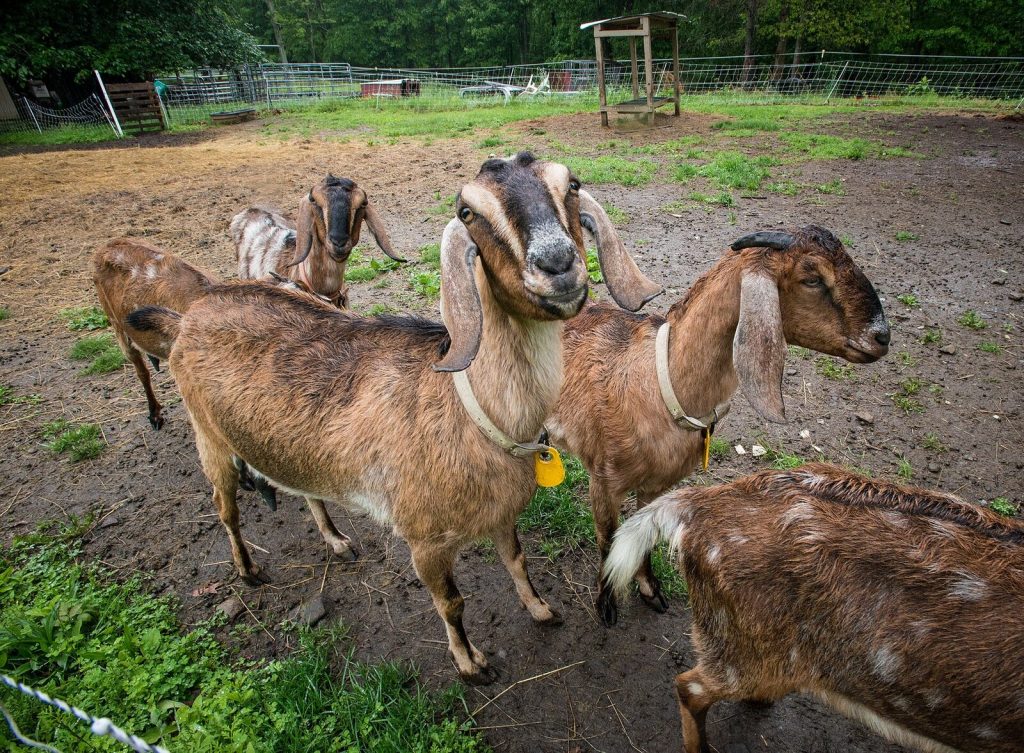
The cost of starting goat farming in Uganda is decided before you price a single animal, by the grazing system you choose. A tethered herd, a communal grazing herd, a fenced herd and a zero grazing herd have almost nothing in common as budgets. Goats browse rather than eat bought rations, so the money goes on land, breeding females and waiting, not on feed.
What Goat Farming Startup Money Buys in Uganda
Uganda keeps somewhere near 17 million goats, and close to 95 per cent of them are indigenous stock. In one agro ecological zone counted in detail, of 739,343 goats only 39,635 were exotic, which is a little over five in every hundred. Whatever the promotional material says about improved breeds, the national herd is local goats kept by households.
That matters for a budget because it tells you what the market you are joining actually looks like. You are not entering a sector of commercial units. You are entering one where most animals are tethered beside a house, and where the small number of people running goats as a business are doing something structurally different from their neighbours.
Startup money buys four things, in descending order of size on most plans. Enough land or browse to carry the herd. Breeding females. A shelter. And the running costs of the months before any kid is old enough to sell. There is no large feed line, which is why goat farming is cheap to enter, and there is a long dead period, which is why it is expensive to sit through.
The Grazing System Decides Your Goat Farming Costs
Ugandan official figures split goat rearing four ways: tethering 60 per cent, communal grazing 19 per cent, zero grazing 14 per cent and fenced grassland 7 per cent. Those are not four versions of one enterprise. They are four different cost structures.
Pick the system first. Then price it. A budget written before that decision is a list of items rather than a plan, and it is the reason so many goat startup figures circulating in Uganda cannot be compared with each other.
Land and Browse: The Largest Capital Item in Goat Farming
This is the line every competing cost page leaves out, and it is the biggest one.
Uganda's national genetics agency budgets grazing land in its own goat enterprise calculator at 0.25 acre per goat per year. Four goats to the acre. That is the figure a Ugandan government planning document uses, and it converts directly into acreage once you know your herd size.
| Herd | Head with kids | Acres needed |
|---|---|---|
| 5 does, 1 buck | about 12 | about 3 |
| 10 does, 1 buck | about 23 | about 6 |
| 20 does, 1 buck | about 45 | about 11 |
Head counts include a year's kids still on the farm. Now compare that with the advice circulating in older Ugandan goat guidance, which suggests aiming for twenty to thirty goats an acre. That is five to seven times denser than the government's own planning figure, and a farmer who buys three acres expecting to run seventy goats on it will be buying feed by the second dry season. Overgrazed land is how a browsing enterprise turns into a feeding enterprise, and a feeding enterprise is where goat margins die.
Land prices in Uganda vary between districts by more than an order of magnitude, so this page will not quote one. What it will say is that the acreage above is the quantity to take to a local land conversation. Renting against buying farmland and how much land you need both matter more here than on almost any other livestock enterprise, because on goats the land is the input.
One relief. Browse is not pasture. Goats take shrub leaves, hedges, weeds and crop residues that cattle walk past, so marginal ground, field edges and land too steep or rocky for cropping genuinely carry goats. A farmer with rough land already has the most expensive input.
Goat House Construction Costs and Space Per Animal
No Ugandan source publishes a defensible cost per square metre for a goat shed, so this page gives you the square metres instead and sends you to a local carpenter for the price.
| Class | Space each | Yard |
|---|---|---|
| Kid | 0.5 sq m | with dam |
| Doe, not in kid | 1.5 sq m | 1.5 by 4 m |
| Doe in kid | 1.9 sq m | 1.5 by 4 m |
| Buck | 2.8 sq m | 2 by 5 m |
Those are the Ugandan government figures. Run a ten doe herd through them and you need roughly 28 square metres of covered space once the buck and a year's kids are housed, plus the yards. A five doe unit needs nearer 15 square metres, and a twenty doe unit about 54.
Note what this settles. Older guidance on goat housing in Uganda states a minimum of 1.5 square metres per goat in one place and half to three quarters of a square metre in another, in the same document. Use the figures by class above instead; a buck needs nearly six times a kid's space and there is no single per goat number.
Spend as little as the animals will tolerate. A goat shed earns nothing. What it has to do is keep rain off, drain properly so the floor stays dry, ventilate, and keep the herd separable, because you will need to shut a sick animal away and you will need the buck away from the does when you are not breeding. A raised slatted floor is worth more than block walls, since a goat standing in wet bedding is a goat with foot problems and a worm burden. The goat housing guide covers the build; everything above is just the sizing.
Buying Breeding Does: The Cost You Cannot Shortcut
The does are the enterprise. Everything else is equipment.
Ugandan reporting has put mature local goats at around 100,000 shillings and crossbred animals from about 150,000 at a year old, while more recent Ugandan farming guides quote local does at 120,000 to 150,000 and improved does up to 300,000. Take 100,000 to 200,000 for a local doe and 150,000 to 300,000 for a cross as a planning band, and expect to be quoted outside it. None of those figures is current and all of them move with the district.
Four things change what a doe is worth, and only one of them is breed. Whether she has kidded before and what she produced, because a proven doe is a known quantity and a maiden doe is a bet. Whether she is in kid, which brings your first income forward by months. Her age, since a doe bought at six years has few kiddings left in her. And whether the seller can tell you anything at all about her, which in Uganda they often cannot, because farmers frequently cannot distinguish breeds and indiscriminate crossing has been named repeatedly as a cause of low national productivity.
Uganda's national genetics agency puts the problem plainly in its own guidance: buy your initial stock carefully, then treat the first batch you breed yourself as the real base population, because those are the animals whose birth weights and prolificacy you actually know. The undefined stock you started with gets sold off gradually as culls. Budget for that. Some of the does you buy will turn out not to be worth keeping, and that is a cost of entry rather than a mistake.
What a Boer Buck Costs and What It Does Not Buy
The buck is the one place on the whole budget where paying several times more can be right, and it is also the easiest place to waste money.
Ugandan prices reported for exotic meat genetics run from about 500,000 to 550,000 shillings for a pure Boer male, up to around 600,000 for a well grown mature buck, and as high as 1.7 million for a pure Savanna male. A good local buck is a fraction of that. Plan on anything from 200,000 to 1,700,000 shillings and treat the spread as evidence that the market for exotic genetics in Uganda is thin and priced by the few people who hold it.
The case for spending it is real. Indigenous Ugandan goats reach 20 to 35 kg mature; a study at Makerere University comparing Boer and native bucks records Boer animals reaching up to 130 kg. Crossing up puts weight on your kids, and weight is what a meat buyer pays for.
Now the two arguments against, both from Ugandan sources rather than from scepticism. First, Uganda's own national genetics agency lists the Boer's demerits as susceptible to worms, suffers in wet conditions, poor disease resistance and milk dries quickly. That is the agency that supplies improved genetics describing the animal it supplies. In a wet district with a heavy worm burden, a Boer cross can cost you more in losses than it earns in weight.
Second, and this decides the arithmetic: Ugandan work on community based goat breeding records that smallholders sell through informal markets where genetic improvement is undervalued. If the trader who comes to your farm prices goats by looking at them, he is not paying a premium for a pedigree you cannot prove. The Boer premium is recoverable where you sell into a channel that pays for weight and consistency, which means abattoirs, restocking programmes and export buyers. It is not recoverable at the roadside.
So buy one good buck rather than several mediocre does upgraded to crosses, keep him separate and keep him alive, and be honest about which market you can actually reach. Boer goat farming and breed selection go into the genetics; where to buy Boer goats covers sourcing.
Fencing, Tethering and the Labour Cost of Browsing
Goats in extensive systems need at least six hours of effective browsing a day, on Ugandan official guidance. Somebody has to make that happen, and how you arrange it is a straight swap between capital and labour.
Tethering costs almost nothing to set up. Rope, pegs, and a person moving animals to fresh browse through the day and carrying water to each one. At five goats that is a chore. At twenty it is a job, and it is the reason tethered herds rarely grow: the labour scales linearly and nobody notices until the animals start losing condition because there was not time to move them all.
Fencing reverses the deal. Large one off cost, then the goats do their own browsing. Fencing costs in Uganda could not be verified for this page and vary with material and terrain, so get a local quote per acre rather than trusting a figure. The decision rule is simple enough without the price: if the labour is paid, fence. If the labour is your own and you have time, tether and put the money into does. If the labour is your children's school hours, fence, because that cost is larger than it looks.
Either way, goats get out. Budget for the fence being tested, the hedge being eaten and the neighbour's crop being compensated at least once.
Goat Herd Health Costs: Worms, Ticks and Vaccination
This is the cheapest line in the budget and the one that decides whether the rest of it survives.
Poor goat health and productivity in Uganda has been attributed in the research literature to predators, long kidding intervals caused by anoestrus, and disease including contagious ecthyma, helminthiasis, trypanosomiasis and brucellosis. Worms sit near the top of that list for a reason: browsing is how goats pick them up, so the cheapest feeding system carries the highest parasite pressure.
Peste des petits ruminants is the other one to budget for. It was first reported in Uganda in 2007 and it spread. A study collecting 2,520 goat and sheep samples from 252 households with no recent vaccination history found overall seroprevalence of 27.3 per cent, split sharply by system: 44.1 per cent in pastoral herds, 31.7 per cent in agropastoral herds and 6.1 per cent in mixed crop and livestock systems. Sex and age moved the odds as well, and what that does to a breeding herd is worked out on the profit calculation page.
Read that against the older advice that free ranging goats are more resistant to disease. They are not. The more a herd moves and mixes, the more it meets, and the figures above measure exactly that. A herd kept on its own land with controlled contact carries roughly a seventh of the exposure of a herd on open pastoral ground.
What to budget in activities, on Uganda's own government guidance: deworming roughly every three months, vaccination at least twice a year, and tick control weekly. Those are frequencies, and this page states no dose, no product, no route and no interval, because those belong on a label and in the hands of a vet who knows your district's disease picture. Ask your district veterinary office what is circulating locally before you buy anything. Goat deworming, common goat diseases, the livestock vaccination calendar and when to call a vet all carry more than a cost page should.
Mineral supply belongs here too, because a browsing goat gets patchy minerals and a lick block is trivially cheap against a failed pregnancy. Mineral supplements covers it.
Working Capital and the Wait Until Your First Goat Market Sale
Here is the goat enterprise's real working capital problem, and it is not a feed bill. It is time.
Published figures for Ugandan Mubende goats in village systems give a kidding interval of 297 days, which is about five kiddings every four years rather than one a year, let alone the two a year that older Ugandan guidance claims. Regional studies of indigenous and crossbred does put age at first kidding between roughly 549 and 663 days. Gestation is about five months.
Put those together. A young doe bought today is roughly eighteen months to two years from her first kid, and that kid is then four to six months from being worth selling. Buy your herd as young stock and you are funding health, labour, water and land for close to two and a half years against zero revenue.
If you need income inside a year, a breeding herd is the wrong enterprise and buying and finishing bought in goats is the right one. The goat fattening business is a different page for a reason.
Goat Farming Startup Cost at Three Herd Sizes
The table sizes the opening budget at three scales. The shelter, health and labour rows are illustrative placeholders, because no Ugandan price could be verified for them. The stock rows are the published bands above. Land and fencing are absent on purpose: the acreage is given earlier and the price is local.
| Cost line | 5 does | 10 does | 20 does |
|---|---|---|---|
| Breeding does | 500k to 1m | 1m to 2m | 2m to 4m |
| One buck | 200k to 1.7m | 200k to 1.7m | 200k to 1.7m |
| Shelter | 400k to 1.2m | 700k to 2.2m | 1.3m to 4m |
| Health, year one | 60k to 150k | 120k to 300k | 240k to 600k |
| Water, salt, labour | 150k to 400k | 300k to 800k | 600k to 1.6m |
| Opening total | 1.3m to 4.5m | 2.3m to 7m | 4.3m to 11.9m |
Shillings, and land excluded. Three things worth noticing. The buck row does not scale, which is why a single buck over twenty does is much better value than the same buck over five. The does dominate the low end and the buck can dominate the high end, which means the cheapest way to blow a small goat budget is an exotic buck bought before the herd is big enough to use him. And the whole opening total for five does sits below what a five pig unit costs to open, which is the honest case for goats.
Where a Goat Farming Budget Usually Goes Wrong
Five failures, all documented Ugandan patterns rather than hypotheticals.
Stocking the land at the density older guidance suggests, then buying feed to cover the gap. The land was the cheap input and the feed is not. Buying the cheapest does available and discovering that indiscriminate crossing and inbreeding have left them poor breeders, which national guidance names as the main cause of low Ugandan goat productivity. Planning on a kid mortality rate of 10 per cent, which is the figure Uganda's own enterprise calculator uses, when studies of African village flocks measure losses before weaning of 19.6 to 43.5 per cent. Running on communal ground to save money and importing every parasite on it. And building a shed that costs more than the does inside it.
There is a sixth, and it is about revenue rather than cost. A good deal of goat material circulating in Uganda builds income on goat milk, cheese and yoghurt. Ugandan reporting on the sector says directly that goat milk is not yet marketable in this country and that very few farmers keep dairy breeds because of it. A regional review notes there has been no tradition of cheese or butter making from goat milk in the region at all. Budget for meat and for breeding stock. Treat goat dairy as an experiment funded from profit, not as a plan.
What the Older Guidance on Goat Farming in Uganda Gets Wrong
Most of the Ugandan goat advice online is old, copied, or written for a different continent, and four specific claims will cost you money.
None of this makes goats a bad enterprise. It makes the published version of the enterprise a bad plan. The goat farming guide covers husbandry, breeding management covers getting does in kid on time, and goat feeding plus feed requirements cover what to do when browse runs short in the dry season.
Goat Farming Startup Cost Questions Farmers Ask
How many goats should I start with? Enough that one buck is not idle and few enough that you can move or check every animal daily. Five does is a real starting herd; ten is where a buck starts earning his keep. Starting at twenty without having kept goats before means learning on twenty animals rather than five.
Is it cheaper to start goat farming than pig or poultry farming? To open, yes, usually. There is no large feed bill and the shelter can be modest. What goats charge you instead is time, and the wait to first income is longer than any other small livestock enterprise in Uganda. Cheap to enter is not the same as quick to return.
Should I buy local goats or crosses to start? Local does and one good buck is the lower risk entry, and it lets you upgrade gradually through your own kids. Buying crossbred does at a premium into a district with heavy worm pressure, or into a market that prices goats by eye, spends money the market will not give back.
How much land do I need for goats? On Uganda's own planning figure, about a quarter of an acre per goat per year, so roughly three acres for a five doe herd once kids are counted and eleven for twenty does. Browse on rough ground, hedges and field edges counts, which is why land unsuited to crops suits goats.
Do I need a goat house if the goats browse all day? Yes. It is for nights, rain, sick animals and keeping the buck away from the does when you are not breeding. It can be cheap, and it should be, but a herd with nowhere dry to sleep loses kids.
How long before the goats start paying? If you buy does already in kid, within about a year. If you buy young does, closer to two and a half years before the first kid is sellable. That gap is the whole working capital question, and it is the reason to spend more per doe and buy fewer.
Where can I get training or support? District veterinary and extension offices, the national agricultural advisory service, and farmer groups that run community based breeding programmes, which exist in several Ugandan districts and are the cheapest route to a buck you could not afford alone. Group membership also gets you into buyer channels that pay for weight, which is where any improved genetics you buy will actually earn something.
Every price here is a published range with its condition attached, or a placeholder marked as one, because several of these costs could not be verified against any Ugandan source. Before you spend anything, go and get three local numbers: what an acre costs to rent near you, what a proven doe sells for in your nearest market, and what a trader last paid for a goat in your village and what it weighed. Then rebuild the table above with your own figures. The goat profit calculation shows what those numbers have to reach for the herd to pay, the goat price page tracks current levels, a livestock record template will make your second year a calculation, and the business ideas hub carries the other enterprise budgets.