
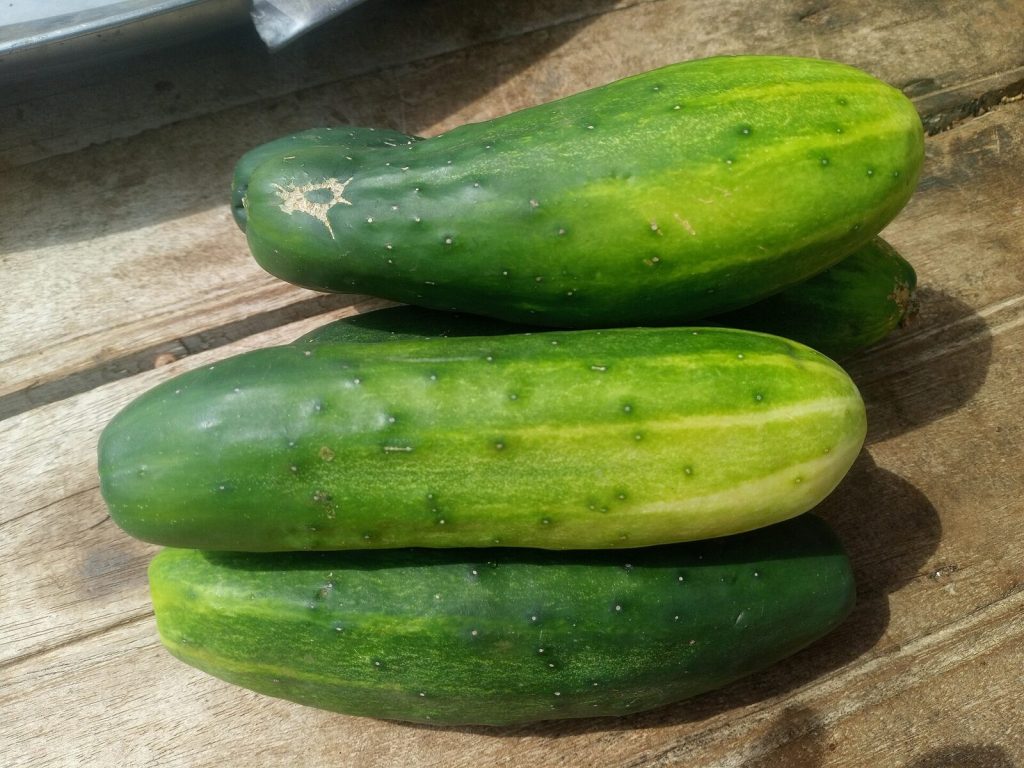
The first decision in cucumber farming in Uganda is which kind of seed you buy, because field cucumber needs insects to set fruit and greenhouse cucumber does not. Get that wrong and an insecticide spray at flowering can cost you the crop. Cucumber is a warm season cucurbit, related to pumpkin and watermelon, grown for immature fruit picked every two or three days over a long window.
The Mistake That Costs a Cucumber Crop Its Fruit
Picture a clean, vigorous cucumber field. Leaves dark, vines running, flowers everywhere. Then almost nothing sets, or what sets comes out bent, waisted and short at one end. The grower reads that as a disease and reaches for another spray.
It is usually pollination. Most open field cucumber cultivars are monoecious, meaning they carry separate male and female flowers on the same plant, so pollen has to be physically moved from one flower to another. A production guide published by a regional seed company for its Southern African market states that monoecious cucumbers depend on bees, that two to three hives a hectare placed near the field improves setting, and that a cucumber flower may need up to eight bee visits before it sets a full fruit. Eight visits, per flower, across a field flowering continuously for weeks.
Now put that next to what Ugandan cucurbit growers actually do. The one published Ugandan survey of cucurbit production practices, covering 105 fields in 28 districts across nine sub regions, records that farmers had limited or no knowledge of the agrochemicals they were applying, that most could not tell one product class from another, and that roughly a fifth of them were combining several products into a single spray. That survey covered pumpkin and watermelon rather than cucumber, and it says nothing directly about cucumber fields. It does describe the agrochemical culture a Ugandan cucumber grower is working inside.
A bee dependent crop and an indiscriminate spray programme are not compatible. That conflict, rather than any question of soil or fertilizer, is the thing most likely to decide whether a Ugandan open field cucumber crop pays.
Choosing Between Field Cucumber Seed and Greenhouse Cucumber Seed
The escape from that conflict is built into the seed. Greenhouse cucumber types are parthenocarpic: they set fruit without pollination at all. Choosing between the two types is the real fork in the road on this crop, and it decides your capital, your labour and your market at the same time.
| Question | Field type | Greenhouse type |
|---|---|---|
| Pollination | Bees needed | Not needed |
| Spraying at flowering | High risk | Low risk |
| Structure cost | Low or none | High |
| Fruit shape control | Weaker | Stronger |
| Seed cost per plant | Lower | Higher |
Neither column is the right answer for everyone. A grower with a shaded structure already standing, or one supplying a buyer who rejects curved fruit, has a case for the parthenocarpic type. A grower opening a quarter acre near a market has a case for the field type and for leaving the insecticide can shut while the crop is in flower. What nobody should do is buy whatever seed the shop hands over and then treat the result as a disease problem.
Both types come in from outside the country. Uganda's own customs declarations for the vegetable seed heading record imports of 232,085 kilogrammes valued at USD 10,022,080 in the most recent full year. No Ugandan cucumber release exists to pick instead. Query NARO's databank of technologies and publications for cucumber and nothing comes back. Query it for bean, sweet potato and tomato and it hands over 40 entries, 29 and two, which is how you know the blank belongs to the crop rather than to the query. The ministry publishes one variety list extract only, covering roots, tubers and bananas. Any cucumber variety name you are offered comes from a seed company catalogue, and the two useful things a seller can tell you are which company bred it and whether it is parthenocarpic. The rest of the questions worth asking at a seed counter are set out on our pages about seed quality and about the hybrid decision.
Temperature and Why Cucumber Suits Uganda Better Than Carrot Does
Cucumber is one of the vegetables Uganda's climate genuinely suits, and it is worth saying because so much of the honest answer on Ugandan vegetables is a warning.
The same seed company guide puts optimum growing temperatures at 20 to 25 degrees Celsius, with growth slowing below 16 degrees. Against that band, the ERA5 reanalysis figure of 23.09 degrees Celsius for Uganda's mean annual temperature lands almost exactly in the middle. Carrot makes the contrast: its published optimum is 15 to 20 degrees with quality falling away above 20, so the same national mean sits above its ceiling. Our carrot farming guide works through what that does to root grade.
Two temperature thresholds matter in practice rather than on paper. Direct sown cucumber needs soil above 13 degrees for even germination, which in Uganda is a question about cold highland ground and cloudy spells rather than about the calendar. And once fruit is picked, the guide puts best shelf life at 10 to 14 days held between 10 and 13 degrees at high humidity, which is a specification no smallholder in Uganda can hit without a cold room. Cucumber is roughly ninety five per cent water and it wilts visibly in a day on a hot stall. That is a marketing constraint, not an agronomic one, and it belongs in the plan from the start.
Spacing, Plant Population and Trellising Cucumbers
Field cucumber is planted wide and then either left to run or trained up. The seed company guide gives rows 1.2 to 1.8 metres apart with plants 50 centimetres to a metre apart in the row, and plant populations ranging from 14,000 to 40,000 a hectare depending on variety and system. Seed goes in 20 to 28 millimetres deep. On beds, two rows about 40 centimetres apart can sit on top of a bed with 1.2 to 1.8 metres from bed centre to bed centre. Our plant population calculator turns any of those spacings into plants per acre so you can price seed against a target stand.
Trellising is the decision that separates a serious cucumber grower from a casual one. The guide describes a structure 1.6 to 1.8 metres high with strong poles every four metres, a heavier gauge wire along the top, a lighter one about 12 centimetres off the soil, and twine or netting strung between them for the vines to climb. Side shoots are pinched out from the base up to about 50 centimetres and left to grow above that. Training happens weekly, not occasionally.
What you buy with that work is straighter fruit, uniform colour with no pale patch where a fruit lay on the soil, less fruit lost to soil borne rots, easier picking and easier pest scouting. What you pay is the materials, the labour to erect and dismantle, and exposure to wind, which the guide suggests meeting with a windbreak upwind of the crop. A useful sequencing trick sits in the same document: a cucumber crop can follow a tomato crop on the same trellis, so the structure is amortised across two crops rather than one. Growers already running trellised crops will find the trellising guide and greenhouse tomato page relevant to the build.
Water: A Crop That Cannot Be Allowed to Dry Out
Cucumber has a shallow demand curve and no tolerance for interruption. The guide's figure is roughly 50 millimetres of irrigation a week, adjusted against evaporation, with soil kept from drying at planting or transplanting and watered well from flowering through fruit development. Drip is the method it names.
Uganda's rainfall does not remove that requirement, it complicates it. National annual rainfall from the ERA5 reanalysis is 1,576.67 millimetres, and a second reputable dataset has been reported at 1,282.74 millimetres over the same period, a difference of around a quarter that has not been resolved. Both datasets agree on the distribution rather than the total, and the distribution is what bites: rain arrives in two seasons and stops, and a cucumber crop that runs into a dry spell at fruit set stops setting. A grower planting on rain alone is planning around the weather rather than around the crop. Our drip irrigation guide covers the practical side.
On soil, the guide gives pH 5.5 to 6.0 and describes cucumber as suited to a wide range of soil types provided drainage and water holding are both adequate, with up to 20 tonnes a hectare of manure or compost improving texture and root growth. It also states that cucumber is native to Africa, which is wrong: the species is South Asian in origin. A single factual slip like that is a useful reminder about what kind of document this is. A seed company technical sheet is a legitimate source for the agronomy of the varieties that company sells, and it is not a research publication, and it should be read as the former.
Harvesting Cucumbers Every Two or Three Days
Picking cadence is where a cucumber crop is won or lost, and it is the part casual growers underestimate.
The guide puts first harvest at 45 to 55 days from planting, with a plant that can keep producing for around 14 weeks where pest and disease pressure allows. From pollination to a picking sized fruit is 15 to 18 days. Target size is roughly 15 to 20 centimetres long and 4 to 7 centimetres across, taken while the seeds inside are still small and soft. Fruit is clipped or snapped close to the stem, never pulled, because pulling tears the vine.
Two instructions from that document are worth more than any of the numbers. Any oversize fruit missed at a previous picking should be removed, because it drains the plant and costs later yield. And damaged or decaying fruit comes off too. A cucumber vine reads a mature fruit as a finished job and slows down; leaving one on is a decision to end the crop early.
Cucumber Pests and Diseases: What Uganda Has Recorded
Uganda has no published cucumber pest survey. What it has is a cucurbit survey that covered the two crops beside cucumber in the same family, and the honest way to use it is as a description of the pest pressure across Ugandan cucurbit fields rather than as a cucumber finding.
Three of its findings bear on cucumber directly. Whiteflies were the insect most often named across the two surveyed crops, present in 29.5 per cent of fields, with aphids at 20.0 per cent and cutworms at 9.5 per cent, and all three feed on cucumber as readily as on pumpkin. Mildews recurred through the disease findings, and a humid cucumber canopy is exactly the situation those fungi like. Third, the insect that dominated the watermelon fields uses more than 125 cucurbit hosts, so a cucumber block planted beside pumpkin, beside watermelon or beside a run of volunteer gourds inherits whatever population is already living there. Our watermelon farming guide sets out how that insect works and what the survey found about holding it back.
One caution about that list. The survey identified diseases with the help of colour photographs shown to farmers in the field, not by laboratory diagnosis. So a pathogen named in it is a farmer's identification supported by an image, which is the right method for a production constraints survey and the wrong basis for buying a specific product.
Which brings the safety rule, and one piece of evidence that argues it better than the rule does. Nothing of that kind is printed here: no rate, no dilution, no interval, no brand. What governs is the text on the registered label, read against your own crop by a district agricultural officer who can see it. Cucumber goes to the table raw and unpeeled, which makes the gap between a last application and a first picking the whole margin of safety. Now the evidence. The seed company guide supplying most of the agronomy on this page carries a cucumber spray table of its own, and heads it as off label suggestions on which the grower must run their own tests. If the firm selling the seed will not stand behind a spray programme for its own crop, no web page should pretend to. Our pages on agrochemical labels and applying pesticides safely set out what to do instead.
The Cucumber Market in Uganda Has No Exit
This is the part no Ugandan cucumber page says, and it changes how much of a crop you should plant.
Uganda's customs declarations for the cucumbers and gherkins heading record trade that rounds to nothing in both directions across recent years: exports between 75 and 1,626 kilogrammes in a year, imports between none and 966 kilogrammes. Not tonnes. Kilogrammes. For comparison, the same declarations show Uganda exporting thousands of tonnes of watermelon a year and importing tens of thousands of tonnes of carrots.
So a Ugandan cucumber grower has one market, and it is the domestic fresh market. There is no export channel absorbing a surplus and no processing outlet visible in the trade data. The regional picture says the same thing: Kenya, which reports its vegetable statistics officially, puts its entire national cucumber crop at 6,394 tonnes, against 92,202 tonnes of carrots and 241,394 tonnes of watermelon. Cucumber is a small crop everywhere in this region.
The practical consequence is about scale and timing rather than about whether to grow it. A quarter acre of cucumber feeding a town, a hotel supplier or a set of stalls you have already spoken to is a different proposition from an acre planted on the assumption that a buyer will appear. Uganda's total formal vegetable exports run between about 22,300 and 34,600 tonnes a year at a border value between roughly USD 19 million and USD 33 million, and between about a fifth and a little over a quarter of that value is re export rather than Ugandan grown produce. A grower banking on that channel should know how small and how crowded it is. Our notes on finding produce buyers and supplying hotels and restaurants are the right starting point, and the sensible order is to find the buyer before planting the seed.
What Ugandan Research on Cucumber Amounts To
It is worth being explicit about how thin the ground is, because a reader deserves to know the basis for what they are being told.
Uganda reports no cucumber production line to the FAO at all. The FAO database carries a separate item for cucumbers and gherkins and 24 African countries file against it. Uganda does not, and its entire vegetable output outside tomato, onion and chillies is folded into a residual category which FAO flags as imputed rather than declared. The national Annual Agricultural Survey names the 16 major crops its coverage focuses on, and every one is a cereal, a root, a pulse, an oilseed, banana or coffee. No vegetable appears among them, which is why no Ugandan cucumber statistic exists to find.
On the research side, a search of Makerere University's dissertation repository returns three cucumber records, of which one is an agronomy study: a screen house pot experiment testing wood ash and human urine on cucumber growth, which counted flowers and leaves rather than marketable yield. That experiment reported that treated plants produced many times more flowers than untreated ones and concluded that the treatments could substitute for mineral fertilizer without risk. Pot trials measuring flower counts do not establish a field yield, and a study that measured flowers and leaves did not test the contamination question that applying untreated human waste to a crop eaten raw and unpeeled obviously raises. That is the whole domestic agronomy record for this crop.
Which is the case for treating every figure on this page as what it is: a seed company's production guidance for its own varieties in a neighbouring region, plus a Ugandan cucurbit survey about two related crops, plus national trade and production statistics. That is a reasonable basis for a first crop and a poor basis for an acre. Grow a small block, keep records of what it actually yielded and what it actually sold for, and you will hold better cucumber data than anything published about Uganda. The wider vegetable farming hub collects the rest of the section, and growers comparing cucurbits should read the watermelon farming guide beside this one.
Common Questions About Growing Cucumbers in Uganda
How long does a cucumber crop take from planting to first picking?
A seed company production guide for this region puts first harvest at 45 to 55 days from planting, with the plant continuing to produce for around 14 weeks where pest and disease pressure allows. From a pollinated flower to a picking sized fruit is 15 to 18 days. Those are the figures for that company's varieties under its recommended management, and no Ugandan trial has checked them here, so treat the first crop as your own test.
What does it cost to start a cucumber plot in Uganda?
No Ugandan cucumber budget can be assembled from published figures, because no Ugandan source publishes a cucumber seed rate, fertilizer recommendation, yield or farm gate price. What can be named is the shape of the stack, and it is unusual. Seed is expensive relative to other vegetables if you buy a parthenocarpic hybrid. Trellis materials are a real capital line that can be spread across two crops. Irrigation is not optional. And the picking labour across 35 to 50 rounds is the line most plans leave out entirely. Collect your own quotes and check current input levels through the supplier directory.
Why are my cucumbers bent or misshapen?
On a monoecious field type, incomplete pollination is the usual cause. A fruit develops on the side that received pollen and stays narrow on the side that did not, which produces the bent or waisted shape. Fruit lying on soil also develops a pale patch and can rot on the contact face. Trellising fixes the second problem and gives straighter fruit. The first needs pollinators in the field during flowering, which means leaving insecticides alone while the crop is in flower.
Do I need a greenhouse to grow cucumbers in Uganda?
No. Uganda's mean temperature of 23.09 degrees Celsius sits inside the 20 to 25 degree band a regional seed guide gives as optimum for cucumber, so the open field is workable. A structure buys three things: a parthenocarpic variety that sets without bees, better control of fruit shape and cleanliness, and protection from rain splash. It costs capital, and our greenhouse cost page sets out what that capital looks like before you commit to it.
How often should cucumbers be picked?
Every two or three days once picking starts. A fruit crosses from picking size to oversize inside that window, and an oversize fruit left on the vine drains the plant and cuts later yield. Clip or snap at the stem rather than pulling, take off damaged and rotting fruit on the same round, and get the crate out of the sun. Over a 14 week picking window that is roughly 35 to 50 visits to the same rows.
Can I export cucumbers from Uganda?
The trade record says almost nobody does. Uganda's declared cucumber exports have run between 75 and 1,626 kilogrammes a year across recent years, which is a handful of crates rather than a trade. Anyone exporting fresh vegetables from Uganda also has to work through a registration system that requires a pack house, a producer traceability system and membership of the sector's apex body, which is a structure built for a company rather than for a grower. Plan a cucumber crop around the domestic market and read our agricultural export basics before assuming anything else.
Is there a Ugandan cucumber variety?
No. NARO's databank holds no cucumber entry of any kind. Run the identical query on bean, sweet potato and tomato and it returns 40 entries, 29 and two, so nothing is broken; the crop is simply not there. The ministry publishes one variety list extract, covering roots, tubers and bananas. Every cucumber variety name on offer in Uganda comes from a seed company catalogue, which is a legitimate source as long as it is named as one. Ask the seller which company bred it and whether it is parthenocarpic, because that second answer changes how you manage the crop.
Checking Cucumber Prices and Finding Seed Suppliers
Cucumber rewards the grower who lines up the buyer before the seed, because the fruit has one market and about a fortnight of life in it. So the last job before planting is a round of conversations: which stalls, hotels or shops in reach will take cucumber, how many a week, at what size, and on what payment terms. Price what you learn against a seed quote and a trellis quote, not against a figure from a web page. The price pages here follow what Ugandan produce is fetching, and the supplier directory lists where growers source seed, drip line and structure materials.