
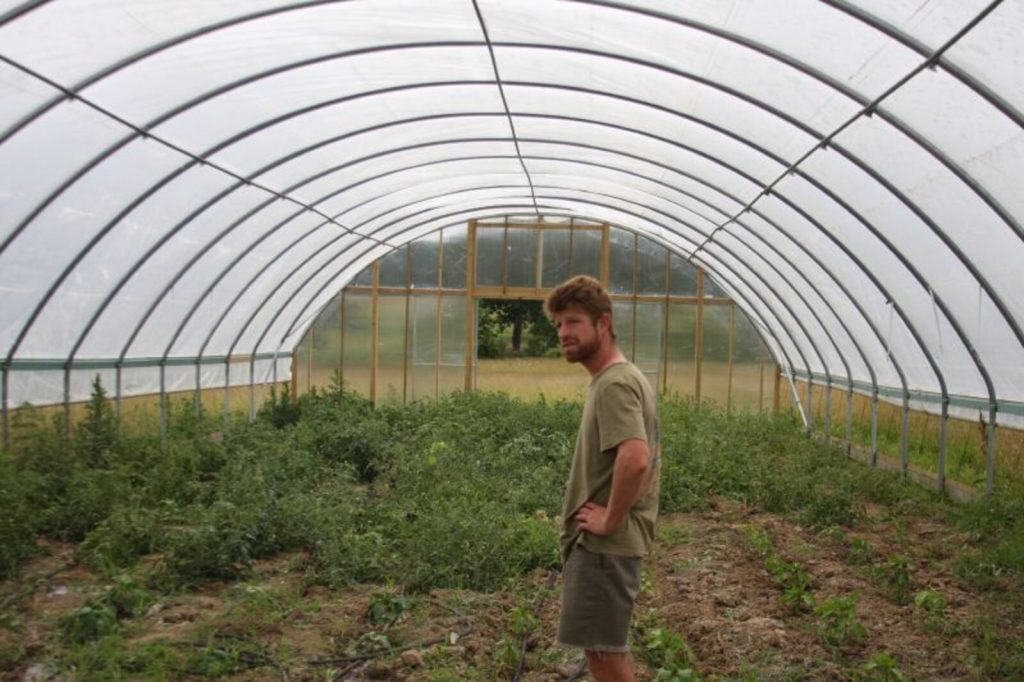
A greenhouse construction business in Uganda puts up a frame that lasts about a decade and covers it with a sheet that lasts about three years. That gap is the business. New builds pay the bills in a good season, and re covering the houses already standing is what keeps a crew fed between them.
What a Greenhouse Construction Business Sells, and What It Sells Again
Search for this trade and you get page after page about running a greenhouse: growing seedlings, selling bedding plants, choosing which tomato to raise. That is a different enterprise entirely. This one sells structures to the people who do that, and it lives or dies on things those pages never mention.
The product is a kit plus a crew. A typical Ugandan and regional package covers the frame, ultraviolet treated polythene, insect netting, doors, the profile and wiggle wire that hold the sheet down, and installation. Around that sits a second income you do not quote for on day one: the sheet comes off again in a few years, the netting tears, a door frame racks, a pole fails at ground level, and somebody has to come and put it right.
Think of the business as two revenue lines with different rhythms. One is lumpy, seasonal and won on price. The other is small, repeatable and won on being reachable.
Why Re Covering Greenhouses Is Steadier Money Than Building Them
The single most useful number in this trade is the ratio between two service lives.
Ultraviolet treated film in this region runs roughly two to four years before it needs replacing, and suppliers commonly warrant it for around three. The frame underneath lasts far longer. Ugandan field research on treated eucalypt poles puts their average service life at about ten years, with decay and termites behind the large majority of failures. Galvanised steel goes further again.
So every house you put up is a customer who has to buy a sheet from somebody roughly three times before the frame is done, plus netting, plus fixings. Over the life of one structure the recovering work can be worth more than the original covering was. A builder who walks away after commissioning has sold one job. A builder who keeps a list of what went up where, and in which month, is selling into a book that grows every season.
Nearly Half the Greenhouses Are Not Working, and That Is Your Problem Too
A structured survey of 138 greenhouse farmers in one Kenyan county recorded 48.6 percent of the greenhouses as not functional at the time of the visit. No equivalent Ugandan count appears to exist and none is invented here, but nothing about conditions on this side of the border suggests the picture is much better.
Builders tend to read that as a farmer problem. It is not, commercially. Look at what it does to your own business model.
An idle greenhouse buys no film. It buys no netting, it makes no callback, and it never becomes a referral. If nearly half your installed base stops cropping within a few seasons, half your recurring revenue never arrives, and the annuity described above is a fiction. Worse, an empty polythene shell standing in a village is a permanent advertisement against the product, whatever the actual reason it stopped.
That is what makes handover a commercial act rather than a kindness. It is also a reason to be careful who you sell to. A customer with no water source, no market for the crop and no working capital for inputs is not a sale, it is a future derelict structure with your name on it.
The Standard Greenhouse Sizes Ugandan Farmers Actually Buy
Fabricators in this region converge on a short list of sizes, and knowing it saves a new business from designing a catalogue nobody wants.
| Size, metres | Typical buyer | How it is priced |
|---|---|---|
| 8 by 15 | First time grower | From a size list |
| 8 by 24 | Small commercial | From a size list |
| 8 by 30 | The common unit | From a size list |
| 16 by 30 and up | Established farm | Per square metre |
The switch matters. Above roughly 300 square metres, regional fabricators stop quoting from a list and start pricing per square metre, because at that point the bill of materials scales cleanly and the site works stop being a fixed overhead. Build your own price list the same way: a small number of fixed offers for the sizes most people ask for, and a rate per square metre above the point where your crew's setup time stops dominating.
The guide to greenhouse sizes covers what each of those footprints will actually grow, which is the conversation you want a prospective buyer to have before they choose.
What Goes in the Quote and What the Farm Supplies
Almost every dispute in this trade is about the edge of the quotation rather than about the price inside it.
Regional package statements are fairly consistent on where that edge sits. The fabricator brings the frame, the ultraviolet film, the netting, the doors, the fixing system and the installation labour. The client supplies sand, aggregate, the water connection, unskilled labour and transport. Nobody reads that line at the point of signing, and everybody remembers it on the morning the crew arrives and there is no sand.
Publish that boundary as part of your offer rather than burying it. A buyer comparing two quotations cannot tell a good one from a cheap one, and the fastest way to look honest is to be the firm whose exclusions are written down.
Pricing a Greenhouse Build When You Cannot Publish a Price
Steel, polythene and fixings move with the import market, so a price list printed today is wrong by the next shipment. That is not a reason to price loosely. It is a reason to price from a live bill of materials.
Build your quotation from four blocks and reprice the first one every time you buy. Materials, taken from current supplier quotations rather than from what you paid last time. Fabrication, which is workshop hours plus consumables and is stable. Site work, which is crew days plus travel and accommodation and varies with distance more than with size. And overhead and margin, which has to carry the quotations you lose alongside the ones you win.
Two ratios from regional supplier price tables are worth holding in your head as sanity checks rather than as prices. A drip kit for a small house is quoted separately at roughly a tenth to a fifth of the structure price. The film for a small house, at regional rates per square metre, comes to well under a tenth of the structure price. If your own numbers land a long way from either, something in your bill of materials is wrong.
The page on greenhouse cost in Uganda sets out the published bands from the buyer's side, which is what your prospects will have read before they call you.
Timber Against Steel in a Greenhouse Frame, and the Warranty You Are Writing
This is a technical choice with a commercial tail, and the tail is the part a new business misprices.
Treated timber is cheaper to buy and quicker to work, and Ugandan field study of treated poles puts average service life at about ten years, with decay and termites behind 85.3 percent of failures in poles treated one way and 67 percent in poles treated another. Untreated timber in ground contact in this region lasts about two years against roughly fifteen for treated, which tells you that treatment quality, not species, is the variable that decides whether your structure embarrasses you.
Steel costs more and imports at a price you do not control. It also removes an entire class of warranty claim from your life.
Whichever you offer, be explicit about what your guarantee actually covers. A warranty that reads as though the whole structure is guaranteed for a decade, on a timber frame in termite country, is a liability you have written by accident. The greenhouse construction guide covers the build detail behind that choice, including ground line protection and anchoring, and it is worth your crew reading rather than only you.
Net Houses and Shade Structures as a Second Greenhouse Product Line
Not every buyer needs a sealed polythene house, and the ones who do not are a market most fabricators serve badly.
A net house costs roughly a third less than the equivalent polythene house, on the regional figures, and it suits crops and climates where the point is insect exclusion and shade rather than trapping heat. Nursery structures are smaller again and turn over faster. Both use the same frame skills, the same crew and much of the same fixing hardware, which means they fill workshop weeks between the big builds without a second set of tooling.
They also lower the entry price of a first sale. A grower who has bought a shade structure from you and had a decent experience is a far warmer prospect for a full house two seasons later than a stranger comparing three quotations. The pages on shade nets in agriculture and nursery shade house construction set out what each does.
Irrigation, Beds and the Farming Work That Follows the Structure
A greenhouse without irrigation is a shed. Almost every house you build needs water delivered to plants inside it, and the buyer will either ask you to do it or hire somebody else while your crew is still on site.
There is a decision here rather than an obvious answer. Fitting the irrigation yourself adds a line to every quotation, uses the same site visit and keeps one firm answerable when something fails. It also means stocking driplines, filters, connectors and a pump, learning to size a system, and carrying the callbacks that come with it. Subcontracting to an installer keeps your bill of materials narrow and your crew fast, at the cost of margin and of coordination.
Either way, know enough to specify it, because a house plumbed badly will be blamed on the house. The page on greenhouse irrigation systems covers what goes inside, and if the irrigation side starts to outgrow the structure side there is a separate business in irrigation installation with its own route to work.
Fabrication, Site Crews and What a Greenhouse Builder Should Subcontract
The work splits into two very different operations and a lot of small firms run them as one, badly.
Workshop fabrication is repeatable, weather independent and schedulable. Cutting, drilling, welding or treating, then bundling a kit by size. It rewards jigs, a standard catalogue and buying material in quantity. Site installation is none of those things. It is travel, weather, a client who has not cleared the plot, and a crew living away from home.
Keep fabrication in house, because it is where your quality and your cost advantage live. Be readier to subcontract at the site end: local unskilled labour is usually the client's contribution anyway, and haulage to a distant district is almost always cheaper hired than owned when you are starting out. What you should not subcontract is the fixing of the sheet and the final tensioning, because that is the part that fails first and the part a customer will judge you on for the next three years.
Handover, Training and Keeping the Greenhouse Farming
The commissioning visit is the last time you have the customer's full attention, and it is the cheapest hour of marketing available to you.
Show them how to open and close the vents and why. Show them what a tear looks like early and how to patch it before it runs. Tell them what the film's service life actually is, in plain terms, so that the day it clouds over they ring you rather than concluding the greenhouse was a swindle. Walk the ground line and point at what will attack the timber. Leave the date of the next visit written down.
Then keep the list. Every structure, its size, the month it was covered, the customer and how to reach them. That list is the asset. It tells you which houses are due for film before the customer knows, it routes a crew efficiently, and over a few seasons it turns a project business into something with a floor under it.
Where Greenhouse Construction Businesses Fail in Uganda
Registering a Greenhouse Construction Business in Uganda
No occupational register or licence specific to greenhouse fabrication was found, and none is asserted here. What applies is what applies to any firm doing paid work. The company gets registered, a tax identification number gets taken out, and each local authority you build in has its own trading requirements. If you take on work for a public body or a donor funded project, that buyer will impose its own prequalification and procurement conditions, which are usually stricter than anything a private customer asks for. Arrangements of this kind change, so confirm the current position locally rather than from an older article. The guide to registering an agribusiness covers the formation steps, and this page sits inside the wider agribusiness section.
Keep books that separate the two revenue lines from the beginning. New builds and maintenance behave differently, carry different margins and need different amounts of cash tied up, and a single lump of turnover tells you nothing about which of them is feeding you.
Frequently Asked Questions
Before taking a first order, price one complete kit for a common size from two or three material suppliers on the same specification, and write down exactly what your quotation includes and excludes. The directory of greenhouse suppliers is a starting point for those comparisons and for seeing how established fabricators package what they sell. Then start a record of every structure you put up and the month it was covered, because that list is the part of the business that compounds.