
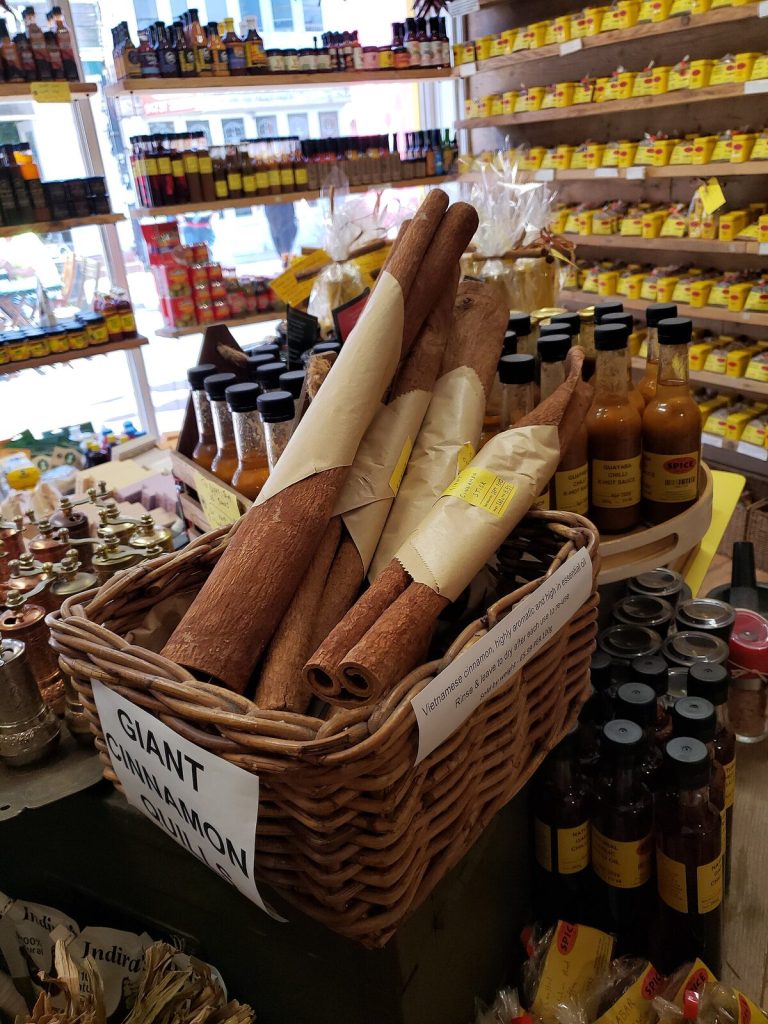
Cinnamon is harvested by cutting young coppiced shoots close to the ground, scraping off the rough outer bark, then peeling the thin inner bark away in sheets. Those sheets are shade dried, rolled and nested into long quills, dried again on racks, and graded by thickness. The bark is the spice. Peeling it is hand work and it takes real practice.
When Cinnamon Shoots Are Ready for Harvesting
The shoot tells you, not the calendar. A stem is ready when its outer bark has gone fully brown along its length, with only the tips still green. Cut too early and the bark tears instead of lifting. Leave it too long and the stem puts on wood rather than bark, so you carry more weight to the shed for the same amount of spice, and the bark itself hardens past the point where it can be peeled at all.
There is a second signal that experienced growers watch, and it has to do with sap. Cinnamon flushes new leaves when the rains arrive, and those leaves come out red before turning green. The window when the flush has just greened is when bark separates from wood most easily. Avoid cutting while the bushes are carrying new red leaves, flowers or fruit, because the bark grips at those stages and your peelers will fight it for every sheet.
A coppiced stand gives its first harvest two to three years after planting, and two to three harvests a year after that under good management. Stretching the interval does not pay. The stems mature, the wood fraction climbs, bark weight barely moves, and you lose the thin high grade material that carries most of the value. Growers who plant cinnamon as a shade tree and wait a decade before touching the bark end up with stems that can only be scraped into chips, which is the cheapest thing the crop produces. The planting side of that decision is covered in our guide to cinnamon farming in Uganda.
Cutting the Shoots at Harvest Without Killing the Bush
Nothing dies in a cinnamon harvest, which surprises people. The plant was cut back to a stump early in its life on purpose, and it responded by throwing up multiple stems from the base. Each harvest takes some of those stems and the base sends up more. A well kept stool goes on producing for decades.
The cut itself is specific. It goes about an inch and a half to two inches above the ground, sharp and clean, and it slants towards the bush rather than away from it. That angle matters because it pushes the next flush of shoots outward instead of crowding them into the middle of the stool, so the bush stays open and the shoots stay straight. A crushed or ragged cut invites rot into the stool, so tools are kept sharp and the cut is made in one stroke.
Field dressing happens before anything leaves the plot. Side branches come off, leaves are stripped, and anything still green and immature is removed from the stem. Weak, diseased or pest damaged stems are cut out at the same time and taken out of the field, since harvest is also the moment sanitation gets done. What goes to the peeling shed is a bare brown stem and nothing else. The leaves and trimmings do not get burned; they have their own use, which comes later in this guide.
Scraping the Outer Bark After Harvest
The rough brown skin on the outside of the stem is not the spice. It is corky, bitter and full of whatever the stem picked up in the field, and it comes off before peeling begins. A curved scraper is run along the stem, taking the outer layer down to the smooth bark beneath.
One detail is worth copying exactly. The stem is held above ground level while it is scraped, never laid in the dirt, because everything peeled off it afterwards goes into food. Soil on the shed floor is the commonest route for contamination into a spice that will be eaten without further washing. A raised bench, a clean mat, a swept floor and clean hands do more for the market value of a batch than any amount of grading later.
Scraping also grades the stem for you. If the outer layer will not come away and the bark below is hard and greenish brown, that stem is past peeling. It is set aside for chips rather than forced, and you make a note of how long it stood since the last cut, because that is the information that stops it happening next season.
Peeling the Inner Bark: The Skill That Decides Your Production
This is the step that separates a batch worth exporting from a sack of broken fragments, and it is the reason true cinnamon costs what it does.
The scraped stem is first rubbed hard with a brass rod along its length. That bruising releases sap and breaks the bond between bark and wood, and you can hear and feel when a stem has loosened. Then the peeler decides how wide a sheet to lift, because sheet width is what sets the grade, and makes long vertical and horizontal cuts with a small hooked knife before working the bark off the wood as an intact sheath. A skilled peeler lifts a sheet almost the full length of the stem, paper thin, without splitting it.
When a stem will not give up a whole sheath, the bark comes off as thin strips instead. Those strips are not waste; they become the filling inside quills and the feedstock for the lower grades. But a shed producing mostly strips is a shed losing money, and the difference is almost entirely operator skill rather than equipment.
Traditional practice uses four hand tools and no machinery: a heavy knife for cutting stems, a curved scraper for the outer bark, the brass rod, and the small hooked peeling knife. There is no mechanical substitute in commercial use. Attempts to mechanise cinnamon peeling have not displaced the hand method anywhere, which is exactly why the labour question later in this guide is the one that decides whether a Ugandan grower can process at all.
Drying Peeled Cinnamon Bark in the Shade
Peeled sheets go into shade, not sun. Direct sun dries the outside of a sheet faster than the inside, and the sheet buckles, cracks and cannot be rolled. In shade, the sheet loses water slowly and does something useful while it does: it curls. The inner face of the bark shrinks more than the outer face as it dries, so a flat sheet pulls itself into a tube on its own. That curl is where the word quill comes from, and it is a property of the bark rather than anything the peeler does.
The sheets are dried only until they have curled to the right degree, which is a matter of hours rather than days, and they are kept clean and off the ground throughout. Overdrying at this stage is a real mistake. A sheet dried brittle will not nest inside another sheet without snapping, and nesting is the next operation.
Forming Quills and Joining the Bark Sheets
A finished cinnamon quill is not one piece of bark. It is several sheets rolled and slid inside one another, with the hollow packed out using the smaller strips and offcuts from the same grade, then trimmed to a standard length. The standard lengths are 42 inches, which is about 105 cm, and 21 inches. A simple measuring frame is used to get the length right, and scissors trim the ends square.
The rule that keeps a batch honest is that the filling must be the same grade as the outer sheet. Packing a fine pale quill with coarse dark offcuts is adulteration, it is visible the moment a buyer breaks a stick, and it is the fastest way to lose a market.
Once formed, the quills go straight back into shade to finish drying, hung on strings or laid on racks or nets with air moving around them. That takes four to seven days, and it ends when the moisture content reaches 14 per cent or below. Below that figure the quill is stable, holds its aroma and resists mould. Above it, you are shipping a mould problem to someone else.
Cinnamon Grades and What Buyers Are Measuring
Graded quill is where the money sits, and the grading system is more precise than most growers expect. Three things are measured. The diameter of the finished quill. How many 42 inch quills it takes to make a kilogram, which is really a proxy for how thin the bark is. And the percentage of foxing, meaning the darker blotching on the quill surface. Between them these three criteria produce roughly 13 named grades.
Thinner and paler wins. The finest grade, Alba, is made from narrow sheets of very thin bark, and it takes about 45 quills to make a kilogram. At the other end, the Hamburg grades are thick, heavily foxed, and it takes only six or seven sticks to fill a kilogram. Growers are pushed towards the fine end because that is where the price is, and the fine end depends on cutting stems young and peeling them well.
| Grade | Quill width | Sticks per kg | Foxing max |
|---|---|---|---|
| Alba | 6 mm | 45 | 10 per cent |
| C5 special | 10 mm | 30 | 10 per cent |
| C5 | 12 mm | 27 | 15 per cent |
| C3 | 18 mm | 20 | 20 per cent |
| M5 | 18 mm | 20 | 60 per cent |
| H1 | 23 mm | 10 | 25 per cent |
| H2 | 32 mm | 7 | 55 per cent |
Compare the C and M rows and you can see what the system is really sorting. C3 and M5 have the same quill diameter and the same count per kilogram. What separates them is foxing, 20 per cent against 60 per cent, which is a cleanliness and handling outcome rather than a bark thickness one. In other words, two peelers working the same stems can produce two different grades, and the gap between them is in the shed rather than in the field.
Formal standards sit above all this. Sri Lanka holds a geographical indication for Ceylon cinnamon and a national standard for it, and there is an international standard for the species as well. None of that is currently reachable by a Ugandan grower, but it is worth knowing that the grade names buyers use are anchored to published specifications rather than to opinion.
Featherings, Quillings and Chips: The Lower Grades of Production
A peeling shed produces far more than quills, and treating the rest as waste is how small processors lose margin. Every fragment has a defined form and a buyer.
Grinding is the obvious route for a Ugandan processor, because it turns fragments into a retail product without needing an export grade quill. It comes with one warning: milled bark loses aroma much faster than a sealed quill, so powder is made close to the point of sale rather than stockpiled. The packaging side of that is covered in our guide to the spice grinding and packaging business.
Leaf Oil and Bark Oil From Harvest Residue
Everything stripped off the stems in the field has a second life. An acre of coppiced cinnamon yields something like 4,000 kg of leaves a year alongside the bark, and leaves are the raw material for cinnamon leaf oil. The leaf is distilled by one of three methods, hydro distillation, steam hydro distillation or straight steam distillation, using ripe and shredded leaf in preference to fresh whole leaf. Leaf oil goes into perfumery, soap and flavouring, and it is a completely different product from bark oil.
Bark oil is distilled from bark itself and it is graded on chemistry rather than appearance. The measurements that matter are cinnamaldehyde, which carries the cinnamon character, and eugenol, which carries a clove like note. A superior grade bark oil runs above 60 per cent cinnamaldehyde with eugenol down around 6 per cent, while an ordinary grade sits at 30 to 44 per cent cinnamaldehyde with eugenol as high as 40 per cent. As cinnamaldehyde falls, eugenol climbs, and the oil moves away from smelling like cinnamon.
For a Ugandan grower, leaf oil is the more realistic of the two, because leaf is the part of the crop that already has volume here and the still is the only real capital item. It is also the route that Ugandan growers most often mention wanting to take and least often actually take, which usually comes down to the distillation equipment rather than the raw material.
Peeling Labour: The Real Constraint on Cinnamon Production in Uganda
Here is the honest obstacle, and it is not agronomy. Cinnamon peeling is a trade. In Sri Lanka it is learned as an apprenticeship over years, peelers work in crews that move between farms, and they are commonly paid as a share of the harvest rather than a day rate, which tells you how strong a bargaining position the skill gives them. Daily output per peeler is low even for a good one, because the work is slow by nature.
Even in the country that has done this for centuries, peelers are the bottleneck. Younger workers have moved to better paid and less demanding work, crews are short, and farms that could be cut two or three times a year get cut less often because there is nobody to peel what would come off. If that is the position in Sri Lanka, it puts the Ugandan position in perspective: no training programme for cinnamon peeling was found in Uganda, no peeler association, no rate card, nothing.
Which leads to a practical conclusion rather than a discouraging one. Anyone planning to process cinnamon bark in Uganda has to treat peeling skill as the first investment, ahead of acreage. That means a small number of people trained properly, practising on your own stems through several harvests, with the batches they ruin treated as training cost rather than loss. Two competent peelers working a small block will out earn a large block with nobody to peel it. It also means your harvest schedule is set by peeling capacity, since a stem has to be cut, scraped and peeled on the same day.
Moisture, Storage and Handling Before Sale
Dried cinnamon is stable but it is not indestructible. Two things damage a finished batch: moisture coming back in, and aroma going out.
Moisture first. The 14 per cent figure is not arbitrary. Above it, mould grows on stored quills and the batch is lost, and in Uganda's humidity a properly dried batch can reabsorb enough water to get there if it is stored in an open sack in an unventilated room. Quills are packed dry, sealed, kept off the floor and off outside walls, and stored somewhere that does not swing between hot afternoons and cold nights, because that cycling is what drives condensation inside packaging.
Aroma second. The volatile oils that make cinnamon worth money leave through any cut surface, which is why whole quills keep far longer than broken pieces and pieces keep far longer than powder. Grind to order. Sell quills whole where you can. Keep the batch out of direct light and away from anything else strongly scented, since bark picks up smells from its neighbours in a store.
Keep records per batch: cut date, stems peeled, weight of each grade produced, days on the rack, and what the buyer said about it. That record is the only way to find out what your own site and your own peelers can actually do, and it is what turns the second harvest into a better one. The same principles applied to other Ugandan spices appear in our guides on spice drying and processing and turmeric processing and drying.
What Ugandan Growers Actually Harvest and Sell
Time to close the gap between the process described above and what happens in Mukono, Kayunga and Wakiso right now. Most Ugandan cinnamon leaves the farm as leaves and branches, sold in bundles to traders in Kampala and across the Kenyan border. Seedlings are a second income line, sold to other farmers wanting to start. Bark is sold in small quantities, often already ground into powder, to local spice sellers.
Graded quill barely features. No Ugandan cinnamon sold by grade name, whether Alba, C or M, turned up in any source. The most advanced documented Ugandan processing is bark powder, produced by growers in a Wakiso community forest project run with Kasuku Organics and the GLS Future Foundation, who were trained in harvesting technique, hygienic storage, quality control, packaging and labelling before they moved from selling branches to selling finished powder. That is a sensible route and it is a real one.
The reason quill is absent is not mystery. It requires young coppiced stems, which most Ugandan stands do not have because they were planted as shade trees. It requires trained peelers, who do not exist here. And it requires enough volume to interest a buyer who trades in grades. Powder sidesteps all three. So the realistic Ugandan sequence is leaves first, clean powder second, and graded quill only if a group of growers decides to build the peeling skill together. The rest of the spices and herbs guides covers the same progression for other crops, and the closest parallel in post harvest terms is how cloves are harvested and dried, where drying discipline decides the grade in much the same way.
Cinnamon Harvesting and Processing Questions
Does harvesting cinnamon kill the tree? No, and that is the point of the system. The plant is deliberately cut back to a stump early in its life so it grows as a multi stemmed bush instead of a tree. Each harvest removes some stems and the base pushes up replacements. Cut properly, about two inches up on a slant, a stool keeps producing for decades. What does damage a stool is a crushed, ragged or too low cut, which lets rot in.
Why is the outer bark thrown away when the inner bark is the spice? The outer layer is corky and bitter, contributes nothing to flavour, and carries field dirt. Removing it is also what makes the inner bark peelable, since the scraping exposes the smooth layer that lifts away from the wood. On older stems the outer layer will not come off cleanly, and once that happens the inner bark can no longer be peeled into sheets, only knocked off as chips.
Why does cinnamon curl into a stick? Because the two faces of a bark sheet shrink at different rates as they dry. The inner face contracts more than the outer, so a flat sheet pulls itself into a tube without anyone rolling it. That only happens if the bark dries slowly in shade. Dried in direct sun, the outside sets before the inside has moved and the sheet cracks instead of curling, which is why shade drying is not optional.
What equipment does a small Ugandan processor need, and what does setting it up involve? Less machinery than most people expect and more building than they expect. The peeling tools themselves are four hand items: a cutting knife, a curved scraper, a brass rod and a small hooked peeling knife. What actually costs money is the shed, because the whole process needs a clean roofed space with raised benches, a swept sealed floor, good airflow and racks or strings for four to seven days of drying, plus enough of it to hold a whole day's cut. Add a scale, sealed food grade packaging, and a mill if you intend to sell powder. None of these have a reliable published Ugandan price, so get quotes locally for the shed materials, racks and a mill before you commit, and check what spice products are currently fetching on our Uganda farm produce prices pages so you can see whether the shed pays for itself at your likely volume. Treat peeler training as a cost line of its own.
Why is graded quill worth so much more than chips or powder? Because the grade is a proxy for how much skilled work survived intact. A fine pale quill means young stems, cut at the right moment, bruised correctly, peeled as whole thin sheets without splitting, dried slowly without marking and nested honestly. Chips mean none of that happened, or the stems were too old to allow it. Powder sits in between on price but loses aroma fastest, so it has a short shelf life working against it. The price ladder is a skill ladder, which is why the same acre can produce very different income depending on who processed it.
Can Ugandan cinnamon meet export requirements? On species, it starts in a good position, since what is grown here is Cinnamomum verum, the low coumarin species that European and North American buyers pay a premium for. Coumarin is the parameter that matters and the tolerable daily intake set by European food safety assessments is 0.1 mg per kilogram of body weight, which true cinnamon comfortably respects and cassia does not. On everything else the answer is not yet, because meeting an export specification means a named grade, a documented moisture level, clean handling you can demonstrate, and consistent volume, and no Ugandan supply currently offers all four. The gap is process and organisation, not the plant.
Before building anything, go and ask. Find out what form and what grade the buyers within reach actually want, whether that is leaf, powder, quillings or graded quill, and what volume they need to place an order. Then check current spice prices for each of those forms so you can see which one pays for the shed. The answer to those two questions should decide what you build, in that order.