
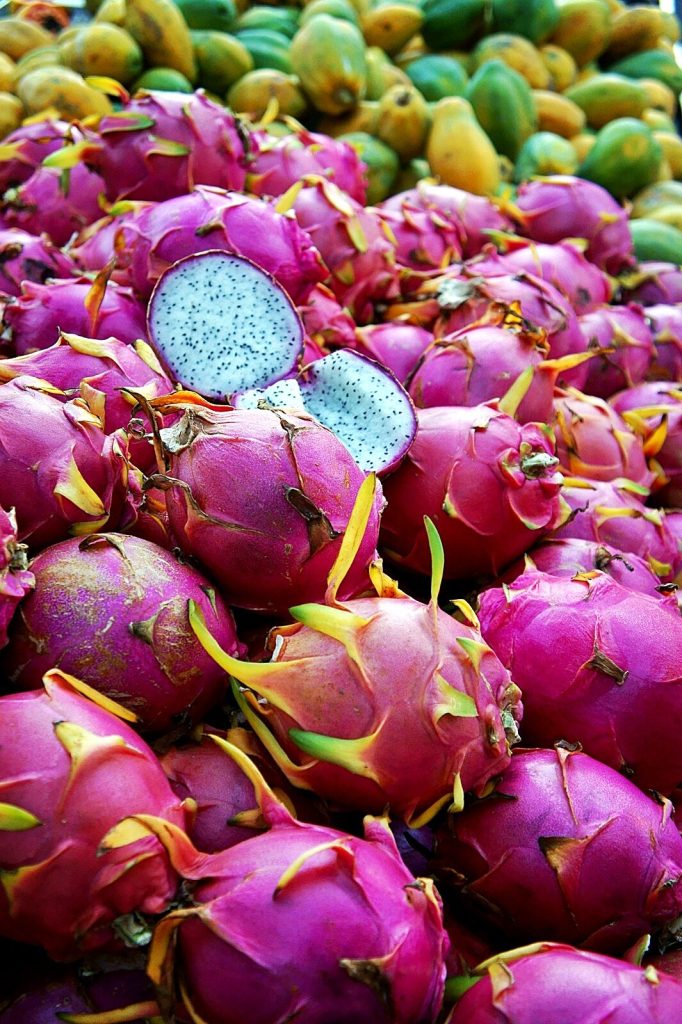
Dragon fruit farming in Uganda runs as a perennial cactus orchard on standing posts, and the first two years carry cost with no crop at all. Planting material moves as stem cuttings rather than seed, because no certified fruit nursery trade exists in the country to supply anything else. Dragon fruit, also called pitaya, is a climbing forest cactus from tropical America whose flowers open after dark and last one night.
What Dragon Fruit Is, and Why the Drought Crop Label Misleads in Uganda
Almost every Ugandan article about this crop opens with the word drought. That framing is where growers go wrong, and it is worth pulling apart before any money moves. Dragon fruit belongs to the genus Selenicereus, long published under the name Hylocereus, and it is a climbing and part epiphytic cactus rather than a desert one. In tropical forest, which is where it comes from, it grows up trees in semi shade.
The rainfall figures settle it. A peer reviewed review of pitaya biology and site requirements records the crop as native to regions receiving roughly 1,730 to 2,540 mm of rain a year, while noting it can withstand 500 to 700 mm. Excess rain causes flowers to drop and fruit to rot. Uganda's national annual rainfall reads 1,576.67 mm in the ERA5 reanalysis, with a second reading of 1,282.74 mm reported from a different dataset and not independently confirmed on this site. Either way Uganda sits below the band the plant evolved in and well above the floor it merely survives at.
Being able to survive a dry spell is a survival trait, not a yield trait. The same review found the largest plant biomass at 70 to 80 percent of field water capacity, and at 50 to 60 percent the plant puts its growth into roots instead of fruit. A Florida extension document on the crop puts it more bluntly: in spite of being a cactus, pitaya has a fairly high water requirement, and dry weather during fruiting cuts production.
So the honest case for planting it in the cattle corridor is narrower than the one being made. The plant will not die in a poor season the way maize does. That is genuinely worth something on land where a cereal fails one year in three. It is a different claim from cropping heavily on little water, and a grower who buys the second claim will underbuild the irrigation and wonder why the fruit stays small.
One more piece of physiology matters for everything that follows. Pitaya runs crassulacean acid metabolism, so its stomata open at night and close by day, fixing carbon in the dark. That is why night temperature governs this crop more than day temperature, a point almost nothing written for Ugandan readers mentions.
Day Length, Flowering and Why Uganda Sits Right at the Threshold
This is the gap in every page ranking for dragon fruit farming in Uganda, and it decides whether the crop flowers on any kind of schedule. Pitaya is a long day plant. A review of supplemental lighting for the crop records a critical day length for flowering of about 12 hours, and states in a second place that the photoperiod must exceed 12 hours for blooming to occur. Taiwan induces off season production by adding roughly six hours of artificial light. In China the same trick carries a whole winter industry.
Uganda straddles the equator, so its day length barely moves. The figures below are calculated from latitude using the standard sunrise hour angle with the usual correction for refraction and the width of the solar disc, and they are arithmetic rather than measurement.
| Place | Longest day | Shortest day | Yearly swing |
|---|---|---|---|
| Far south Uganda | 12h 12m | 12h 02m | 10 min |
| Kampala belt | 12h 08m | 12h 06m | 2 min |
| Gulu | 12h 17m | 11h 58m | 19 min |
| Far north Uganda | 12h 22m | 11h 53m | 29 min |
| Binh Thuan, Viet Nam | 12h 46m | 11h 28m | 1h 18m |
| Pune, India | 13h 14m | 11h 01m | 2h 13m |
| Southern Taiwan | 13h 31m | 10h 45m | 2h 46m |
| Guangxi, China | 13h 33m | 10h 43m | 2h 50m |
Read the threshold claim carefully, because it is published to the nearest hour. Uganda's longest natural day anywhere in the country is about 12 hours 22 minutes, in the far north, and only about 12 hours 8 minutes through the Kampala belt. That clears an approximate 12 hour threshold by minutes, which is inside the precision of the threshold itself. So nobody can say from this that the crop will not flower here, and Ugandan growers plainly are picking fruit.
What the arithmetic does say, without depending on where exactly the threshold sits, is that Uganda has almost no seasonal day length signal at all. Two minutes of yearly variation around Kampala against nearly three hours in Guangxi. That difference is astronomy and it is not in dispute. Two things follow for a Ugandan planting.
First, there is no long day season pushing the orchard into one concentrated bloom, so the Vietnamese pattern of a heavy main season followed by a lit off season has no version here. Expect flowering to be scattered and weakly triggered rather than sharp, and expect to learn your own farm's rhythm rather than importing a calendar.
Second, and this is the part that should change a budget, the entire Asian yield toolkit for this crop exists to lift plants over a threshold during short winter days. Uganda has no winter to lift out of, and no summer peak to work from either. A yield figure achieved under night lighting does not transfer, and neither does the off season price premium that pays for the lamps.
There is a second flowering trigger, and Uganda does have it. The Florida extension document states that a dry period is required for abundant bloom induction, with irrigation resumed from flowering through harvest. Uganda's two dry spells a year supply that signal twice. Between the two mechanisms, the practical instruction is to keep a written record of when your own plants bud, because nobody has published a Ugandan flowering calendar for this crop and your notebook will be better evidence than anything on the internet.
Rainfall, Temperature and Soil Drainage for Dragon Fruit in Uganda
Temperature tolerances for the crop are wide and the useful bands are narrow. Best growth sits at mean temperatures of 18 to 26 C, and the crop is grown where means run 14 to 32 C. Above 28 C, each further degree cuts net night carbon uptake by 58 percent and early morning uptake by 30 percent. Above 38 C flowering is inhibited outright, though the plant survives to about 40 C if the roots have water.
Because carbon fixing happens at night, the day and night pairing matters more than either figure alone. Peak uptake was measured at 30 C by day with 20 C at night. A pairing of 18 by day and 8 at night halves it, and so does 38 with 28. At 42 and 32 the plant fixes nothing across the day. A grower at higher elevation in the south west should check their own night minimum before planting a block, because cold nights sit on the same side of that curve as a scorching afternoon.
Drainage is the line item most Ugandan plantings get wrong, and it follows directly from the rainfall point above. In heavy textured soil, waterlogging rots the flat stem segments wherever they touch the ground. The published fix in field plantings is to build ridges or raised beds and to cut away any stem that reaches soil level. Soils otherwise matter less than most crops require: free draining is the requirement, high organic matter helps, alkaline soil is no barrier, and the plant is sensitive to salinity where sodium is involved. Anyone planting a commercial block should read their soil rather than guess it, which is what soil testing before fertilizer application is for.
Sunlight carries a trap that bites at Ugandan altitudes. Severe stem sunburn has been reported in growing regions with low humidity or high altitude, and the extension recommendation is about 30 percent shading for the first three to four months after planting where insolation is damaging. Too much shade cuts both yield and fruit quality, so this is a nursery stage measure rather than a permanent structure. The related warning is sharper still: sunburn commonly happens when plants are moved from a shady place straight into open ground. A batch of cuttings raised under shade netting and planted out at midday is the exact case described.
Irrigation follows the same logic. Water is needed from flowering through harvest, withheld to help induce bloom, and never allowed to sit. A low volume system suits that pattern better than a flood, and drip irrigation is the usual answer on a post planting where every plant sits at a known point.
Planting Material: Cuttings, Curing and Why No Certified Seedling Trade Exists
Dragon fruit can be raised from seed, and almost nobody should. Seedlings vary in fruit and stem characteristics, and time from sowing to fruit production runs up to seven years. One Ugandan newspaper feature puts the seed route at three years instead. The span between those two is the honest answer, and either end of it is long enough to rule the method out for anyone planting to sell.
Cuttings are what the trade actually moves. Stem segments of 12 to 38 cm are taken, given a slanted cut at the base, treated with a fungicide, then left to cure in a dry shaded place for seven to eight days so the wound heals. After that they go either straight into the field or into pots, where four to six months builds a root system worth planting. Cuttings grow fast once away, around 3 cm a day, and a longer cutting reaches the top of its post sooner than a short one.
Now the part no seller will tell a buyer. Uganda has no certification scheme for fruit planting material, and there is nothing a buyer can ask to see. The evidence sits in three places: the ministry's certified seed table covers maize, beans, sorghum, soybean, sunflower, groundnut and rice and no fruit at all; a regional banana manual states outright that planting material certification programmes are close to non existent in Eastern and Central Africa with no regulated framework for smallholders; and a Ugandan fruit tree study names thin propagation information among the constraints growers report. At least one Ugandan nursery advertises certified dragon fruit cuttings. There is no scheme against which they could be certified.
That absence bites harder on this crop than on most, for a reason specific to the cactus. Because propagation is by stem cutting only, no seed law touches the trade at any point, and the material a grower buys is living stem tissue from another farm's plant. Stem tissue is exactly how the main disease of this crop travels. Anyone raising their own material from plants they have watched for a season is on firmer ground than anyone buying in, which is the same conclusion this site reached on pawpaw for different reasons, and starting a seedling nursery covers the mechanics.
Variety naming is the other soft spot. Ugandan pages list four varieties as pink, red, white and yellow. Colour is not a variety name, and the yellow one is a different species with smaller fruit, higher sugar and different pollination behaviour from the rest. Worse, the Florida extension document states directly that information on self incompatibility in the named cultivars and unnamed selections moving through nurseries is not well documented, which makes variety recommendations difficult at best and potentially unreliable. That is the truthful answer to which variety suits Uganda: nobody can tell you, and a seller who does is guessing.
Spacing, Support Posts and Plant Population Per Acre
The post is the capital item on this crop, and the arithmetic of how many you need is where Ugandan budgets come apart. An acre covers just over four thousand square metres. At a spacing of two metres by two metres, that gives roughly 1,000 planting positions. At three metres by three metres it gives roughly 450. Both are in use internationally and the wider one is closer to what the established producing countries appear to run, for reasons the yield section works through.
Here is the confusion to avoid. The reported Ugandan practice leans four cuttings against each post, and some accounts say two. So the number of cuttings is two to four times the number of posts, and a page that quotes 2,000 plants an acre beside 1,000 posts is quoting two different things. One is a structure count and the other is a planting material count. Price them separately or the largest line in the budget goes missing, which is precisely what happens on the one full Ugandan cost sum in circulation.
On the structure itself, the load is the design problem. A mature plant is a heavy mass of water filled stems, and the published requirement is a trellis able to withstand several hundred pounds of stem weight. Bare wire is ruled out in the specification because it cuts into the stems; where wire is used it goes inside plastic hose. The extension specification is a treated pole of four to six inches diameter with a strong metal grid fixed at the top. The Ugandan version reported from a Nakaseke farm uses a concrete pole of six or seven feet set two feet into the ground with an old motorcycle tyre fitted at the crown, chosen because rubber does not transmit heat into the stems the way metal does and lasts the productive life of the plant. That is one farm's practice reported in a newspaper rather than a national recommendation, and a grower should price both the concrete and the treated timber option locally before committing a thousand of them.
Wooden posts that rot are the reported failure. A support that collapses in year four takes the plant with it, and by then the plant is the expensive part.
Hand Pollination and the Harvest Weight It Adds
Dragon fruit flowers open at night, once, and close by the following morning whether or not they were fertilised. In the pre anthesis state the stigma sits above the anthers, so no self pollination happens on its own. What that arrangement costs is measurable, and a controlled trial on two clones across two seasons measured it.
On the white fleshed, self compatible clone, fruit set reached 100 percent under hand self pollination, hand cross pollination and open pollination alike. Fruit weight did not. Hand cross pollination gave fruit of about 588 g, hand self pollination about 374 g, and open pollination about 204 g. Same clone, same orchard, same season. The heaviest treatment produced fruit close to three times the weight of the lightest, and seed count tracked it, with more than 1,300 seeds per fruit under hand crossing.
On the red fleshed, self incompatible clone the result was harsher. Full fruit set under hand cross pollination, and no fruit at all under either treatment that excluded a pollen donor. A red fleshed block planted as a single clone, with no compatible partner nearby and nobody moving pollen, sets nothing.
Do not count on wild pollinators filling the gap. The night flying moths and bats that service these flowers do so in the parts of tropical America where the plant is native, and Uganda is a long way outside that range. Even in the Indian trial, bats and moths were rarely seen at all; nocturnal beetles, blowflies and honey bees turned up instead, and how well any of them actually moved pollen is something the authors would not vouch for. Two independent reviews record partial or complete self incompatibility in the two main cultivated species, so the safe design is the one the Florida extension gives: plant two or three genetically different types rather than one clone, and know which is which.
Years to First Harvest and What the Establishment Period Costs
A perennial's establishment period is a cost with no revenue, and on this crop that period is the whole shape of the budget. The sources disagree about its length, so here is the span rather than a single figure. From a cutting, the Florida extension says many plants fruit six to nine months after planting. A review of the crop's biology puts flowering after the first year. A Ugandan newspaper feature says cuttings begin producing within 18 months, and a Ugandan nursery says 18 to 24 months.
Those are not all describing the same event. A first flower, a first fruit and a first harvest worth loading onto a vehicle are three different milestones, and the shorter figures are describing the first two. Where the sources converge is on full bearing at three to four years, which is the age band the highest published per plant figures are attached to, and on a planting life of about 20 years. The Nakaseke farm reports the tyre and the plant lasting 15 years or more.
Two items inside that timeline are routinely left out of Ugandan sums. One is the pollination labour, which is not a one off. The other is post replacement, because the failure reported from the field is a support giving way under a mature plant rather than the plant itself dying.
What Dragon Fruit Yields, and Which Figures Do Not Reconcile
Start with what does not exist. There is no dragon fruit item in FAO's production statistics for any country in the world. Not for Uganda, and not for Viet Nam either, which is the largest producer on earth and files its entire unlisted fruit output inside a residual line. So every yield number on this topic, anywhere, comes from extension guidance, a trial or an industry compilation. None of it is a national count.
The best available figures are national area and output pairs from an industry compilation, and five of the six divide out cleanly.
| Country | Area ha | Output t | Yield t/ha |
|---|---|---|---|
| Viet Nam | 55,000 | 1,000,000 | 18.2 |
| China | 40,000 | 700,000 | 17.5 |
| Indonesia | 8,500 | 200,000 | 23.5 |
| Taiwan | 2,500 | 49,000 | 19.6 |
| Malaysia | 680 | 7,820 | 11.5 |
| Philippines | 485 | 6,062 | 12.5 |
One row in that source breaks its own arithmetic and it is worth naming. The Viet Nam entry states a productivity of 22 to 35 tonnes a hectare in the same paragraph as the area and output above, which divide to 18.2. The audit is published rather than the claim. Taking the rows that reconcile, national average yield for this crop in countries with decades of experience runs about 11.5 to 23.6 tonnes a hectare, which is roughly 4,650 to 9,550 kg an acre.
Per plant figures circulate more widely and they disagree by a factor of five. Australia's industry produces roughly 740 tonnes a year from about 40,000 plants, which works out near 18.5 kg per plant per year across young and mature plants together. Florida extension material gives about 100 kg per plant per year for three to four year old plants, and that is a single garden specimen on its own trellis with stems running to six metres, not a post in a row. An Israeli figure of 30 to 35 tonnes a hectare appears in a breeding review, attributed there to a personal communication rather than a published measurement, which is how it is reported here.
These figures are a planning frame taken from elsewhere, and they are labelled that way because Uganda has no measured yield for this crop at any density. Fruit weight itself varies by type, with the red and white pulped species recorded at 200 to 600 g and the yellow one at 80 to 200 g, before the pollination effect above is applied on top.
Pruning, Training and Keeping the Canopy Open Against Stem Disease
Pruning on this crop does three jobs at once, and skipping it costs yield twice over. Training comes first. While the plant is climbing, every lateral along the main stem is removed and the main stem is tied to the post. Once it reaches the crown its tip is cut, which forces branching, and the new laterals are trained over the top so that fruiting wood hangs down. That cascade is the shape the whole structure is built for.
Production pruning follows for the life of the planting, one to three times a year on a vigorous plant, and best done soon after harvest. Damaged, diseased and dead stems come out. So does any stem reaching the soil, because that contact point is where stem rot starts in wet ground. Stems that block harvesting or crowd the canopy come out too, and the remaining ones are tied back so they do not snap under their own weight.
Left alone, the plant becomes a dense tangle. Light stops reaching the stems, yield falls, harvesting gets harder, and pest and disease incidence rises because the canopy no longer dries after rain. Airflow through an open canopy is the cheapest disease control available on this crop and the only one that costs nothing but labour. Prunings are carried out of the field rather than dropped between rows, and composted somewhere else. Pruning also triggers flowering and branching, so it pays back directly rather than being tidying.
The published practice treats pruning cuts with a fungicide to reduce stem rot, and cuttings are treated the same way before curing. No product and no rate appears here, because the right answer is on the label of a product registered in Uganda and a district extension officer can confirm it. Reading an agrochemical label properly is the skill that makes that instruction usable.
Pests and Diseases Recorded on Dragon Fruit, and What Is Not Established for Uganda
The disease that matters most on this crop worldwide is stem and fruit canker, caused by the fungus Neoscytalidium dimidiatum. Extension material also records fruit and stem rot from Colletotrichum gloeosporioides and Bipolaris cactivora, plus a bacterial problem from Xanthomonas campestris. On the insect and mollusc side, damage has been reported from mites, thrips, ants, scales, leaf footed bugs, mealybugs and slugs, and fruit is taken by birds and rodents.
Whether the canker fungus is already in Uganda is not settled, and it is worth being precise rather than reassuring. A European food safety assessment of the pathogen lists it as present in Africa in Algeria, Egypt, Ghana, Guinea, Mali, Nigeria, Sierra Leone, South Africa, Sudan, Tanzania, Tunisia and Zimbabwe. Uganda is not on that list. The same assessment records its own key uncertainty about the worldwide distribution, because the fungus has two forms that were misidentified from appearance alone before molecular tools existed. So absence from the list is not evidence that Uganda is free of it, and no page should claim either way. What is clear is that it is present in the region, including in Tanzania.
The reason this matters more on dragon fruit than on most crops is the propagation route. The fungus is recorded causing dry rot of stem cuttings in an unrelated crop, this crop moves only as living stem cuttings, and no scheme inspects any of them in Uganda. The planting material is the pathway. A grower who buys cuttings from four different farms has taken four separate chances.
Control, as far as anything can be stated safely, is cultural and it is the pruning regime above: keep the canopy open so stems dry fast after rain, cut out infected stems, carry them off the field, and do not plant into ground that drains badly. Where a fungicide is used on cuttings and pruning cuts, the rate and any interval sit on the product label and a vet or extension officer confirms what is registered locally. The fruit is eaten fresh with the pulp scooped out, so a pre harvest interval applies to anything sprayed near harvest and it must be respected.
On fruit flies, the honest position is a gap. Bactrocera dorsalis is established in Uganda and is the dominant species in trapping work across several agro ecological zones, which this site covers on the mango farming pages. Whether it attacks dragon fruit under Ugandan conditions is not established from the sources reached, so it is not asserted here either way. The sensible response to a suspected infestation is a trap and a report to a district extension officer rather than a spray bought on a guess.
Harvesting, Handling and the Thin Ugandan Market
Fruit is cut rather than pulled, using hand clippers, and the stub at the attachment is trimmed flush to the skin so it does not puncture neighbouring fruit in a crate. Only well coloured mature fruit is taken, since it does not improve off the plant. Thorny types are slower to pick than thornless ones and gloves plus long sleeves are the standard answer. Shelf life is the constraint that shapes everything after that: four to five days at room temperature, or several weeks refrigerated in bags.
Ugandan market structure is the part a grower should think hardest about, because it is unlike any other fruit in this section. Dragon fruit reaches consumers here through Kampala supermarkets and a handful of city markets, in small quantities, as a novelty. That is a display case market, not a tonnage market. It is also frequently sold by the piece rather than by weight, and a price per fruit with no agreed weight behind it is a price the grower did not set. Insisting on a scale is the single cheapest thing a new grower can do, and the gap between farm gate and retail price is where the argument for doing so lives.
The high price attached to this fruit and the small volume on sale are the same fact seen twice. A scarce novelty in a thin market carries a scarcity price, and the price is not independent of the volume arriving. One grower filling a supermarket shelf is a supplier. Twenty growers each harvesting several tonnes into the same shelf space is a glut, and it is the growers who planted on the current price who will find out first. Anyone planting more than a plot should have the conversation with a buyer before buying posts, which is what selling produce to supermarkets sets out.
Export is talked about more than it is done, and there is a classification reason it cannot be measured. No six digit customs code exists for dragon fruit anywhere in the world trade classification, and six digits is the deepest level published. The crop sits inside the residual fresh fruit basket, code 081090, which it shares with passion fruit and several others. Uganda does declare that basket in both directions, and every declared partner row sums exactly to the world total, so the data is real. The whole basket, across every fruit in it, ran below 900 tonnes of declared exports a year and below 600 tonnes of imports in the two most recent years queried. Whatever share of that is dragon fruit, it is a fraction of a small number. This site's passion fruit page works through the same code in more detail, and passion fruit is by far the larger claimant on it.
Where the Ugandan Numbers Come From, and What Uganda Does Not Count
Every figure on this page is labelled with what kind of figure it is, because on this crop the provenance is the story. Uganda publishes nothing about dragon fruit at all, and that was checked five ways with a control on each so that a broken search could not be mistaken for an absence.
FAO's production statistics carry no pitaya, dragon fruit or cactus fruit item among the 273 items filed by African countries or the 285 filed by Asian ones. Viet Nam is the control that makes it decisive: the world's largest producer has no item either, and its unlisted fruit output sits in a residual line flagged as imputed. Uganda's own equivalent line reads 7,913 hectares and 52,431 tonnes of other fruits, with the area and production imputed and the yield estimated, so not one figure in it was counted. Uganda files no row at all under the separate tropical fruits residual line that 20 other African countries do report, while its banana and pineapple rows in the same file are present and readable.
The agriculture ministry's own statistical abstract does not contain the word dragon or the word pitaya anywhere. The control passes hard, because the same document carries twelve monthly price rows each for watermelon, matooke, Bogoya, Ndiizi, apples, pineapple, passion fruit, avocado and oranges. So the search works and the blank is specific to this crop.
Two research repositories that answer reliably return nothing Ugandan on the crop. A search of the European biomedical and life sciences index returns only papers that mention the fruit in passing, against 270 hits for avocado and Uganda together. The CGIAR repository returns Latin American tropical fruit programme documents, against more than five thousand hits for banana and Uganda. Ministry sitemap and archived document searches also came back empty, and those are reported here as a tool limit rather than a finding, because the same searches also fail to find mango and pineapple, which the ministry demonstrably does publish on.
What follows for a reader is simple enough. Any number you see about dragon fruit in Uganda is either borrowed from another country or is one farm's own report of its own results. Neither is worthless. Both should be labelled, and a page that does not say which it is handing you is not telling you enough.
Dragon Fruit Farming Questions Ugandan Growers Ask
How long before a dragon fruit plant gives its first real harvest in Uganda? From a cutting, first flowers can appear inside the first year and first fruit within six to nine months on the fastest published account, with Ugandan reports putting it at 18 to 24 months. Full bearing is a three to four year event on every source that separates the two. From seed it can take up to seven years, which is why almost nobody uses seed. Plan the finance around full bearing, not around the first flower.
Does dragon fruit need hand pollination in Uganda? On a self incompatible type planted without a compatible partner, yes, absolutely, or there is no crop. On a self compatible type it decides fruit size rather than fruit set: a controlled trial measured around 588 g under hand cross pollination against around 204 g under open pollination on the same clone. Since the fruit sells by weight, that difference is the business. The window runs from about four hours before the flower opens to twelve hours after, so evening and early morning both work.
What does it cost to establish an acre of dragon fruit in Uganda? No verified Ugandan total exists, so here is the structure with the assumptions named rather than a figure to quote. The lines are land opening and ridging, the support posts, the cuttings, a water source and low volume irrigation, manure or compost, shade material for the first three to four months, tying material, and labour for training, pruning and pollination. Two of those dominate. The post count is fixed by your spacing, at roughly 1,000 positions an acre at two metres by two metres or roughly 450 at three by three, so a single local quotation for one post multiplies straight out. The cutting count is two to four times the post count, not equal to it. Price both locally and the total is yours rather than borrowed. The one full sum circulating for Uganda gives an all in total of 6,000,000 to 10,000,000 shillings, and its own stated cutting price of 20,000 to 40,000 shillings each applied to its own stated 2,000 plants an acre comes to 40,000,000 to 80,000,000 shillings on planting material alone. Its largest line is several times its total, and it omits the concrete posts entirely.
What price does dragon fruit fetch in Uganda? No national price series tracks it, so no figure can be given honestly. For scale, here is what the national monthly retail series does record per kilogramme, as a band across twelve months: passion fruit 5,823 to 7,827 shillings, apples 5,029 to 5,591, oranges 1,469 to 1,908, pineapple 1,330 to 1,769, avocado 1,352 to 1,668 and watermelon 1,019 to 1,377. Passion fruit is the dearest locally grown fruit in that series and apples are mostly imported. A widely reported dragon fruit farm gate claim of 10,000 to 15,000 shillings a kilogramme sits above the retail price of every fruit Uganda actually measures. That does not make it false. It does mean it is a scarcity price in a display case market, and it will not survive tonnes arriving. Check two Kampala outlets yourself before building a plan on it.
How many posts and how many cuttings does an acre need? About 1,000 posts at two metres by two metres, or about 450 at three by three. Cuttings run two to four per post in reported practice, so the cutting order is 900 to 4,000 depending on which combination you choose. Keep the two counts separate in writing from the first day, because merging them is how the biggest line in the budget disappears.
Can dragon fruit be grown from seed in Uganda? It can, and it is a poor idea for anyone growing to sell. Seedlings vary in fruit and stem characteristics, so a block raised from seed is not one variety, and time to fruiting runs up to seven years on the published figure. Seed is for a breeder or a hobbyist. Cuttings from a plant whose fruit you have seen is the only sensible route.
Is dragon fruit genuinely suited to the cattle corridor and the drier districts? Partly, for a narrower reason than the one usually given. The plant tolerates dry spells that would kill maize, which has real value on land that fails often. It is not a desert plant: it comes from forest regions receiving 1,730 to 2,540 mm of rain a year and grows there in semi shade, and biomass goes into roots instead of fruit once soil water falls to half of field capacity. Dry season irrigation from flowering through harvest is part of the plan, not an optional extra. The genuine risks in drier districts are stem sunburn, which is reported to be worse at high altitude and low humidity, and heat above 38 C stopping flowering.
What yield should a Ugandan grower plan for? Nobody can give you a Ugandan figure, because none has ever been measured. The defensible frame is the national average band from the established producing countries, about 11.5 to 23.6 tonnes a hectare, or roughly 4,650 to 9,550 kg an acre, and that is a mature orchard figure rather than a year two figure. Divide by your own post count to get a per post expectation. Treat the 100 kg per plant figure that circulates with suspicion: it belongs to a single sprawling garden plant, and applied to a thousand posts it implies more than ten times the best national yield on earth.
What do cuttings cost, and is there certified planting material in Uganda? There is no certification scheme for fruit planting material in Uganda, so any cutting advertised as certified is certified against nothing. Because of that, and because this site names no seller, no price is given here; the band quoted by sellers appears above only inside the audit of a cost sum that does not add up. What a buyer can do instead is inspect the batch, ask which farm it came from and whether that farm has had stem canker, and get at least two genetically different types so the flowers can pollinate each other.
Which diseases should a Ugandan dragon fruit grower watch for? Stem and fruit canker from Neoscytalidium dimidiatum is the main one worldwide, alongside stem and fruit rots and a bacterial problem. That canker fungus is recorded in twelve African countries including Tanzania; Uganda is not on the list, and the assessment that publishes the list flags real uncertainty about its true distribution, so nobody should claim Uganda is clear of it. It travels on stem cuttings, which is the only way this crop is propagated. The controls that cost nothing are an open pruned canopy that dries quickly after rain, cutting out and removing infected stems, keeping stems off the soil, and planting only on free draining ground or raised beds. Any product and any rate comes off a label registered in Uganda, checked with a district extension officer, and a pre harvest interval applies because the fruit is eaten fresh.
Checking Current Prices Before Buying Planting Material
Because nothing official tracks this crop in Uganda, the useful numbers are the local ones you gather yourself. Two visits to Kampala outlets selling the fruit will tell you more about the real price than any article, including this one. A single quotation for one concrete post and one treated pole, multiplied by your own post count, turns the largest line in the budget from a guess into a figure. And a written record of when your own plants bud and flower is the only Ugandan flowering calendar that will exist for this crop until somebody publishes one.
Current fruit prices and input prices move with the season and the supplier, so check them fresh rather than carrying a figure over from last year. The prices section tracks what is moving in Ugandan markets, and the suppliers section is the place to start when you are looking for posts, irrigation fittings or planting material. Other perennial fruit options, and the cost shapes they carry, sit in the fruit farming guides, with watermelon costs worth reading beside this page as the short cycle alternative on the same kind of land.