
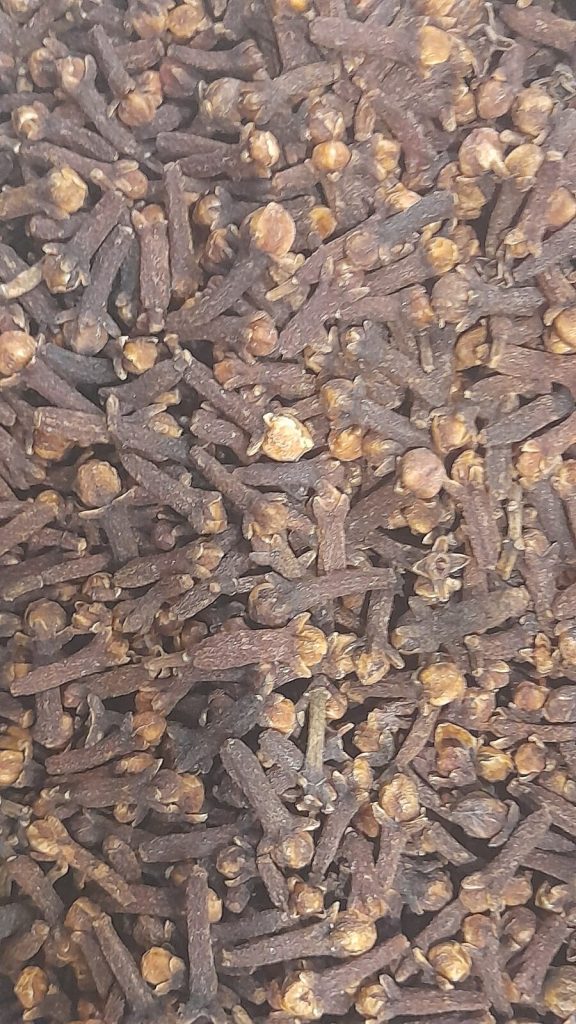
Cloves are picked by hand as unopened flower buds, then dried in the sun on mats for three to seven days until they turn hard and brown and lose about two thirds of their weight. How cloves are harvested and dried is what sets the grade, since a bud taken a few days late or left in a heap before drying loses most of its value. Moisture has to fall below 12 percent before a buyer will take it.
A note on where this practice comes from, because it matters. Uganda has no commercial clove harvest, so everything below describes how the crop is handled in the places that do produce it: Zanzibar and Pemba, Madagascar, Indonesia, the Comoros, Sri Lanka and the hill tracts of southern India. If you have a trial planting coming into bearing, or you handle cloves as a trader or processor, this is the operation you are dealing with. If you dry any other spice, the discipline transfers almost intact.
The Clove Harvest Window That Decides Everything
The clove harvest is unusual among spice crops because the marketable product is a flower bud caught before it opens. There is no ripening to wait for and no second chance. Once the petals part, the bud is a flower, and a flower dries into something the trade does not want.
That gives a narrow window. The Indian Spices Board describes the target as buds that are plump and rounded, still under 2 cm long. Wikipedia puts harvest size at 1.5 to 2 cm. Kerala Agricultural University is blunt about the consequence of missing it: if buds develop past the right stage they open, the petals drop, and an inferior spice comes off the dryer.
Timing is also seasonal and it moves with elevation. In the Indian plains flowering runs September to October, while at higher elevations it slides to December and January. Zanzibar's main harvest falls between September and December. A second complication: clove is an alternate bearing tree, so a heavy crop drains it and the following year is light. Planning labour and drying space around last season's volume is a reliable way to get caught short or stand idle.
Reading a Clove Bud Before Harvesting
Here is where the sources genuinely disagree, and it is worth setting out honestly rather than picking one and sounding certain.
The Indian Spices Board says to take the buds before they turn pink. Kerala Agricultural University says to harvest when the base of the calyx has turned from green to pink. Wikipedia describes buds that start pale, go green, then turn bright red when ready. Read together, those are three points along one colour sequence, and the spread between them is a matter of days.
What all of them actually agree on is the petal test, and that is the check to use. The bud must be full sized, plump and firm, with the four petals still shut into a tight ball at the tip. The long calyx below ends in four small spreading sepals. If the petals have parted at all, that bud has gone. If the whole cluster has flushed deep red and started opening, the picking should have happened earlier and the lot will grade down.
Practically, a picker walks a tree every few days through the season rather than stripping it once, because buds on one tree do not mature together. The published figure is three to eight separate pickings over a season. That is the single biggest labour cost in the crop and the main reason clove sits at the expensive end of the spice shelf.
Hand Harvesting Cloves From a Tall Tree
Harvesting cloves has never been mechanised, and the reason is the bud stage. A machine cannot tell a bud that is ready from one that needs three more days, and shaking a clove tree brings down the wrong material along with the right. So it is done by hand, cluster by cluster, from inside the canopy.
The complication is height. A mature clove tree runs 8 to 12 m and sometimes 15 m, so a good part of the crop sits well above the ground. Pickers work from ladders or climb into the branches, which is dangerous work and the reason so many accounts of the harvest dwell on it. Lower clusters can be pulled off by hand from the ground.
One rule cuts across all of it: do not damage the branches. Both the Spices Board pamphlet and the Kerala package single this out, because clove sets next season's buds on the wood you are standing on. Broken or stripped branches reduce the following crop, and wounds are the entry point for the dieback fungus that kills everything above a branch junction once it takes hold. A harvest that gets this wrong costs two seasons, not one.
Whole clusters come off together and go into a basket. Nothing is sorted up the tree. Sorting happens on the ground, where you can see what you are doing and where the clock on the next step has already started.
Separating Buds From Stems Before Drying
Buds arrive attached to the inflorescence axis, the slender branched stalk, and they have to come off before drying. The method described by Kerala Agricultural University is worth copying exactly: hold the cluster in one hand and press it against the palm of the other with a slight twisting movement. The buds release and the stalk stays whole.
Buds and stems then go into separate piles. Not one pile to be picked over later. The stems are a saleable product in their own right, covered further down, and mixing them into the bud lot is a defect that buyers measure.
This is also the sorting moment. Over ripe cloves, buds that have already opened, and fallen flowers come out now. So do the mother cloves, the ripe ovoid brown berries that form where flowers were left to set fruit. All of them are defects in a bud lot.
Then move. This is the step where most avoidable value is lost, and it is lost by doing nothing. Kerala Agricultural University is specific: drying starts immediately after the buds are separated. Left too long in heaps, green buds ferment, and fermented buds dry into what the trade calls khoker cloves, whitish and shrivelled, which are counted against you at grading. A basket left overnight because the yard was full is a basket downgraded.
Sun Drying Cloves on Mats, Day by Day
Traditional drying is sun drying on woven mats, and it is still how the great majority of the world's cloves are cured. The buds go out in a thin layer on a clean drying floor and are raked through repeatedly. Raking does two jobs: it evens out the colour, which buyers look at, and it stops mould taking hold in the damp middle of a pile.
Layer thickness is the thing beginners get wrong. A thick bed dries on top and sweats underneath, and the underside goes mouldy or ferments while the surface looks finished.
Two details that separate a good yard from a poor one. The drying surface has to be clean and off the bare ground, because grit and soil become foreign matter in a graded lot. And the buds come in at night, every night, since dew reintroduces moisture and undoes a day's work.
The Moisture Target That Ends Clove Drying
Drying is finished when moisture is low enough for the lot to keep and to pass inspection, and there is a published number for that. ISO 2254, the international specification for whole and ground cloves, sets maximum moisture for whole cloves at 12 percent by mass. The Codex reference for whole cloves carries the same 12 percent ceiling and adds a floor on the other side of the equation: volatile oil of at least 17 ml per 100 g on a dry basis. Those two numbers between them are most of what a serious buyer is testing for.
Nobody sun dries with a moisture meter, so the field tests matter.
That two thirds loss is worth internalising before you plan anything. Three kilos of picked buds become about one kilo of spice. Anyone quoting a clove yield without saying whether it is fresh or dried is quoting a number that could be wrong by a factor of three.
Shade Drying and Mechanical Dryers for Cloves
Shade drying gets asked about constantly, usually by people who have had a lot go mouldy in the rain. The honest answer is that clove is not a shade dried spice. The published methods are sun drying and artificial drying, and shade simply extends the wet period during which fermentation and mould are winning. Where sun is unreliable, the answer is a dryer, not shade.
On dryers, the research is thinner than you would hope and there is no standard clove drying temperature. What exists is instructive. Published work on oven drying clove buds ran at 50C down to a moisture content of 13 percent give or take one point, and tracked measurable changes in the phenylpropanoid compounds that carry the flavour. A review of clove volatile composition notes that industrial drying is conducted at low temperature, in the region of 25C to 35C, precisely to avoid driving off the volatiles that the buyer is paying for.
The principle behind those two findings is the useful part: heat dries cloves faster and takes the aroma with it. Clove's whole value sits in its volatile oil, so a dryer that rushes the job destroys the thing being sold. Anyone building or hiring a dryer for cloves should run a small batch first and compare it by smell and by grade against a sun dried batch from the same picking, because these are research figures rather than a recommendation and nobody has published a tested schedule for a smallholder scale dryer.
Mechanical drying does solve one problem outright, and it is the problem in the next section. A grower with a dryer is not at the mercy of the weather during the picking season. The same logic applies across the board, and the general case for drying equipment is worked through in the guide to drying and processing spices for better grades.
Rain During the Clove Harvest and What It Costs
The clove harvest often lands inside a rainy period, which is an awkward piece of biology. Zanzibar's picking season runs September to December, overlapping the short rains, and that overlap is the single largest quality risk in the crop.
Analysis of the Zanzibar sector traces the mechanism plainly. Prolonged wet weather through the harvest and drying season brings fungal growth and bud rot, and it darkens the clove. A darkened, damp lot does not fail outright, it simply drops: out of premium Grade 1 and into Grade 3 or distillation grade, where it is bought for its oil rather than as whole spice. The buds were picked at the right stage and still lost most of their premium, on the mats.
The knock on effect explains a pattern that confuses growers. A store full of rain damaged low grade cloves can sit unsold while the world market is short of high grade cloves. The market is not short of cloves in general, it is short of clean, dry, bright, unbroken ones. Quality and volume are separate markets.
What a grower can do about it is unglamorous: a covered drying area to move mats under at short notice, mats that can be shifted by two people rather than a fixed floor, picking scheduled around the forecast where possible, and never leaving a picked basket undried because the weather looks bad. That last one is the trap. Waiting for better sun ferments the buds into khoker while you wait.
Grading and Sorting Dried Cloves for Buyers
Once dry, the lot is sorted again, and this pass is what buyers actually pay against. Kerala Agricultural University describes the sort simply: remove the mother cloves and the khoker cloves, then bag and store in a dry place. The trade grades are more granular and it helps to know the vocabulary, because a buyer will use it.
| Spec | Grade 1 | Grade 2 |
|---|---|---|
| Moisture | under 12 pc | under 12 pc |
| Volatile oil | 17 pc min | slightly lower |
| Headless max | 2 pc | 5 pc |
| Khoker max | 0.5 pc | 3 pc |
| Mother cloves max | 0.5 pc | 4 pc |
Those tolerances come from a published trade specification used by spice importers, and the gap between the two columns is where the money is. Grade 1 allows half a percent of khoker. Grade 2 allows six times as much. Everything in the first column is decided by how fast you got the buds onto the mats and how carefully you sorted, not by anything the tree did.
For anyone selling into this system for the first time, the leverage is entirely in the sort. A lot presented already graded, clean and consistently dry gives you something to argue from, which is the starting point for negotiating properly with a produce buyer rather than accepting whatever is offered.
Clove Stems and Mother Cloves: The Second Market
The stem pile set aside earlier is not waste, and this is where the separate piling pays for itself. Clove stems are dried the same way as the buds, thin layer, no heaping, no fermentation, and they sell into the oil trade.
The numbers explain why. Kerala Agricultural University gives clove bud oil at roughly 17 percent yield on steam distillation with eugenol at 85 to 89 percent, the fine grades reaching the top of that band. Clove stem oil yields 5 to 7 percent, but its eugenol runs 90 to 95 percent, higher than the bud oil, with a coarser and woodier smell. Leaf oil comes in at 2 to 3 percent yield and 80 to 85 percent eugenol. Oleoresin extraction recovers 18 to 22 percent.
So a clove tree produces three distillable materials, and the by product carries the most eugenol of the three. The bud oil is the premium flavour product, the stem and leaf oils feed the industrial eugenol market. For a small grower the practical read is narrow but real: keep the stems, dry them properly, and find out whether anyone locally distils before throwing them away.
Mother cloves are the exception. They come out of the spice lot as a defect, but they are the seed. If you are propagating, those are your planting material, and clove seed dies within days of leaving the fruit, so the decision to keep them has to be made at the drying floor and acted on immediately. The propagation side of that sits in the guide to growing clove trees and the years the crop takes.
Storing Dried Cloves Without Losing the Aroma
Dried cloves store well for a spice, which is part of why the trade has worked the way it has for centuries. What destroys a stored lot is moisture, and after that, air.
The instruction from Kerala Agricultural University is to bag the sorted cloves and store them in a dry place. That understates how much dryness matters. A lot bagged at 13 or 14 percent moisture rather than under 12 will develop mould in the sack, and the damage shows up at the buyer's warehouse rather than at yours. The bend test before bagging is the last chance to catch it.
Beyond that, the sensible practice is the same as for any aromatic spice. Keep the sacks off the floor and away from walls. Keep them out of direct sun, since heat drives off volatiles in storage just as it does in a dryer. Keep them away from anything else with a strong smell, because clove both gives and takes odour. And store whole rather than ground, since a whole bud holds its oil behind an intact skin while ground clove starts losing aroma from the day it is milled. The packaging side of this is worked through for farm produce at large in the guide to packaging farm products for sale.
If you handle more than one spice, the same discipline carries across with the details changed. Turmeric processing and drying runs on a different process, boiling and slicing rather than picking a bud, but the moisture logic and the storage rules are the same ones. The rest of the family sits in the spices and herbs section.
Questions About Clove Harvesting and Drying
How do you know when cloves are dry enough? Press one. A properly dried clove does not bend, it resists and snaps. Alongside that, look for an even bright brown colour and check the weight, since a finished lot weighs about a third of what went onto the mats. The formal target is under 12 percent moisture, which is the ISO ceiling for whole cloves, but the bend test is what you will actually use.
How many days does it take to dry cloves in the sun? Between three and seven days, and the variable is sun strength rather than anything about the buds. Kerala Agricultural University gives four to five days in sunny weather, Tamil Nadu Agricultural University five to seven, and Zanzibar practice treats about three days of strong sun as a minimum. Dry until the tests pass. A calendar is not a measurement.
How much weight do cloves lose in drying? About two thirds of the fresh green weight. Roughly three kilos of picked buds give one kilo of dried spice. This is the reason fresh and dried yield figures are so often confused, and why you should always ask which one a number refers to.
Can cloves be dried in a machine instead of the sun? Yes, and it is the only real answer to a wet harvest season. Be careful with heat. Published trials used 50C, while industrial drying is done far cooler, around 25C to 35C, to protect the volatile oil that gives clove its value and its price. There is no tested schedule for a small dryer, so run one batch and compare it by smell and grade against a sun dried batch from the same picking before committing a whole harvest to it.
Why did my dried cloves come out pale and shrivelled? That is khoker clove, and it means the buds sat in a heap and fermented before drying started. It is the most common and most costly post harvest fault in the crop, and the fix is simply speed: separate the buds from the stems and get them onto mats the same day, even if the sun is poor. Buyers cap khoker content at half a percent for the top grade.
What do dried cloves sell for? The price swings with grade, origin and the world market, and whole Grade 1 cloves trade at a large premium over dark, damp or broken material bought for distillation. Because no Ugandan farm gate benchmark exists for this crop, there is no honest single figure to quote here, and any number would be out of date by the season. Check current spice and produce prices and talk to more than one buyer before agreeing anything.
How long do dried cloves keep? Well dried whole cloves, sorted and bagged under 12 percent moisture and kept cool, dark and away from other smells, hold their aroma for a long time. What shortens that is moisture in the bag, heat in the store, and grinding. Grind only what is about to be used.
Grades and prices both move through a season, so the useful habit is to check current spice prices before you agree a sale and to talk to more than one bulk buyer or supplier about what specification they actually test for. On this crop the specification is the price, and a lot that was dried carefully and sorted honestly argues for itself. If you are working out where to take a finished lot, start with the buyer side for cloves, and if you are sourcing rather than selling, the supplier side is the other half of the same market.