
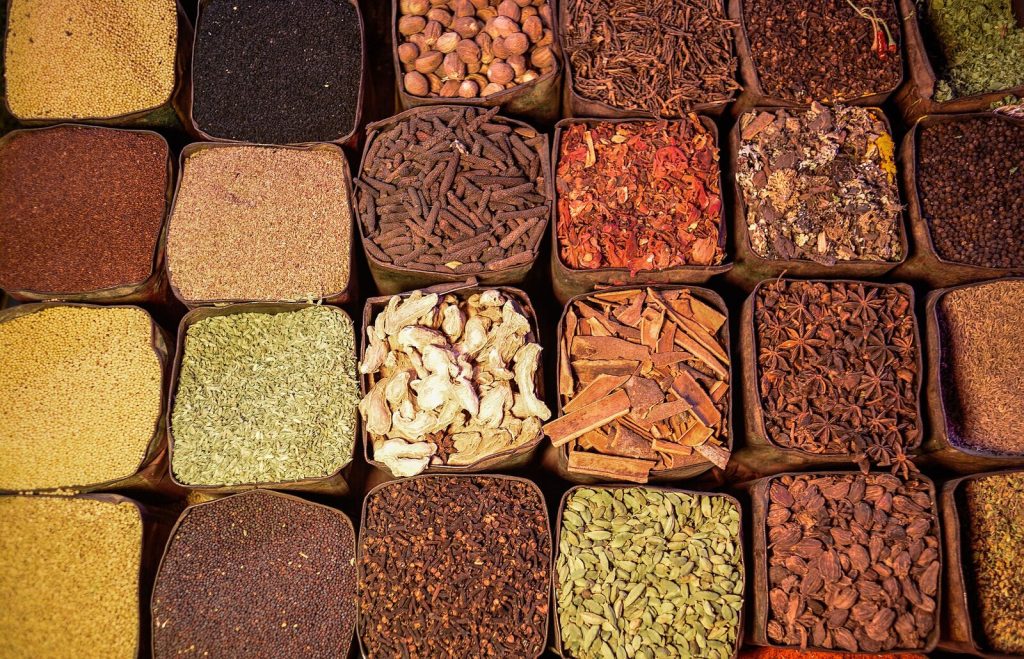
You cannot tell whether a nutmeg tree is male or female until it flowers, and from seed that takes eight to ten years. A plantation needs roughly one male tree in ten. This nutmeg farming guide treats that single fact as the decision, because Myristica fragrans is a lowland tropical tree that Uganda does not commercially grow, and the waiting is where the money goes.
It is worth saying at the start that Uganda reports no nutmeg production to FAO at all, and that the country's lowest ground sits above the altitude band the tree is documented to grow well in. Those two things are checkable and they are checked below. What follows is a feasibility assessment, the same treatment clove and cinnamon got on this site, and it ends in a different place from the pages promising a Ugandan nutmeg industry.
Half Your Nutmeg Trees Will Be Male, and That Decides the Whole Planting
Nutmeg is dioecious. Male flowers and female flowers sit on different trees, and only the female tree carries fruit, so only the female tree earns. A Ghanaian study on sex determination in nutmeg puts the practical consequence in plain words: at the juvenile stage the sexes cannot be told apart by looking, not until flowering, and the female is the economic plant. The authors say the difficulty is holding back the development of the spice and flavouring industry in their country. That is a researcher describing a first order commercial problem, not a botanical curiosity.
Now put timing against it. A seedling nutmeg begins to flower and fruit at around eight to ten years. So the answer to "what did I plant" arrives a decade after you planted it, by which time the trees have had ten years of land, weeding, water and shade management. A plantation, meanwhile, needs only about one tree in ten to be male to get good pollination, and those males want to be spread evenly through the block rather than clustered. Every male above that tenth is a tree that occupied ground for ten years and will never fruit.
There is one complication in the grower's favour and it cuts both ways. The World Agroforestry Centre records that nutmeg is not strictly dioecious: male trees show varying degrees of femaleness, ranging from no fruit at all through to as many fruits as a good female tree. So "male" is not a clean verdict, which is a small mercy and a real problem at the same time, because it means you cannot confidently cull a tree the first season it shows male flowers. You may be cutting down something that would have fruited.
Research has chased a way round this. There are published attempts to identify tree sex in seedlings with molecular markers, and a separate paper on candidate markers for monoecy in a nutmeg core collection. The Ghanaian study that tried the marker route reported that its bands did not separate cleanly and that the expected double amplification was not seen in all samples. So even in a laboratory the method is not settled, and it is certainly not a service a Ugandan nursery can offer you.
Is Nutmeg Grown in Uganda? What FAO, MAAIF and NARO Publish
No, and the checks are worth setting out because a live page on this site claims otherwise.
FAO records nutmeg under a combined item covering nutmeg, mace and cardamoms together, which means the series cannot separate nutmeg from cardamom and no honest page should pretend it can. Twenty one countries report anything at all under that item. I pulled FAO's regional production bulk files and checked every Ugandan row: Uganda has zero rows for that item, and zero for cinnamon, cloves, the anise and coriander group, the mint group and the catch all aromatic crops group. Uganda reports only pepper, dry chillies, vanilla at about 183 tonnes and ginger at about 1,626 tonnes.
Six African countries do report the nutmeg, mace and cardamom item: Tanzania at about 815 tonnes, Ethiopia at 161, Malawi at 91, Kenya at 62, Togo at 35 and Madagascar at 17. Uganda is not among them, and its neighbours being present is what makes the absence meaningful rather than a gap in African reporting.
MAAIF's website returns "nothing matched your search terms" for nutmeg. NARO's website returns nothing either. In both cases I ran controls first: cassava and ginger return real content on both sites, so the search engines work and the blank is about the crop. Nothing has been released here as a variety, nothing trialled, no leaflet written, no package of practices drawn up.
What the trade data does show is the opposite of production. Uganda imports that spice group, and the volume is rising: roughly 9.6 tonnes, then 12.2, then 18.0 tonnes across three consecutive years, coming in mainly through the Netherlands, the United Arab Emirates, Kenya, India and Pakistan. Uganda's exports in the same group run at two to three tonnes, which at that scale reads as re-export rather than harvest. The import bill for the whole group sits between about 56,000 and 71,000 US dollars a year. That is the entire addressable Ugandan market, and it includes cardamom.
| Country | Tonnes | Mostly |
|---|---|---|
| Guatemala | 96,409 | Cardamom |
| India | 54,000 | Cardamom |
| Indonesia | 41,444 | Nutmeg and mace |
| Nepal | 8,674 | Cardamom |
| Sri Lanka | 4,059 | Nutmeg and mace |
| Grenada | 714 | Nutmeg and mace |
| Uganda | no return | Imports it |
Read that table carefully, because it is the one place promotional pages mislead by accident. The biggest numbers in FAO's nutmeg item are cardamom tonnage from Guatemala, India and Nepal. The countries that are actually nutmeg names are Indonesia, Sri Lanka and Grenada, and the whole reported world total for the combined item is only about 218,000 tonnes. Nutmeg is a small global crop concentrated in a handful of humid island lowlands.
African Nutmeg Is a Different Tree, and Neither One Is a Plantation Crop
Search for nutmeg in African agricultural writing and most of what comes back is not Myristica fragrans at all. This matters, because a Ugandan grower told that nutmeg grows in Africa is being told something true about the wrong plant.
African nutmeg, or calabash nutmeg, is Monodora myristica, and it is not even in the same family as true nutmeg. It sits in the Annonaceae, alongside soursop and custard apple. It is a large forest tree, 10 to 35 metres and exceptionally 40, and its natural range runs right across tropical Africa from Gambia to Sudan and Kenya and south to Angola and Tanzania, at elevations of 1,140 to 1,800 metres. So it genuinely occurs in Uganda, at Ugandan altitudes, unlike true nutmeg. Its aromatic seeds are ground as a condiment with a flavour resembling nutmeg, and they are sold in local markets across West Africa.
And here is the fact that closes the door on it as a crop. Reference works record that Monodora myristica trees seldom set fruit when cultivated, because they lack the beetle that pollinates them in the wild. It is beetle pollinated, and the beetle does not follow the tree into a plantation. The seeds sold in African markets are almost all gathered from wild trees. So Africa's own nutmeg is a wild harvest product, not a planting proposition, for a completely different reason from the one that stops true nutmeg.
A third tree, Pycnanthus angolensis, is also sold under the African nutmeg name and does belong to the true nutmeg family, the Myristicaceae. It is a wild forest tree rather than a spice crop, and nothing in the literature treats it as one.
What a Nutmeg Tree Needs, Measured Against Ugandan Soil and Altitude
Set the tree's published requirements beside Uganda's actual conditions and two of the four come out wrong, and one of the two is not close.
Rainfall fits. Nutmeg prefers 1,500 to 3,500 mm a year and tolerates 1,200 to 4,000. Uganda's mean comes out at 1,576.67 mm on the ERA5 reanalysis and 1,282.74 mm on the CRU TS4.07 series, so it is inside the tolerated range on either and inside the preferred band on the higher of the two. On total rainfall alone Uganda looks fine whichever dataset you take, which is exactly why the promotional pages sound plausible.
Temperature fits. The tree does best between 22 and 34 degrees Celsius and tolerates 12 to 38. Uganda's mean annual temperature is about 23 degrees. It is frost sensitive, which rules out the high Rwenzori and Elgon slopes but not the plateau.
Rainfall distribution does not fit. Nutmeg prefers a climate without a pronounced dry season, and its natural habitat is described as humid volcanic lowland with even rainfall. Uganda has two pronounced dry seasons, December to February and June to August. Flowering in nutmeg is probably triggered by short dry spells and fruiting becomes more seasonal where the dry season is marked, so the tree would still flower here. It would flower in pulses rather than continuously, and a shallow rooted evergreen sitting through a two or three month dry season without irrigation is under stress for a quarter of every year.
Altitude does not fit, and this is the hard one. Nutmeg is a tree of coastal lowland humid tropics and is documented as succeeding up to about 500 metres. Nowhere in Uganda drops below 614 metres, and that single lowest spot is river bank on the Albert Nile up at the South Sudan border. Ordinary towns are far higher again: 1,200 metres at Kampala, 1,156 at Mbale, 1,116 at Gulu. There is no farmland in Uganda inside nutmeg's stated altitude band, because the whole country is above it. That is a stronger statement than the one that applies to cinnamon, which at least has lake basin land in its lower tolerance. Nutmeg has none.
Soil is against it too. The World Agroforestry Centre gives preferred soils as volcanic in origin with high organic matter at pH 6.5 to 7.5, and Ecocrop gives a preferred pH of 6 to 7 tolerating 5.5 to 7.5. Ugandan soils are mostly acid and heavily weathered, and a lot of cropland sits below the 5.5 floor. The tree also has a superficial root system and needs a position sheltered from strong winds, which on an open Ugandan plateau block means planting a windbreak first.
Nutmeg and Mace: Two Spices You Harvest From One Fruit
One thing the promotional pages get right is that a nutmeg fruit yields two separate products, and it is worth knowing how they sit together because it changes the handling.
The fruit splits to reveal a single large seed wrapped in a bright red, net like covering. That covering is the aril, and dried it becomes mace. The seed inside, dried and shelled, is nutmeg. They come from the same fruit, in the same picking, and they are graded and priced separately. Mace is the lighter, scarcer product and the one used mainly in savoury cooking, soups, sauces, curries and pickles, while nutmeg goes into both sweet and savoury food.
The fruit does not stop there. The flesh around the aril is eaten as a delicacy in parts of Southeast Asia, and the young husks are made into jellies, marmalades and sweets that are popular in West Java and Malaysia. Distilled oils come from the seed and from the aril, plus bark, leaf and flower, and oleoresin extracts go into canning, soft drinks and cosmetics. So a mature nutmeg tree is a multi product tree, which is part of why it looks attractive on paper.
The catch is that all of it depends on fruit, and fruit depends on the tree being female and being old enough. Two products from one fruit is only an advantage after year eight.
How Long Before a Nutmeg Tree Yields Anything
This is where the published figures start disagreeing, and where a page currently live on this site contradicts itself inside two paragraphs, so the numbers are worth laying out cleanly.
The most careful source, a USDA inventory of tropical perennial fruits, gives seedling trees commencing fruiting at about eight to ten years, and grafted trees at four to five. Other guides put first fruiting at seven to nine years. Ecocrop puts peak production after 15 to 20 years, with an economic life of 30 to 40 years and sometimes 60 to 70. Taken together, the honest statement is: seven to ten years from seed, four to five from a graft, peak yield somewhere between year fifteen and year twenty, and a productive life measured in decades after that.
Anyone telling you five or six years from seed is out by half a decade, and that error is the difference between a sound plan and a ruined one. Compound it with the sex problem and the picture is stark: you plant, you wait eight to ten years, you find out which trees are female, and only then do you start climbing towards a peak that is another five to ten years further on. For comparison, cocoa in Uganda starts bearing in three to four years, and it is a tree crop that actually has buyers here.
Grafting Is the Only Way to Know a Seedling's Sex Before You Plant It
If nutmeg is going to be planted at all, grafted material is the only sane route, and the reason is arithmetic rather than agronomy.
A graft carries the sex of the tree it was cut from. Take budwood or scion material from a known, proven female and the resulting tree is female, which removes the lottery entirely. It also brings first fruiting forward from eight to ten years to four to five, which halves the period you are carrying the cost of the block with nothing coming off it. Two problems solved by one technique.
The obstacle is supply. Grafted nutmeg needs a source of proven female parent trees and somebody who can graft this species reliably, and neither exists in Uganda because the crop is not grown here. Importing grafted tropical tree material across borders means phytosanitary clearance and a survival rate through transit that nobody should assume. A nursery in Uganda offering nutmeg seedlings is almost certainly offering seedlings raised from imported seed, which is the lottery, not the solution.
If someone does offer you grafted nutmeg, the questions are straightforward and you should ask all of them. Which species. Where was the parent tree, and has it fruited. Who did the grafting and when. Is there a phytosanitary certificate. If the answers are vague, what you are buying is a decade of your land.
Raising Nutmeg Seedlings, Shade and Spacing If You Still Plant
For completeness, and for anyone planting a few trees as a curiosity rather than a business, this is what the published agronomy says.
Nutmeg is normally propagated from seed, and the seed loses viability fast, so it is sown fresh rather than stored. Raise seedlings in a shaded nursery: young plants scorch in full sun and need protection in their early years. The tree tolerates full sun and dappled shade once established, so permanent shade trees are planted where the site is exposed or on a slope.
On the site itself, drainage is the non negotiable part. The tree will grow on almost any soil provided there is enough water and the soil drains, but it will not tolerate standing water. A superficial root system means a wind sheltered position, so plan the windbreak before the block. Plant with plenty of organic matter worked in, because the preferred soils are high in it.
Spacing recommendations for nutmeg vary by source and no Ugandan figure exists, so this page will not invent one. What can be said is the requirement that drives it: males should make up roughly ten percent of the stand and be distributed evenly through it rather than grouped at one end, because the tree is insect and moth pollinated and is not self fertile. If you are planting seedlings, you cannot arrange that until year eight to ten, which is another way of stating the same problem.
Nutmeg Yield Per Tree and Per Hectare, and the Figures That Contradict Each Other
The yield figures in circulation for nutmeg are unusually soft, and the reason is that they are reported per tree and per hectare without the tree count that would let you reconcile the two.
Ecocrop gives 1,000 to 5,000 fruits per tree per year and, separately, 500 to 1,200 kg of nutmeg per hectare. Both are ranges of five to one and two and a half to one respectively, and neither states the planting density, the age of the trees, or whether the per hectare figure counts the ten percent of males that produce nothing. Without a tree count you cannot check one against the other, which is exactly the condition in which a figure gets copied between pages for twenty years without anyone dividing.
Two further conditions sit on top of both numbers. Peak production only arrives after 15 to 20 years, so any per hectare figure is a mature plantation figure and not a year ten figure. And fruiting is more seasonal where the dry season is pronounced, which describes Uganda, so a Ugandan tree would not be delivering the even year round cropping the source figures assume.
Nutmeg Is Toxic in Quantity, Which Is a Handling Rule for Anyone Growing It
This is a documented fact about the seed rather than a claim about what it does for anybody, and it belongs on a farming page because a grower stores, dries and sells the material in bulk.
Nutmeg contains myristicin, and in quantity the seed is poisonous. Reference works on medicinal plants state that taken in excess the seed causes severe headache, nausea, dizziness and delirium. The clinical literature is more precise: a review of myristicin toxicity puts the threshold dose producing effects at about five grams of ground nutmeg, carrying one to two milligrams of myristicin, and describes that as the toxic dose, with death possible at higher doses. Symptoms typically appear three to six hours after swallowing it. Poison centre case series exist from more than one country, and the literature includes a report of a fatal case.
Five grams is far more than any recipe asks for, which is the reassuring half of the fact. The unreassuring half is that it is a small enough quantity to be swallowed deliberately, and one poison centre review found that the clear majority of single substance nutmeg exposures it recorded were intentional. Myristicin is the compound behind that misuse.
For a grower the practical rules follow from this without much interpretation. Store dried nutmeg and ground nutmeg where children cannot reach it, the same way you would store an agrochemical. Never sell it with any suggestion of a dose, a remedy or a quantity to take. And treat any page telling you nutmeg controls diabetes or improves heart health as a warning about the page, because attaching a health benefit to a spice that is genuinely toxic in quantity is how somebody gets hurt. This guide makes no claim at all about what nutmeg does to a body.
Harvesting, Drying and Separating Mace From Nutmeg
The processing sequence is worth knowing even in a feasibility assessment, because it is the part of nutmeg that would have to work if anything else did.
Fruit is picked when it splits on the tree, which is the tree telling you it is ready. The fleshy husk comes off first. Then the red aril is peeled away from the seed by hand, flattened, and dried separately: that is mace, and it has to be dried carefully because it is thin and loses colour, which is what it is graded on. The seed goes into its own drying, in shell, until the kernel rattles loose inside, after which the shell is cracked and the nutmeg kernel comes out whole.
Two things about that sequence matter for a Ugandan attempt. It is hand work at every step, so labour is the dominant cost and quality is entirely down to care. And drying in a climate with high humidity through much of the year is the point where mould gets in. Mycotoxin contamination is a documented problem in traded nutmeg, which means an export buyer will test for it and a badly dried batch is not a discount, it is a rejection.
Where the Market Actually Is for Nutmeg in Uganda
The binding constraint on nutmeg in Uganda is not the altitude or the sex ratio or the ten year wait. It is that there is no buyer, and the size of the gap is measurable.
Uganda imports roughly 10 to 18 tonnes a year of the nutmeg, mace and cardamom group, and that is rising. The bill for it is somewhere between about 56,000 and 71,000 US dollars a year. Take the most optimistic possible view, that a Ugandan grower captures the entire national import market, and that is still a market of tens of tonnes shared with cardamom, worth well under a hundred thousand dollars. It will not carry a plantation sector and it certainly will not carry twenty of them.
Export is the argument that gets made instead, and the numbers do not support it either. The whole reported world crop for that FAO item is about 218,000 tonnes, most of it cardamom, with nutmeg concentrated in Indonesia, Sri Lanka and Grenada. Those are established origins with established buyers, grading systems and shipping routes. A new origin entering that trade needs volume, consistency and certification, and Uganda would be starting from nothing, from above the altitude band, on acid soil, with no grafted material and no released variety.
The honest recommendation is to plant something else and, if you want nutmeg on your land, plant a tree or two in a homestead for interest rather than an acre for income. The spices that actually earn in Uganda are a short list and they are all on the spices and herbs hub. Ginger farming has the strongest commercial record of any of them, on reported tonnage that has climbed steeply over a decade. Vanilla is the other Ugandan spice with a real reported crop. If what you want is a tree crop with shade and a long horizon, black pepper and cardamom are the closer analogues, and it is worth reading the clove and cinnamon assessments too, because those two crops sit in the same position as nutmeg and the reasoning repeats. The comparison of what actually pays is the page to read before committing land.
Nutmeg Farming Guide: Questions Ugandan Growers Ask
Can nutmeg grow in Uganda at all?
A tree will survive in a sheltered, well drained, warm spot with organic matter worked in, and there is no reason a homestead tree could not live for decades. Whether it fruits usefully is a different question. Uganda's entire land area sits above the altitude band nutmeg is documented to succeed in, the country has two pronounced dry seasons where the tree prefers none, and the soils are more acid than it likes. Survival and production are not the same thing, and the pages claiming a Ugandan nutmeg industry are describing the first while promising the second.
How can I tell if my nutmeg tree is male or female?
By waiting for it to flower, which from seed takes about eight to ten years. There is no way to tell from the leaves, the bark or the habit, and researchers working on molecular markers for this have not produced a method clean enough to be a nursery service. The only practical answer is to start with grafted material taken from a tree that has already fruited, which carries the parent's sex and fruits at four to five years instead of eight to ten.
What is the difference between nutmeg and mace?
They come from the same fruit. Mace is the dried red net like aril that wraps the seed; nutmeg is the dried kernel inside. They are peeled apart by hand at harvest, dried separately and graded and priced separately, with mace the scarcer of the two and used mainly in savoury cooking.
Is African nutmeg the same thing?
No. African or calabash nutmeg is Monodora myristica, in the custard apple family rather than the true nutmeg family, and its range genuinely includes Uganda at 1,140 to 1,800 metres. It is not a plantation crop either, for a different reason: it seldom sets fruit in cultivation because the beetle that pollinates it in the wild is not present. The seeds traded in African markets are gathered from wild trees. A third tree, Pycnanthus angolensis, also carries the African nutmeg name and is a wild forest tree rather than a spice crop.
How much would it cost to start a nutmeg orchard in Uganda?
The cash cost of planting is not the real number. There is no Ugandan price for nutmeg seedlings because no established nursery supplies them, and grafted material would have to be imported with phytosanitary clearance, so any figure quoted to you is a negotiation rather than a market price. The cost that matters is eight to ten years of land, weeding, shade management and dry season water before you know how many of your trees are female, against a national import market for the whole nutmeg and cardamom group worth under a hundred thousand dollars a year. That is the arithmetic to run before you ask anybody's price.
How long until a nutmeg tree produces, and for how long after that?
Seven to ten years from seed and four to five from a graft to first fruiting, peak production after 15 to 20 years, and an economic life of 30 to 40 years and sometimes much longer. Any source telling you five or six years from seed is wrong by about half a decade.
Is nutmeg dangerous?
In culinary quantities it is a normal kitchen spice. In quantity it is poisonous: the clinical literature puts a toxic dose at around five grams of ground nutmeg, with symptoms appearing three to six hours later and fatal cases on record. That is a documented fact rather than a scare, and for a grower it means storing bulk dried and ground nutmeg out of reach of children and never selling it alongside a suggested dose or a health claim.
Why do so many pages say Ugandan farmers have planted thousands of nutmeg trees?
Because nobody checks the production records, and a claim like that costs nothing to write. Uganda files no return at all in FAO's nutmeg, mace and cardamom series while six of its neighbours and trading partners in Africa do. MAAIF's site search returns nothing for nutmeg and so does NARO's, with cassava and ginger working as controls on both. Uganda imports the spice group and its imports are growing. The pattern repeats across minor spices, and the tell is always the same: heavy claims about local production, no tonnage, no variety and no named grower.
Anyone weighing nutmeg against a real alternative should start from what Ugandan markets are paying this season, not from a figure lifted off a promotional page. The price pages follow what is moving, the buyers directory is where to check whether anyone is taking volume in a crop before you plant it, and the suppliers listing is the place to look for planting material whose provenance you can verify. For a tree that will occupy your land for decades, talk to your district agricultural officer and to a buyer before you dig a single hole.