
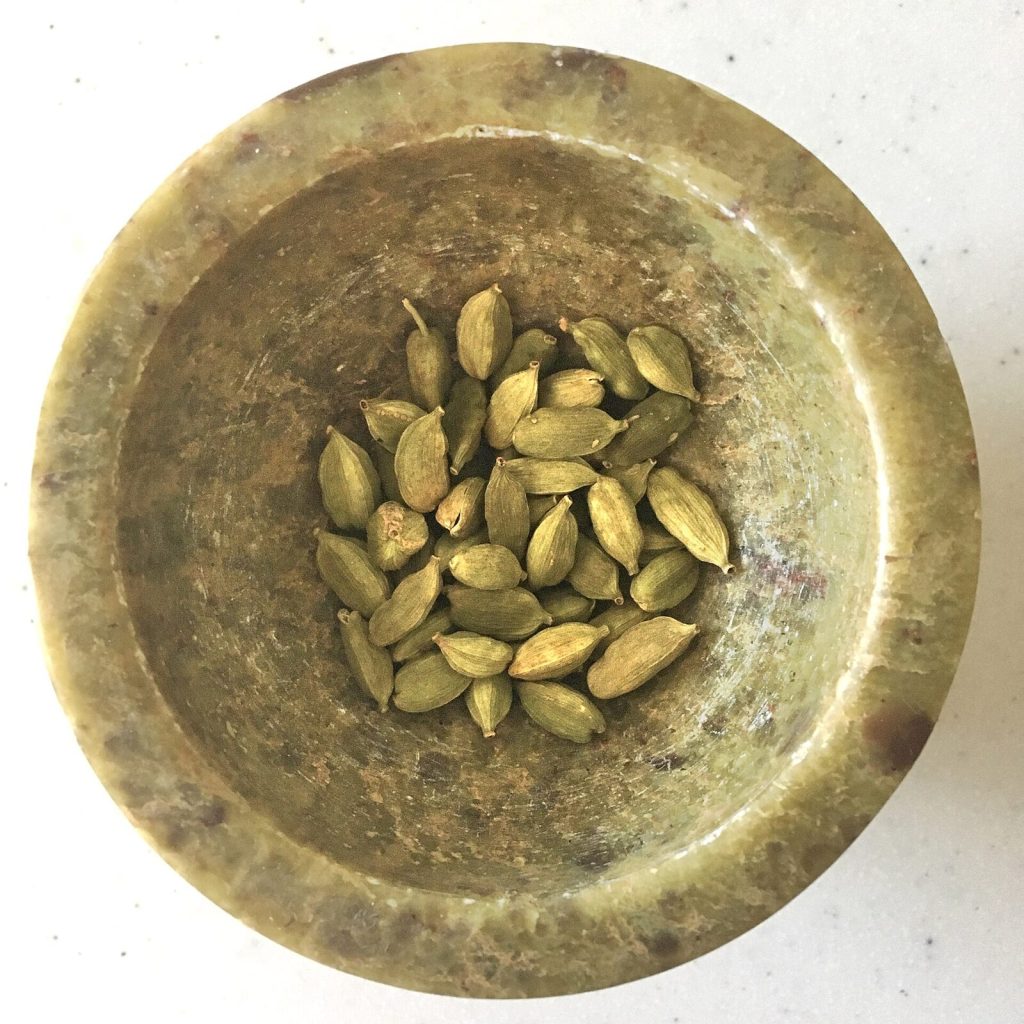
Cardamom farming in Uganda means green cardamom, Elettaria cardamomum, the South Indian species, and not the black cardamom of the Himalayas that several Ugandan pages describe. The planting material came into Mukono from South India and spread west from there, so a grower buying seedlings today is buying the green type. Cardamom is a shade loving perennial in the ginger family, harvested for its aromatic capsules, and in Uganda it is still a small crop grown by a small number of people.
Which Cardamom Species Uganda Actually Grows
Get this wrong and everything after it is wrong too. Two unrelated plants are sold under the name cardamom, they want different altitudes, they are dried by opposite methods, and they sell into different markets.
Green or true cardamom is Elettaria cardamomum, native to the wet evergreen forests of the Western Ghats in South India. Black or large cardamom is Amomum subulatum, a plant of the eastern Himalayas. ICIMOD, the research centre for the Hindu Kush Himalaya region, records that large cardamom is grown in eastern Nepal, Sikkim, parts of Darjeeling and southern Bhutan, and that Nepal holds 68 percent of world output, India 22 percent and Bhutan 9 percent. Three jurisdictions, 99 percent of the crop, all of them in one mountain system. Uganda does not appear in that picture, and no Ugandan trial, nursery or shipment of black cardamom turned up anywhere in this research.
What Uganda has is the green species. The estate that introduced cardamom to Mukono farmers states that its planting material came from South India, which is Elettaria country and not Amomum country. The same reporting describes the Ugandan product as high in volatile oil and mentions European buyers putting it into wine and coffee, which is a green cardamom use. Black cardamom is dried over a fire on purpose, to pick up smoke, and goes into savoury Himalayan cooking. Nobody puts it in coffee.
| Feature | Green cardamom | Black cardamom |
|---|---|---|
| Species | Elettaria cardamomum | Amomum subulatum |
| Home range | Western Ghats, South India | Eastern Himalayas |
| Altitude | 600 to 1,500 m | Himalayan hill belt |
| Pod | Small, pale green | Large, dark brown |
| Drying | Warm air, colour kept | Over fire, smoky |
| Grown in Uganda | Yes, in small plots | No record found |
If a nursery offers you black cardamom seedlings, ask what species is on the label. There is no Ugandan agronomy for it, no buyer network for it here, and no evidence anyone has fruited it in this country.
How Cardamom Farming Reached Uganda and Which Districts Grow It
Cardamom is not a traditional Ugandan crop. It arrived commercially through a single private estate in Mukono, Uganda Crop Industrial Limited, which began planting it in 2002 and started an out grower scheme the following year after vanilla prices fell and growers wanted something else to plant under the same shade trees. Farmers were trained, given seedlings and tools against a share of the first harvest, and organised into parish level groups.
The districts that come out of that history are Mukono, Buikwe, Jinja, Kyenjojo, Kabarole and Bundibugyo. Two clusters, really: the Lake Victoria crescent, and the Rwenzori foothills in the west. Both are wet, both are already carrying shade crops, and both sit inside cardamom's altitude band. Growers there were also already handling vanilla and black pepper, which matters, because all three want the same kind of plot.
How big is it now? Nobody publishes that. FAO lumps cardamom together with nutmeg and mace in one statistical item, so there is no separate Ugandan series to read. Neither MAAIF nor UBOS breaks it out. The estate itself once put the national planted stock at close to two thousand farmers and its own exports at about three tonnes of dry capsules a year, but those are the numbers of a company recruiting growers, they are old, and no independent count exists. A grower who set up the Uganda Fruits and Spice Growers Association puts the whole country's commercial spice producers at fewer than twenty, with fewer than eight of them farming above five acres, and reckons roughly 98 percent of the spice consumed here is imported. Treat cardamom as an establishment crop with a thin market, not a sector with a floor under it.
What Cardamom Needs, Measured Against Ugandan Soil and Rainfall
Cardamom is fussy in a specific way. It wants constant moisture, filtered light, acid forest soil and no wind. Where those four line up it does well. Where one is missing it survives and never pays.
Indian research puts the crop between 600 and 1,500 m, on well drained forest loam that is acidic, around pH 5.0 to 6.5, under 40 to 50 percent shade when rainfed and 55 to 60 percent when irrigated. Heavy wind exposure rules a site out. Most of Uganda sits comfortably inside the altitude band, which is why the altitude question is rarely the one that fails a plot.
Rainfall is the question that fails plots. The US Library of Congress country description of Uganda records mean annual rainfall above 2,100 mm near Lake Victoria, above 1,500 mm in the mountains of the southeast and southwest, and about 500 mm in the northeast. Mean annual temperature runs from about 16 C in the southwestern highlands to 25 C in the northwest, and the southern half of the country has two rainy seasons, with rain from early April and again from October. So the wet crescent and the western foothills can carry cardamom on rain alone in a good year. The drier north and east cannot, and the high cool southwest around Kabale and Kisoro sits above the altitude band and at the cold end of the temperature range, which is why the districts that actually grow it are not the ones some pages name.
| Requirement | What cardamom wants | Ugandan fit |
|---|---|---|
| Altitude | 600 to 1,500 m | Met widely |
| Rainfall | Wet and well spread | Lake crescent, Rwenzori |
| Soil pH | 5.0 to 6.5 | Met on forest loam |
| Shade | 40 to 60 percent | Needs planting first |
| Wind | Sheltered site | Check the plot |
| Dry months | Watering needed | Plan irrigation |
Choosing Cardamom Planting Material and Checking a Seedling Seller
Planting material decides the plot for the next decade, and it is the weakest link in Ugandan spice farming. The grower association's own account of the sector names scarce and poorly germinating planting material as the first obstacle new entrants hit.
Two routes exist. Seed raising is cheap and slow. Seed is collected from healthy high yielding plants, acid treated briefly, washed, then sown into beds mixed from rotted cattle manure, wood ash and forest soil and covered with fine sand. Germination starts roughly a month after sowing and keeps trickling on for up to three months, which means one bed gives you seedlings of several ages. Seedlings move to a secondary nursery at the three to four leaf stage, spaced 20 by 20 cm or potted into bags of the same size, and they are ready for the field at 18 to 22 months old. That is a long nursery and it is the part people underestimate.
The second route is suckers, each carrying one grown tiller plus a young shoot. Suckers come true to the mother plant and start faster, but a farm never has many spare, so they are mostly used for gap filling. The Indian Institute of Spices Research developed a trench based rapid multiplication method for bulking suckers under an overhead shade frame, which is how a serious nursery produces numbers.
Questions worth asking any seller, because a cardamom seedling is an expensive thing to guess at: which species, seed raised or sucker derived, how old, where the mother plants are, and whether you can see them fruiting. A seller who cannot answer the first question is not worth the second. Anyone offering a guaranteed buyback price alongside the seedlings is selling two promises, and the price one is the easier to break.
Shade Trees, Spacing and Plants Per Acre in a Cardamom Plantation
Shade is not a nicety here. Cardamom evolved under a forest canopy and it scorches in open field, so the shade layer is part of the planting plan rather than an afterthought. Ugandan growers have used albizia, which fixes nitrogen, drops leaf litter and breaks the wind, and have interplanted cardamom with coffee, banana and black pepper on the same ground. Indian practice runs a mixed population of medium sized shade trees rather than a single species, which spreads the risk if one gets sick.
Pits are dug 60 cm each way and filled back with compost and topsoil, on the contour where the ground slopes. Indian spacing is 2.0 by 1.5 m for smaller types and 2.5 by 2.0 m for larger ones. Ugandan growers have planted wider, about 3 m each way, giving roughly 500 plants per acre, which suits an intercropped plot where shade trees and pepper standards are competing for the same room.
That spacing decision sets everything downstream. Wider spacing means fewer plants, less early yield and more room for the intercrop that pays the bills while the cardamom matures. Tighter spacing in a pure stand gives more plants per acre and a heavier crop later, but only if the shade and the water are both right. On a Ugandan smallholding carrying coffee or banana anyway, the wider layout is the honest choice.
One easy gain: pollination. Cardamom flowers need insects, and Indian recommendations put 10 to 15 bee hives per hectare near the plantation to lift capsule set. On a small plot that is a couple of hives and a second product off the same ground.
Manure and Fertilizer for Cardamom Production
Cardamom is a heavy feeder of potassium, which makes sense for a plant putting its value into capsules. Indian recommendations apply compost at 25 tonnes per hectare plus 75 kg nitrogen, 75 kg phosphorus and 150 kg potassium per hectare, split in two doses timed to the two rain periods, June to July and October to November. Convert to a Ugandan acre and the compost figure is about 10 tonnes, which is a real cartage job and the main reason plots get underfed.
Those rates come from Indian conditions and no Ugandan fertiliser trial for cardamom exists that I could find, so treat them as a starting point rather than a prescription and get the soil tested before committing to a potassium spend. Mulch is the cheap half of the work. Towards the end of the rains, a light raking around each plant to a radius of about 75 cm followed by mulching holds moisture through the dry months, and the shade trees supply the material.
Weeding is done as needed rather than on a calendar, and old or dying shoots are cut out at the same time as the shade is thinned or let back in. Shade regulation is an annual job, not a one off: a canopy that was 50 percent three years ago is 70 percent now.
Cardamom Pests and Diseases That Decide the Crop
The pest list is short and the disease list is where the money goes. Thrips scar the capsules and drop the grade. Shoot and fruit borer, hairy caterpillar and mites all appear in the Indian pest record, and root knot nematodes are a nursery problem before they are a field problem.
The one to understand properly is Katte, a mosaic virus, which Indian research names as a serious drag on productivity. It is spread by the banana aphid, which matters a great deal in Uganda, where banana is everywhere and is often the very intercrop giving the cardamom its shade. A virus has no cure. Management is clean planting material, removal of infected clumps as soon as they are spotted, and keeping the aphid population down. Anyone who tells you a spray cures mosaic is guessing.
Rhizome rot and clump rot hit nurseries and waterlogged plots, and capsule rot hits during heavy rain. All three are drainage and hygiene problems first. Raised nursery beds, treated planting material, and not planting into ground that held a rotted crop last season do more than any product.
A word on sprays. The Indian packages this section draws on also print pesticide names and doses, and those are left out of this page deliberately. Registration is country by country, so an active that is legal on a Kerala plantation may have no Ugandan approval for cardamom at all. Show the problem to an extension officer first. Buy only what is licensed here for the crop, read the rate off that product's own label, and keep the interval the label sets between the last spray and picking, since capsules are eaten whole.
Harvesting Cardamom Capsules and Drying Them Green
First bearing comes about two years after planting in Indian practice, and Ugandan growers report two and a half to three years. Either way, three seasons of inputs go in before anything comes out. Picking then runs at intervals of 15 to 25 days through the season rather than as one harvest, which is the labour reality of this crop: somebody walks the plot every two or three weeks for months. Ugandan growers report two peaks, March to April and October to November, tracking the two rain seasons.
Ripe capsules are picked, and the reason is colour. Green is what the grade is built on, and unripe capsules dry to a dull, shrunken pod. Indian practice soaks freshly picked capsules for 10 minutes in a 2 percent washing soda solution before drying, which helps hold the green through the drying process.
Drying is where small growers lose value. In a drier, 45 to 50 C for 14 to 18 hours is the recommendation; in a fuel kiln, overnight at 50 to 60 C. Capsules go in a thin layer and get stirred so they dry evenly. Too hot and the green goes brown, which is the whole grade gone. Open sun drying works but bleaches the colour, so it sits at the bottom of the price range. Dried capsules are then rubbed by hand or against coir matting to clean them, winnowed, sorted by size and colour, and held in black polythene inside wooden chambers, because light fades stored capsules too. For the general principles behind this kind of work, the wider spice drying and processing guide covers the shared ground.
Roughly 5 kg of fresh capsules give 1 kg of dried. That ratio is worth committing to memory, because every price comparison and every yield claim depends on which of the two someone is quoting.
Cardamom Yield Per Acre and the Income Claim That Does Not Add Up
You will meet a figure of fifteen million shillings from one acre of cardamom. It has been in a national newspaper and it has been copied since. The arithmetic is printed alongside it, so it can be checked, and it does not survive the check.
So what should a grower expect? Honestly, nobody knows, because no measured Ugandan cardamom yield trial exists. The Indian national average of roughly 400 kg of dried capsules per hectare is the only defensible benchmark, well managed Indian plots beat it by a wide margin, and a young Ugandan plot with borrowed agronomy and no variety work behind it has no reason to start at the top. Plan on a modest crop from year three, rising as the clumps fill, and judge your own plot by weighing what comes off it rather than by a multiplication somebody else did. If you want the arithmetic method itself, the comparison of spice returns sets it out across crops.
Selling Ugandan Cardamom and What Buyers Grade On
This is the part that should decide whether you plant. Cardamom has no Ugandan commodity market, no floor price and no auction. The out grower schemes that introduced the crop buy from the farmers they trained, and outside those arrangements a grower with 40 kg of dried capsules has to find a buyer, one at a time.
Grading is on colour first, then size, then aroma and oil. A bright green, plump, evenly sized capsule sells; a brown, split or shrunken one goes into the bottom lot with the dust. That is why the drying section above matters more than the fertiliser section. Two growers with the same field crop can be two grades apart after a week of bad drying.
The market context is genuinely favourable in one narrow sense: Uganda imports almost all the spice it consumes, so there is domestic demand that local production is not filling. The constraint is that cardamom demand is small, concentrated in Asian food retail and a few processors, and a new grower is competing on quality against Guatemalan and Indian product that has decades of grading discipline behind it. Find the buyer before you plant, not after. The cardamom supplier and trade page covers who moves it, and the wider spices section compares cardamom against the other options on the same plot.
If you want a shade crop for the same ground with a shorter wait and a broader buyer base, ginger matures within a single season and sells in every market in the country. That is not an argument against cardamom. It is an argument for planting cardamom alongside something that pays yearly.
Questions Ugandan Growers Ask About Cardamom Farming
Is the cardamom grown in Uganda black or green? Green, Elettaria cardamomum. The planting material came from South India, which grows only the green species. Black cardamom, Amomum subulatum, is a Himalayan crop, and Nepal, India and Bhutan hold 99 percent of the world's output between them. No Ugandan planting of it is on record.
How long before a cardamom plant starts bearing? About two years after planting in Indian practice, two and a half to three years as Ugandan growers report it. Full production comes later still. Budget for three years of inputs with no income from that plot.
What does it cost to start a cardamom plot? The seedlings are the visible cost and the smallest one. Shade establishment, pit digging, compost cartage at roughly 10 tonnes an acre, three years of weeding and mulching, and a drier or kiln at harvest all sit above it. Seedling prices quoted in older Ugandan coverage were a few hundred shillings each, which at 500 plants an acre is a modest figure next to the labour. Get current quotes locally, because a stale seedling price is the least reliable number in this crop.
What price does cardamom fetch in Uganda? Far apart depending on what you are selling. Ugandan out grower coverage has reported farmgate figures in the low thousands of shillings per kilogram for fresh capsules and several times that for dried, while retail figures quoted by grower groups run much higher again. There is no published Ugandan reference price, so treat any single number you are shown as that buyer's offer on that day and ask two others.
Can cardamom grow in Kabale or Kisoro? Those districts sit around 1,900 to 2,300 m, above the 600 to 1,500 m band Indian research gives for green cardamom, in the zone where Uganda's mean annual temperature falls toward 16 C. Pages that name them as the best cardamom districts are describing the wrong species. The documented growing areas are Mukono, Buikwe, Jinja, Kyenjojo, Kabarole and Bundibugyo.
Does cardamom need a greenhouse or a nursery shed? Not a greenhouse. It needs a shaded nursery, because seedlings sit there for 18 to 22 months before they are field ready, and it needs shade trees over the field for life. A simple overhead frame with leafy twigs or coir matting is the standard nursery cover.
Can I intercrop cardamom with coffee or banana? Yes, and Ugandan plots do exactly that. Coffee, banana, albizia and black pepper standards all work over or beside cardamom. One caution: banana carries the aphid that spreads Katte mosaic, so if you are intercropping with banana, watch for mottled leaves and take out affected clumps early.
Before committing land to cardamom, check what dried capsules are actually fetching from buyers you can reach, and talk to a grower group or an out grower scheme in one of the districts already producing it. A confirmed buyer and a working drier matter more to this crop than anything you will read about it.