
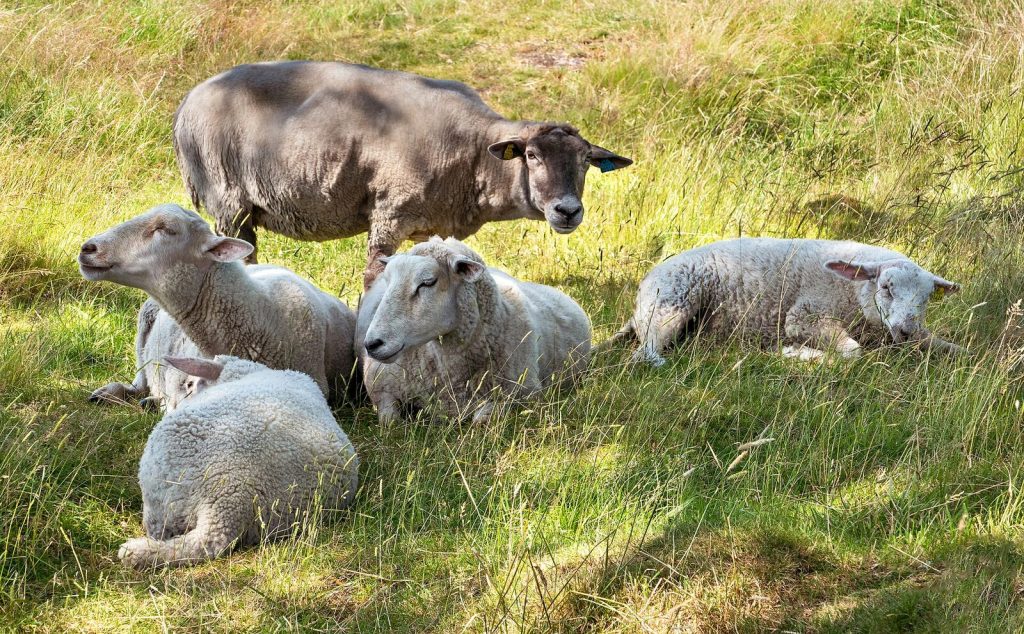
One mineral is a requirement for a goat and a poison for a sheep. Sheep are susceptible to copper toxicity where goats tolerate it and need more of it, and Ugandan smallholders keep both species in one pen and buy one bag. That is where a sheep feeding guide for Uganda has to start, because almost everything else in a sheep ration comes off pasture that costs nothing.
Feeding a Ugandan sheep flock well is mostly about grazing time, body condition and timing, and only occasionally about a bag. The parts that need care are the parts where sheep differ from the other animals on the farm, and the parts where the dry season takes the pasture away.
Sheep Are Grazers: What a Ugandan Flock Eats and Why It Is Not What a Goat Eats
Goats browse and sheep graze. A goat takes leaves, twigs and shrub material from above ground level; a sheep works the grass and herb layer. In a good season that distinction hardly shows. In a dry one it decides which animals hold condition.
A Ugandan drought study around Lake Mburo makes the point with numbers. Goat mortality fell rather than rose when the rains failed, and goat prices roughly doubled, because acacia browse stayed standing after the grass had gone. Cattle in the same districts suffered badly. A sheep, being a grazer, sits nearer the cattle end of that comparison than the goat end.
The differences do not stop at what the animal picks. A peer reviewed review of sheep and goat nutrient requirements records three mineral differences between the species, and all three run in the goat's favour. Goats can compensate for low dietary calcium availability and sheep cannot, which showed up as a smaller rise in one hormone alongside a larger rise in a bone breakdown marker in sheep. Goats recycle phosphorus more efficiently, through greater salivary secretion. And goats tolerate copper where sheep do not, which is the one that matters most and has its own section below.
So a sheep ration is not a goat ration. That is worth saying plainly because on this site the goat side is documented in much more detail, and the temptation is to read across. What a goat needs, what Ugandan goats measurably eat, and why tethering caps their intake are all on goat feed requirements, and none of those figures should be applied to a sheep.
Grazing Hours as the Main Feed Input on a Sheep Farm
The single biggest lever on a Ugandan sheep flock's nutrition is how many hours a day the animals actually spend eating, and on what. At a Kenyan livestock ministry station on semi arid ground receiving 680 mm a year, flocks grazed natural pasture in paddocks for about eight hours a day, enclosed them at night, provided mineral licks and free choice water, and gave supplement seldom, even to nursing dams. Its lambs reached roughly 30 kg at a year.
Eight hours is the number to hold on to, because it tells you what a grazing sheep needs in order to eat enough. A flock let out late, brought in early, or moved through ground that has already been grazed off is not getting its intake, whatever the pasture looks like. On a tethered animal the limit is harder still: it can only eat what stands inside the radius of the rope, so the rope has to move.
Two things follow for the farm rather than the animal. Pasture that is grazed continuously by too many animals stops recovering, and the stocking figures that survive checking in this region are modest: nine sheep to the hectare at that Kenyan station, and about four small ruminants to the acre implied by Uganda's national genetics agency budgeting a quarter acre a goat. And pasture kept back rather than grazed flat is the cheapest supplement there is, which is the idea the station used for flushing before mating.
Where grazing genuinely runs out, planted forage closes the gap more cheaply than a bag. Napier grass is the usual starting point and hay making is how a wet season surplus becomes a dry season ration, both written for cattle but the agronomy is the same.
Why the Dry Season Feed Gap Hits Sheep Harder Than Goats
Uganda's cattle corridor receives 300 to 800 mm of rainfall and the sheep are in it. The pattern that matters is not the annual total but the distribution, and the herbaceous layer a sheep depends on is the part of the vegetation that disappears first. Browse persists. Grass does not.
Crop Residues in Sheep Feeding: Fibre Without Much Protein
Residues are what Ugandan smallholders actually have, so the question is not whether to use them but what to expect. Ugandan guidance on small ruminant feeding points at crop residues, agro industrial by products and forages as the affordable base, and the honest limit is that residues are high in fibre and low in crude protein, which makes them a filler rather than a feed. An animal on residues alone will stop losing weight and will not gain.
Ugandan community based breeding guidance names two things that lift a residue based ration at the points where it matters: urea treated straw and protein blocks, used strategically during critical periods rather than continuously. Urea treatment works and it is a measured chemical treatment with a lethal overdose, so it is learned from an extension officer with the rate in front of you. No rate, ratio or concentration appears on this page for that reason.
Cereal by products are the other route, and maize bran is the one most Ugandan farms can get. What it does and what it cannot do is on maize bran in animal feeding. Store any of it badly and it becomes a health problem rather than a feed, which how to store animal feed safely covers.
One hazard needs naming here although the detail belongs elsewhere. Peelings from sweet potato and cassava are rationed on purpose by Ugandan farmers, and the reason is lethal: a heavy feed of peelings followed by water kills small ruminants. Three toxic compounds are named in the Ugandan literature, two of them in sweet potato, oxalate and trypsin inhibitors, and the third, cyanogenic glucosides, in cassava peel. All three are plant compounds rather than anything species specific, and no safe quantity has been established for either species. The mechanism and the Ugandan practice are set out on goat feed requirements, and no quantity appears on either page.
Roughage and Fibre Before Concentrate in a Sheep Feeding Plan
The instinct when a sheep looks thin is to add concentrate. There is a floor underneath that decision and crossing it causes a different problem than the one you were solving, because a rumen needs coarse material to keep working.
The international feeding standards set that floor explicitly for sheep. A peer reviewed review reports them requiring at least 10 percent crude fibre and 10 to 20 percent roughage for growth and maintenance in sheep, with minimum neutral detergent fibre of 33 to 38 percent for lactating ewes and 22 to 26 percent for growing and finishing ewes. Those are not targets to reach for; they are limits not to go under. Read them as the reason a concentrate heavy finishing ration on a sheep goes wrong, and note that they come from international standards rather than from any Ugandan recommendation.
There is a second reason to keep roughage in. Chewing and rumination drive saliva flow, which is what buffers the rumen, and the same review treats chewing time as the working indicator of whether a ration is doing that. A flock that has stopped ruminating is a flock in trouble regardless of what the feed sheet says.
The opposite failure is real too. That review notes that free access to forage without any concentrate can hold production back where the forage itself is of low quality, which is exactly the late dry season situation above. So the sequence is roughage first, always, and a small strategic supplement at the points in the year where the animal's demand spikes.
Copper and Mineral Supplements: The Feed That Can Kill a Sheep
This is the section to read twice if you keep sheep alongside goats or cattle.
A peer reviewed review of sheep and goat nutrient requirements states the position directly: sheep are susceptible to copper toxicity while goats are more tolerant, which results in a higher copper requirement in goats. Copper is in mineral mixes, in licks and in compounded feeds, and it is there because most species need it. A product formulated to meet a goat's requirement, or a cow's, is carrying more of it than a sheep is built to handle.
Calcium and phosphorus follow the same shape with lower stakes. Sheep cannot compensate for low dietary calcium availability the way goats can, and goats recycle phosphorus more efficiently. Neither of those is a poisoning risk; both are reasons a ration that keeps goats in good order can leave sheep short.
Water for Sheep, Measured Against Feed Intake Rather Than in Litres
Every feeding page gives water as litres per head per day. This one does not, and the reason is worth stating because it is a lesson about sources rather than about sheep.
Uganda's own government small ruminant manual gives two water figures that differ by roughly a factor of thirty for the same animal, one in its nutrition section and one in its cost calculator. Where a source contradicts itself that badly, the site publishes neither reading, which is the position already taken on the goat pages. The international standards are also less specific for sheep than for goats on water, so there is no clean number to substitute.
What does travel is a relationship. The review reports that for sheep the water requirement in lactation runs about 2.8 times the maintenance requirement. That is the useful fact, because it tells you the ewe with a lamb at foot needs nearly three times what the dry ewe beside her needs, and it holds whatever the local volume turns out to be. Intake also rises with temperature, with dry feed and with production level, so a fixed figure would be wrong most days anyway.
In practice the Ugandan constraint is supply rather than requirement. Water goes in free choice and clean, troughs get emptied and refilled rather than topped up, and in a district where the source is seasonal the honest planning question is how many animals you can water in month nine rather than how many litres each one drinks.
Feeding Ewes Around Mating and Lambing
Most of the return on feeding a sheep flock comes from four short windows rather than from feeding better all year. Ugandan community based breeding guidance puts it the same way: match nutrient supply to mating, gestation and lactation, and use flushing to lift ovulation and fertility.
| Stage | What changes in the feeding | What to watch |
|---|---|---|
| Before mating | Flushing: put ewes onto regenerating pasture about a month ahead | Ewes gaining, not just holding |
| Early pregnancy | Steady maintenance, no changes | Condition not slipping |
| Last weeks | Rising demand as the lamb grows fastest | Ewes carrying twins fall behind first |
| Lactation | Highest demand of the year, water most of all | Lamb growth, udder, ewe condition |
Flushing at that Kenyan station was done by grazing management rather than by buying anything: ewes went onto regenerating pasture about a month before the breeding season to lift body condition. That is the cheapest reproductive intervention available to a Ugandan flock and it needs nothing but a paddock held back.
Two thresholds from that station are better read as feeding targets than as facts about sheep. Its rule was that a ewe under 25 kg did not go to the ram, and that first joining waited until somewhere between twelve and eighteen months of age. If your ewe lambs are not reaching that weight by that age, the answer is in the feeding rather than in the mating decision.
And the season lever. Lambs born at the start of the long rains reached 31.1 kg at a year against 29.8 kg for lambs born in the other season, a difference the station's records show as reliable, because the later lambs were weaned into the dry season. Timing the mating so that lambing lands as the grass comes moves the lamb's whole growth curve onto free feed.
Feeding Lambs From Birth to Weaning
A lamb's first feed is colostrum and its main feed for the first weeks is milk, which makes early lamb nutrition a matter of feeding the ewe. That is why the section above sits before this one.
Weaning at the Kenyan station happened at 90 to 120 days, with lambs running freely with their mothers until then. Over that period the lamb moves from milk to pasture, and the transition is where losses happen: a lamb that has not learned to graze properly before its milk supply falls away stalls. Access to the same pasture the ewes are on, from early, is what teaches it.
Two things the station's records show about lambs are useful even without a ration figure. Weaning weights ran 20.5 kg for a single lamb against 19.6 kg for each of a pair, so a ewe rearing two needs more feed and her lambs will still be lighter. And dam age affected weight at a year, which means a very young or very old ewe produces a lamb that needs more help.
Ugandan keepers already do one part of this well. In a Karamoja study, 94 percent kept lambs and kids separately from adults and herded animals under a year apart from the rest of the flock. That gives the young stock the feed they can actually reach at the feeder and cuts the parasite load they pick up from adults, both without costing anything.
What Uganda's Compulsory Standard Says a Sheep Feed Is
There is a legally enforced Ugandan standard for sheep feed, and almost nothing written for Ugandan sheep keepers mentions it. US 812, Goats and sheep feeds, Specification appears in Uganda's Schedule of Compulsory Uganda Standards, and its scope reads that it prescribes requirements for goats and sheep feeds. Compulsory means enforced rather than advisory, and it applies to feed placed on the market rather than to something you mix at home.
Three things about its place in that schedule are worth a sheep keeper's attention, and all three come from the schedule's own entries rather than from the specification tables.
| Compulsory feed standard | Species covered | Edition status |
|---|---|---|
| Compounded poultry feeds | Poultry | Revised and amended as a regional standard |
| Compounded pig feeds | Pigs | Revised and amended as a regional standard |
| Compounded cattle feeds | Cattle | Revised and amended as a regional standard |
| Goats and sheep feeds | Goats and sheep | Still the original Ugandan edition |
First, the sheep and goat standard is the one that was left behind. The pig, cattle and poultry standards were each technically revised into regional East African standards and then amended, every one of them cancelling and replacing an older Ugandan standard. The goats and sheep standard is still the original Ugandan edition it started as.
Second, sheep and goats share one document. Set that beside the copper, calcium and phosphorus differences between the two species and the problem is obvious: one specification cannot be optimal for both, and a bag labelled for goats and sheep does not tell you which species its numbers were set for. That is the strongest practical reason on this page to ask a question at the counter.
Third, there is a compulsory standard for compounded dairy goat feed and none for dairy sheep. That is consistent rather than arbitrary: Uganda reports no sheep milk production to FAO at all, so there is no dairy sheep sector for a standard to regulate.
Whatever the label says, this page publishes no nutrient value from that standard or any other, because the specification tables themselves are not publicly reachable and inventing their contents would be worse than leaving the gap. Naming the standard and its scope is the useful part.
Feeding a Flock That Is Carrying Worms
The last thing a sheep feeding plan has to reckon with is not a feed at all. The review used throughout this page states that parasitism can change the nutrient requirements of sheep and goats, which means a wormy animal is both eating and losing at the same time, and the shortfall is not one that better feeding closes.
That matters more in this region than the general statement suggests, because the treatment is failing. Pooled across the African trial literature, about half of individual dewormer tests now fail the international bar, and the share failing has grown. Sheep do better than goats on that measure, at a mean egg count reduction of 88.4 percent against 84.8, and both species are in trouble. Haemonchus, a blood feeder that produces anaemia rather than diarrhoea, is the genus most likely to survive a dose.
The practical position is two sided and both sides matter. A well fed sheep tolerates a burden better than a thin one, so feeding is part of parasite management. And no amount of feeding substitutes for control, because the animal that is losing weight on unlimited feed is telling you the problem is not the feed. The evidence for that, in a Ugandan pen, is on goat fattening, and the district by district Ugandan test results are on deworming. This page states no product, no dose and no interval; a veterinary officer sets the programme, and when to call a veterinarian says when to stop guessing.
Frequently Asked Questions
How much should I feed a sheep per day? This page gives no kilogramme figure, and that is deliberate rather than an omission. No Ugandan measurement of sheep intake exists that I could find, the feeding standards that do publish requirements express them in nutrient terms against a forage base that is not Ugandan, and a ration figure lifted from another country's pasture is a number that looks useful and is not. Work from grazing hours, from body condition felt by hand weekly, and from the four demand windows above. A flock grazing about eight hours a day on pasture that has not been grazed flat, with licks and clean water always there, is being fed.
Can I feed sheep the same mineral supplement as my goats or cattle? Not without checking, and this is the one question on the page with a serious answer. Sheep are susceptible to copper toxicity while goats tolerate it and need more of it, so a product formulated for goats or cattle can carry more copper than a sheep handles. Read the label for which species it is formulated for, and if it does not say, ask the seller and treat an unanswerable question as a no. A veterinary officer knows what is on sale locally, and mineral supplements for livestock covers the product side. No copper figure appears anywhere on this page.
What does it cost to feed a sheep in Uganda? Almost nothing, if the plan is right, and that is the point rather than a dodge. No Ugandan sheep feed cost series exists, and the evidence on the neighbouring species runs strongly against buying feed: in a controlled trial on small ruminants in this region, grazing alone gave the best gross margin and concentrate diets the worst. So the useful answer is a proportion rather than a figure. The cash lines worth having are a mineral lick, a strategic supplement in the four demand windows, and whatever it costs to conserve wet season forage. Feed bought at dry season prices to keep animals you should have sold is the line that empties the enterprise. Prices for bran, cake and licks move by season and supplier, so check locally.
Do sheep need hay in Uganda? They need something conserved, and hay is the most accessible form of it. The pattern that breaks Ugandan sheep flocks is surplus in the wet season and nothing in the late dry season, and the only cheap bridge between the two is forage cut and stored while it is standing. Hay making and napier grass are both written for cattle and the agronomy carries over.
Can I feed sheep cassava or sweet potato peelings? Ugandan farmers do, in small quantities, on purpose. The lethal combination is a heavy feed of peelings followed by water, and the three toxic compounds involved are named in the residues section above. No safe quantity has been established, so no quantity appears here. Treat peelings as an occasional small addition rather than a feed, keep the water separate from the feeding, and read the detail on goat feed requirements.
How much water does a sheep drink? No litre figure is published on this site, because Uganda's own government small ruminant manual gives two figures for the same animal that differ by roughly thirty times, and the international standards are less specific for sheep than for goats. What is reliable is the relationship: a lactating ewe needs about 2.8 times what she needs at maintenance. Water goes in free choice and clean, intake rises with heat and with dry feed, and the practical Ugandan question is whether your source holds through the dry season rather than how many litres a head.
Should I give a fattening ration to sheep I want to sell heavier? Carefully, and with roughage kept in. Sheep need at least 10 percent crude fibre and 10 to 20 percent roughage in the diet under the international standards, and going under that floor causes a rumen problem rather than faster growth. On the economics, the regional trial evidence on small ruminants says bought concentrate rarely earns its cost, so a small strategic supplement on top of good grazing beats a concentrate based ration. The full arithmetic of finishing a small ruminant for sale is on goat fattening.
Is there a Ugandan standard for sheep feed? Yes, and it is compulsory. US 812, Goats and sheep feeds, sits in Uganda's Schedule of Compulsory Uganda Standards and prescribes requirements for goats and sheep feeds. Two things about it are worth knowing: it covers both species in one document, while the two species differ on copper, calcium and phosphorus, and it is still the original Ugandan edition where the pig, cattle and poultry feed standards were all revised into regional standards and amended. The specification tables are not publicly reachable, so no nutrient value from it appears here. What you can do is ask a seller which standard a bag is compounded to. For the wider picture of sheep as an enterprise, sheep farming in Uganda covers the market and the disease side, and best sheep breeds covers what the flock should be made of.
The cheapest improvements to a Ugandan sheep flock's feeding are all free: an extra hour of grazing, a paddock held back for flushing, lambing timed to the start of the rains, and a hand on the backbone once a week. Where you do buy, buy a lick and buy it knowing which species the label was written for. Current prices for licks, bran and cake are worth checking with local suppliers each season, and small ruminant prices tell you what the animals at the other end of the plan are worth.