
A Ugandan pond of African catfish reaches roughly 0.8 to 1 kg over a six to eight month cycle under good management. Figures six times that size circulate freely, and they are where catfish plans go wrong. Start from the weight, the buyer and the pond wall, in that order, because this species will grow almost anywhere and sell almost nowhere.
Catfish Farming in Uganda: What African Catfish Weighs at Harvest
Catfish farming in Uganda means one species, Clarias gariepinus, which the ministry's extension manual ranks second after Nile tilapia. Its listed strengths are real: hardy and adaptable, a fast grower, eats anything, breathes atmospheric air, and better suited to ponds and tanks than to any other unit. What the promotional material drops is the entry beneath those, in the same manual, under disadvantages. This fish digs. A wall it can dig through is a wall it will leave through, and a wall it merely digs into is a wall your seine snags on.
Harvest weight is where a plan is made or lost. Uganda's own commercial pond production manual for this species, quoted in a government commissioned study of the farmed fish market, gives 0.8 to 1 kg after six to eight months of good management. Farm features in the Ugandan press put it at six kilogrammes in six months. No Ugandan document read for this guide carries anything near the larger figure.
One species point before anything else, because it is the mistake a fingerling buyer can actually make. Clarias liocephalus, locally Nsonzi, is listed by the ministry as not recommended for commercial farming, reaching about 32 cm and under a kilogramme, with a large head for its body length, and it is normally mistaken for C. gariepinus fry and fingerlings. You cannot fix that after stocking. Buy from a hatchery that can tell you what it produced and how.
Who Actually Buys Farmed Catfish in Uganda
Answer this one before you dig, because it is the question a Ugandan catfish plan usually skips.
Eating catfish is a northern and eastern habit here, strong enough in places to make the fish a local delicacy. Visit those markets, though, and what is on the slab came out of a river or a lake. Nobody paid to feed it. Your fish arrives into that, which is a price fight rather than an opening, and a government commissioned study of the farmed fish market draws the conclusion without softening it: at small commercial scale, whether farming this fish pays is an open question, and what surrounds the grower is a thin supply line rather than a working chain.
There is a second customer, and it does not eat. Nile perch fishers buy catfish fingerlings for bait by the thousand, and that trade, rather than growout, is what has kept Ugandan catfish hatcheries in business. Selling seed and selling table fish are separate enterprises with separate skills, separate certificates and separate risks. Work out which one you are entering. The species question against tilapia sits on the tilapia and catfish comparison, and the hatchery route on the catfish hatchery page.
Volume limits what a small farm can place anywhere. An artisanal processor takes under 100 kg of live fish in a day; an industrial one takes more than a tonne. Three product forms are already on sale, being fillet, whole smoked fish and a sausage, while the dried and salted trade runs west over the border. Smoking looks like the obvious escape from the cold chain problem, and the arithmetic bites: drying costs weight, which raises the cost of every kilogramme you finally sell, and a wild fish through the same smoker never carried a feed bill. The assessment expects farmed smoked catfish to struggle against it. Buyer types are mapped on the marketing guide.
Siting and Building a Catfish Pond on Compacted Soil
For most species a leaking wall is a water bill. For catfish it is an escape route, so compaction is a catfish specific line of spending rather than a general virtue.
Soil comes first, and the threshold is specific: at least 30 percent clay, in a clay or a clay loam. Sandy, gravelly or rocky ground holds nothing without a liner over it. Then compaction, properly: the manual's own equipment list runs from manual hand compactors to motorised compactors and sheep foot packer rollers, and it lists containers, jerry cans, hoses and sprinklers alongside them, because soil compacts at a workable moisture content and dry soil will not knit. A core trench, an impermeable clay layer inside the wall, is listed as optional and is the thing that stops both seepage and wall sliding; HDPE sheet does the same job. On a catfish pond, treat the optional items as ordinary.
The general standards apply as they do to any pond: average water depth about a metre, freeboard of 20 to 30 cm, the outlet set 60 cm above the intended water level so fish cannot swim out, pipes that can be screened completely against predators getting in, and rectangular ponds of matching widths so one seine net serves the whole farm. Full sequence sits on the pond construction guide.
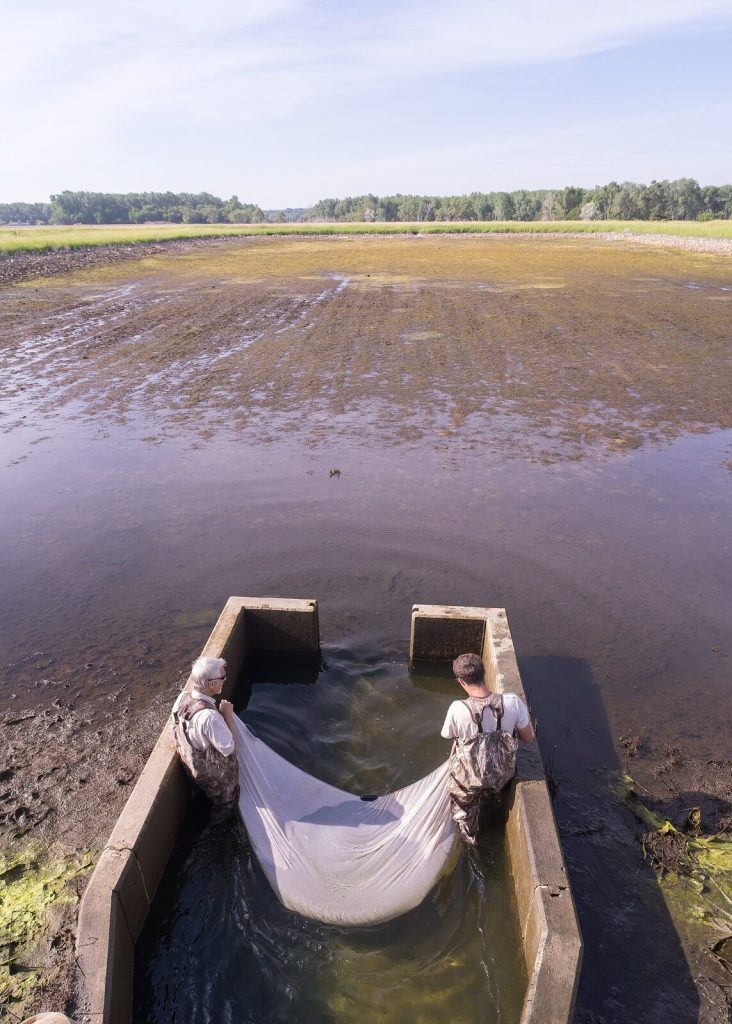
A harvest basin is listed as optional too, and for catfish it earns its cost. A fish that burrows is a fish that does not come quietly out of a draining pond, and a basin is the difference between lifting your crop and digging for it.
Stocking Rates for Catfish Production and Polyculture With Tilapia
Look for a Ugandan farm with nothing but catfish in it and you will look for a while. This species mostly shares its water with tilapia, in the north and east too where it is the better liked of the two, and the surveyed split between single species and mixed ponds comes out near enough even. Near enough is the right phrase: the report puts the two shares at 46 and 56 percent, which totals 102, so it is an impression rather than a count.
Risk spreading is not why anyone does it. The catfish are there to eat tilapia fry, and eating the fry is what stops a mixed sex tilapia pond filling up with fish too small to sell. Ministry ratios put them at 10 percent of numbers behind all male tilapia and 20 to 30 percent behind mixed sex, going in roughly two months later so that they are not yet large enough to take the stock you bought. Notice whose crop that is. A tenth of your numbers will never fill a catfish order, and it does not turn a tilapia pond into a catfish enterprise.
A catfish enterprise means monoculture and a stocking plan built around catfish. Pond stocking numbers across systems and pond sizes are on the stocking density guide. What this page can say from the primary source is that the density figures published for catfish nursery units are internally inconsistent, which is covered below, and that no growout survival rate for Ugandan catfish ponds appears anywhere in this research. Count your own stocking and your own harvest from the first cycle, because that number is worth more to you than any published one.
Feeding African Catfish, and What Not to Feed Them
The requirement is 32 percent crude protein in the ministry's nutrient table, and broodstock sit higher again at 45 percent, which is the top of what the feed market sells. Those numbers are less interesting than where the food comes from. A catfish pond holds no second larder. Plankton is not this fish's business, so the water grows nothing it will eat, and every gramme of intake is a gramme off an invoice.
Underfeeding then shows up less as slow growth than as a missing crop. That asymmetry is the argument for lining up feed for the whole cycle before you stock rather than a month at a time, since a supply gap in month four has nothing to fall back on. Why the ration should be set from a sampled weight instead of from a chart, and what a sound pellet looks like, are on the fish feed requirements page.
Now the part that needs saying plainly, because Ugandan pages circulate it. Do not feed tilapia fingerlings to catfish. A tilapia fingerling is a purchased input, and turning one into catfish flesh is the most expensive protein you can buy. If catfish are eating your tilapia fingerlings, that is either a polyculture ratio set too high or a pond that was stocked in the wrong order, not a feeding strategy. Bran on its own is the same mistake wearing a thrifty coat: the fish keep eating, the months keep passing, and what comes out at the end is undersized.
Pellet size deserves more attention on this species than on most. Catfish take feed unevenly, and that same trait is behind the ministry's note that feeding them evenly inside a cage is difficult and that growth comes out ragged when you try. In a pond it appears as a spread of sizes at harvest, so match the pellet to the fish at every sampling and grade once the spread widens.
Catfish Seed: Why Fingerlings Come From a Hatchery
Catfish will not usefully reproduce in a pond, so every fingerling you stock came out of a hatchery process you should understand well enough to judge.
Broodstock are held with the sexes separate, at 3 males per square metre and 4 to 5 females per square metre, in small ponds of 500 to 1,500 square metres, on a 45 percent protein diet, at an average size above 400 g each. Note that the ministry's criterion is weight rather than age, which is worth knowing because the figures in circulation for Ugandan catfish talk about first reproduction at twelve months. A ripe female has a swollen abdomen and eggs that look brownish green with a black dot.
Spawning is induced. The female is anaesthetised to calm her, injected into the dorsal muscle with a releasing hormone or a pituitary extract at a dose based on her body weight, then held about ten hours in a covered dark tank with flowing water of roughly 6 litres a minute and a lid, because she will jump. Eggs are stripped into a shallow bowl. Milt cannot be squeezed out of a male catfish the way it can from a tilapia, so the testis is cut and the milt pressed out through cloth. Eggs and milt are mixed with a feather, rinsed, and become sticky on contact with water, so they are spread across a screen and set in a hatching tank. Hatching follows within 24 to 30 hours at 29 to 30 degrees, in water that is well aerated, steady in temperature and low in iron.
No dose, product or volume appears here. The injection is a veterinary procedure done by weight, by someone trained to do it, and a growout farmer does not need the number. What a growout farmer does need is the judgement to tell a hatchery that runs that process properly from one that does not, and the full operation is on the catfish hatchery page.
Nursery Management, Grading and Shooters in Catfish Farming
The first fortnight after hatching is a feeding sequence, not a calendar, and getting it wrong is the commonest way a batch of catfish disappears.
| Stage | Timing | What changes |
|---|---|---|
| Yolk sac | Days 1 to 4 | No feeding needed |
| First feed | About day 4 | Live food or artemia only |
| Zooplankton | 3 days | Gut still developing |
| Weaning | Over 7 days | Less live, more dry feed |
| Dry feed alone | After weaning | Pellet size by fish size |
| Move to larger unit | Day 8 to 10 | Grade out the shooters |
| Fingerling | About 6 weeks | Roughly 2 to 3 inches |
Catfish larvae absorb the yolk sac and begin feeding about four days from hatching, and their first food has to be live, from pond production or artemia, because the digestive system is not yet developed enough for dry feed. After three days on zooplankton, wean them over about a week by cutting the live food back and raising the artificial feed, and only then move to dry diets alone. A grower who buys fry rather than fingerlings and has no live food available has bought a mortality.
Two nursery routes, and each carries its own numbers. In flow through tanks, keep gentle flow at 4 to 6 litres a minute with good aeration, clean the walls and siphon out dirt and dead fry every morning, and move the fish to a larger tank or pond after eight to ten days. In nursery ponds, fertilise for zooplankton before stocking, hold the water at 30 to 40 cm and raise it to 60 cm after four or five days, raise the fish for four to six weeks, and grade every ten days. Expected survival through the nursery is 60 to 80 percent, which is a nursery figure and says nothing about growout.
Water Quality on a Catfish Farm and the Limits of Its Tolerance
Catfish breathe atmospheric air and survive water that would kill tilapia. That is a margin for error, not a licence, and the distinction is worth money.
Surviving is not thriving. The fish that pulls through a bad week comes out of it smaller than it should be, having eaten bought feed the whole time, so tolerance buys you recovery rather than performance. The ministry's growing optimum is 26 to 28 degrees for this species exactly as it is for tilapia, and none of the handling rules relax for the tougher fish: never handle catfish at 21 degrees or below, handle only fish that have not been fed for at least 24 hours, keep dissolved oxygen around 5 mg per litre while handling, and do not move fish across a temperature difference of more than 3 degrees without acclimation. Skip a sampling below 22 degrees, below 4 ppm oxygen, after heavy runoff into the pond, or in water that smells. Monitoring routine is on the pond water management guide.
Incubation and nursery water is stricter again: low iron, steady temperature, real aeration. Hatchery water that is merely adequate for growout catfish will lose eggs.
A Nursery Pond Instruction No Fish Farm Should Follow
This section exists because the primary Ugandan source for catfish nursery management carries one instruction that this guide will not repeat as advice, and saying so is more useful than quietly dropping it.
That is a judgement about what is safe to publish for a food producing pond, not a claim that the ministry is wrong about entomology. Everything else in that section, including the depths, the timings, the survival range and the grading interval, is used on this page as it stands.
Catfish Health, Escapes and Pond Security on the Farm
Price an outbreak and two rules do the work. Treated fish are unsellable until the treatment is done, and at smallholder scale treating a whole pond usually costs more than it returns, which means the bill arrives as a harvest you never made rather than as a drug invoice. Medicines help a fish through an infection. The manual says outright that they replace nothing a farmer should have been doing anyway.
The notifiable condition to know for this species is epizootic ulcerative syndrome, a fungal infection of finfish caused by Aphanomyces invadans, which the manual illustrates in African catfish. It shows as necrotic skin lesions, outbreaks typically carry high mortality, and occurrence is associated with the onset of rains and the flooding of plains, which is a seasonal warning a pond farmer can act on. A suspected case goes to the local fisheries or veterinary officer. The commonest fungal problem across fish farms is Saprolegnia, an opportunist showing as a cotton like growth on fish or on dead eggs, which takes hold where immunity is already down for another reason. No treatment concentration or interval appears on this page; signs and reporting are on the fish disease page.
Harvesting and Selling Live Catfish Within Ten Hours
Farmed fish in Uganda moves without refrigeration, which puts roughly ten hours between lifting a fish and selling it. Plan the harvest backwards from that clock.
Work the seine first, two or three passes with a bag on it, and leave the plug alone until the net starts coming up light. A quarter of what you think is in there is the usual signal to start dropping the level; the last of the fish then come off the basin. Budget more labour for this than a tilapia pond needs. A fish that digs will use the bottom against you, and part of your crop will be in mud rather than in water.
Then move them. Catfish handle live transport better than most species, which is exactly why the bait trade works on them, but the rules still apply: fish unfed for at least 24 hours, oxygen at saturation, containers out of the sun, and no long hold in tight confinement without aeration or flowing water. Middlemen pool live fish across several farms because one smallholder rarely fills a truck, and a single farm's harvest often does not travel far unless the farmers are organised into a group. Method is on the live fish transport guide and the harvest sequence on the fish harvesting guide.
Plan the harvest around a buyer who has already agreed a date. On a ten hour clock, a pond harvested on a hope is a pond harvested into a discount.
Permits for Commercial Catfish Farming and Seed Production
Paperwork follows the structures rather than the species, so a catfish farm carries the same obligations as any other commercial unit of its size. Semi intensive and intensive commercial farms need an Aquaculture Establishment Certificate from the ministry's Directorate of Fisheries Resources, issued after an environmental impact assessment certificate from the National Environment Management Authority. A hatchery or anyone breeding fish needs seed production certification, and under the Fish (Aquaculture) Rules 2022, statutory instrument number 97, anyone intending to breed fish needs a fish breeding permit; the ministry's older manual cites the 2003 rules for the same ground, so confirm which instrument applies to you rather than quoting either at an officer.
Water is licensed separately. Building an impoundment or a valley dam needs a construction permit, drilling and pumping need their own permits, and extracting 270 litres a minute or more from a stream over a day needs a surface water permit, all from the Ministry of Water and Environment. That matters here because the cheapest looking catfish option, letting fish fend for themselves in a swamp or a dammed stream, is the one most likely to need permits nobody applied for, and it is also the one with no control over escape at all. You will not find a fee figure here, nor a chapter number for the environment law, and that is deliberate: several of these instruments have been renumbered, and quoting an old citation at an officer is worse than quoting none.
Where to Check Catfish Fingerling and Feed Supply
Three errands, in this order. Walk the nearest market and ask a trader what size of catfish they want, on which day, at what price, and whether what they are selling today came off a farm or out of open water. Then telephone hatcheries until one will commit to uniform fingerlings in the month you mean to stock, and ask how they keep Nsonzi out of a batch. Last, confirm the 32 percent protein feed exists in every pellet size your cycle will pass through, because a pellet gap in month five is a lost month. Price bands are kept on the fingerling price page, hatchery options on the fingerling supplier page, seed handling on the fingerling management page, the whole input list on the cost of fish farming page, and the tilapia alternative on the tilapia farming guide, with the rest of the cluster at the fish farming hub. One thing no website should be your source for: whether catfish is actually moving in your district, and what your permits now require. That is a conversation with the district fisheries officer.
Catfish Farming Questions Ugandan Farmers Ask
How big do catfish get in six months in Uganda? About 0.8 to 1 kg over a six to eight month cycle under good management, from the ministry commissioned report citing the Ugandan production manual for the species. Claims of six kilogrammes in six months circulate in Ugandan reporting and nothing in the Ugandan literature supports them. If a seller quotes you a harvest weight, ask for the number of fish, the pond area, the period and the stocking weight.
What do catfish fingerlings cost and what does feed cost? Catfish fingerlings run roughly 200 to 400 UGX each and tilapia fingerlings roughly 150 to 300, with delivery rather than collection putting you at the top of either band. Manufactured fish feed runs roughly 3,500 to 5,000 UGX a kilogramme, the upper end being imported floating feed. Both move with supply.
Is catfish farming profitable in Uganda, and does the fish sell for more than tilapia? It sells for less, which is part of why buyers pick it: the government commissioned study puts Ugandan preference for catfish down to size and cheapness. Farmed tilapia leaves the farm gate at roughly 8,000 to 8,200 UGX a kilogramme while the lake is landing heavily and nearer 9,000 when it is not, and no catfish band from this research was solid enough to print, so your own market visit is the source for that one. As for whether the enterprise pays, treat it as unproven at small commercial scale. The assessment calls profitability there questionable and describes what surrounds the grower as a supply line too thin to be called a chain, while 200 surveyed small fish farms in central Uganda returned 45 percent reporting a profit on their last harvest at an average net return on investment of 0.05. Two things change that answer: a named food buyer in the north or east, or selling fingerlings into the bait trade.
Can I keep catfish with tilapia? That is how the majority of Ugandan pond farms already do it. A tenth of your numbers in catfish alongside all male tilapia, or 20 to 30 percent alongside mixed sex, going in a couple of months behind the tilapia, holds down tilapia breeding and pulls the average weight at harvest up. Be clear what that makes you, though. At those ratios the catfish is doing a job inside somebody else's crop.
What should I feed catfish? A compounded feed at 32 percent crude protein, in a pellet size matched to the fish, with fry taken through live food and weaning first. Do not feed them tilapia fingerlings, which is an expensive habit that some Ugandan pages recommend: a fingerling is a purchased input. Bran alone is not economy either, it just stretches the cycle.
Can I produce my own catfish fingerlings? Not casually. Catfish will not spawn usefully in a pond, so seed comes from induced spawning by injection, hand stripping, milt taken from the testis, incubation in aerated low iron water, and live food for the larvae in their first days. It also needs a fish breeding permit and seed producer certification. Buying fingerlings and learning growout first is the cheaper order to do things in.
Why did my catfish disappear from the pond? Check the wall before you blame a thief. This species burrows into pond walls, and where the wall was not well compacted it burrows through, so the pond leaks and the fish go with the water. That is the ministry's own listed disadvantage for African catfish, and it is the reason compaction, a core trench and a harvest basin are worth paying for on a catfish pond above all others.