
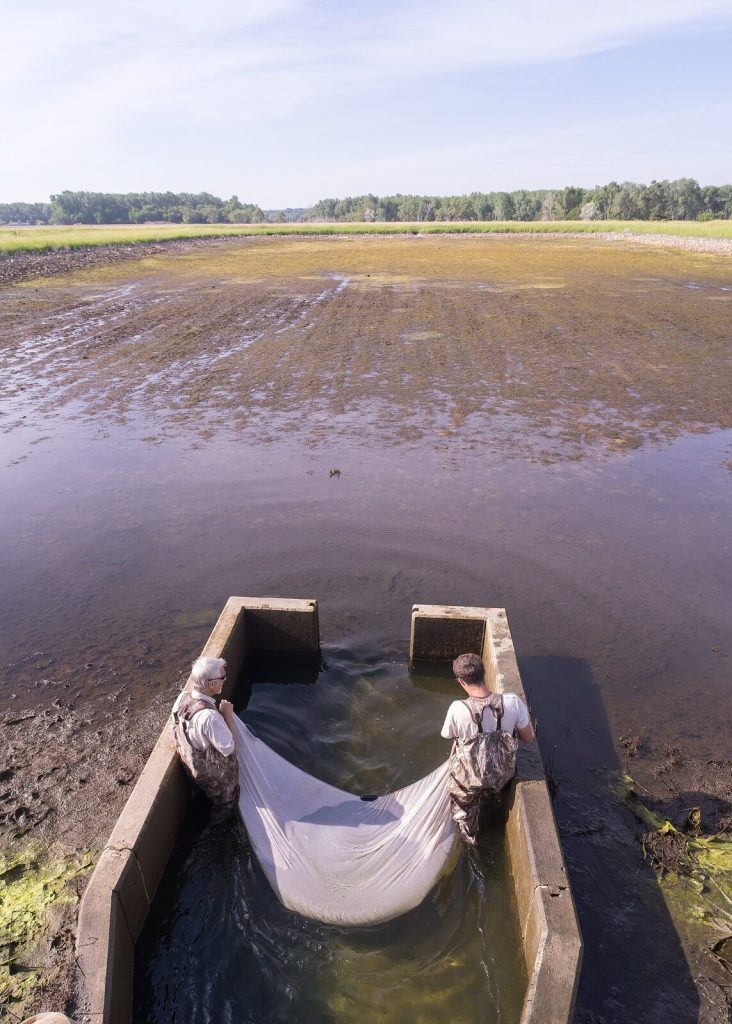
Fish pond water management in Uganda turns on a rule most new farmers have backwards: a productive tilapia pond is not flushed with fresh water, it is held still. Ministry guidance calls this static water management, where nothing flows through except a top up for evaporation and seepage. The plankton bloom you bought with lime and fertilizer is the thing being protected, and flowing water throws it away.
Static Green Water: Why a Ugandan Fish Farm Does Not Flush Its Ponds
MAAIF's aquaculture training manual is explicit. If you are fertilizing a pond to raise fish production, use the static water technique and do not allow water to flow continuously through the pond, because pond fertility and plankton are lost with it. Water goes in to replace what evaporates or seeps away, or to flush the pond deliberately when something has gone wrong. That is the whole exchange schedule.
This matters because the advice a beginner usually hears is the opposite. Change the water regularly sounds like hygiene. In a green water tilapia pond it means discarding the natural food the fish are grazing on, and the lime and fertilizer that produced it, then paying again next week. Tilapia feed on the bloom, and phytoplankton alone can carry young tilapia up to roughly 100 to 150 g before bought feed has to do the work.
Clear water in a pond is not a clean pond. It is an unproductive one, and it comes with two extra problems the manual names: birds can see the fish more easily, and sunlight reaches deep enough for aquatic weeds to grow.
Dissolved Oxygen and What It Does to Feeding and Growth
Oxygen is the first thing a pond runs out of and the fastest way to lose a whole stock. The manual's recommended water quality table puts dissolved oxygen at 4 mg/l up to saturation, and describes what sits underneath that band. At 1.4 to 5 mg/l fish survive with reduced metabolism and lower feed intake, which shows up as a worse feed conversion, slower growth, stress and more disease. Between zero and about 1.5 mg/l it is lethal, especially if the exposure runs several hours. Above saturation, fish get gas bubble trauma instead.
The manual states a dissolved oxygen floor in three different places, and reading them together gives a working rule rather than a contradiction. Its water quality table gives 4 mg/l as the recommended minimum. Its section on low oxygen disease says to maintain oxygen at or above 5 mg/l. Its organic matter section says oxygen must not drop below 3 mg/l for several hours at a time after feeding, especially in tanks, and its broodstock guidance uses the same 3 mg/l as an early morning limit. So treat 5 as the target, 4 as the level you manage to, and 3 as the short spell you have to recover from, not the place you operate.
Crowding is not the real constraint at high stocking density. The manual says so directly: the physical crowding of fish is not the primary limiting factor, and what actually limits a densely stocked unit is low dissolved oxygen and the build up of metabolic wastes. Density is a proxy. Oxygen is the thing. That is also why stocking density and water quality are the same conversation.
The Early Morning Oxygen Check Every Fish Farm Needs
Oxygen in a pond swings through the day. Plankton produces it in sunlight and consumes it all night, so the low point comes just before dawn. The manual gives the measuring window: in ponds, take the reading early in the morning between 5 and 6 a.m. A midday reading tells you almost nothing about the hours that kill fish.
Piping deserves its own note, because it is the signal farmers misread most often. Tilapia can pipe for about an hour every morning with very little problem. Piping for long stretches, something like six hours a night, severely slows growth, because the fish is spending energy on breathing rather than on flesh. Piping late into the morning for several days running means night time oxygen is reaching nearly zero, and it is one of the conditions under which you must not add more fertilizer.
Water Temperature, Feed Intake and Handling Limits
Fish take their body temperature from the water, so temperature sets the pace of everything: metabolism, how fast wastes break down, and how much oxygen the water can hold in the first place. Warmer water speeds up decomposition and demand while holding less oxygen, which is the squeeze a tropical pond lives in.
The recommended band is 25 to 30 degrees, with 26 to 28 named elsewhere in the manual as the optimum for raising tilapia and catfish. Below that, the consequences step down in stages: 15 to 25 degrees gives reduced feed intake, slower growth and a worse feed conversion with more stress and disease; 10 to 15 degrees gives poor growth with reproduction greatly reduced; and 0 to 10 degrees is the lower lethal range. One handling limit is absolute and it shows up in two separate sections: tilapia and catfish are not handled when water is at 21 degrees or below, and a difference greater than 3 degrees between two waters needs acclimation rather than a straight transfer.
In ponds and outdoor tanks you have almost no control over this. At high altitude, greenhousing a unit is possible where the sums work. In tanks, recirculated heated water is an option. In a pond, the honest answer is that season and weather decide, which is why the same manual tells you to plan around temperature rather than fight it.
Pond pH, Fish Growth and Ammonia
The manual gives pH three different ranges in three different places, which is worth naming rather than smoothing over. Its water quality table says 6.0 to 8. Its stress response figure, adapted from published work, marks the ideal as 6.5 to 8.0. Its low pH disease section says the optimum range is 6.5 to 9. Aiming at 6.5 to 8.0 satisfies all three, which is the safe way to read a source that disagrees with itself.
The failure points are consistent across those readings. Below pH 4 is the acid death point. At pH 5 fish survive but are stressed, growing slowly and eating less, and that is named as the lower limit for tilapia. From 9 to 11 fish are stressed with slow growth. Above 11 is the alkaline death point, at which all life in the pond dies, including the bacteria that were processing your wastes.
pH also decides how poisonous your ammonia is, which is the link farmers miss. Ammonia sits in water in two forms. The ionised form, ammonium, dominates in acidic water and fish tolerate it. The unionised form is the toxic one and it dominates as water turns alkaline. So the same total ammonia reading is harmless at one pH and damaging at another, and the manual's ammonia control list includes holding pH below 8 for exactly this reason.
Alkalinity, Hardness and Liming: Two Rates, Two Stages of the Farming Cycle
Alkalinity and hardness together decide how much the pond's pH swings between afternoon and dawn. The manual wants total alkalinity above 20 ppm and hardness above 20 ppm, with both above 60 ppm described as desirable. Below that, daily pH swings become extreme, fish are under constant physiological stress, and primary production falls so there is less natural food for young fish. Calcium in harder water also matters for eggs, bone and tissue. One exception is named: hard water should be avoided in catfish hatcheries.
Ugandan water sits across an enormous range on this. Rainforest river water can be soft, under 20 mg/l, while water from East Africa's great lakes is usually above 300 mg/l. So a neighbour's liming practice tells you nothing about your own pond.
Liming is worth doing when pond pH is below 6 or total alkalinity is below 20 mg/l, and the manual is equally clear that if the pond is not acidic, liming will not help. It gives two rates for agricultural lime, in two different modules, and both are real:
For a pond being prepared before stocking, where alkalinity is under 20 mg/l or the pond is acidic below pH 6, the grow out module gives 350 kg of agricultural lime per hectare of water surface. For a pond already in production, where you have tested acidity with litmus paper, a pH meter or a water quality kit and judged the response to fertilizer, the water quality module says about 150 to 200 kg per hectare may be adequate. Same two triggers, different stage of the cycle, and the wider band across the manual is 150 to 350 kg per hectare. For a new pond the instruction is different again: send soil samples to a laboratory and get the lime requirement measured.
There is a second way of reading those two figures and it points the same way, so it is worth holding both. The lower figure is phrased as what may be adequate once the lime requirement has been estimated, while the higher one sits in a preparation table with no measurement step in front of it. Measuring is the deciding condition as much as the stage is. So measure where you can and treat 150 to 200 kg per hectare as a starting point rather than a ceiling, and budget the higher figure where you cannot measure at all.
Lime goes on before fertilizer, so the fertilizer has something to work with. In an empty pond, spread it evenly across the bottom. In a pond holding fish, mix it with water and sprinkle the mixture over the surface. Three materials are commonly available in Uganda and they are not interchangeable. Agricultural lime is calcium carbonate and it is the one preferred for managing pond pH, because it buffers. Hydrated lime, sold as builders' lime, and quick lime, which is calcium oxide or burnt lime, both drive pH straight above 10, and pH 10 and above is toxic to fish and to the other aquatic life in the pond.
That property makes hydrated lime the pond disinfectant. Drain and clean the pond, spread enough hydrated lime to cover the bottom in a thin layer, then add water. The pH goes to 12 or above, which kills most disease agents and pests, and stays elevated for about a week. Nothing is stocked during that week, and pH gets checked before anything goes in. Hydrated lime is never added while fish are present, because the pH jump is almost always lethal, and it is a strong base, so nobody should be breathing the dust or getting it on skin or in eyes.
Fish Pond Fertilizer Rates That Reconcile, and Two That Do Not
Fertilizing a pond is not feeding the fish. It is growing the phytoplankton the fish then graze, which is why rates are written per unit of water surface rather than per fish. The manual's stated targets for sustaining a bloom in a tilapia pond are 16 kg of nitrogen and 5 kg of phosphorus per hectare per week.
Its inorganic combinations check out against those targets. Urea at 3.5 g per square metre per week works out to 35 kg of urea per hectare, and triple superphosphate at 2.5 g per square metre works out to 25 kg per hectare, which between them deliver the stated weekly nitrogen and phosphorus once each fertilizer's nutrient content is applied. Urea alone is given as 3 g per square metre per week, written out as 300 g per 100 square metres, or roughly 30 tablespoons. Diammonium phosphate alone is 2 g per square metre per week, written as 200 g per 100 square metres, or about 15 tablespoons weekly. Those figures are internally consistent and usable.
Two application details change how much of what you buy actually reaches the water. Phosphate in granular fertilizer is strongly held by pond mud, so broadcasting granules means much of the phosphorus settles and never enters the water column. Dissolve it in water first and sprinkle the solution, or suspend it in a porous bag or on a platform that does not sit on the bottom. Liquid fertilizer is heavier than water and sinks if poured neat, so it gets diluted in a bucket first. Apply in the middle of the morning, when oxygen is climbing and there are enough hours of sun left to use the nutrients.
One buying rule follows from all this. Prefer single nutrient fertilizers over compounds, because some weeks you need nitrogen only and some weeks phosphorus only. Where only a compound is available, pick the one higher in phosphorus, since phosphorus is usually the limiting nutrient in a fish pond.
Reading Pond Fertility With a Secchi Disc Before You Add Fertilizer
A secchi disc is the cheapest useful instrument in aquaculture and you can make one. Cut a circle 20 cm across from board or sheet metal, paint it white and black in four equal quadrants, drill a small hole in the centre, and pass a string or a stick through it marked in centimetres.
Take readings around midday when nothing casts a shadow, or failing that at the same time every day, and stand so your own shadow is off the disc. Lower it slowly until it just disappears and read the mark. Raise it slowly until it just reappears and read again. Average the two, and that is your secchi depth. Then read the colour of the water alongside the number, because clay and plankton give the same reading and mean opposite things.
| Secchi reading | What it means | What to do |
|---|---|---|
| Under 20 cm | Too turbid. If plankton, night oxygen is at risk. If clay, productivity is low | Add no fertilizer. Flush the pond if it smells foul |
| 20 to 30 cm | Good for tilapia production | Hold this level. Add nothing below 25 cm |
| 30 to 45 cm | Good condition if the water is greenish | Keep up the weekly application |
| 45 to 60 cm | Plankton becoming scarce | Add more fertilizer. If no bloom follows, check pH, alkalinity and leaks |
| Over 60 cm | Too clear. Weak production and weed risk | Weed the pond first, then fertilize |
Two things about that table repay attention. The fertilizer cut off and the good range overlap: the band described as good for tilapia production starts at 20 cm, while the instruction not to add more fertilizer starts at 25 cm. So the working target is a green pond reading somewhere between about 25 and 45 cm, and a reading of 30 to 45 cm sits inside that as a comfortable place to be. The other point is the cost of getting it wrong upwards. A pond with too much fertility loses oxygen at night and early morning, swings wildly in pH, kills fish more readily, and is described in the manual as difficult to manage at all. Under fertilizing costs you growth. Over fertilizing costs you the stock.
Six Times Not to Add Fertilizer to a Fish Pond
Ammonia, Feeding Rates and Organic Matter
Ammonia is the by product of the fish digesting protein and of bacteria breaking down organic matter. It is not something that arrives from outside; on a fed pond, you are making it. The manual says fish tolerate 0.01 to 0.05 mg/l without a measurable effect on production, as long as oxygen and temperature are in range, which is a real caveat rather than a footnote. Catfish can take much more, in the region of 0.6 to 2 mg/l, for short periods only. Sustained exposure damages the gills, which impairs oxygen uptake, and the manual notes that fish with ammonia damage succumb more readily to flukes and other parasites.
The four controls it lists are all upstream of the water: limit feeding rates, hold pH below 8, adjust the fertilizer regime, and increase water exchange through the unit. Notice that three of the four are things you do rather than chemicals you add.
Organic matter is the same story told through feed. Oxygen demand rises the moment feed goes in, from the fish digesting it and from bacteria working on what was not eaten. The manual's controls are to feed only what the fish clear at each meal, prefer digestible feed with high water stability such as steam extruded floating pellets, feed less when using a cheap feed that disintegrates in water, and keep oxygen above 3 mg/l in the hours after feeding. Uneaten feed and waste get removed from tanks daily and from pond bottoms between cycles. There is more on matching feed to the fish in the feeding guide and in what a fish feed has to contain.
Manure is also organic matter, so the same rule applies to it. Small amounts, often, rather than a cart load once a month.
Borehole Water Against Surface Water on a Fish Farm
Screening is worth singling out, because it does three jobs at once on a Ugandan farm: it keeps your fish in, keeps wild fish and their parasites out, and stops frogs coming up the water channels. Pond design carries part of the load too. The manual's list for low oxygen in earthen ponds includes keeping the freeboard from being too high, controlling siltation and avoiding shallow ponds, which is why water management and how the pond was built cannot be separated.
Carrying Capacity: The Ceiling Water Quality Puts on Production
Carrying capacity is the maximum weight of fish a system can hold, and the manual says three things set it at the same time: the species and size of fish, the water quality factors of oxygen, temperature, ammonia, flow and volume, and the feed. Fry need more oxygen than adults because their metabolism runs faster. Feed matters because it drives both suspended solids and ammonia. Flow and volume matter because they dilute and flush what the fish produce.
For a tilapia pond of about one metre average depth fed commercial pellets, carrying capacity is 8 to 10 tonnes per hectare, which is 0.8 to 1.0 kg per square metre. The matching ceiling on the input side is 100 kg of feed per hectare per day, or 10 g per square metre per day, in a fertilized pond with no aeration. Those two figures are the same statement seen from two ends, and between them they explain why a pond stops growing fish no matter how much feed goes in. Once you are at the ceiling, extra feed becomes ammonia and oxygen demand.
Water quality management, read this way, is not maintenance. It is the work of raising the ceiling, and everything in this article either lifts it or protects it. What the ceiling then means for money is worked through in the cost of fish farming.
Managing Water Quality in Tanks and Cages on a Fish Farm
A pond, a tank and a cage fail differently, and the manual sets out the responses side by side. In a flow through tank or raceway, low oxygen is answered with aeration or oxygenation, not overfeeding, daily removal of uneaten feed and waste, water exchange held at the right rate, lower density, and daily monitoring after feeding. A tank gets siphoned every day. Ammonia is managed by exchange rate and feeding technique.
A cage is a different business, because you do not own the water. Almost all the controls move to site selection and layout: avoid silty sites, sites close to heavy vegetation, points where effluent is discharged from land, and highly eutrophic water. Set cages in line with the current, choose mesh that lets water through, and leave enough distance between cages for real exchange. Monitor oxygen with the seasons and the daily cycle in mind. Where a problem is persistent and caused by the water body itself, the manual's answer is blunt: change sites. For organic matter under cages it even says move the farm after enough years.
Recirculating systems and aquaponics add a biofilter, which becomes a thing to check when ammonia climbs, along with settlement tanks and solids filters. They also bring their own disorders, nitrite poisoning in particular. In a tank system heated or greenhoused water is at least possible, which it is not in a pond.
When Poor Water Is Already the Disease
A group of Ugandan fish problems are not infections at all. The manual classes them as non infectious diseases caused by the environment, and they cannot be cured with medicine because nothing is infecting the fish.
Low oxygen is the first of them, with sudden deaths, piping, and fish crowding the inflow. Low pH gives chronic stress, heavy mucus on the gills and a fish that cannot get oxygen even in oxygenated water, and makes some metals more toxic. Ammonia poisoning shows as hyper excitability, fish that stop feeding, gill damage, and reduced growth and resistance. Excess dissolved carbon dioxide, which happens where pH is low and the water is poorly buffered, and in hatcheries drawing on borehole water, stops the fish clearing carbon dioxide from its blood, so it weakens and loses appetite even with oxygen present; the answers are aeration, lower density and lime. Nitrite poisoning turns the blood and gills brown and mimics suffocation in water that measures fine, and it is handled with a partial water exchange, more aeration, nitrifying bacteria in the biofilter, lower density and less feed. Gas supersaturation puts bubbles in the blood vessels of the eyes, gills, skin and organs.
The practical value of that list is diagnostic. If fish are dying and the water has not been measured, the water is the first suspect, not a pathogen, and no treatment will work until it is fixed. One warning belongs here as well: several chemicals used against parasites also kill algae, so treating a green water pond can crash the bloom and the oxygen with it. That interaction, and what to do about sick fish, is covered in fish diseases and treatment.
Monitoring Pond Water Without Buying Every Meter on the Market
The equipment runs from a secchi disc and a thermometer through single parameter test strips to field kits and electronic meters for oxygen, pH, conductivity, salinity and turbidity. Most meters read temperature too. Electronic meters need calibrating to give a reliable reading, and the manual's advice is to have the supplier demonstrate it rather than work it out from the box.
A multipurpose field kit covers the parameters a pond actually needs, across ranges broad enough for aquaculture: ammonia nitrogen, nitrite, pH, alkalinity, carbon dioxide, chloride, dissolved oxygen and hardness. For a small pond farm, a secchi disc, a thermometer and a kit that reads pH, alkalinity and ammonia will answer most questions you are going to ask.
Some questions need a laboratory: setting up a new farm, a sudden fish kill, moving to a new system, or a routine annual check. Collect the sample properly or do not bother. Use a clean half litre bottle, a new unopened mineral water bottle emptied out is acceptable, and label it with the site details. Rinse it three times with the water you are about to sample, filling it part way, capping, and pouring away from the sampling spot. Draw from the water column about 30 cm below the surface, avoiding mud, debris and surface film, and without stirring up sediment. Keep the sample cool and out of the sun, preferably on ice, and get it to the laboratory quickly. Do not send a sample that will arrive on a weekend or a public holiday, because the readings drift in an unpreserved bottle.
Where water genuinely has to be treated rather than managed, the manual names a short list and what each costs you. Alum clears clay turbidity, but it is acid forming, pulls down total alkalinity and pH, and removes phosphorus, so a pond treated with alum may then need liming and fertilizing. Zeolite takes ammonia out of water and is meant for long haul live fish transport rather than for ponds; it is recharged by soaking overnight in salt solution or oven drying, and it does not work in salt water. Rock salt, sold locally as magadi, buffers transport water and holds down nitrite. Every one of those is a container treatment, not a pond routine, and moving fish is its own subject in transporting live fish.
Fish Pond Water Questions Ugandan Farmers Ask
How often should I change the water in my fish pond? In a fertilized green water tilapia pond, you do not. You top up for evaporation and seepage, and you flush deliberately when the water smells bad or fertility has run away from you. Continuous flow through a fertilized pond removes the plankton and the fertilizer together.
Why is my pond water green, and is that a problem? Green is usually good. Green from phytoplankton is the natural food your tilapia are grazing and the reason you limed and fertilized. It becomes a problem when it gets too thick, which you detect with a secchi disc rather than by eye: under 25 cm and you stop adding fertilizer. Brown is mud, not food, and means low productivity.
What is the right pH for a fish pond? Aim for 6.5 to 8.0, which satisfies every range the ministry manual states in its three separate places. Below 6 you should be looking at liming. Above 8 the ammonia in your water becomes more toxic, so pH control is part of ammonia control.
How much does it cost to manage pond water? The recurring items are lime, fertilizer and, if you use one, an aerator plus the power to run it. Lime and fertilizer costs move with the season and the dealer, so check current prices rather than budgeting from a figure on a page. The one thing worth knowing in advance is that these lines are small beside feed, which has been measured at the large majority of variable cost on Ugandan fish enterprises. Skipping lime to save money on a pond that then fails to respond to fertilizer is the most expensive saving available. The full budget is in the cost of fish farming.
Do I need an aerator for a small pond? Not usually, if you stay inside carrying capacity and inside the daily feed ceiling. Aeration becomes the answer when oxygen is consistently low at dawn, when you want to stock more heavily than the water supports, or in tanks. Before buying one, work through what the manual asks: the surface area or volume to be aerated, the biomass in the unit, whether your power supply is reliable, what the running and maintenance costs are, whether anyone nearby can repair it, and whether it makes economic sense on your farm.
Can I use borehole water for fish? Yes, with treatment on the way in. Borehole water is typically low in oxygen, cool, sometimes acidic and can carry dissolved gases, all of which are fixed by exposing it to air, letting it stand, or cascading it into a holding tank before it reaches the fish. What you cannot fix is a contaminated aquifer, so check the water at the source before building around it.
My fish are at the surface gulping air every morning. How serious is that? An hour of it at dawn is tolerable. Six hours a night, or piping that continues well into the morning for several days, is a growing problem that is already costing you growth and will eventually cost you fish. Stop feeding, aerate if you can, and do not add fertilizer or manure while it continues.
Can I raise fish and crops on the same water? Yes. Ugandan extension guidance covers integrated farming and aquaponics as deliberate systems rather than as a compromise. The real concern with crops nearby is pesticide drift and runoff into the pond, which is a management question about where and when you spray, not a reason to separate the two.
Water is the one input on a fish farm you cannot buy in a bag, and most harvest disappointments trace back to it. Prices and availability for lime, fertilizer, test kits and aeration equipment shift with season and supplier, so check what is on offer locally before committing, and compare notes with the rest of the cluster from the fish farming hub, particularly choosing a pond size, managing fingerlings and harvesting. For seed and input suppliers, start with where to find fingerlings.