
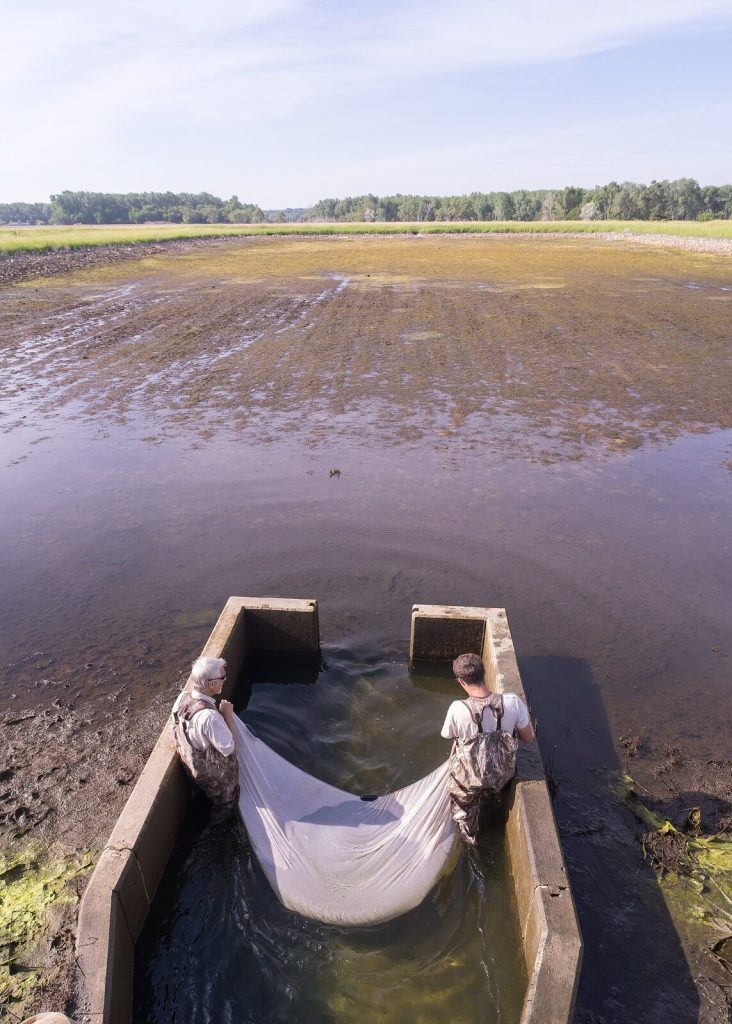
Pond size in Uganda should follow the fish your buyer takes on one day, not the land you happen to own. Four Ugandan institutional figures sit between 500 and 10,000 square metres for a single pond, and the gap between them is not a disagreement about engineering. It is a disagreement about how much fish a farm can sell at once, which is the question size actually answers.
That framing is unusual and it is deliberate. Search results for pond sizing are dominated by ornamental garden ponds in Britain and the United States, where the constraint is how many koi a water volume keeps alive. A production pond is a different problem: the volume decides how many kilogrammes leave the pond on harvest day, and harvest day is a single day.
The Pond Size Ugandan Farmers Actually Build
Start with the numbers, because their spread is the argument.
So the pond a Ugandan farmer has is roughly a quarter of the pond the ministry's construction standards assume, and a twentieth of the pond its engineers design for a commercial operator. Nothing in the extension material acknowledges the gap. It matters in a very practical way: pipe sizing, dyke slope and drain times in the published standards all step at 1,000 and 2,000 square metres, so a farmer with a 500 square metre pond is reading specifications written for a pond twice or four times the size.
Why Pond Size Is a Cash Flow Decision on a Fish Farm
The ministry's business module contains a figure nobody quotes, and it is the strongest piece of sizing advice in Ugandan extension material. It compares the cash flow of two tilapia farms with the same total water. The first runs three large ponds, where a sale happens when a pond is ready to harvest and the pond is then held, still being fed, until all the fish are bought. The second runs several small ponds sized to market demand, on an all in and all out system where a pond is stocked, emptied and restocked as a unit.
Look at what the first shape does to a farm. The fish reach market size, the buyer takes what the buyer wants, and the rest stay in the water eating. Nothing in a fed pond costs more than feed. So a day of held stock is a day of outgoings with nothing coming back, and the pond stays out of production until the last fish leaves, since it cannot be drained, dried and restocked while it is occupied. The second shape converts the same water into a series of smaller, complete harvests you can actually sell out.
This is why sizing from the land is the wrong way round. Land tells you the ceiling. The buyer tells you the pond.
Sizing the Pond to What Your Buyers Take in a Day
Live sale is the Ugandan norm. Smallholders trade at the gate, and a middleman puts the output of several farms into one load, because a single pond rarely fills a vehicle. A pond is drained over a day or two and then it is all there, alive, in a harvest basin or a net, losing condition by the hour.
The sizing question follows directly. How many kilogrammes will your buyer take in one visit, and how often will they come? Ugandan market work found buyers coordinating so that the eventual price landed near or below cost where a grower had no alternative outlet, which is exactly the position a farmer is in with four hundred kilogrammes of live tilapia and one middleman on the bank. A smaller pond harvested more often gives you a second buyer, a second price and a second chance.
Work the arithmetic backwards from that. If a buyer takes 150 kg on a visit and comes monthly, a farm wants several ponds each holding roughly that, finishing in sequence, not one pond holding a tonne that finishes once. Buyer options are covered in marketing farmed fish, and the price consequences of selling into a glut are in the cost of fish farming.
Turning Pond Area Into Kilogrammes of Harvested Fish
An area converts into fish only through a management level, and in Uganda the two ends of that range differ by a factor of ten. Measured small scale output runs about 1,500 kg per hectare against about 15,000 kg per hectare for commercial ponds. A Ugandan feasibility model used 3 tonnes per hectare for small extensive ponds living mainly on natural food, and 15 tonnes per hectare for hectare sized semi intensive ponds on formulated feed. The ministry's stated pond carrying capacity sits between them at 8 to 10 tonnes per hectare, for a tilapia pond of one metre average depth fed commercial pellets.
Those are not competing claims. They are the same pond at different levels of input.
| Pond water area | Extensive, natural food | Fed pond, 1 m deep | Fed pond, 1.5 m deep |
|---|---|---|---|
| 250 m2 | about 75 kg | 200 to 250 kg | 300 to 375 kg |
| 500 m2 | about 150 kg | 400 to 500 kg | 600 to 750 kg |
| 1,000 m2 | about 300 kg | 800 kg to 1 t | 1.2 to 1.5 t |
| 2,000 m2 | about 600 kg | 1.6 to 2 t | 2.4 to 3 t |
Read that table as arithmetic, not as a promise. The extensive column is the modelled 3 tonnes per hectare; the middle column is the ministry's stated carrying capacity; the right hand column is derived by holding the same biomass per cubic metre and deepening the pond, which is the assumption the Ugandan engineering design makes and which the ministry does not state. Every column assumes the fish live, which they do not entirely, and none includes a survival allowance. The number of fingerlings behind these weights, and what survival does to them, is worked out in stocking density.
One derived figure is worth sitting with. The measured average Ugandan pond of 500 square metres yields about 150 kg a cycle run extensively, or 400 to 500 kg fed to the ministry's stated capacity. The ministry's own classification puts small scale production at under 10 tonnes a year. So the typical Ugandan pond, at one cycle a year, lands somewhere between about 2 and 5 percent of the ceiling of the smallest production scale the ministry recognises.
Why Pond Depth Belongs in the Yield Calculation
Here is the reconciliation that makes the numbers above hold together, and it is the part most sizing advice gets wrong by leaving depth out.
The ministry states pond carrying capacity as 8 to 10 tonnes per hectare, then adds, in the same sentence, that this is for a pond of one metre average depth. Divide the figure by that depth and it becomes 0.8 to 1.0 kilogrammes for every cubic metre of water. Now take the Ugandan engineering design for a hectare pond: 1.5 metres deep, modelled at 15 tonnes per hectare. Divide by its depth and you get almost exactly 1.0 kilogramme per cubic metre. The two figures are the same ceiling. One pond is simply half a metre deeper.
So surface area does not size a pond. Volume does. A 1,000 square metre pond at 1.5 metres holds as much fish as a 1,500 square metre pond at one metre, on less land and behind less dyke. That is a real saving and it comes with three real costs: more water to fill and to replace through the cycle, more oxygen to keep in a deeper column where wind mixing reaches less of it, and a deep end that may become unsafe to walk while seining. Depth as a construction specification, including the shallow and deep end figures and the reason a pond is held at an average of one metre, sits in the pond construction guide.
What this rules out is the shallow, wide pond. It uses the most land, holds the least fish per hectare of it, and hands wading birds a place to stand.
Pond Width Sets the Seine, and the Seine Sets Your Harvest Labour
Width is the dimension a farmer chooses last and regrets first. A seine net has to span the pond, so the pond's width fixes the net you must own or hire, and the net then fixes how many people it takes to pull a harvest.
The labour evidence from Uganda makes this concrete. In the 200 farm survey, 64 percent of farmers owned one or two ponds and rented their nets, and 61 percent hired between one and five people at harvest. Harvesting labour was a tiny share of total cost, under one percent, while production labour ran near 30 percent. What that combination means is that harvest labour is cheap but harvest access is not free: a rented net has to be booked, and a net that does not fit your pond is useless whatever it costs.
Hence the ministry's instruction, which is about the farm rather than the pond: build every pond on the farm to the same width so that one seine serves all of them. Widen one pond and you have bought a second net. Length is the dimension to vary, and the gradient limits it, since the gentler the slope the longer a pond can run before its floor stops falling toward the drain.
One Large Pond or Several Small Ponds on the Same Farm
Set the two shapes side by side on the things that actually differ.
The ministry's cash flow comparison comes down on the side of several small ponds sized to market demand, and the Ugandan evidence on why is not really financial. It is that 64 percent of surveyed farmers had one or two ponds, which means most Ugandan fish farms cannot stagger anything. A single pond farm has one harvest, one price and one buyer per cycle, and with Ugandan seed giving roughly one cycle a year, that is one throw of the dice annually.
If you can only afford one pond, size it to a buyer you have already spoken to. If you can afford two, build them the same width and stock them a couple of months apart.
Matching Pond Size to Production Scale in Uganda
The ministry classifies farms by annual tonnage, which lets you work back from an ambition to an area. Its table needs one correction first: the printed inequality signs on the outer rows are reversed, giving small scale as more than 10 tonnes a year and large scale as under 50. The middle row resolves it, and the reading below is the coherent one.
| Scale | Tonnes a year | Pond water needed |
|---|---|---|
| Small | Under 10 | Up to about 1 ha |
| Medium | 10 to 50 | About 1 to 5 ha |
| Large | Over 50 | Over 5 ha |
The water area column is derived, and the assumption behind it is worth stating plainly: it takes the ministry's own upper carrying capacity of 10 tonnes per hectare and one completed cycle a year. Run extensively on natural food at 3 tonnes per hectare, every figure in that column multiplies by more than three. Run two cycles a year, which Ugandan seed does not currently allow, and it halves.
The useful consequence is a reality check on ambition. Reaching the bottom of the ministry's medium scale band means around a hectare of water under good feeding, which is twenty ponds of the size Ugandan farms average. Anyone planning to supply a hotel or a processor weekly should do that sum before digging.
Nursery and Hatchery Ponds Are Sized Differently
Seed ponds are small on purpose and the reasons have nothing to do with market absorption.
Ugandan hatcheries produce tilapia seed in ponds of 100 to 500 square metres, at an annual capacity of 200,000 to 300,000 fingerlings each. Catfish broodstock are held in ponds averaging 500 to 1,500 square metres. Ugandan guidance also notes that hatchery and nursery ponds are often smaller than growout ponds and carry their harvest basin inside the pond rather than outside it, because they are drained far more often, and that a spawning pond's size, shape and depth all affect how efficiently seed can be harvested from it.
The logic is the inverse of a growout pond. A growout pond is sized so that one harvest can be sold; a nursery pond is sized so that it can be emptied, graded and refilled repeatedly without losing fry in the corners. Frequency of draining, not tonnage, sets the size. Hatchery operations are covered in the hatchery business guide and seed handling in fingerling management.
Soil and Dyke Work Change With Pond Size
Bigger ponds are not just longer versions of small ones, and three things change as the area grows.
The wall face has to get gentler. Ugandan standards give a slope of 2:1 to 4:1 for ponds of 1,500 to 5,000 square metres and 4:1 to 7:1 for ponds of 5,000 to 20,000 square metres, because a longer stretch of open water builds bigger waves and a steep face collapses under them. Perimeter dykes on large ponds also need reinforcing against wave action, and pond orientation starts to matter where prevailing winds are strong, both of which the ministry's design guidance lists under hydrological data rather than under construction.
Pipes step up. Drain pipe diameter changes at 1,000 square metres and inlet diameter changes with water availability, so a decision to enlarge a pond is also a decision to buy larger pipe.
And soil volume grows faster than area suggests, because a bigger pond needs a bigger wall on top of more excavation. That is the real reason a family without machinery is steered toward 2,000 square metres rather than a hectare: it is the largest pond that can be built and managed by hand. The construction sequence itself, and the soil tests that decide whether any of this is possible on your site, are in the pond construction guide.
Water Supply and Land Put a Ceiling on Farm Pond Size
Two limits bite before land does.
The first is fill time. Ugandan guidance requires a pond to fill within 10 days, and every pond on a farm to fill in under 50 days, because a part filled pond grows water plants and collects predators before there are any fish to protect. A pond you cannot fill inside that window is too big for your water source, whatever the land allows.
The second is a permit threshold. Drawing 270 litres a minute or more in any 24 hours, out of a lake, river, swamp or dam, needs a surface water permit from the Ministry of Water and Environment, and pumping either groundwater or surface water needs its own permit regardless of volume. That threshold is a genuine sizing constraint: a farm can be planned to sit under it, or planned to go through the permit process, and knowing which before you dig is cheaper than finding out after. The regulatory picture is summarised on the fish farming in Uganda pillar.
Ponds also cannot be sited in wetlands or below the water table, which removes the flattest and wettest land on many Ugandan holdings from the calculation entirely.
Sizing for One Harvest a Year
Everything above compounds because of one finding. A review written inside NARO and Makerere puts the reason bluntly: the tilapia seed on sale here is slow enough that a pond yields one crop a year against two from an improved strain. A Ugandan feasibility model allowed a full twelve months for a small extensive pond to bring fish to 400 grammes.
One cycle a year changes what a pond has to be. It means the pond has to carry a year of costs before it returns anything, that a harvest landing in a glut month cannot be made up later in the year, and that a mistake in stocking is not recoverable for twelve months. It also means staggering only works across ponds, never within one, so the argument for several smaller ponds gets stronger the slower your fish grow.
Sizing advice that assumes two or three crops a year is describing a different country. Plan the pond as an annual crop, and ask what one annual harvest of that weight would do to your cash position and to the price you can hold out for. The full margin arithmetic is in the fish farming profit calculation, and the feed bill that runs the whole twelve months is set out in fish feed requirements. Other systems change the sizing question completely, and those are covered in cage fish farming and tank fish farming, both reachable from the fish farming hub.
Fish Pond Size Questions Ugandan Farmers Ask
What is the best size for a first fish pond in Uganda? Around 2,000 square metres if you have the water, the land and a buyer for roughly half a tonne to a tonne a cycle, because a ministry commissioned feasibility study picked exactly that size as the largest a family can build and run without machinery while still using the pond's natural food production. Around 500 square metres if you are learning, which is what most Ugandan farms in fact run. What decides it is not ambition; it is how much live fish your buyer will take in a day.
How many fish can a 500 square metre pond hold? Stated as weight, because that is how the ceiling works: about 400 to 500 kg at the ministry's stated carrying capacity for a fed pond of one metre average depth, or nearer 150 kg run extensively on natural food. Converting that weight into a number of fingerlings depends on your target harvest size and your survival rate, and both are handled in stocking density.
Is a bigger pond cheaper to build per square metre? Yes, and it is more expensive to run out of. A larger pond needs less wall and fewer pipes per hectare of water, so construction cost per square metre falls. What rises is the amount of fish arriving on one day, the feed spent holding unsold stock, and the size of a single loss. Construction quotations sit on the cost of fish farming page.
Can I make a small pond produce more by stocking more fish? No, past a point that is fixed by water rather than by intention. The ceiling is the biomass the pond can carry, which is set by oxygen, waste and feed rather than by how many fingerlings you buy, and crowding beyond it produces small fish and dead fish instead of more kilogrammes. Deepening the pond raises the ceiling because it adds volume. Adding fingerlings to the same volume does not.
How much land do I need for a commercial fish farm? To reach the bottom of the ministry's medium scale band, 10 tonnes a year, you need roughly a hectare of water under good feeding and one cycle a year, plus land again for dykes, channels, access routes and an effluent treatment pond. Run on natural food alone, the water area needed more than triples.
Should all my ponds be the same size? The same width, at minimum, so one seine net serves the farm, and there is a real case for the same size throughout if you intend to stagger stocking, because equal ponds produce equal harvests you can promise a buyer. Vary length rather than width where the ground forces it.
Does pond shape matter as much as size? Rectangular is the Ugandan recommendation, for seining, feeding and management. Beyond that, shape mostly matters through width, and through whether the floor can be made to fall toward one drain point across the whole area.
Settle the size against a buyer and a water source before you settle it against your land. While you are planning, check what fingerlings, feed and netting currently cost and who is supplying them in your district, since a pond sized for a tonne of fish and stocked with whatever seed was available that week is the commonest way a good design stops paying. The supplier directory and the current fingerling prices are the place to start.