
Irrigation farming in Uganda means watering crops on purpose instead of waiting for rain, and its strongest commercial case here is the dry season vegetable market rather than survival. Systems run from a watering can and bucket up to solar pumped drip on a few acres. Uganda holds heavy surface water in its rivers, lakes and wetlands, plus groundwater almost everywhere, yet only a sliver of farmland is watered by hand or machine.
That gap is the whole story. This is not a country short of water. It is a country where water sits a few hundred metres from the garden and nobody has built the ten metres of pipe that would move it.
Why Irrigation Farming Pays Best in Uganda's Dry Season
Ask why a farmer should spend money on irrigation farming and the honest answer is not drought. Most of Uganda gets enough rain in a normal year to grow a maize crop without a single litre of added water. The answer is price.
Vegetable supply in Uganda collapses in the dry months. Rain fed tomato, onion, cabbage and green pepper gardens all finish at roughly the same time, because they were all planted at roughly the same time, and then for several weeks the markets in Kampala, Mbarara and Gulu are short. Prices climb steeply. When the rains return, every farmer harvests at once and prices fall through the floor.
Irrigation breaks you out of that queue. A grower who can water through December and January is selling into a thin market, and a grower who can raise a nursery before the rains arrive gets to market weeks ahead of the crowd. That timing advantage, not water security, is what makes the investment work on a vegetable farm. It is also why irrigation tends to pay on tomatoes and other high value vegetables long before it pays on maize.
Two other benefits are real but secondary. Watering removes the gamble on when the rains start, which matters more every year. And it lets perennials such as coffee, bananas and vanilla hold their flowers through a dry spell instead of dropping them, which is a yield protection argument rather than a price argument.
How Much Ugandan Farmland Is Actually Under Irrigation
The numbers are small enough to be startling. Uganda has roughly 77,000 hectares of irrigated land on record, which is under 2 percent of the country's assessed irrigation potential, according to figures published by the World Bank with the Ministry of Agriculture, Animal Industry and Fisheries. The National Irrigation Policy sets a target of 1,500,000 hectares of total irrigated area by 2040.
Household level survey work by the Economic Policy Research Centre puts it in sharper terms. Depending on the season measured, somewhere between 0.7 percent and 2.3 percent of crop growing households had an irrigation system at all, and between 0.3 percent and 1.4 percent of planted area was under irrigation. The share moves with the season because plenty of farmers irrigate a small patch for part of the year and nothing for the rest.
Of the area that is irrigated, most of it is surface irrigation, meaning water is led along the ground in furrows, basins or canals. Only a small share is under pressurised systems such as drip or sprinkler. Published research on Ugandan irrigation development puts the surface share very high, though the exact percentage varies with the source and the year of the survey.
Half of the country's irrigation potential sits close to surface water, which is the single most useful fact in this article for a smallholder. It means a large share of farms could irrigate off a nearby stream, lake or hand dug well without waiting for a public scheme, a canal or a dam.
Rainfall Patterns That Decide When You Irrigate
Most of Uganda runs on two rainfall seasons. The longer rains fall roughly March to May, the second season roughly September into December, and the dry gaps sit December to February and again June to August. Karamoja is the exception, with a single rainfall season and a long hard dry period after it.
Those neat brackets are exactly what has stopped being reliable. Work by the World Bank with MAAIF records that over the last decade the long rains have shortened from about nine months to six or seven, the onset has become uncertain, and long dry spells now cut into the middle of what should be a wet season. Smallholders have noticed: 68 percent named a weather event as the biggest risk to their farming, far ahead of pests and diseases at 15 percent and market prices at 8 percent.
A dry spell inside the rains is the case most farmers underestimate. Ten rainless days when maize is tasselling or beans are flowering will cost you yield even in a year that finishes with normal total rainfall. A small irrigation set that can carry a crop through two such gaps often earns more than one sized to run a whole dry season.
| Period | Most of Uganda | Irrigation role |
|---|---|---|
| Dec to Feb | Dry | Main irrigated selling window |
| Mar to May | Long rains | Cover dry spells only |
| Jun to Aug | Dry | Second irrigated window |
| Sep to Dec | Second rains | Cover dry spells, raise nurseries |
Use the table to pick a target, then size the system to it. A farmer who only wants insurance against dry spells needs far less water storage than one planning a full irrigated dry season crop, and paying for the second when you only need the first is the most common way money gets wasted here. The irrigation water requirement calculation is the right place to turn that decision into litres.
Water Sources for Irrigation Farming: Rivers, Lakes and Wetlands
Surface water is the cheapest water to reach if you have it. A stream, a river, a lake shore or a valley dam needs no drilling, and the lift is often short enough for a small pump or even a treadle pump. Reliability is the thing to check before you spend: walk the source in the driest week of the year, not in April. Plenty of Ugandan streams that look permanent in the rains are dry sand by late July.
Lakes and large rivers give you a source that does not fail, at the cost of distance and lift. Where the farm sits above the water, the pipe run and the vertical lift decide your pump and your fuel bill more than the acreage does, which is covered properly in the guide on choosing an irrigation pump.
Wetlands need care, and this is a legal matter rather than a technical one. Uganda's wetlands are protected under national environment law, and draining, filling or converting one for farming is restricted. Certain uses may require approval from the responsible authority, and some are not permitted at all. Farmers have lost crops and gardens to enforcement action in wetland margins. Before you plan anything that touches a swamp edge, take the question to the district environment officer and the wetlands authority rather than to a neighbour.
Boreholes, Shallow Wells and Rainwater Harvesting on the Farm
Where no surface water is within reach, groundwater is the next option. A shallow hand dug well is the entry level version and it works on a surprising number of Ugandan farms, particularly in valley bottoms and near seasonal streams where the water table sits a few metres down. Yield is modest, so a well usually feeds a tank rather than a pump running continuously, but it is enough for a vegetable plot.
A drilled borehole is the serious version: deeper, far more reliable, and a much larger outlay that only makes sense once the irrigated area justifies it. Yield varies enormously with geology, and the honest answer to "how much will my borehole give" is that nobody knows until it is drilled and tested. The detail sits in the guide to boreholes for agricultural irrigation.
Rainwater harvesting is the one Ugandan farmers most often overlook, which is odd in a country with this much rainfall. An iron sheet roof on a house, a store or a poultry unit sheds a usable volume in every storm, and tanks or a lined pond hold it for the dry weeks. It rarely runs a whole dry season crop on its own. It does bridge dry spells inside the rains, and that is the cheapest irrigation water most farms can get. See rainwater harvesting for farms for sizing, and farm water storage tanks for holding it.
One point on storage that catches people out. Storage and source are separate problems. A tank does not create water, it only moves when you can use it. Farms that fail usually failed at the source, not the tank.
Water Abstraction Permits Ugandan Farmers May Need
Taking water is regulated in Uganda, and irrigation farming can cross the threshold where a permit applies. Under the Water Act, the Ministry of Water and Environment states that a surface water abstraction permit is required where a motorised pump is used to take water from a stream, river or lake, or where more than 400 cubic metres a day is diverted or impounded from a surface water body. A groundwater abstraction permit covers taking water from a borehole, well or spring with a motorised pump. Separate construction permits apply to works that impound, dam, divert or convey surface water.
What that means in practice for a smallholder: fetching water by can or bucket is not the case these rules are written for, while putting an engine or solar pump on a river bank may well be. The safe move is to ask the Directorate of Water Resources Management or your district water office what applies to your specific source and pump before you buy, because the requirement attaches to the method of taking water as much as to the volume.
Do not take the specifics from an article, this one included. Permit categories, thresholds, forms and fees are set by the regulator and they change. Confirm them directly.
Irrigation Methods Used on Ugandan Farms
Four method families cover almost everything done in Uganda, and they differ most in how efficiently they put water where the roots are. FAO's irrigation training material gives typical field application efficiency of about 60 percent for surface irrigation, 75 percent for sprinkler and 90 percent for drip, with the caveat that slack management pulls all three down.
Manual watering with cans, buckets and hose pipes is where most Ugandan irrigation farming actually happens. It is precise, it costs almost nothing to start, and it is limited by how much water a person can carry. Labour, not equipment, is the constraint.
Surface irrigation runs water along furrows, into basins or down borders. It suits flat or gently graded land, needs no pressure at all, and is how most of Uganda's existing irrigated area is watered, including the lowland rice schemes. Water use is the least efficient of the four and levelling matters enormously.
Sprinkler irrigation throws water over the canopy and wets the whole field, which suits close spaced and broadcast crops. It needs pressure, so it needs a pump, and it loses water to wind and evaporation that drip does not. The mechanics are set out in sprinkler irrigation explained.
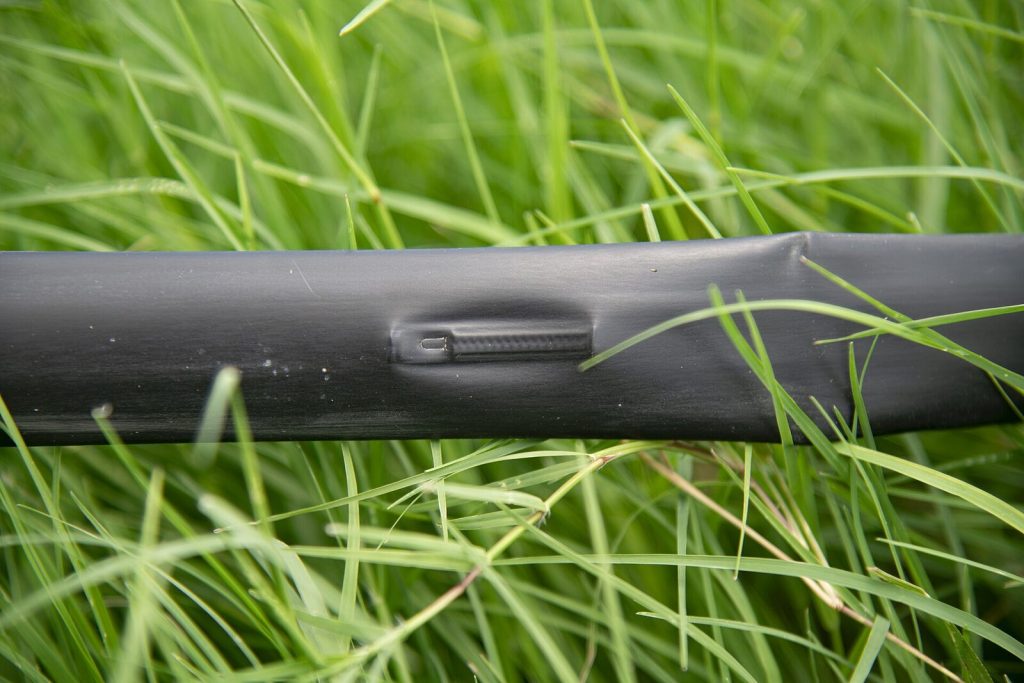
Drip irrigation delivers water slowly through emitters at the base of each plant. Highest efficiency of the four, it keeps leaves dry, and it accepts fertiliser through the line. It also clogs if the water is not filtered, which is the failure that ends most Ugandan drip installations. Full treatment in drip irrigation explained, and a direct comparison in drip against sprinkler.
Scaling From a Watering Can to a Solar Irrigation System
This is the part that most irrigation writing skips, and skipping it is why so much of it is useless to Ugandan farmers. Almost nobody starts with a complete drip system on two acres. They start far lower down, prove the market, then climb. Each rung below is a real step that thousands of Ugandan growers are standing on right now.
Climb one rung at a time and let the market pay for the next. A farmer who has sold two dry season tomato crops off rung 3 knows something a farmer with a loan and rung 6 does not: whether the buyers are actually there.
Government Support for Smallholder Irrigation Farming
Uganda runs a public programme aimed squarely at individual smallholders rather than at large schemes. Launched in 2020 and led by MAAIF with World Bank financing, it works as a matching grant: the farmer pays a share of the equipment cost and government subsidises the rest, delivered through district local governments alongside extension advice and a farmer registration and advisory app. Reported eligibility covers plots up to about 2.5 acres.
Uptake in the early phase was heavy on interest and lighter on delivery, with tens of thousands of farmers registering interest, thousands of farm visits carried out, and a much smaller number of systems actually installed in the first months. Treat the programme as a real route worth asking your district production or agriculture office about, not as a guarantee.
Two constraints named in the same research are worth knowing before you shop. Irrigation equipment in Uganda has been costing 30 to 50 percent more than the same equipment in Kenya, driven by low sales volumes, import duties and freight. And the market carries a lot of cheap low quality kit that looks attractive and fails early. The weak knowledge base is the third constraint, and it is the reason a supplier who will not explain filtration to you is the wrong supplier.
Separate public schemes exist for medium and large irrigation, mostly serving lowland rice growers in eastern and northern Uganda, with Doho in Butaleja in the east, Olweny in Lira and Dokolo and Agoro in Kitgum in the north, and Mubuku in Kasese in the west. Those are a different route from the one an individual vegetable grower takes.
Common Irrigation Farming Mistakes on Ugandan Farms
Most failures are not technical. They are sequencing errors.
Buying the system before checking the source. A pump and drip lines sitting idle because the stream dried up in July is the most expensive mistake in this article. Test the source in the driest week first.
Skipping filtration on drip. Silty river or pond water will block emitters within weeks. A filter is not an optional accessory on drip, it is the part that decides whether the system still works next season.
Sizing for the whole farm instead of the profitable corner. Irrigating a quarter acre of tomatoes for the dry market beats irrigating two acres of maize in almost every case. Start where the margin is.
Forgetting that irrigated crops need feeding. More water means more growth and more nutrient demand, and a watered crop on unfed soil disappoints. Water and fertility move together.
Planning production without planning the sale. The dry season premium exists because supply is thin, and it can vanish if a large grower nearby floods the same market. Talk to your buyers before you plant, and read up on finding produce buyers.
Ignoring maintenance. Flushing lines, cleaning filters, servicing the pump, checking for leaks. FAO's own efficiency figures carry the warning that poor discipline drags every method down, and an unflushed drip system is a 90 percent efficient design running at far less.
Frequently Asked Questions About Irrigation Farming in Uganda
How much does an irrigation system cost in Uganda? There is no single answer, and anyone quoting one figure is guessing. The total depends on the water source, the lift, the area, the method and the pump, and Ugandan irrigation equipment has been running 30 to 50 percent above Kenyan prices because of low volumes, duties and freight. Prices also move with the exchange rate. Ask two or three suppliers to price the same written specification, then read the breakdowns against each other using the irrigation system cost per acre guide as your reference. A quote that undercuts the others has usually dropped something, and filtration is the usual casualty.
Can I get government help paying for irrigation equipment? Uganda's micro scale irrigation programme is a matching grant run through MAAIF and district local governments, where the farmer contributes a share and government covers the rest, with eligibility reported for plots up to around 2.5 acres. Terms, the farmer share and the equipment list are set by the programme and change, so confirm current conditions at your district production or agriculture office rather than relying on figures from any article.
What is the smallest plot worth irrigating? Smaller than most people assume. Growers regularly build a real business on a quarter acre of vegetables watered through the dry months, and plenty begin with nothing more than a nursery bed and a few lines. Acreage is the wrong measure. What decides it is whether the crop is valuable and whether you can put it into a market that is short. Maize on that same ground would not repay the pump at all.
Do I need a permit to irrigate from a river on my land? Possibly, and it turns on how you take the water rather than on who owns the land. The Ministry of Water and Environment requires a surface water abstraction permit where a motorised pump draws from a stream, river or lake, or where more than 400 cubic metres a day is diverted or impounded, and a groundwater permit for motorised abstraction from a borehole, well or spring. Ask the Directorate of Water Resources Management or your district water office about your specific case before buying a pump.
Which crops make the most sense to irrigate in Uganda? High value, short cycle vegetables with a dry season price spike: tomato, onion, cabbage, green pepper, watermelon and leafy vegetables. Perennials such as coffee, bananas and vanilla come next, where watering protects flowering through a dry spell rather than chasing a price window. Staples like maize and beans are the hardest to justify, because the value per litre of water applied is low, and irrigating them usually only makes sense to cover a dry spell rather than to grow a full dry season crop.
How much water does an irrigated crop actually need? It varies with the crop, its growth stage, the soil and the weather, so any single litres per plant figure is misleading. Demand is highest in the hottest, windiest, driest weeks and at flowering and fruiting. Work it out for your own plot with the irrigation water requirement method rather than copying a number. A sandy soil needs smaller, more frequent applications than a clay one.
Is drip always better than sprinkler for a Ugandan farm? No. Drip uses the least water and keeps foliage dry, which suits widely spaced vegetables and fruit, but it demands clean filtered water and it is impractical on broadcast or densely planted crops. Sprinkler covers a whole field and tolerates dirtier water, at the cost of wind and evaporation losses and wetter leaves. The comparison of drip against sprinkler works through the decision crop by crop.
What goes wrong most often with new irrigation systems? Clogged drip emitters from unfiltered water, a source that fails in the dry months, and a pump too small for the lift. All three are avoidable at the planning stage and expensive afterwards.
If you are weighing up a system, start by writing down your water source, the lift in metres, the area you actually intend to water and the crop you intend to sell, then take that page to two or three suppliers and ask each for an itemised quote including filtration and installation. Compare the component lists, not just the totals, and check current equipment prices and what other growers in your district paid before you commit. More detail on every part of this sits in the irrigation, greenhouses and water guides, and where to buy irrigation equipment covers what to look for in a supplier.