
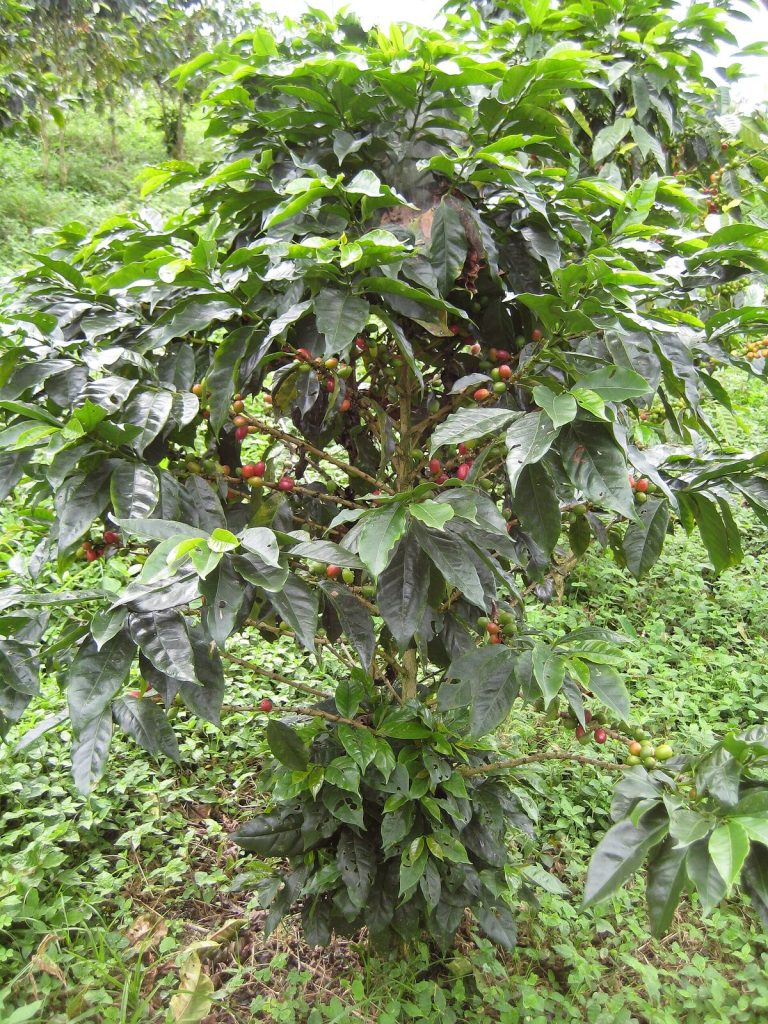
Ugandan coffee fertilizer guidance is written per tree, and the per acre totals in the published tables are just that per tree rate multiplied by a plant count. Get the per tree figure and your own tree count right and everything else follows. Two national handbooks and a research handbook agree on roughly 200 g of compound fertilizer a tree a year for young coffee and roughly 400 to 500 g for producing trees, split across the rains.
Almost every other question about coffee fertilizer runs through one gate first, and that gate is soil pH. Below about 5.5 the published programme changes product, not just quantity, because an acidifying nitrogen source on already acid soil makes the problem worse. So this page runs in the order the decisions actually come: test, build the organic base, fix the pH, then choose a rate, a timing and a placement.
Where the ministry's own tables disagree with each other, both figures appear here. There are several such places, including one arithmetic error in a per acre column and two products given opposite pH conditions in two handbooks from the same institution. No rate on this page overrides the bag label or a laboratory recommendation for your own soil.
Start With a Soil Test, Not a Fertilizer Bag
Every Ugandan source on coffee nutrition says the same thing before it gives a single number: fertilizer rates are site specific and come from a soil analysis rather than a table. The handbooks describe blanket application as the thing to avoid, and the research handbook states plainly that rates depend on soil fertility status, tree age, planting density and yield target, all of which vary between one farm and the next.
That is not a formality, because response to fertilizer varies enormously with what the soil already holds. The handbooks group it three ways, and the grouping is more useful than it first looks. Response is poor on already fertile soils with large nutrient reserves, which are typically the plots closest to the house where manure and residues have been dumped for years. Response is large on nutrient deficient but still responsive soils, usually the plots further out that have never had anything applied. And response is very poor on degraded soils, where mineral fertilizer does little unless it goes on alongside large quantities of organic matter.
Read that back and the practical instruction is counterintuitive. The convenient plot near the homestead is often the one where bought fertilizer earns least, and the distant plot is where it earns most. Testing is what tells you which you have.
Soil and leaf analysis are both available for a fee at the plant, soil and water analytical laboratories at Makerere University and at Kawanda Agricultural Research Institute, and the handbooks tell farmers to ask extension workers for help reaching the service. The general soil testing guide covers what a report tells you.
How to Take Coffee Soil and Leaf Samples
A bad sample produces a confident report about soil you do not have, so the sampling protocol carries as much weight as the laboratory work. The handbooks specify three composite samples for a block of two to four hectares, each composite drawn from 20 separate spots.
Leaf analysis answers a different question: what the tree has actually taken up, rather than what the soil holds. Sample 16 trees an acre, walking diagonally across the block, and build a composite of at least 100 leaves. Take the third or fourth pair of leaves from the tip of an actively growing branch, from average trees only, skipping anything obviously sick, unusually vigorous or odd. Sample in the morning while leaves are turgid, and never after a foliar spray. Pre flowering is the time if you take only one sample a year; large plantings benefit from sampling every four months, particularly where a nutrition problem has already shown up.
Leaves going to the laboratory within two days need no drying at your end, since they are dried there at 60 to 65 degrees. Anything held longer gets spread out and dried at room temperature or in shade. Store samples in paper bags, never plastic, away from sun, rain and contamination.
Visual diagnosis has a real place but a narrow one. Tip burn, chlorosis and necrosis are classic deficiency symptoms and they are also caused by herbicide scorch, weed competition, disease and insect damage, so the handbooks tell farmers to confirm with an extension worker rather than buying a nutrient off a leaf photograph.
What Coffee Takes Out of the Soil
Nitrogen drives vegetative growth, raises the bearing capacity of the tree and increases bean size. Deficiency shows as slow new growth, a uniform yellowing across the leaf or faint yellowing between the veins, leaf drop starting on the densest fruiting branches, and dieback at the tips.
Phosphorus builds roots, brings berries to maturity earlier and increases bean density. It is the nutrient the handbooks put in the planting hole for exactly that reason, as a single measured handful of a phosphate fertilizer placed in the root zone and kept off the stem.
Potassium is the berry nutrient: it runs berry development and ripening, mucilage formation, and the healing of tissue injured by picking, pruning and hailstorms, and it regulates water uptake from the soil. That last function is why potassium supply shows up in how a garden handles a dry spell, and it is one reason maize and sorghum stalks are the preferred mulch material in every Ugandan coffee document, since they are comparatively rich in it.
Calcium, magnesium and sulphur are needed in moderate amounts, and zinc, copper, boron, iron, manganese, molybdenum and chlorine in small ones. The research handbook makes the point that conventional compound fertilizers supply the three main nutrients and leave soils short of secondary and micronutrients, zinc and boron in particular, which is the argument for a blended product that carries both, or for a foliar application to correct a specific shortfall.
Manure and Compost for Coffee: The Published Rates
Organic matter is the base of the programme rather than an alternative to it. Both handbooks ask for a basin of manure per tree at least once a year in addition to the inorganic blend, on the reasoning that manure improves soil structure and structure is what lets the tree take up anything else you apply.
The annual quantity is published at three different values by three Ugandan sources, and they resolve into a workable band once you notice that some refer to a planting hole and others to an established tree.
Which manure you have changes what it is worth. The handbooks publish nutrient percentages for common farmyard manures, and the spread is wide enough to matter: cow manure around 0.6 percent nitrogen, chicken around 1.1, rabbit around 2.4. Chicken droppings are named as the best source of stable nitrogen and also carry a lot of phosphate. Cattle manure is rich in nitrogen while fresh and loses it as it dries, so cow dung intended for coffee wants decomposing under cover rather than in an open heap in the sun.
Compost is the other route, and the handbooks give both a heap method and a pit method. The pit version uses three pits side by side, each 1.5 to 2 m wide and about 1 m deep, filled in layers: about 10 cm of slow material such as twigs and stalks at the bottom, 10 cm of green material, about 2 cm of animal manure, then a thin layer of arable topsoil to supply the micro organisms, repeated until the heap stands 1 to 1.5 m high and covered with grass or banana leaves. Contents move to the second pit after two to three weeks and to the third two to three weeks later, which frees pit one for the next batch and makes the system continuous. Heap composting is ready about six weeks from building, after two turnings. Either way, start the compost about six months before you need it, and keep the finished product covered, since rain washes the nutrients out and sun burns them off. Spread it around the tree at least two feet out from the stem. Compost making and using cow manure go further.
Mulch as Part of the Coffee Fertilizer Programme
Mulch belongs in a fertilizer guide because the handbooks list conserving applied fertilizer among its benefits: a mulched surface loses less to runoff and keeps nutrients where roots can reach them. Maintain a layer at least 5 to 15 cm deep each season, which the training manual puts as up to six inches, using dried grass, maize or sorghum stalks, bean haulms, coffee husks, straw or compost. Maize and sorghum stalks are singled out for their potassium content.
Keep it off the trunk. At least 15 cm clear of the stem on a young plant and 30 cm on a mature tree, because mulch against the collar invites rot and gives ants and termites a bridge into the tree. On young coffee the area worth mulching is within the canopy spread, since the root system has not extended beyond it yet.
The handbooks are unusually frank about mulch's drawbacks and two of them are nutritional rather than practical. Mulching can lead to a shortfall or total unavailability of zinc and magnesium. And prolonged use of elephant grass or swamp straw as mulch is recorded as capable of causing yellowing and eventual death of the coffee bush. Against that, mulch is credited with limiting excessive manganese uptake in acid soils and raising soil potassium. Rotate your mulch materials rather than relying on one source year after year, and leave some rows unmulched in fire prone areas.
Lime and Soil pH: The Gate Before Any Fertilizer Decision
Both handbooks give the same target window: pH 5.5 to 6.5, within which coffee is well supplied with the major nutrients. The Robusta handbook adds that below 5.5 crop performance is held back and liming is needed to bring the soil back into range.
The lime rate published for a planting hole is 100 g, which works out around 45 kg an acre at 450 Robusta trees and 68 kg at 680 Arabica trees. Note what that rate is for: it treats a hole, not a field. Correcting the pH of an established garden is a different job, the quantity depends on your soil report and the soil's buffering, and no Ugandan coffee document I could reach publishes a field rate. So for an established block, the amount comes from the laboratory recommendation.
The trigger for liming is where the two handbooks part company, and it is worth knowing about before you act on either table. The Robusta programme applies lime if pH is below 5.5. The Arabica programme applies lime if pH is below 4. Both handbooks' own soil chapters give 5.5 to 6.5 as the target, so the 5.5 trigger is the one consistent with the rest of both documents, and a pH of 4 is far outside what either says coffee tolerates.
The pH reading then selects the nitrogen product, and here the two tables give opposite instructions for the same fertilizer.
Fertilizer Rates for Coffee Trees Up to Two Years Old
Both handbooks carry a blend intended for nursery coffee, coffee at planting and coffee up to two years old, at a minimum of 100 g per tree per rain season. That comes to 45 kg an acre for Robusta at 450 trees and 68 kg for Arabica at 680. It can go on in one application or in two splits during the rains, and a 10 kg bag covers about 100 young trees at the minimum rate.
The research handbook reaches a similar annual total by a different route: 50 g per tree per application on new plants, with up to four applications a year, which is 200 g a tree a year. Two rain seasons at 100 g is also 200 g a tree a year. Two independent documents landing on the same annual figure through different split patterns is about as much agreement as Ugandan coffee guidance offers, so 200 g a tree a year for young coffee is a figure worth trusting.
The Robusta programme table is more granular and pH conditional, giving 75 g per tree per rain season of a compound fertilizer for newly planted coffee where pH is above 5.4, rising to 150 g per tree per rain season once the tree is past two years, plus urea at about 76 g per tree per rain season where nitrogen is short. At planting itself, a single phosphate application of 60 g per tree is specified, which is 27 kg an acre at 450 trees, placed in the root zone and not touching the stem.
The 60 g figure comes with the most practical measuring tip in any of these documents. A full, level soda bottle top holds about 6 g of granular fertilizer, so ten level bottle tops per tree is the 60 g rate, and the handbook checks its own arithmetic by noting that this equals 27 kg an acre at 450 plants. A cut down water bottle works the same way for larger rates. Use a calibrated measure of some kind rather than a handful, because a handful varies by hand and by granule size.
Fertilizer Rates for Producing Coffee Trees
From three years old the published minimum doubles to 200 g per tree per rain season, applied in at least two splits. That is 90 kg an acre for Robusta at 450 trees and 136 kg for Arabica at 680, and a 10 kg bag covers about 50 producing trees. The blend both handbooks name for this stage is given as 16:2:31 in their fertilizer chapters and as 15:2:31 in their programme tables, so check the grade printed on the bag rather than either number, and expect a high potassium formulation because potassium is the berry nutrient.
Across the whole year that is 400 g a tree, which the research handbook matches with 100 g per application four times a year, timed to March, May, August and November. A Ugandan viability study costs compound fertilizer at 500 g a tree a year, a little above both. So the defensible planning band for a producing coffee tree is about 400 to 500 g a year, which is 180 to 225 kg an acre for Robusta and 272 to 340 kg for Arabica.
| Tree stage | Per tree per season | Per tree per year |
|---|---|---|
| At planting | 60 g phosphate | One application |
| Newly planted | 75 to 100 g | 150 to 200 g |
| Past two years | 100 to 150 g | 200 to 300 g |
| Three years and up | 200 to 250 g | 400 to 500 g |
The mature stage in the Robusta programme is presented as a set of five product options rather than one recipe, which is the right shape for a decision that depends on a soil report. Muriate of potash appears at 200 g per tree per season for fruit growth and maturation and for quality. A high potassium compound appears at 250 g per tree per rain season to balance growth and flowering. Calcium ammonium nitrate appears at 256 g per tree per season on acid soil, in two seasonal applications with different jobs, the first around April to set fruit and the second to help ripening. Double superphosphate appears at 200 g per tree per year where phosphorus is short. Which of those five you need is what the analysis is for.
Reading the Per Acre Column: An Arithmetic Warning
The per acre totals in these tables are derived, not measured, and in one block they are derived wrongly. This is worth a section because a farmer who buys to the per acre column rather than measuring per tree will over apply.
Check the Arabica programme first, since it is clean. At 680 trees, 100 g a tree gives 68 kg and the table prints 68. At 200 g it gives 136 and the table prints 136. At 250 g it gives 170 and the table prints 170. At 256 g it gives 174 and the table prints 174. Every row reconciles.
Now the Robusta mature block. At 450 trees, 200 g a tree gives 90 kg and the table prints 90, correctly. But three rows stating 250 g a tree print a per acre total of 115.2 kg, and 250 g at 450 trees is 112.5 kg, not 115.2. The figure 115.2 only divides at 460.8 trees an acre. It is the correct total for the calcium ammonium nitrate row, which states 256 g a tree, and it appears to have been carried across onto rows that state 250 g.
When to Apply Coffee Fertilizer Through the Season
The handbooks organise timing around the four rights of fertilizer management: right product, right rate, right time, right place. On timing, the principle is to make nutrients available when the crop is using them. A basal application goes in at or just after planting to support early growth. Nitrogen, being mobile and easily leached, goes on as a top dressing at the stages of fastest growth, and splitting that top dressing improves how much of it the tree actually gets.
Split patterns differ by source, which gives you a choice rather than a conflict. Two splits across the two rain seasons is the handbook pattern. Four applications a year, at March, May, August and November, is the research handbook pattern and fits Uganda's bimodal rains with an application early and late in each season. Both deliver the same annual quantity; four smaller doses lose less to leaching and cost more in labour.
One line in the handbook deserves reproducing because almost nothing else written about fertilizer says it. If the crop has developed poorly because of poor rainfall and output prices are expected to be low, the top dressing can be cancelled and the fertilizer held over for the next planting season. Fertilizer is not a ritual. On a crop that has already lost its yield potential to drought, it is money you can still choose not to spend.
Foliar fertilizers are a supplement for correcting a deficiency or for getting nutrients in when dry weather or cold is blocking uptake through the soil, not a replacement for soil application. Apply them when evaporation is low, in the morning or evening, never in the heat of the day.
Where to Place Fertilizer Around a Coffee Tree
Placement decides how much of what you bought the tree can reach. Granular fertilizer goes in as a ring around the tree just before the cropping season, or is mixed with the soil at planting. Compost and manure go around the tree at least two feet out from the stem.
The handbooks separate two families of method. Broadcasting spreads fertilizer across the whole surface and suits a mature dense stand whose roots occupy the entire soil volume, with a variant called banding that lays a circle of fertilizer on the surface below the drip line. Its two drawbacks are stated plainly: it feeds weeds across the whole field, and nutrients get fixed in the soil through contact with a large mass of moist earth. Placement puts the fertilizer at a specific point relative to the tree and its roots, and suits small quantities, poorly developed root systems, low fertility soils, and phosphate and potash in particular, because phosphate is immobile and is used far better when placed than when scattered.
The short version for a smallholder block: place it while the trees are young and the root system is small, band it around the drip line once the canopy has closed, and keep granules off the stem either way.
Nutrient Antagonism and the Weakest Link in Coffee Nutrition
Too much of one nutrient can cause a deficiency of another, and the handbooks publish a table of which suppresses which. Excess potassium interferes with magnesium, calcium and sodium uptake. Excess phosphorus suppresses zinc, iron and copper. Excess nitrogen affects potassium and calcium. Excess manganese or zinc can induce iron deficiency symptoms. Excess aluminium suppresses phosphorus, which is part of why acid soils perform badly regardless of how much phosphate goes on.
The consequence is that a deficiency symptom is not automatically a shortage in the soil. It can be a surplus of something else locking it out, and the correction for that is a soil report rather than more of whatever the leaf appears to be missing. Piling on a single nutrient because the leaves look pale is how a garden acquires a second deficiency it did not have.
Alongside that sits the older idea the handbooks illustrate with a barrel made of planks of different heights: the crop performs to the least available nutrient, and a barrel holds only as much as its shortest plank allows. Add the limiting nutrient and something else immediately becomes limiting instead. That is the argument for balanced feeding and for testing, rather than for buying whichever bag is cheapest per kilogramme of nitrogen.
Checking Fertilizer Quality Before You Apply It
Adulterated fertilizer is a documented problem and the handbook gives a field test for the fully soluble products, which include urea, ammonium sulphate, ammonium nitrate, muriate of potash, triple superphosphate and diammonium phosphate. Add 100 g of the fertilizer to one litre of water. Genuine material dissolves, the water temperature drops as it does so, and only a very small undissolved carrier residue is left. Sand or brick dust does not dissolve and stays visible at the bottom.
Two points that test does not cover. It does not work on granular blends that are not fully soluble, and it does not tell you the nutrient percentages, only that something insoluble has been mixed in. For everything else the label is the evidence, which is one of the arguments the handbooks make for inorganic over organic sources: you know exactly what percentage of each nutrient you are applying, rather than guessing at the composition of a heap.
On where to buy, the handbook's instruction is to use dealers registered and certified by the Ministry of Agriculture, Animal Industry and Fisheries. This site names no dealer, no brand and no supplier. Ask a district agricultural office which local dealers hold current registration, because that is a matter of public record they can check and a page cannot. Sourcing fertilizer and current fertilizer prices cover the buying side.
What Fertilizer Does to Coffee Yield in Uganda
The Robusta handbook states the response directly: fertilizer application can raise Robusta output from a current average of one tonne to as much as three tonnes of clean coffee per hectare per year, and also improves the tree's disease resistance, drought tolerance and bean quality. That is a threefold claim and it is worth checking against measured data rather than accepting on its own.
A Ugandan field study that sorted smallholders by how many recommended practices they followed did exactly that. Growers applying no fertilizer and no consistent manure averaged about 232 kg of clean coffee an acre for Robusta and about 180 for Arabica. Growers applying fertilizer alongside pruning, de-suckering and a planned pest programme averaged about 841 kg an acre for Robusta and about 805 for Arabica. That is roughly a threefold to fourfold difference in measured output, in the same direction and of the same order as the handbook's claim.
Two honest qualifications on that comparison. Fertilizer was not the only thing that changed between those groups, so the multiple belongs to the whole package rather than to the bag alone. And even the best measured group falls short of the 3,000 to 4,000 kg per hectare that the handbook attributes to clonal varieties under good management, which is about 1,215 to 1,620 kg an acre. Fertilizer closes a large part of the gap between a neglected garden and a good one. It does not close the gap between a good garden and a variety trial. Coffee yield per acre works through that ladder, and the main growing guide puts nutrition alongside the other things that move a Ugandan coffee yield. Nutrition guidance for the other crops in the export crops section is built the same way, per plant rather than per acre.
Coffee Fertilizer Questions
Take a soil sample before you buy anything, then get current quotations for your chosen product from more than one registered dealer in your own district, since fertilizer prices differ by region and by season. A district agricultural office or the regional coffee extension office can confirm which dealers hold current registration and what the analysis of your soil actually calls for.