
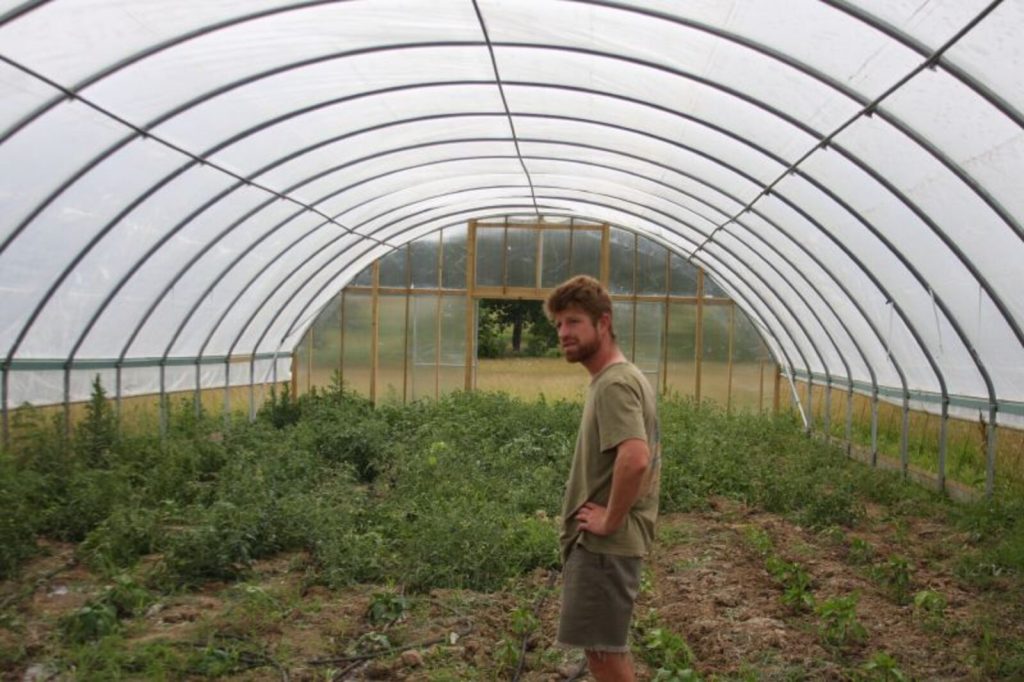
Greenhouse pest management works in one order: keep pests out, watch for the ones that get in, fix the growing conditions that favour them, use biological options where they fit, and spray last. A covered crop in Uganda is warm, humid and protected from weather, which suits whitefly, thrips, mites and rot organisms exactly as much as it suits the tomato.
Why a Greenhouse Turns a Minor Pest Into a Crop Failure
You paid for the house to take the weather out of the equation. The pests get that benefit too. Outside, a rainstorm knocks aphids off a leaf, a dry spell checks a fungal outbreak, and predators wander in from the hedge. Inside, none of that happens. A pest that arrives in the doorway on a seedling tray meets steady warmth, no rain, no wind, and almost no natural enemies.
The multiplication rates are what make this urgent. Whitefly females lay 150 to 300 eggs and complete the cycle from egg to adult in 21 to 36 days, faster as house temperature rises. Thrips females push several hundred eggs into plant tissue and go from egg to adult in 7 to 13 days. Aphid nymphs start reproducing within 7 to 10 days, each female producing 50 or more. Two spotted spider mite populations can rise tenfold in a week when conditions are hot and dry, natural enemies are absent and the plants are well fed, which describes a well managed greenhouse precisely.
Then there is the structural problem. Beds inside a house are permanent, so the same crop family grows in the same soil season after season. Soil pests and soil borne pathogens accumulate with nothing to break the cycle. FAO's warning on this is direct. Pack plants tightly into a house that does not breathe and the result is viruses, blights on the foliage, spotting, and rots in the stem, the fruit and the root, all of it escalating within days and all of it pulling the grower towards the sprayer. That last part is the trap. A house managed badly does not just lose a crop, it converts the grower into a heavy sprayer, and the evidence from Uganda says that is exactly what happens.
The Pests That Actually Matter Under Cover in Uganda
Ugandan research narrows the list. A participatory IPM programme working with smallholder tomato growers identified the major pest constraints as late blight, bacterial wilt, viruses, bollworm, aphids, thrips and whiteflies. Baseline surveys in that work found farmers spraying a variety of pesticides 12 to 24 times per growing season. The package the programme settled on, built around a bacterial wilt resistant tomato variety called MT56, mulching, staking and a minimum spray schedule of 3 to 4 sprays per season, produced yields 40 percent higher along with lower production costs from the reduced spraying. MT56 and mulching together cut production costs by 21 percent.
Read those two numbers against each other. Twelve to twenty four sprays a season, against three to four, with better yields from the smaller number. Greenhouse pest management done properly is cheaper than doing it badly, and the saving is larger than most growers expect.
| Pest | What you see | Where to look |
|---|---|---|
| Whitefly | Sticky honeydew, sooty mould, leaf curl | Undersides of youngest leaves |
| Thrips | White streaks, curled new growth | Flowers and growing tips |
| Spider mites | Fine stippling, webbing | Leaf undersides, hottest bays |
| Aphids | White cast skins, honeydew, ants | New shoots and stems |
| Tuta absoluta | Blotch mines, bored fruit | Leaves, then fruit near the calyx |
| Root knot nematodes | Stunting, galls on roots | Lift a weak plant and wash the roots |
Nothing on that list is exotic. All of it is present in Ugandan vegetable production, and the greenhouse changes only the speed at which it builds. The crop specific angle on tomato and sweet pepper sits in the guides to tomato greenhouse farming and pepper greenhouse farming, and the broader subject lives in the irrigation and greenhouse guides.
Whitefly and Thrips as the Virus Carriers of the Greenhouse
These two matter far beyond the damage their feeding does, because they carry viruses, and an infected plant cannot be cured. Control of a viral disease is entirely prevention or delay of infection, which means it is really vector control.
The whitefly Bemisia tabaci transmits tomato yellow leaf curl virus. FAO describes it as having become the limiting factor in vegetable production across the Mediterranean and the Near East, which is a warning worth taking seriously in a Ugandan house. It is about 0.2 mm wide, which is the number that decides your netting. Adults sit on the undersides of the youngest, most tender leaves, so that is where you look. Their honeydew feeds a superficial black fungus called sooty mould, which downgrades fruit even where the plant survives.
Thrips carry tomato spotted wilt virus on both tomato and pepper. Western flower thrips is the most injurious species, and it does a lot of damage before anyone notices, because the adults are about 1.5 mm long and feed inside buds where they cannot be seen. The feeding marks show up as white streaks on leaves, with new growth curling under. One detail of their life cycle explains most spray failures against them: the larvae drop off the plant into the soil and pass through two stages there before adults emerge. A foliar spray misses that part of the population entirely.
Aphids carry their own viruses, cucumber mosaic virus and potato virus Y on tomato and pepper. Tobacco mosaic virus arrives a different way, in the seed and on hands and tools, which is why buying clean seed and washing hands before handling plants is virus management rather than housekeeping.
Spider Mites and Aphids in a Hot, Dry Greenhouse
Spider mites are the pest that punishes a badly ventilated house twice. Hot, dry conditions are ideal for two spotted spider mite development, and the mites actually feed faster in that heat, because increasing their feeding rate is how they limit their own water loss. Populations that can increase tenfold in a week turn a few stippled leaves into a bay of dead plants inside a month. The full life cycle runs from 7 days to 3 weeks depending on temperature, so the warmer your house, the shorter your reaction time.
Look for fine brown, yellow or white stippling on the leaves, then turn the leaf over. High populations always come with webbing, and the webbing is not just cosmetic: it shields the mites and the leaf surface from spray droplets, which is a large part of why growers spray repeatedly against mites and see no result. The honest response to that is earlier detection, not a stronger mix.
Aphids are easier to spot if you know the signs, which are shed white skins, shiny honeydew, curled new leaves, distorted growth and ants working the plants. They come in through the vents from weeds outside. One monitoring warning: yellow sticky cards will catch winged aphids arriving from outdoors, which is useful early warning, but they will not tell you about the aphids already in your crop, because most of those are wingless and never fly onto a card.
Tuta absoluta in Greenhouse Tomato Production
Tuta absoluta, the tomato leafminer, reached Uganda in 2015 during its spread across East Africa, and it changed tomato pest management wherever it arrived. Recorded yield losses normally run from 11 to 43 percent and reach 100 percent in some locations. The larvae mine the leaves, leaving irregular blotches, then bore into the fruit, which destroys the marketable product rather than merely reducing it.
Two things about it are worth knowing before anything else. First, the monitoring tool is a pheromone trap rather than a sticky card, and there are sourced densities: for monitoring in a tomato greenhouse, three pheromone traps per 400 square metres, with insecticide treatment considered when catches reach a threshold of three males per trap per day. Where mass trapping is used in greenhouses the figure given is 20 to 25 pheromone traps per hectare. Pheromone monitoring on its own carries no pre harvest interval, which makes it the one intervention you can run right up to picking without a residue question.
Second, and this is the part that should govern your whole strategy: intensive use of synthetic insecticides against this pest has already produced resistance to all classes of insecticides. Spraying your way out of Tuta absoluta is a strategy with a known end point. Exclusion, trapping, sanitation and crop rotation with non solanaceous crops are what hold it, and the soil treatment section below matters here too, because the pest pupates in the soil.
Root Knot Nematodes and Continuous Cropping in Greenhouse Soil
This is the pest problem that a fixed house creates by existing. Root knot nematodes, including Meloidogyne incognita, Meloidogyne javanica and Meloidogyne arenaria, cause yield losses of around 30 percent in tomatoes in the tropics. They are invisible until you lift a stunted plant and wash the roots, where the galls are unmistakable.
Their worst effect is indirect. The stunting they cause makes plants more susceptible to soil borne fungal disease such as Fusarium wilt and to bacterial wilt caused by Ralstonia solanacearum, so a nematode problem presents as a wilt problem and gets treated as one. Meanwhile the population builds, because nothing about a permanent greenhouse bed interrupts it.
Grafting onto resistant rootstocks is the technical answer, and it is part of the Ugandan story: grafting onto bacterial wilt resistant rootstocks was among the technologies developed in the Ugandan IPM work, and rootstocks identified as conferring tolerance to these soil problems include Solanum torvum, Solanum macrocarpon and Solanum aethiopicum. The obstacle is cost, since producing grafted seedlings in quantity is expensive, which is why grafting has not spread widely in tropical production. For most Ugandan growers the practical measures are the soil treatments and the rotation discipline covered further down, plus buying seedlings from a nursery that can vouch for their health.
Diseases That High Humidity Feeds in the Greenhouse
Every disease in this section is a humidity problem before it is a fungicide problem, which is why ventilation is the first line of disease control and not a separate subject.
Botrytis, grey mould, is the clearest case. Anywhere between 60 and 90 percent relative humidity, the plant hardly notices. Hold the house above 95 percent for a long stretch, above all overnight, and Botrytis cinerea develops fast. Condensation is the second half of the mechanism and growers underestimate it badly. Those beads of water on the inside of the cover are high humidity made visible, they sit there from dusk until a few hours past dawn, and a fungal spore needs exactly that film to germinate. Dawn drip onto the canopy is an infection route, not a nuisance.
Powdery mildew follows the same condensation trigger and, along with Botrytis, is where fungicide resistance in protected crops mainly sits. Two organisms, both encouraged by a house that does not breathe, both already prone to resisting what you spray at them.
Late blight is named in the Ugandan work as one of the major tomato constraints, and a humid house with wet foliage gives it what it needs. Anything that keeps leaves wet, including hand watering, overhead watering and leaking irrigation, feeds it.
Bacterial wilt deserves separate respect because you cannot spray it and you cannot easily get rid of it. Ralstonia solanacearum survives in weeds, in seeds and in soil for 2 to 10 years. It travels in running water, in moved soil and on infected transplants. Its development is favoured by high temperatures of 30 to 35 degrees C together with high relative humidity, which is a description of an under ventilated Ugandan greenhouse in the middle of the day. Symptoms are dark brown vascular tissue inside the stem, browning of the pith and cortex, and complete wilting. Once it is in a bed, resistant varieties, clean transplants, water management and soil treatment are the tools, and MT56 exists because Ugandan researchers took this seriously.
Two practical notes. Using field soil as a growing medium carries a high risk of soil borne disease including bacterial wilt, so where a bed is filled, the source of that soil matters. And wet floors create a microclimate that promotes disease outbreaks, so leaks and spills from the greenhouse irrigation system are a disease control failure. The humidity side of all of this is governed by greenhouse ventilation, and crop specific symptom identification is covered under tomato diseases and their treatment.
The Order of Control, and Why Spraying Comes Last
Exclusion First: Insect Netting, Door Discipline and Clean Seedlings
Netting is the first line, and the hole size decides what it stops. Leafminers need nothing finer than 0.8 mm. Whitefly and aphids call for 0.35 mm. Thrips are the demanding case at 0.15 mm. Woven screen at 50 mesh, sold as whitefly proof, is rated the strongest mechanical barrier there is, and western flower thrips walk through it anyway, being the smaller insect. So be honest with yourself about which pest your net is really stopping.
Three limits on netting are worth stating plainly. Screens do not suppress or eradicate anything, they only exclude most of what arrives, so they have to be installed before the pest appears rather than in response to it. They also exclude beneficial insects, which is a real cost if you are using biological control. And finer mesh chokes airflow badly, which raises temperature and humidity and can increase your fungicide use, so the mesh choice is a ventilation decision at the same time. That trade is worked through in detail on the greenhouse ventilation page.
Monitoring Greenhouse Pests With Sticky Traps and a Weekly Scouting Round
Monitoring is what converts everything else from guesswork into decisions. A weekly scouting programme is the standard, because early detection means smaller canopies, smaller populations and better spray coverage if it comes to that.
Use yellow sticky cards for whiteflies and small moths, and blue cards for thrips, since blue catches more thrips than yellow does. Place one to four cards per 100 square metres, spaced evenly through the house in a grid, with extra cards near doorways and vents where pests arrive, and some just above the crop canopy. Move them up the stake as the crop grows. Read them weekly, and twice a week as temperatures climb, because insect development speeds up with heat. Replace them weekly too, since a card coated in dust and debris stops catching.
Know what cards cannot tell you. Spider mites, broad mites, mealybugs, scales and wingless aphids do not fly, so they never appear on a card. Immature thrips and whiteflies are not caught either. A house can be badly infested with mites while every card reads clean, so cards go alongside plant inspection rather than instead of it. FAO's plant inspection method for whitefly is worth copying directly: check susceptible plants at ten locations within an area of 100 square metres, looking at one or two leaves per plant on both sides of the aisle, examining the undersides for nymphs, pupae and adults.
For Tuta absoluta, use pheromone traps at three per 400 square metres as described above. And if you are releasing winged biological control agents, cut the number of sticky cards back, because adult parasitic wasps get caught on them like anything else.
One cheap addition worth knowing: petunia and faba bean plants work as thrips and virus indicator plants. Petunias go in at one plant every 6 to 9 metres and faba bean at 12 pots per 100 square metres, flowers removed so the insects feed on foliage where you can see the damage, with a blue non sticky card in each pot to draw thrips to the plant.
Cultural Control: Sanitation, Pruning and Soil Treatment Between Crops
This tier is where the Ugandan IPM package earned its 40 percent yield gain, and it is the tier growers skip because none of it looks like pest control.
Sanitation is a daily habit rather than an end of season job. Remove and dispose of infected leaves as soon as you see them, take out severely diseased plants before they contaminate their neighbours, and clean up crop refuse at the end of each day's work. Avoid injuring plants during pruning and tying, because cuts, bruises and cracks are where infection enters.
Pruning and training do double duty. They improve air circulation through the canopy, which reduces disease incidence including botrytis, and they open the plant up so that inspection and spray coverage actually reach the leaf undersides where the pests live. Spacing matters the same way: overcrowding produces weak growth and reduces air movement, which increases both insect and disease problems.
Between crops is where the soil gets dealt with. Solarization is the method that suits Uganda, because it is free beyond the cost of plastic. Lay transparent polyethylene of 25 to 30 micron over the soil surface and bury the edges with no gaps, wet the soil first so the absorbed heat travels below the surface layer, and leave the sheet in place for 4 to 6 weeks, irrigating if the soil dries out underneath. Transparent plastic works and black plastic does not, because black produces no greenhouse effect under the sheet. The temperature rise is about 10 degrees C in the topsoil and less further down. It needs at least 30 days of high solar radiation and no crop in the ground, so plan it into the drier window between Uganda's two rainy seasons.
What solarization buys you is specific and useful: it reduces Meloidogyne populations, and it kills greenhouse insects that pupate in the soil, which includes leafminers, Tuta absoluta and western flower thrips. Those are exactly the pests that foliar sprays chronically miss. Where an empty house can be closed up in warm weather, closing it achieves a similar kill through the whole space, though a Ugandan house built with permanently open netted sides cannot be closed, which makes sheeting the beds the usable version here. Where steam is available, heat treatment at 100 degrees C is the most thorough option, and 70 degrees C held for half an hour is enough for fungal and bacterial pathogens and nematodes.
Finally, rotation and crop separation. Destroy old crops as soon as the last picking is done, keep new crops separated from maturing crops, and avoid overlapping crops, especially continuous year round cropping, because overlap is how a pest population walks from one crop to the next without ever facing an empty house. Rotating to a non solanaceous crop breaks the life cycle for Tuta absoluta and helps with the soil borne problems too.
Biological Control Options in a Greenhouse Crop
Biological control is a real option for aphids, mites, fungus gnats, thrips, whiteflies and some caterpillars, and an enclosed house is the environment where it works best, because released organisms stay where you put them. Two constraints decide whether it succeeds.
First, timing. Natural enemies do not act as quickly as pesticides and cannot be used as a rescue treatment. They work when introduced early in the cropping cycle, while plants are small, pest numbers are low and damage is not yet visible. A grower who calls for biologicals after the crop is visibly infested has already missed the window.
Second, chemical history. Many insecticide residues can adversely affect natural enemies for up to three months after application, so a house that has been sprayed heavily is not ready for a release. That cuts both ways: choosing biological control is a decision about what you will not spray.
There is a specific warning where a pest is carrying a virus. With whitefly transmitting tomato yellow leaf curl virus, biological control needs caution, because keeping a beneficial population alive means keeping a low pest population to feed it, and a low whitefly population can still move virus through the crop.
Among softer materials, FAO names soaps, oils, neem products, azadirachtin, Bacillus thuringiensis and Beauveria bassiana as having a role in greenhouse vegetable IPM. Those are materials, not recommendations, and this page cannot tell you whether a product containing any of them is registered for your crop in Uganda. That question goes to MAAIF's register of agricultural chemicals and to a registered dealer. Note also that commercial availability of biological agents against plant pathogens remains limited, and in many countries those agents require registration before growers may use them at all.
Spraying Last: Chemical Control and Operator Safety in an Enclosed House
Two things about spraying in a greenhouse differ from an open field, and both cut against the operator.
The first is exposure. In a field, spray drifts away from you. In a house, you are inside the cloud, in a structure built to hold air still, with the cover keeping the vapour in. That is a materially higher exposure to the same product, and it is why the safety rules below are not formalities. Regional survey evidence gives a sense of what the harm looks like in practice: among tomato farmers surveyed in Kenya and Zambia, skin itching was reported by 30.6 and 24.8 percent, dizziness by 17.0 and 13.8 percent, headache by 10.7 and 31.5 percent, stomach ache by 2.9 and 9.6 percent, with sneezing, coughing, eye irritation, vomiting and nosebleeds making up a further 4.2 and 27.8 percent.
The second is that sprays fail differently here. Most greenhouse insects and mites sit on the undersides of leaves, and coverage is the limiting factor: with high volume spraying it is estimated that less than 10 percent of the active ingredient reaches the target. Spider mite webbing shields the mites and the leaf surface from droplets. Thrips larvae are in the soil, not on the leaf. Egg stages can seldom be controlled at all and pupal stages are mostly unaffected, while young larvae and nymphs are easier to kill and need less insecticide. Once a population is high, even 95 percent control leaves a large absolute number of survivors behind. None of that is fixed by increasing the dose, which is the conclusion growers reach and the one that causes the harm.
On timing, two pieces of sourced guidance are worth carrying. Mites and whiteflies should be dealt with as soon as they are observed rather than allowed to build, and FAO's guidance is that sprays against them should not be spaced longer than 4 to 5 days apart until control is achieved, which is guidance on not letting a gap open rather than a programme to follow. Insecticides are usually best applied in the late afternoon or evening as temperatures fall, which lowers the risk of leaf burn and allows the longest possible airing before workers return. Do not spray plants that are water stressed, since they are more prone to phytotoxicity. Calibrate the sprayer, because a calibration error produces either under dosing that fails or overdosing that is illegal. How to read what the label actually says is covered on how to read agrochemical labels, and the practical side of protection and mixing on safe pesticide application.
Pre Harvest Intervals and Residues on Fruit That Is Eaten Raw
Greenhouse tomato and sweet pepper are eaten raw, usually unpeeled, often washed carelessly. That makes the pre harvest interval a food safety control rather than a piece of paperwork, and the Ugandan evidence on how it is treated is uncomfortable reading.
The clearest Ugandan evidence on this comes from a small study, and its size is worth stating before its numbers. Fifty tomato farmers and six vendors were interviewed in one sub county of Wakiso District in central Uganda, with the fieldwork done in 2013. That is a single community rather than a national picture, so read what follows as a close look at one place, not as a measurement of Ugandan farming.
Within those 50 growers, 46 of them, or 92 percent, named spraying with synthetic pesticides as their main way of dealing with pests and diseases, and 44 percent reported spraying three times a week through the wet season. Then the part that matters here. Of the farmers who answered the question, 45.8 percent reported spraying less than a week before harvest and 29.2 percent sprayed at or after harvest, which on a sample this size means roughly 22 and 14 growers respectively. Asked why they sprayed at that point, 35 of the 50 said it extended shelf life, 25 said it attracted customers and 23 said it controlled pests. On the knowledge question, 24.5 percent did not know that spraying at or after harvest poses any health risk to the consumer, and a further 22.4 percent were unsure. Class II products, mostly organophosphates, were the ones being used, and one farmer quoted in the study described spraying a mancozeb fungicide towards harvest because it made the fruit shine and drew buyers. The authors concluded that shelf life and fruit appearance are what drive growers to ignore the pre harvest no spray period.
A sample that size, drawn from a single sub county, settles nothing about national prevalence. What that study does establish is that the behaviour is real, that it is done deliberately rather than by accident, and that the reason is commercial: fruit that looks better sells better. Anyone selling greenhouse tomato or pepper into the same markets is competing against that, which is a commercial pressure, not an agronomic one.
Spraying fruit to make it look better and keep longer means the residue is on the fruit deliberately, at the point of sale, with no interval at all. Regional work on this makes the consequence explicit: where farmers do not observe pre harvest intervals, these substances enter the human food chain, and a published Ghanaian study measuring residues on tomato found chlorpyrifos at 10.76 mg/kg, with the accompanying risk assessment indicating high cancer risk for adults and children. That is one study in one country, quoted here to show what the failure produces rather than as a Ugandan measurement.
So the rule for a greenhouse grower selling raw eaten fruit is simple to state and hard to keep. The pre harvest interval is printed on the label of every product, it is specific to that product and that crop, and it is the last day you may spray before picking. It is not a guideline that shortens when a buyer arrives early. No number appears on this page because the number belongs to the product in your store, and inventing one for a page like this would put a residue in someone's food. Read the label, and if the label is missing or unreadable, do not use the container.
Resistance Builds Fast Under Continuous Greenhouse Cropping
A greenhouse is a resistance machine if you spray it like a field. The same crop, the same pest population, the same chemistry, several cycles a year, with no untreated refuge anywhere nearby. Every survivor breeds with every other survivor.
The evidence is already in. Intensive synthetic insecticide use against Tuta absoluta produced resistance to all classes of insecticides. On the disease side, fungicide resistance in protected crops sits mainly with Botrytis cinerea and powdery mildew fungi, which are precisely the two organisms a humid house grows best.
What follows from that is rotating modes of action rather than rotating brand names, since several products can share one mode of action and rotating between them achieves nothing. Ask the dealer for the mode of action group of what you are buying and keep a record of what went on each bed and when. This page does not name a rotation sequence, because a sequence that is not checked against what is currently registered in Uganda would be a guess, and a wrong guess about rotation accelerates exactly the problem it claims to solve. That is a question for a local extension officer with the current register in front of them. What the page can say without hesitation is that fewer, better targeted sprays slow resistance, and that the Ugandan work reaching 3 to 4 sprays a season with higher yields shows this is achievable rather than theoretical. The general principles of insecticide groups are covered under insecticides explained.
Frequently Asked Questions About Greenhouse Pest Management
What mesh of netting should I use on my greenhouse? Match it to the pest you are actually trying to exclude. Thrips need 0.15 mm, whitefly and aphids 0.35 mm, leafminers 0.8 mm. Finer is not better, because fine mesh cuts airflow hard, raises temperature and humidity and can increase your fungicide use. Whichever you choose, install it before the pest season rather than in response to an outbreak, and check the joins rather than the panels for gaps.
How many sticky traps do I need, and where do they go? One to four cards per 100 square metres, spaced evenly in a grid, with extra cards at doorways and vents and some placed just above the crop canopy, moving up as the crop grows. Yellow for whitefly and small moths, blue for thrips. Read them weekly, twice weekly when it is hot, and replace them weekly. Mites, mealybugs and wingless aphids never appear on a card, so inspect plants as well.
What insecticide should I spray for whitefly in my greenhouse? That is a question for a registered dealer or a local extension officer with MAAIF's register of agricultural chemicals in front of them, not for a web page. What can be said here is that the product must be registered for your crop, the rate and the intervals are on the label and must not be exceeded, the spray decision should follow a monitoring threshold rather than a calendar, and whitefly should be dealt with as soon as it is observed rather than allowed to build. Where whitefly is moving virus, exclusion and clean transplants do more than any spray will.
How long after spraying can I harvest? Only the product label answers that, because the pre harvest interval differs by product and by crop. Treat it as the last day you may spray before picking rather than as a suggestion. Be aware too that the interval is widely ignored in Ugandan tomato growing: in a study of 50 growers in one sub county of Wakiso District, 45.8 percent of those answering reported spraying inside the last week before harvest and 29.2 percent sprayed at or after harvest, most of them to make the fruit look better for buyers. Greenhouse tomato and pepper are eaten raw, so any residue goes straight to the consumer.
How long before workers can go back into the house after spraying? The re entry interval on the label governs it, and in an enclosed structure the physical step matters as much as the clock: open the house up and let it air out before anyone goes back in. Spraying in the late afternoon or evening gives the longest airing before the next working day. Never spray a house that has been closed up and then send someone in.
What does greenhouse pest management cost? Less than doing it badly, which is the finding that should shape the budget. Ugandan IPM work recorded baseline spraying of 12 to 24 times per season, against a package built on a resistant variety, mulching, staking and 3 to 4 sprays a season that delivered 40 percent higher yields, with the resistant variety and mulching cutting production costs by 21 percent. Your own spend will turn on netting grade and area, trap and lure quantities, protective equipment, and how many sprays your monitoring actually calls for, so price those items separately rather than as a single figure. Product availability and current prices come from pesticide suppliers, whose prices move with the exchange rate and the season.
Can I grow tomatoes in the same greenhouse beds every season? Not without paying for it. Continuous cropping in fixed beds builds root knot nematode populations, which cost around 30 percent of tomato yield in the tropics and open the door to Fusarium wilt and bacterial wilt, and bacterial wilt itself survives in soil for 2 to 10 years. Rotate to a non solanaceous crop where you can, solarize the beds between crops under transparent plastic for 4 to 6 weeks, clear old crops out as soon as picking ends, and avoid running overlapping crops in the same house.
Agro dealers and greenhouse suppliers carry netting by grade, pheromone lures, sticky cards, protective equipment and registered crop protection products, though what is actually on the shelf changes through the year. Ask more than one registered dealer for a quote, and put three questions to each: the hole size of the net in millimetres, the pest it is rated to exclude, and whether the chemical product is registered in Uganda for the crop you are growing. Confirm every rate and interval against the label in front of you before money changes hands.