
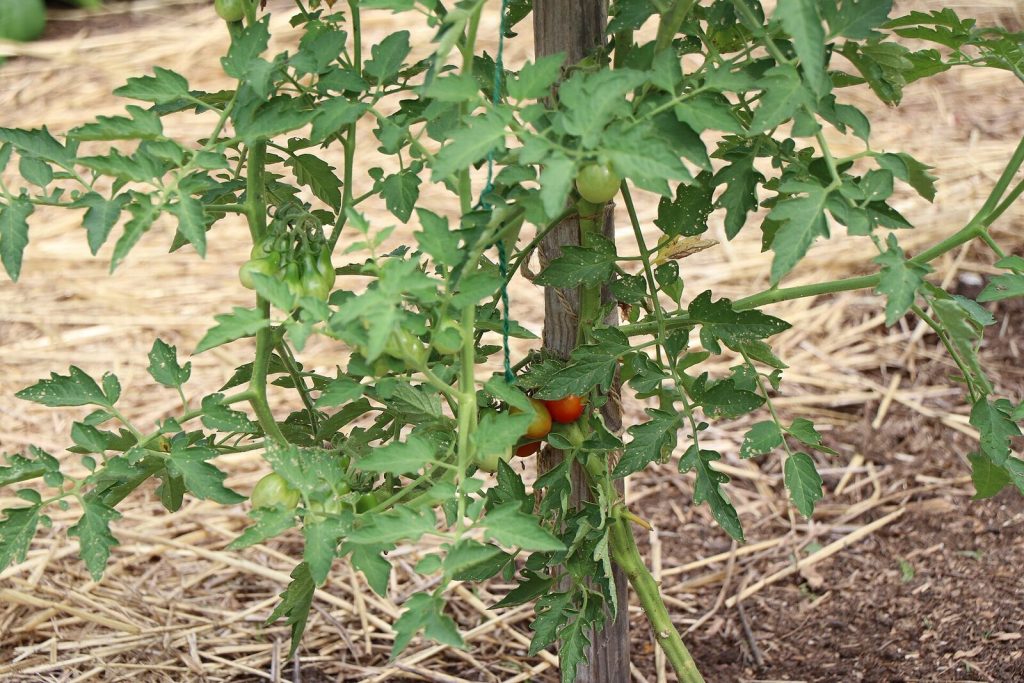
Tomato farming in Uganda happens on small plots, averaging 0.68 of an acre, planted twice a year against the two rain seasons and almost entirely from imported seed. A survey of 240 growers in the eight main producing districts measured an average of about 4,850 kg an acre. Divide national production by national area and that figure halves, because most Ugandan tomato is not grown in those eight districts.
That second number is the one worth sitting with. The same NARO paper that reports the survey also reports national output of 40,124 tonnes from 6,671 hectares, which works out at roughly 6 tonnes a hectare, or about 2,430 kg an acre. The survey districts managed double the national rate. Neither figure is anywhere near the 18 to 23 tonnes an acre that circulates in variety advertising for this crop.
What Tomato Farming in Uganda Looks Like on the Ground
The clearest picture of Ugandan tomato production comes from a NaCRRI survey, published by NARO staff and covering 240 farmers and 16 key informant groups across eight districts in five agro ecological zones: Wakiso and Mukono in the Lake Victoria Crescent, Nakaseke in the central woodland savannah, Mbarara and Kasese in the western medium to high farmlands, Rukiga in the south western highlands, and Mbale and Bulambuli on the Mount Elgon farmlands.
Plots ran from 0.1 to 3.5 acres, with a mean of 0.68. Land preparation was by hand hoe on 85.3 percent of farms, tractor on 9.1 percent, herbicide on 4.6 percent and ox plough on 1 percent. Growing was mono crop on 78.4 percent of farms, and farmers gave a practical reason rather than an agronomic one: spraying a tomato crop is hard to do without hitting whatever is planted beside it.
Men ran 84.1 percent of the surveyed plots. Just over half the farmers had stopped school at primary level. Both of those matter for a crop whose margin depends on reading a chemical label and timing a market.
Where Tomato Seed Comes From, and Why It Sets the Whole Budget
Uganda has almost no formal tomato variety release record, and this is the single fact that reorganises everything else on a tomato farm. NARO's own technology catalogue holds 121 released technologies. Searching it for tomato returns exactly one variety: Tenten, released by NaCRRI in 2021, a cherry type with fruit around 20 g, recorded at 23.2 tonnes a hectare on station, 92 days to maturity, a 36 day shelf life and high resistance to tomato mosaic virus, fusarium wilt and root knot nematodes. The same catalogue search returns no onion variety at all and no cabbage variety. A control search for maize returns forty results including several released NAROMAIZE lines, so the catalogue does surface varieties where they exist.
NARO states the consequence plainly. Its own news service describes Ugandan farmers as highly dependent on imported seed for tomato, onion and cabbage, puts horticultural seed imports from Europe and Asia at around USD 7 million, and describes a project with the Korea International Cooperation Agency whose purpose is to build a domestic vegetable breeding and certification base for five crops, tomato among them, with breeding greenhouses at Namulonge and Mukono and a seed testing facility at Kawanda.
So when a page names a tomato variety for Uganda, ask where the name came from. The five varieties the NARO survey found most planted were Asilla F1 at 35.3 percent of growers, Tengeru 97 at 21.1 percent, Rambo at 18.1 percent, Novela F1 at 17.7 percent and Riogrande at 10.3 percent. Those shares are a measurement of what Ugandan farmers buy. They are not Ugandan releases, and a seed company catalogue is a legitimate place to read a variety's attributes only if the page says that is what it is reading. Our guide to buying tomato seed works through the provenance of each name and what the packet codes mean.
Seed cost follows from the same fact. Farmers in the survey ranked high seed cost among the four constraints they named most often, and the paper attributes it to hybrid seed being imported, which loads transport and distribution onto the shelf price. That is also why Tengeru 97 keeps a fifth of the market while being, on the survey's own disease ranking, more susceptible than Riogrande, Novela F1 and Rambo. Cheap seed on a susceptible variety is a rational choice for a grower who cannot fund the alternative, and it is a decision with a spray bill attached.
Determinate and Indeterminate Tomato Varieties Need Different Farms
Growth habit decides more of the field work than variety name does. Determinate types stop extending once fruit sets on the top bud, stand around a metre, ripen over roughly seven to fourteen days and hold themselves up without support. Indeterminate types keep extending, reach about two metres, and flower, set and ripen at the same time across a long season, which means they need real staking rather than a token stick.
Pick the wrong one for your labour and cash position and the crop punishes you twice. A determinate block gives one concentrated picking window, which is a gift if you have a buyer waiting and a problem if the whole district ripens in the same fortnight. An indeterminate block spreads income across weeks but asks for stakes, twine, weekly pruning and a longer exposure to blight and to leafminer.
The survey recorded 73.3 percent of Ugandan growers mulching, and it recorded mulch being used as a substitute for staking, giving fruit something clean to lie on. That works on a determinate bush. On an indeterminate variety it means sprawl, and sprawl in a wet Ugandan season is a blight incubator.
Planting Seasons and Why Most Ugandan Tomato Growing Is Rain Fed
Most surveyed farmers planted twice a year against the two rain seasons, April to June and September to November. The minority who could afford to irrigate staggered production through the year and got four crops out of the same land. Others moved into wetlands during the dry months, where water is reliable, which brings its own land and environmental questions.
Timing inside the season is where growers get caught. The survey notes that farmers plant towards the end of the rains to dodge early and late blight, then meet drought during flowering and fruit set, which is exactly when tomato is least able to take it. Losses arrive as small fruit, sun scorch and poor shape rather than as a dead crop, so they are easy to under count. Drought and seasonal variability both appear in the top four production constraints the farmers named.
Irrigation buys two separate things: it buys the off season price, and it buys insurance on the crop you already planted. Hand watering, which is how nearly two thirds of irrigating farmers do it, buys the second but rarely enough of the first. If you are weighing the step up, our explanation of how drip irrigation actually works on a small plot is the place to start, and growing under cover is a different enterprise again, covered in tomato greenhouse farming.
Raising Seedlings and Getting Plant Spacing Right Per Acre
Nearly every surveyed farm transplanted from a nursery, and 8.2 percent did not raise their own seedlings, taking them from a neighbour or letting volunteer plants from the previous crop stand. Both routes move soil borne bacterial wilt and seed borne virus straight into a clean field, which is worth knowing before you accept a free tray of seedlings. The full nursery specification, from bed siting to the leaf stage that says a seedling is ready, sits in tomato nursery management.
On spacing the survey found something more useful than a recommendation. Ugandan farmers were planting at 30 by 45 cm, 45 by 45, 60 by 60, 75 by 75, 90 by 90 and 100 by 100 cm, and 90.5 percent planted in lines. Those spacings put between roughly 4,050 and 29,980 plants on an acre, a range of more than seven times on the same land. Seed, fertilizer, stakes and picking labour all scale with plant count, so two neighbours can follow the same guide and build budgets that differ by a factor of seven. The survey names 60 by 60 cm as the spacing that gives optimum yield under field conditions, and our tomato spacing guide works through the population arithmetic and the provenance of that figure.
Soil Fertility and Fertilizer on a Ugandan Tomato Farm
Declining soil fertility ranked high among the constraints farmers named, and the paper's explanation is structural rather than careless: at a mean holding of 0.68 of an acre, nobody can leave land fallow, so continuous mono cropping mines nutrients out through the harvest.
What growers apply is not what a textbook would predict. Foliar products led, with diammonium phosphate second. Cattle manure, urea and compound NPK followed. Goat manure, compost and single superphosphate came last, and growers put that down to local availability rather than preference. Foliar feeds win on visible response speed. Diammonium phosphate wins on labour, because farmers apply it once at planting and never return, where urea and NPK want splits.
The gap that leaves is potassium, and a NARO field trial at Namulonge put numbers on it. Soil at that site tested at 5.8 parts per million phosphorus and 27.7 parts per million potassium, both low, and cherry tomato responded to nitrogen and potassium together up to 100 kg nitrogen, 60 kg phosphate and 100 kg potash a hectare, in three splits. Doubling the nitrogen and potash to 200 kg each dropped the yield below the plots that got nothing at all. That result deserves the emphasis: on that soil, over fertilizing was worse than not fertilizing. The whole schedule, the splits and the arithmetic for converting a per hectare rate onto your own plant count are in the tomato fertilizer schedule, and a soil test before you buy fertilizer is what tells you which nutrient you are actually short of.
Pests and Diseases That Decide Whether There Is a Tomato Crop
Farmers ranked pest and disease burden as their number one production constraint, named by about a fifth of respondents. Caterpillars came first among pests, then thrips, worms and whitefly, with moths, spider mites, leaf hoppers and scales as minor problems. Pest pressure was heaviest in the central districts, lighter in the cool south west.
On disease the ranking was bacterial wilt, caused by Ralstonia solanacearum, then early blight, late blight, leaf spots and viral disease. Tomato yellow leaf curl virus was reported on 8.2 percent of farms and anthracnose on 2.2 percent. Bacterial wilt turned up in all eight districts. The paper ties its prevalence to two things at once: continuous mono cropping on land too small to rotate, and the absence of tomato varieties resistant to it.
That second point contradicts the most common piece of advice given to Ugandan tomato growers, which is to plant a resistant variety. For bacterial wilt there is nothing on the Ugandan market that a Ugandan research document confirms as resistant, and the survey names that absence as a cause of the problem. Resistance itself is not the missing piece: Ugandan multi location trials measured a genotype called MT56 at 13.13 percent wilt incidence against 66.30 for Marglobe, and it was never released, so what is missing is a route from a trial plot to a seed packet. Rotation, clean planting material, roguing infected plants and not moving soil or water from an infected block are what remain. Full detail sits in tomato diseases and their treatment.
Spraying is where the money and the risk concentrate. Chemical sprays were used by 95.7 percent of surveyed farmers, with 62.1 percent spraying weekly, 20.7 percent twice a week and 3 percent three times a week. The finding that should stop a reader is about mixing. Across the farms surveyed, the strongest reported insecticide mix was about forty times the weakest, and the strongest fungicide mix was more than two hundred times the weakest, and not one farmer said the rate they used came from the manufacturer's recommendation. The rate on the label is the rate. It is set for the product, the pest and the crop, it carries a pre harvest interval because tomato is eaten fresh, and no article should hand you a number in place of it. Take the dilution from the container and have an extension officer or a registered agro dealer confirm the product is cleared for tomato in Uganda. Our tomato spraying schedule covers timing and rotation of modes of action without inventing a dose.
Harvesting Tomato and the Container You Sell It In
Surveyed farmers sold in three main containers: wooden boxes on 64.7 percent of farms, plastic basins on 23.3 percent and woven baskets on 18 percent. Boxes travel to market; basins and baskets do the picking. None of them has a standard weight.
Almost three quarters sold ripe fresh fruit. Another 18.4 percent picked at mature green, and the paper is specific about why: mature green fruit survives the long transit to regional buyers in Kenya and South Sudan. Harvest stage is a market decision made weeks earlier, not a judgement call on the day.
The container is also where value leaks. Farmers named non standardised scales as a marketing constraint on 13.4 percent of farms and exploitation by traders on 14.2 percent, and the paper records middlemen buying in extra large boxes. A price agreed per box, where the box is whatever the buyer brought, is not a price you set. Weigh what leaves the farm even if you sell by the box, so you know your own cost a kilogramme. Where to sell tomatoes covers the channels, and tomato processing is the route some growers take out of the fresh market entirely.
Tomato Prices in Uganda Swing Harder Than Almost Any Other Crop
Price fluctuation was the marketing constraint farmers named most. The measurement backs them. MAAIF's Statistical Abstract, in the monthly commodity price table sourced to UBOS, puts tomato market prices between 2,143 and 2,851 UGX a kilogramme across the months of a year, a swing of 33 percent, which puts tomato among the most volatile items in that table, behind round onions at 65 and matooke by the bunch at 56.5.1 percent. Those are market prices rather than farm gate prices, so a grower sees a wider spread than that, not a narrower one.
The survey's own farm gate figures show how much wider. Across 222 farms the reported price ranged from USD 0.054 to USD 1.126 a kilogramme, with a mean of USD 0.590. The low end is a bumper harvest, and the paper says it plainly: at peak production, prices are often too low for farmers to break even. A tomato budget built on the high end of that range is fiction. Current market numbers live on the tomato price page, and the cash stack behind an acre is in cost of tomato farming per acre.
Yield Per Acre: What Ugandan Tomato Farms Actually Get
Three figures sit in the same NARO paper and they do not all mean the same thing, so it is worth separating them. National production divided by national area gives about 6 tonnes a hectare, near 2,430 kg an acre. The 240 surveyed farms in the best growing districts averaged about 4,850 kg an acre, which the paper also expresses as 12 tonnes a hectare. The regional yield potential it cites for East Africa under good management is 16 tonnes a hectare, about 6,000 kg an acre.
So the ladder of documented figures runs from roughly 2,400 kg an acre on a typical rain fed plot up to roughly 6,000 kg, which is the regional potential the survey cites for good management and good weather. Above that you are in modelled territory rather than measured, and our profit page handles the higher levels as scenarios with certified hybrid seed, irrigation and a full spray programme attached to each. The spread between individual farms was wider still: raw plot yields across the survey ran from 144 kg to 12,120 kg, though plot sizes differed, so that is not a per acre range.
What none of it supports is the 18 to 23 tonnes an acre attached to popular varieties in promotional material, which would be 44 to 57 tonnes a hectare. That is above what a naturally ventilated tunnel achieves and several times the best measured Ugandan field figure. A page that multiplies one of those yields by a scarcity price is selling something. Tomato yield per acre works the numbers properly, and tomato farming profit per acre carries the margin scenarios including the ones that lose money.
What Goes Wrong Most Often on Ugandan Tomato Farms
The constraint ranking from the survey is a better planning document than any yield table, because it tells you what actually removes the crop. Farmers named high pest and disease burden most often, at about 20 percent of responses, then high input costs at about 11 percent, high seed cost at about 10 percent and seasonal variability at about 9 percent. Poor soil fertility also ranked high. Further down came labour costs, weeds, excessive rain, poor varieties, thin production information, vermin, adulterated agrochemicals and hail.
Note what that list is mostly made of. Two of the top four are prices you pay, one is weather and one is biology. Only the biology responds to better field work, which is why so much of the honest advice on this crop is about not overspending on inputs that will not return.
Adding a season of irrigation, keeping records of what each block cost, and selling with other growers all attack different parts of that list. Only 37.1 percent of surveyed farmers belonged to any group at all and 88 percent sold alone, so the bargaining problem is real and it is not mysterious.
Frequently Asked Questions About Tomato Farming in Uganda
How much tomato can one acre realistically produce in Uganda? Plan on 2,400 to 6,000 kg an acre. The lower end is close to the national average implied by production and area statistics; the upper end is the East African potential the NARO survey cites under good management and weather. The surveyed average across 240 farms in the main growing districts sat near 4,850 kg. Above about 6,000 kg an acre you are past every figure the Ugandan literature actually measures, so treat higher numbers as scenarios with conditions attached rather than as expectations.
Which tomato variety should I plant in Uganda? There is no Ugandan released open field variety to point you at. NARO's catalogue holds one tomato variety, a cherry type, and everything else on the market is imported. The survey's most planted names are Asilla F1, Tengeru 97, Rambo, Novela F1 and Riogrande, and the honest basis for choosing between them is growth habit, the diseases in your own field and what your buyer wants, not a yield figure from a packet.
Is there a tomato variety that resists bacterial wilt? Not one you can buy, which is a different answer from none existing. Ugandan work did produce one: on farm screening put a genotype called MT56 and four introduced lines at 98.6 to 100 percent resistance, and multi location trials across six Ugandan agro ecological areas gave MT56 13.13 percent wilt incidence against 66.30 for Marglobe and 66.13 for Roma. Those trials were run because release required them, and release never followed, so MT56 is not in the released catalogue and not on a shelf. Meanwhile the NARO survey names the absence of resistant varieties as a reason bacterial wilt is common in all eight districts it covered, and both things are true at once. Treat any resistance claim on a packet or a poster as a claim by whoever printed it, ask for the breeder's technical sheet, and manage the disease by rotation and clean planting material rather than by variety alone.
Do I need irrigation to grow tomato in Uganda? Most Ugandan tomato is rain fed and gets two crops a year. Irrigation does two separate jobs: it lets you plant outside the rains and reach a better price, and it protects the crop you already have through flowering and fruit set, which is when water stress costs the most yield. Over eight in ten surveyed farmers applied water somehow, and nearly two thirds of those did it by hand.
What does an acre of tomato cost to establish in Uganda? Enough that the input bill, not the yield, is what usually decides the outcome. Farmers in the NARO survey named high input costs and high seed cost among the four constraints they mentioned most, with the spray programme the largest single call on cash. Published Ugandan budgets differ widely and input prices move with the exchange rate, so the figure belongs in a live costing rather than in a guide. Our cost of tomato farming per acre page builds the stack line by line and says which lines move most.
How long does tomato take from sowing to first picking? Roughly three to four months in total on most Ugandan farms. About three to six weeks of that is in the nursery, judged by leaf stage rather than by the calendar, and the rest is in the field. Determinate types then give a concentrated picking window of about a fortnight, while indeterminate types keep setting fruit for weeks.
Can I save seed from my own tomato crop? From an open pollinated variety such as Riogrande or Tengeru 97, yes, which is one reason cheaper open pollinated seed keeps market share. From an F1 hybrid the next generation will not come true, so saved seed from Asilla F1, Novela F1 or Rambo is a gamble on a crop you have already paid to establish. Seed also carries disease, so saving from a block that had virus or wilt moves the problem into next season.
Why do tomato prices collapse just when my crop is ready? Because almost everyone plants against the same two rain seasons, so the district harvests together. Monthly market prices for tomato swing about 33 percent across a year in MAAIF's own price table, second only to round onions, and farm gate prices reported by surveyed growers ranged from a few cents a kilogramme at peak supply to over a dollar in scarcity. Staggering planting, irrigating into the off season, or selling with other growers are the three levers that exist.
Before you commit cash to a block, check what tomato is actually fetching this month on our tomato price page, compare seed offers through where to buy tomato seeds, and read the rest of the vegetable cluster from the vegetable farming hub. Prices and seed availability change by season and by supplier, so treat every figure here as a planning band and confirm the current number locally before you buy.