
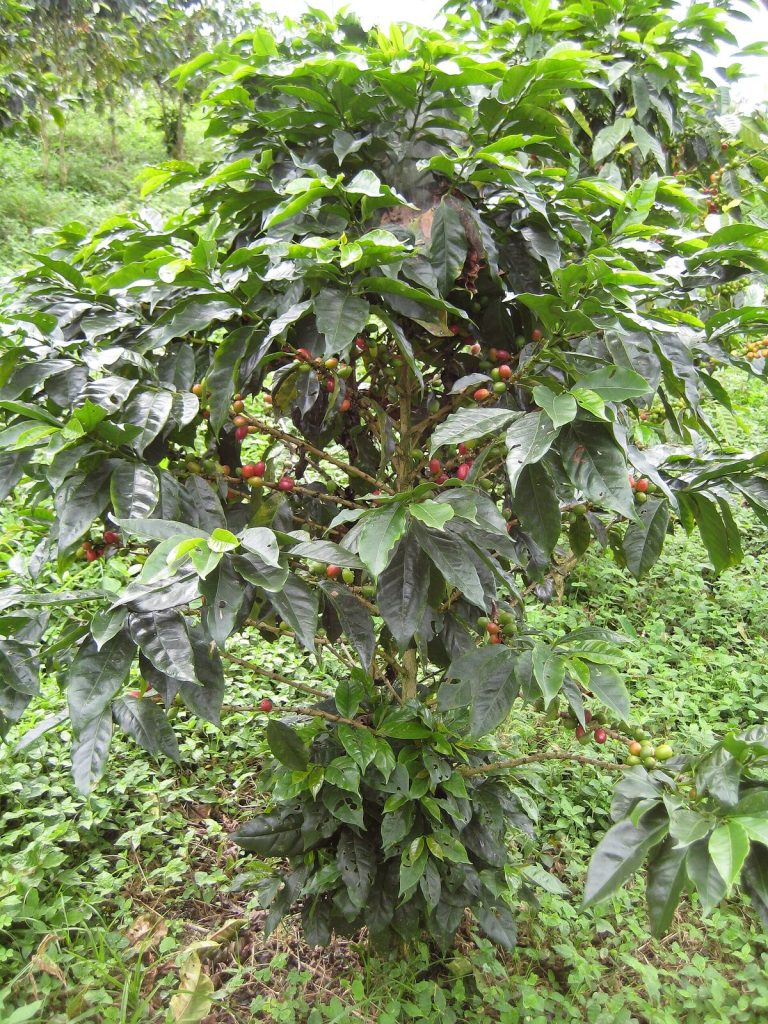
For most Ugandan land the choice between Robusta and Arabica coffee farming is already made, because the two species occupy different altitudes and barely overlap. Robusta takes the low ground and is about 80 percent of the national crop; Arabica takes the highlands and earns more per kilogramme. Only a narrow band of country makes this a genuine decision.
If you are in that band, the usual advice is not much help. It says Robusta yields more and Arabica pays more, which is true at one management level and stops being true at another. The measured Ugandan evidence points somewhere more interesting, and in one place it points the opposite way.
The Altitude Gate: Where Coffee Growers Actually Have a Choice
Start with the figure that removes the question for most readers. The two published bands are Robusta on low ground and Arabica in the highlands, and how much they overlap depends on which passage of the ministry's own handbooks you read.
Those ceilings do more work than the altitude figures. Set the two published optima side by side and they barely touch: 22 to 28 degrees for one species, 15 to 24 for the other. The overlap is two degrees. Past 28 Robusta still has room before its stated damage point at 30; past 24 Arabica has none at all, because 24 is where its handbook puts the limit. So the mid twenties is comfortable ground for one species and already beyond the other, and that is a sharper test than any altitude band because each figure is stated once rather than twice.
Soil runs the opposite way to intuition. The lowland species asks for more depth, 1 to 1.5 metres of working soil where it is moist and up to 3 metres where it is dry, while the highland species asks for roughly a metre. Neither tolerates waterlogging and both want the same slightly acidic pH, so depth is the one soil variable that separates them, and it favours Arabica.
Yield Per Acre: The Robusta Advantage Shrinks as Farming Improves
One Ugandan field study measured both species at three management levels on the same footing, which makes it the only source that can answer this properly. Clean coffee per acre per year came out like this: Robusta about 232 kg under traditional practice against Arabica's 180 kg; Robusta about 505 kg under improved practice against 473 kg; Robusta about 841 kg under recommended practice against 805 kg.
The mechanism behind it is a pair of numbers pulling in opposite directions. Robusta is planted at roughly 450 trees an acre and Arabica at about 680, so Arabica puts about half again as many trees on the same ground. Divide the traditional figures by those populations and Robusta gives about half a kilogramme of clean coffee a tree against Arabica's quarter kilogramme. Robusta yields about twice as much per tree; Arabica plants about half again as many trees. That is why the per acre gap is so much narrower than the per tree gap, and it is the single most useful sentence in this comparison.
The Arabica per tree figure has an independent check behind it. Its handbook separately gives national average productivity as 0.3 kg of clean coffee per tree per year, from a completely different direction, and the study's traditional figure divided by 680 trees lands in the same place. Two unrelated sources agreeing is rare on this crop. Everything above the measured figures, including what the variety tables promise and how far above field reality those promises sit, belongs to the coffee yield per acre page; the two tree counts are derived from the spacing geometry on the coffee spacing page.
Price Against Cost: Arabica Earns More Per Acre and Keeps Less of It
The same study recorded what each group of farmers was paid and what they spent. No shilling figures appear on this page, for a reason given at the end of this section, but the ratios are the finding and they are clear.
Arabica's producer price ran about 39 to 52 percent above Robusta's across the three groups, with the premium at its widest among traditional farmers and its narrowest among those following recommended practice. Because of that premium, Arabica's gross income per acre came out ahead of Robusta's at all three levels, even where it produced less coffee.
Then the cost side moves, and it moves hard. Among traditional farmers Arabica's variable cost was about 39 percent lower than Robusta's, because those growers were using family labour and buying almost nothing. Among improved farmers it was about 43 percent higher. Among those following recommended practice it was about 87 percent higher, which is very nearly double, driven by hired labour, bought inputs and a planned programme against the two highland diseases.
Follow that through to what is left. Gross margin as a share of revenue was 88, 73 and 70 percent for Robusta across the three groups, and 94, 71 and 57 percent for Arabica. Arabica starts better and ends thirteen points worse. Its gross margin per acre stays ahead throughout, but the lead narrows from about 25 percent at traditional practice to about 30 percent at improved and then to about 9 percent at recommended, against a cost base nearly twice as large.
So the honest answer to "which is more profitable" is this. Arabica is paid more for less coffee, and the more a grower spends closing the yield gap, the less of that extra price they keep. A grower who can finance the cost side is choosing between two similar margins with very different amounts of cash at risk. A grower who cannot is better served by the species whose costs rise more slowly. Working out which of those two you are is a better use of an afternoon than comparing yields, and the break even method is the tool for it.
Why no shillings here. Those figures are one study's producer prices from a single period, they would read as current if printed without that period, and they would sit awkwardly beside the cost of coffee farming page, which keeps the budgets and deliberately publishes no current price for the same reason. The ratios survive any exchange rate and any season, which is what makes them worth printing. For current levels by product, the live coffee price page is the place to look.
How Much Weight the Measured Farm Figures Can Carry
Everything in the two sections above rests on one study, so its size belongs in the open rather than in a footnote.
That is why this page argues from percentages rather than handing over a verdict. The direction is large enough to act on: the yield gap narrows, the price premium narrows, the cost gap widens. The exact size of each is not.
Planting Material: A Ugandan Bred Clone Against a 1950s Selection
This comparison has nothing to do with money and it may matter more than anything above, because it decides what a grower can walk into a nursery and buy.
| Question | Robusta | Arabica |
|---|---|---|
| Raised from | Cuttings | Seed |
| Breeding system stated | Self sterile | Not stated |
| Variety mixing rule | Five lines or more | None given |
| Bred in Uganda | Ten released lines | None in the table |
| Covered against both main diseases | Not applicable | Two of six entries |
The difference is easiest to see as two shopping trips. A Robusta grower can ask for ten named lines bred at Uganda's own coffee research institute and released within the last two decades, every one of them carrying recorded resistance to the disease that nearly ended the crop. The catch is a rule that comes with them: because the species will not fertilise itself, the published instruction is five different clones or more in one production garden, so the trip is for a labelled mixture and not for a single favourite. How that works is set out on the Robusta growing guide.
An Arabica grower gets six entries, four of them mid century selections from a regional quarantine station and two credited to Kenyan breeders, and not one of the six is credited to Uganda in the column that records where each came from. Two of the four the same handbook's prose calls recommended and authorised carry remarks in its table refusing them for cultivation. Of the two entries clear of both highland diseases, one dates to 1970 and the other to 1985, and both are recorded as reaching only a handful of growers in one area. Row by row treatment is on the Arabica growing guide.
Two limits keep that comparison honest. The Arabica handbook says nothing about the species' breeding system and issues no mixing rule, and that is a gap in a document rather than a property of the plant, so read no conclusion into it either way. And a missing Ugandan credit in that table says what the published list contains, not what exists in every research record in the country.
The age of the Arabica list has a published explanation. Work reviewing coffee breeding programmes internationally identifies a development time of over twenty years per variety as one of the field's hardest operational constraints. On that clock a list assembled from mid century material is what you would expect to still be holding, and nothing a grower does this season shortens it.
Disease Pressure Is Not Symmetrical Between the Two Species
Both species have a serious disease problem. The difference is that one of them has been answered and the other has not.
Robusta's problem was coffee wilt disease, identified in 1993, which had destroyed about 56 percent of Uganda's Robusta trees by 2002 and took the six clones then recommended down with everything else. Breeding produced ten resistant lines and those are now the recommended material. It cost the country a decade and most of its trees, and it worked.
Arabica's problems are coffee leaf rust and coffee berry disease, both highland diseases, and the ministry's own variety table records the widely available older material as very or highly susceptible to one or both. No breeding answer has reached the published Ugandan list. The handbook is direct about the consequence in its own comparison of the two species: it states that Robusta is less susceptible to pests and disease and needs fewer fungicides and pesticides than Arabica. That is the ministry comparing its two crops in its own words, and it is the only such statement in either handbook.
One knock on effect reaches into the shade decision. Shade cuts heat stress and frost risk, and Arabica needs both, but the handbook also lists higher leaf rust risk among the drawbacks of shade trees. So shade on Arabica is a balance to be managed rather than a good to be maximised, where on Robusta the calculation is simpler. Ministry guidance on whether to spray at all splits along the same line, and the split is set out with its own thresholds on the coffee pest and disease control page. Nothing is named here: a product, a strength and a waiting period come off the container, checked with someone who has seen the garden.
Labour and Processing: Two Different Jobs on the Same Farm
The two species are trained differently from the first year. Robusta is bent along the row and pegged down so that suckers break from the base, ending on three stems. Arabica is nipped, meaning the tip is clipped off the young seedling to force stems from lower down. Different tools, different timing, different skill, and neither is a minor detail because a stem count cannot be changed later without losing a season.
At the other end of the year the split is larger. Most Ugandan Arabica is wet processed, and that is a capital question rather than a technique question: machinery, a large and clean water supply, drying space and a dedicated store, all bought before the first crop pays for anything. Robusta mostly leaves the farm as whole dried cherry instead, and so does Arabica in the one exception the handbook names, covering Kasese and the south west. So two Arabica growers in different districts face different capital bills for the same species, while a Robusta grower faces the lighter bill almost everywhere. Method detail is on the coffee processing methods page and picking standards on the harvesting and post harvest page.
Two things are the same and worth saying so. Both species carry two harvests a year, a main crop and a smaller second one, on a calendar that differs by region. And both are renewed by cutting back rather than replaced, staying productive for 40 to 50 years through repeated change of cycle, with the same three physical signs saying a bush is due. The pruning guide covers the operation for both.
What the Ministry's District Counts Do and Do Not Tell You
A reader wanting to know whether both species are realistic on their land naturally asks how many districts grow both. Three ministry documents answer, and they answer differently.
The Robusta handbook gives 60 districts growing only Robusta, 13 only Arabica and 38 both, out of a stated 104. Those three add to 111. The clonal nursery manual gives 66, 13 and 25 out of 104, which adds to 104 exactly. The Arabica handbook gives 44 Arabica districts, 28 growing only Arabica and 15 growing both, and 28 plus 15 is 43 rather than 44. Its percentages do not fit its own base either: it calls 44 districts 51 percent, which against 104 would be 42 percent, and solving each of its three percentages for a total gives something near 87.
So only the nursery manual's split adds up to its own stated total, and the figure these documents disagree about most is precisely the one this page is about. How many districts grow both species comes out as 38, 25 or 15 depending on which you open. Two of the three agree that 13 districts grow only Arabica, with the Arabica handbook the outlier at 28.
The useful conclusion is not a number. It is that a district list cannot settle this for you, and your own altitude and mean temperature can. Both handbooks agree on the two things that matter more than any count: Robusta is about 80 percent of national volume and Arabica about 20, and they occupy different ground.
Working Through the Choice for Your Own Garden
Four questions, in this order, because each one can end the decision before you reach the next.
Whichever way it goes, get the district agricultural office to confirm what is certified locally before buying, and a soil test before the first hole. Both species are perennials that stay in the ground for decades, so the establishment decisions are the ones that cannot be revisited. For the wider picture, the general coffee farming guide covers both species at overview depth and the export crops hub sets coffee beside Uganda's other export crops.
Questions Growers Ask When Choosing Between the Two
Before committing either way, confirm with the district agricultural office which certified material is genuinely available near you and check current prices by product, since a price premium you cannot reach and a variety you cannot buy both count for nothing. Knowing who buys which product in your district is worth settling in the same conversation, and a plant population count on your own layout will tell you how many trees you are really budgeting for.