
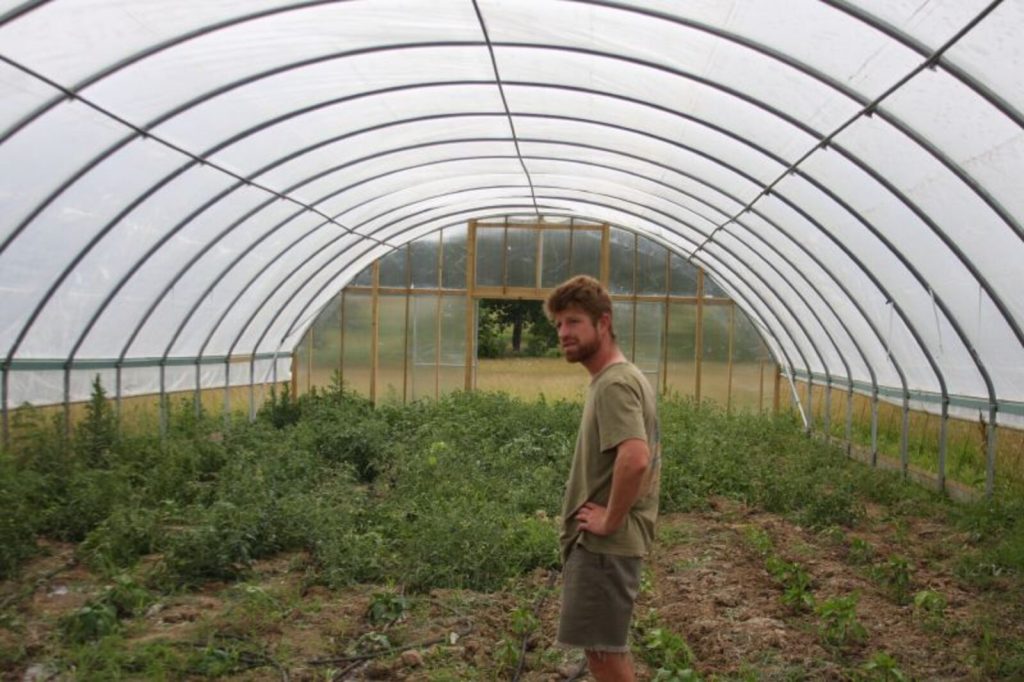
Greenhouse farming in Uganda works mainly by keeping rain off a high value vegetable crop, which suppresses the leaf disease that wrecks open field tomato through the wet months. Structures are sold ready to install in standard sizes by agricultural equipment suppliers here. A greenhouse is a framed shelter covered in UV treated polythene with netted side vents, used most often for tomato, sweet pepper and cucumber.
Most writing on the subject was produced for countries with a winter. Read enough of it and you come away believing a greenhouse is a warming device. One Ugandan newspaper feature describes greenhouses as artificially heated enclosures whose main benefit is keeping crops warm through the cold months.
Uganda has no cold months. Cultivated land here does not frost.
That single inherited error sends farmers down the wrong road before they buy anything. It is worth correcting properly, because what a greenhouse actually does in this climate is narrower, more useful and much harder to get right than the brochures suggest.
Why Greenhouse Farming Suits Uganda's Climate for Different Reasons
Uganda sits on the equator with a warm tropical climate. Average temperatures run in the range of 25 to 29 degrees Celsius, and even in the hottest stretch from December to February the evenings settle at about 17 to 18 degrees. Most of the country takes 1,000 to 1,500 mm of rain a year across two wet seasons, roughly March to May and September to November, with a single long wet season from March to November in the north.
Read that against what a tomato crop wants. Greenhouse tomato grows best with daytime air temperatures of roughly 21 to 28 degrees, and the published upper threshold for greenhouse crops sits near 28 degrees, with about 35 degrees as an absolute ceiling. Uganda's ambient air is already inside the optimum band, sometimes above it.
So the warmth is free and, more to the point, already there. Nothing needs heating. What the structure buys you is control over the two things Ugandan weather does to a vegetable crop: it rains on it, and it carries the pests and spores that arrive with the rain.
What a Greenhouse Does and Does Not Do for a Ugandan Crop
Greenhouse farming in this climate delivers four things reliably. It keeps rain off the leaves. It lets you plant outside the normal season so the harvest lands when open field supply has collapsed. It puts a physical barrier between the crop and flying insects. And it concentrates a crop into a small enough area that intensive feeding, staking and pruning become practical.
The list of things it does not do is longer and rarely printed.
Rain Exclusion and the Disease Pressure That Destroys Open Field Tomato
This is the part to get straight before anything else. Ugandan tomato is hit hardest by leaf and fruit diseases that need free water on the plant surface to establish and spread. A survey of tomato growers in a major Kenyan production county, using the same crop and much the same weather, found late blight reported by 26.8 per cent of farmers, early blight by 25.5 per cent and bacterial wilt by 25.0 per cent as the diseases most damaging their crop.
Late blight and early blight are exactly the problems a roof addresses. Splashing rain moves spores from soil to lower leaves and from leaf to leaf. Long wet periods on the leaf surface let them germinate. Take the rain away and you break the cycle at its weakest point, which is why a greenhouse crop typically needs fewer fungicide sprays than the same variety in the open during the same months.
Bacterial wilt is the trap. It is soil borne, it kills plants outright, and a polythene roof is no defence at all. Farmers who build a greenhouse on ground that has grown tomato, pepper, Irish potato or eggplant repeatedly are importing the pathogen into the beds along with the topsoil. In the Kenyan county mentioned above, bacterial wilt was the main reason tomato growers walked away from their greenhouses altogether. More on identification and management sits on our guide to tomato diseases and how to treat them.
Greenhouse Structure Types Available in Uganda
Four structure types are sold or built here, and the choice sets both the price and how many seasons you get before rebuilding.
Typical dimensions from regional fabricators put the gutter height at roughly 2.2 to 3.0 m on timber houses and 2.2 to 4.0 m on steel, with an apex of about 4.5 to 6.0 m. Those heights are not decoration. Head room above the crop is where excess heat collects before it leaves through the roof vent, and a low house cooks. The full build sequence, from siting to internal layout, is set out in our greenhouse construction guide, and the sizes actually sold here are compared in the greenhouse size guide.
Crops Grown Under Greenhouse Cover in Uganda
The economics only work for crops that earn a lot per square metre and reward a long picking window. That narrows the field quickly.
| Crop | Why under cover | Main difficulty |
|---|---|---|
| Tomato, indeterminate | Off season, no blight | Soil wilt, heat |
| Sweet pepper | High price, long pick | Slow start, thrips |
| Cucumber | Fast, clean fruit | Mildew in still air |
| Chilli | Steady, hardy | Low value per plant |
| Seedlings | Clean, fast turnover | Needs misting |
| Herbs | Contract buyers | Thin local market |
Leafy vegetables, cabbage and onion rarely justify the structure because the price per square metre will not carry it. Our page on crops to grow in a greenhouse goes through the shortlist properly, and tomato greenhouse farming covers the crop that most Ugandan houses are built for.
Heat, Ventilation and the Ceiling on Greenhouse Yield in the Tropics
Polythene is transparent to sunlight and nearly transparent to the near infrared that carries the heat, passing something like 85 to 89 per cent of it into the house. Once inside, a good share of that energy is re radiated as long wave heat that the film holds back. That is the greenhouse effect, and in Uganda it is a liability.
Measured figures from a naturally ventilated polythene tunnel in a comparable sub humid climate are sobering. With the ends open and screened, hourly mean air temperature inside ran up to 11 degrees above the outside air, peaking near 39 degrees. The same study's mechanically cooled tunnel held the gap to about 6 degrees. Engineering practice treats anything over 5 to 6 degrees above ambient as a ventilation failure.
Put Uganda's 25 to 29 degree ambient underneath an 11 degree rise and the arithmetic is unpleasant. Fruit set falters. Colour development stalls, because the pigment that turns a tomato red is made between roughly 18 and 32 degrees and shuts down when the crop sits above 32 for long stretches. Pale, blotchy fruit from a greenhouse is usually a heat problem, not a nutrition problem.
Worse, the heat stacks vertically. Air near the film is hottest, air in the canopy coolest, with differences of several degrees across that gap, and the growing tips of a tall tomato crop end up in the worst of it. Growers commonly report wilting at the top of two metre plants while the lower canopy looks fine.
Two design consequences follow. Roof venting is not optional in Uganda, and the vent area has to be generous. And the crop itself throttles airflow: a tall tomato crop has been measured cutting the ventilation rate of a side vented tunnel by 72 to 85 per cent against a bare house. The house that ventilated adequately in week three may not ventilate at all in month four. This is the single most common design failure in the region, and greenhouse ventilation treats it in detail.
Pests and Diseases Inside a Warm Enclosed Greenhouse
A warm, sheltered, irrigated space with a continuous host crop is close to ideal for several of the pests that already trouble Ugandan tomato. A survey of 584 tomato farmers across five Ugandan regions found African bollworm reported by 52 per cent, whiteflies by 37 per cent, aphids by 25 per cent, cutworms by 24 per cent and the leaf miner Tuta absoluta by 23 per cent. Whitefly, aphid, thrips, spider mite and Tuta all breed faster in warmth and all do more damage under cover than outside once they are established, because nothing is washing them off and predators are shut out with everything else.
The same Ugandan survey found 92 per cent of tomato growers relying on chemical pesticides. Inside a sealed house that becomes its own problem: spray intervals shorten, resistance builds in a closed population, and residues sit on fruit in an enclosed space with poor air exchange. Follow the rate and the interval printed on the product label, observe the stated period between the last spray and picking, and have a local extension officer or a registered agro dealer confirm what is legally registered for the crop before you buy anything. Never scale a rate up because the crop looks bad.
Netting the side vents and running a proper entry porch is what actually keeps the pressure down. So is refusing to plant a second crop straight into the same beds. Practical detail is on greenhouse pest management.
Water Supply, the Constraint That Closes Ugandan Greenhouses
A greenhouse crop has no access to rainfall. Every litre arrives through the pipe, seven days a week, through the dry season, for eight months or more of a tomato cycle. Miss a week in January and the crop aborts flowers you cannot get back.
Water ranked second only to pests and disease among the constraints growers reported in the Kenyan study discussed below. That is why a house put up beside the homestead for convenience, and watered from a jerrycan, tends to be standing empty by its second season. Do the daily demand sum before the structure is ordered, not after it is up. Storage and delivery choices are laid out in farm water storage tanks.
Who Makes Greenhouse Farming Work in Uganda and Who Walks Away
Nobody publishes an honest failure rate, so here is the best evidence available. Peer reviewed work on smallholder greenhouse farming in Kenya, where adoption is further along than in Uganda and the climate is comparable, reports failure rates above 30 per cent. A structured survey of 138 greenhouse farmers in one Kenyan county found 48.6 per cent of the greenhouses were not functional at the time of the visit. No equivalent Ugandan census appears to exist, and it would be dishonest to invent one, but nothing about Ugandan conditions suggests a better outcome.
The reasons are consistent and none of them is the structure.
One finding from that survey deserves more attention than it gets. Houses owned by institutions were non functional 60.5 per cent of the time and those owned by groups 55.6 per cent, against 38.2 per cent for houses owned by individuals. Ownership predicted outcome better than almost anything else. A structure that belongs to everybody gets watered by nobody, and that pattern should give pause to any group or school planning a shared unit.
The people who make it work tend to share a short list of traits. They already grow the crop competently in the open. They have water they control. They have a buyer identified before the seed goes in. They accept that the structure is the cheap part of the commitment. And they start with one modest house rather than three.
Selling a Concentrated Greenhouse Harvest
An open field plot dribbles produce out over a few weeks. A well run greenhouse tomato crop picks two or three times a week for months, and the volume is predictable enough to promise to a buyer in advance. That predictability is the commercial point of the whole exercise and most Ugandan growers waste it by selling to whoever turns up at the gate.
Off season timing is the lever. Plant so the house is in full production when the open field crop has been flattened by rain and prices are at their highest, rather than when everyone else is picking. Supermarkets, hotels, restaurants and institutional kitchens all pay for reliability over months and will not deal with a supplier who can only deliver in a good week. Our page on where to sell tomatoes in Uganda lists the channels, and current market levels are tracked on the tomato price page.
Frequently Asked Questions About Greenhouse Farming in Uganda
Does a greenhouse in Uganda need heating? No. Ugandan ambient temperatures already sit at or above what greenhouse vegetables want, and cultivated land does not frost. A greenhouse here needs the opposite: roof and side venting, insect netting sized so it does not choke the airflow, and shading if the house runs hot. Any supplier or article offering you a heating system for a Ugandan vegetable house has misread the climate.
How much does a greenhouse cost in Uganda? Ugandan suppliers publish bands rather than fixed prices, because size, frame material, location and how much of the work you do yourself all move the figure. Timber framed houses are quoted in the region of UGX 4,000,000 to 9,000,000 and metal framed houses from roughly UGX 4,500,000 for the smallest units up to about UGX 15,000,000 for standard commercial sizes, with larger houses above that. Those figures cover the structure only. Irrigation, water storage, crop inputs and labour sit outside them. The size by size breakdown is on our greenhouse cost page, and running costs and payback are handled separately in the cost of greenhouse farming. Ask every supplier for a written quote listing what is and is not included, since prices move with the steel and film market.
Can you really grow all year round in a greenhouse? You can plant all year, which is not the same claim. The useful version is that you can time a crop to mature outside the normal Ugandan harvest window, when supply is short. Continuous production in the same beds for years without a break is how bacterial wilt and root knot nematode take hold, so most growers rest or replace bed soil between cycles.
Is a net house good enough instead of polythene? For seedlings, leafy vegetables and herbs, often yes, and it will be cooler and cheaper. For tomato in the wet season, no. The whole benefit you are paying for is rain exclusion, and a net does not exclude rain. Net houses also let flying pests in if the mesh is chosen for shade rather than for insect exclusion.
How long does the polythene cover last? Treat it as a consumable rather than as part of the building. Two hundred micron UV treated film is the regional standard, warranties on the UV treatment here run to about three years, and independent ageing work on stabilised films puts real service life in the two to four year band. Equatorial sun at Ugandan altitudes works a film hard, so expect the shorter end of that. Provision for the re cover from your first season and it stops being a shock.
Is greenhouse farming suitable for a first time farmer? Rarely. The structure is easy to buy and the crop inside it is one of the more demanding things you can grow, needing pruning, trellising, daily irrigation, careful nutrition and confident pest identification over an eight month cycle. Most people who make it work grew the same crop in the open first. If you are starting from nothing, learn the crop outside for a season or two and build the house after.
What size should a first greenhouse be? Smaller than you want. A single house of around 120 to 190 square metres is enough to learn the crop on, small enough to water from realistic storage, and small enough that one bad cycle does not end the venture. The trade offs by size are in the greenhouse size guide.
If greenhouse farming still looks like the right fit for your land, water and market, the next step is comparing structures properly rather than taking the first quote. Read the rest of the irrigation and greenhouse guides, work out your daily water demand, then ask two or three suppliers for written quotes on the same size and specification so you are comparing like with like. Current structure prices and installation charges move with the steel and polythene market, so check them fresh rather than relying on a figure you read months ago.