
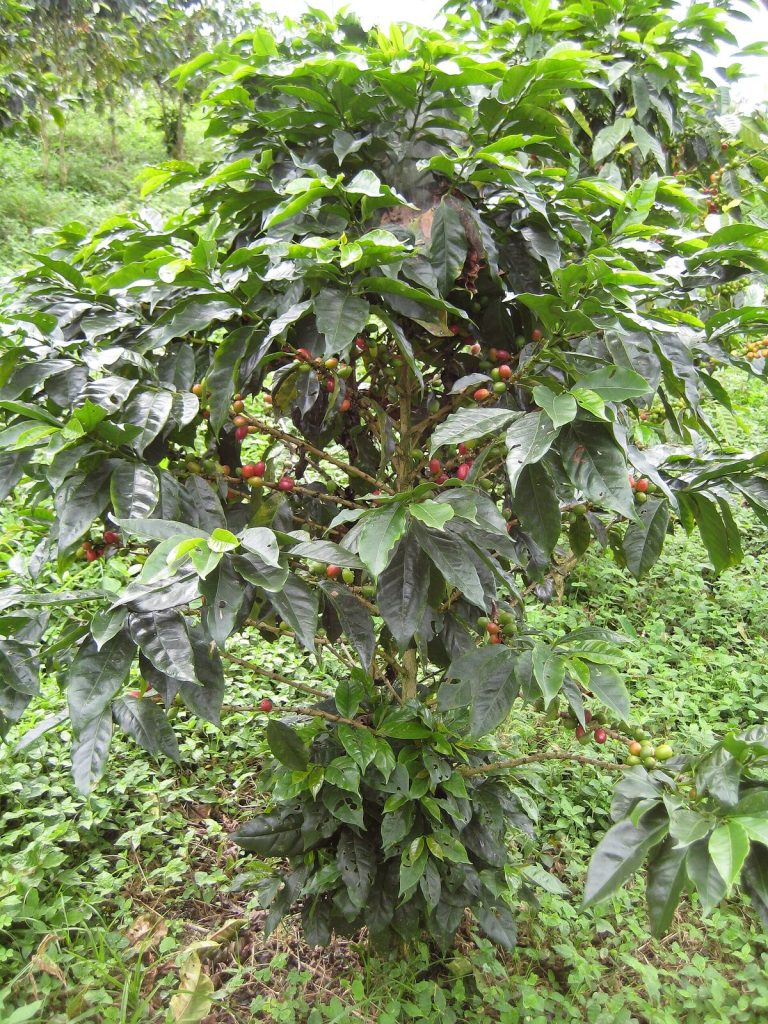
Coffee farming in Uganda is really two crops, not one: Robusta on land below about 1,500 metres and Arabica on land above about 1,200, each with its own spacing, variety list and canopy system. Planting material comes from certified nurseries, the first worthwhile harvest lands in year three, and measured field data puts typical smallholder output at roughly a quarter of what the best managed gardens produce.
That gap is the whole subject. Uganda ranks second in Africa after Ethiopia and eighth in the world for coffee, the national coffee handbooks put 1.7 million households in production and over five million people across the value chain, and the ministry's own training material has been in circulation for years. Yet the same ministry documents record a national average of about one tonne of clean coffee per hectare against clonal varieties released to give three or four times that.
Nothing on this page is a projection. Every figure traces to a Ugandan government handbook, a ministry training manual or a field study that measured what farmers actually harvested, and where two of those documents disagree the disagreement is printed rather than smoothed over. There is a lot of disagreement. The export crops hub carries the rest of the section.
Where Coffee Grows in Uganda: Altitude, Rainfall and Soil
Altitude picks the crop for you. Robusta is a low and mid altitude plant, and the national handbook for it gives the growing band two ways in two places: 900 to 1,200 metres above sea level in its opening description of the species, then 900 to 1,500 metres in the chapter on growing zones. Arabica occupies the highlands, published at 1,200 to 2,500 metres in its own handbook, though that same document elsewhere describes the crop as sitting between 1,300 and 2,500. Cup tests quoted in the handbook place the premium Arabica band at 1,500 to 2,500 metres.
So the honest instruction is a range, not a line. Land under about 1,200 metres is Robusta land. Land over about 1,500 metres is Arabica land. Between those two figures both handbooks claim the ground, and the deciding factors become temperature, what neighbours already grow well, and which certified nursery you can actually reach.
Temperature separates them more cleanly than altitude does. Robusta wants 22 to 28 degrees, and above 30 degrees the handbook records flower abortion, poor fruit set and premature ripening, which is a yield loss before a single berry forms. Arabica prefers a daily range of 15 to 24 degrees; above 24 it records photosynthesis shutting down, and below 15 growth is held back. Arabica also takes frost damage, which is one of the reasons shade trees are treated as part of the crop rather than a nicety.
Rainfall is where the two crops agree. Both handbooks ask for 1,200 to 1,800 mm a year well distributed across nine months, and both stress the distribution ahead of the total. That distinction matters for Uganda, because the two most widely used climate reanalyses disagree about the country's annual rainfall by roughly a quarter: the ERA5 series gives about 1,577 mm and a CRU reading is reported at about 1,283 mm. Which one you take does not change the verdict here, since both sit inside coffee's published band, so the annual total is not the constraint. The dry gap is, and the two datasets agree about that. Roughly 14 percent of Uganda's rain falls in the December to February quarter, a quarter of the year carrying a seventh of the water, and that is the stretch that kills newly planted seedlings.
Soil requirements are near identical: fertile, well aerated, free draining, slightly acidic, rich in organic matter, with volcanic red earth or sandy loam named as the ideal and heavy clay named as the thing to avoid. Neither crop tolerates waterlogging. Both handbooks give a pH window of 5.5 to 6.5. Fall under that and the Robusta handbook records the crop as limited by it, with lime the correction. Rooting depth differs: Arabica asks for about a metre before roots meet an impermeable layer, while Robusta asks for 1 to 1.5 metres in moist areas and up to 3 metres in drier ones.
Robusta and Arabica: Choosing the Coffee Type Your Land Will Grow
Robusta accounts for about 80 percent of Uganda's coffee volume and Arabica about 20 percent, and Uganda is the world's fourth largest Robusta producer. Robusta is native here: wild stands still grow in forest reserves around the Lake Victoria basin, with the handbook estimating 150 to 400 hectares of them. Arabica was introduced from Ethiopia.
The agronomic differences run deeper than cup price. Robusta carries roughly 2.7 percent caffeine against Arabica's 1.5, takes 10 to 11 months from flower to ripe cherry, and is recorded as less susceptible to pests and diseases, needing fewer fungicides and insecticides. Arabica ripens faster, prices higher, and demands more spraying and more careful shade. A grower who chooses Arabica for the price and budgets for Robusta's spray programme has already made the most common planning mistake in the sector.
| Condition | Robusta | Arabica |
|---|---|---|
| Altitude | 900 to 1,500 m | 1,200 to 2,500 m |
| Daily temperature | 22 to 28 C | 15 to 24 C |
| Heat limit | Above 30 C | Above 24 C |
| Rainfall | 1,200 to 1,800 mm | 1,200 to 1,800 mm |
| Soil pH | 5.5 to 6.5 | 5.5 to 6.5 |
| Rooting depth | 1 to 3 m | About 1 m |
| Spacing | 10 ft by 10 ft | 8 ft by 8 ft |
| Trees per acre | About 450 | About 680 |
Fuller treatments sit on the type specific pages: growing Robusta, growing Arabica, and the decision between them.
Coffee Varieties Released for Ugandan Farming
Ten Robusta clones have been released since 2009 by the national agricultural research organisation through its coffee research institute at Kituza in Mukono District. Seven carry release dates of 2009 and three of 2017, and all ten are described as resistant to coffee wilt disease and to leaf rust, tolerant of red blister disease, with big beans and good cup quality. The older material they replace is the reason the list exists: open pollinated elite seed is recorded as susceptible to rust, red blister and wilt and is being phased out, while the six older clones are also susceptible to wilt.
Read the published yields on that clonal list with care, because they are the single most inflated set of numbers in Ugandan coffee. The variety table gives figures from 2,200 up to 4,900 kilogrammes of clean coffee per hectare a year. The very same handbook, forty pages later, states that clonal coffee under good management attains 3,000 to 4,000 kilogrammes per hectare, and elsewhere that some clonal varieties average 3,000. Two of the table's entries sit above the ceiling the document itself publishes. Those are variety trial potentials, and treating them as field expectations is how a nursery pitch turns into a loan a garden cannot repay.
Arabica is the weaker list. Four varieties are named in the handbook's opening section as the recommended and authorised choices, all of them East African selections dating from the 1950s and 1960s. Its own variety table then marks two of those four as not recommended for cultivation, both being very susceptible to leaf rust and coffee berry disease. A grower who reads the prose and orders accordingly buys a variety the same document tells them to avoid four pages later. Two later introductions, a dwarf hybrid and a compact selection, are recorded as resistant to coffee berry disease but grown by only small numbers of farmers around Mount Elgon, one of them unpopular because of how heavily it needs feeding.
The practical instruction: ask the nursery which released clone or selection you are buying, by name, and check that name against the recommendation column rather than the yield column. Certified nurseries are the only legitimate source, and where coffee seedlings come from matters more on a forty year crop than on anything annual.
Preparing Land and Digging Coffee Planting Holes
Land preparation for coffee starts a year before planting on forested ground, and the reason is a fungus. Old tree stumps and their roots are a common source of Armillaria infection in young coffee, so the handbook's instruction is to ring bark forest trees at least a year before felling them, then clear stumps and roots thoroughly. Clearing the surface and leaving the roots is not land preparation for coffee. It is a slow disease.
Couch grass gets the same seriousness. The handbook calls it the worst enemy of coffee on fallow Ugandan land and asks for complete eradication by digging and handpicking or by herbicide before planting, not after. Mature trees worth keeping for shade are retained at roughly 20 by 20 metres. Land up to 15 percent slope gets rows run across the slope with a 1 to 2 percent fall for drainage; steeper than that and contour planting with terraces becomes the method, marked out with a wooden A frame.
Planting holes are 60 cm deep and 60 cm across, which is the two foot cube every Ugandan extension diagram shows, dug at least three months before planting. Topsoil goes on one side of the hole and subsoil on the other, and on a slope the topsoil goes uphill so it falls back in first if rain arrives early. Then the sources part company on two details worth knowing about:
Put a peg in the centre of a half filled hole before completing the backfill, so the planting position is still findable when the rains come. Compost, if you are making it rather than buying manure, wants to be started about six months ahead.
Planting Coffee and Carrying It Through the First Two Years
Planting material is judged on leaf pairs and roots. Clonal cuttings go out with three to four pairs of true leaves and elite seedlings with four to five, which the training manual states as six to eight leaves. Reject any seedling whose roots protrude far beyond the polythene pot, because the taproot is probably damaged, and reject a twisted taproot outright. Check for root mealybug, aphids, sucking insects and brown eye leaf spot before the seedlings ever reach your field, since buying planting material is also the commonest way of importing a pest.
Timing follows the rains, and the calendar differs by region. Central, Western, Rwenzori, South Western and Busoga plant in March to May and September to October. Northern and Elgon regions plant April to August. Get the plantlets in within the first two or three weeks after the rains start, work in the early morning or late afternoon or on a cloudy day, and soak the seedlings thoroughly before planting. The regulator's extension guidance adds a useful test: plant after at least four consecutive rainy days, which is a better signal than a date.
Set the collar level with the surrounding soil or very slightly above, to allow for settling, and leave neither a depression nor a heap around the stem. A depression collects water against the collar and invites collar rot. Firm the soil by hand, give each plant temporary shade from a tree branch or a split banana stem, and ring the plant with mulch kept clear of the stem. If phosphate fertilizer is available, one measured handful in the root zone at planting stimulates root growth, kept off the stem.
Then comes the part almost no promotional page covers: the first two years are a watering job. The handbook publishes a schedule of about 2 litres per plant up to six months old, 3 litres at one year, 5 litres at two years and 7 litres at the peak growth stage around three years, three times a week, falling to twice or once weekly when rain is helping. Where no irrigation exists, a bottle drip beside each seedling is recorded as effective for survival. Inspect the field regularly, and replace dead plants quickly to keep a full stand, because gaps do not fill themselves and every missing tree is a permanent hole in the yield.
Beyond the water, the young field earns its keep from something else. Beans, groundnuts, soya, non climbing Phaseolus beans and vegetables can be grown between young coffee rows, two crops a year for the first two years, confined to the central two metres of the inter row with half a metre left clear either side of the coffee. Maize, millet, rice, cassava and potatoes are excluded, being heavy nutrient feeders. Continuous beans on the same plot in humid areas bring aphid problems, so rotate what goes in there.
Coffee Spacing, Shade Trees and the Banana Intercrop
Robusta goes in at 10 ft by 10 ft, also written as 3 m by 3 m, for about 450 trees an acre. Arabica goes in at 8 ft by 8 ft, or 2.4 m by 2.4 m, for about 680. Three separate ministry documents give those two population figures, which makes them the numbers to plan against, though the arithmetic behind them is not as tidy as it looks and a grant costing annex uses a different figure again. The spacing page works through why the plant count moves and what to order seedlings against.
Shade trees are established at least a year before the coffee, planted in rows through the garden, and kept to a maximum height of 4 to 5 metres so they can be managed. Spacing is published at approximately 20 to 40 metres apart, tightened to 10 to 15 metres in warmer and drier areas such as the mid north. Recommended species vary by region and include Ficus natalensis, Albizia coriaria, Ficus mucuso, Cordia africana and Ficus ovata.
The list of trees to keep out is more useful than the list to plant. Avocado and Albizia chinensis are alternate hosts of the black coffee twig borer, so a shade tree can become a pest reservoir. Grevillea robusta and Maesopsis eminii draw pit sawyers. Milicia excelsa grows too slowly to be useful. Eucalyptus and jackfruit throw a narrow cone of shade rather than an umbrella. Thorny species are unmanageable, and poisonous trees are out. The handbook is also honest about the cost of shade: it lists higher coffee leaf rust risk among the disadvantages, alongside competition for water and nutrients and the labour of repeated lopping.
Windbreakers are a separate job from shade, sited along the plantation boundary and established before the coffee. Avocado, jackfruit and mango are named, and Ficus natalensis is preferred at 60 ft by 60 ft, with rows about 30 metres apart on flat ground and 15 metres on a slope.
The coffee and banana field is the classic Ugandan system and it has a published ratio: one banana to four coffee, so each banana shades four bushes and each bush is shaded by one banana. With Robusta the banana sits on a 20 ft grid and with Arabica on a 16 ft grid. Bananas planted more thickly than that start competing for nutrients instead of providing shelter. Banana management is worth getting right if it is carrying your early years.
Canopy Management on a Ugandan Coffee Farm: Training, Pruning and Stumping
Ugandan coffee is grown on a multiple stem system, usually three stems, and the tree is built to that shape early. Training means bending the young plant along the row in an east to west line and pegging it at about 45 degrees so dormant buds at the base break and throw suckers, from which three are kept. Capping, or nipping, does the same job by clipping the growing tip instead of bending the stem.
The timing is published three ways by three ministry sources: five to six months after planting or at about 60 cm of height in the Robusta handbook, six months in the training manual, and six to nine months at about a foot and a half in the regulator's extension guidance. All three describe the same operation on a plant somewhere between about 45 and 60 cm tall, so watch the plant rather than the calendar.
After that, three ongoing jobs share the name pruning and run on different clocks. Annual pruning happens at the end of the main harvest and takes out broken, dead, aged, diseased and unproductive wood. De-suckering runs through the year, removing water shoots while they are still soft. And the change of cycle, or stumping, cuts the whole bush back to renew it, which is the operation that lets a Ugandan coffee tree stay productive for 40 to 50 years without replanting. Published timings for the first change of cycle run from seven to ten years after planting, and the interval after that from six to seven years. The pruning guide sets out the procedure and the reason the published years disagree.
Pests and Diseases That Decide a Ugandan Coffee Yield
Coffee wilt disease is the reason Uganda's variety list looks the way it does. Detected in 1993, it is recorded as having destroyed about 56 percent of the country's Robusta trees by 2002, and the ministry's clonal nursery manual gives that endpoint rather than leaving the figure open. That matters, because written without an endpoint the same number reads as a running total that is still climbing. and every clone released since 2009 is selected for resistance to it. There is no spraying your way out of it. The controls are resistant planting material, removing and destroying infected trees rather than dragging them through the garden, and disinfecting cutting tools between trees, because the pathogen travels on a pruning saw.
The black coffee twig borer is the other constraint that shapes daily decisions, and it is managed largely by canopy and shade choices rather than chemistry: continuous de-suckering to stop the humid microclimate it favours, pruning to open the canopy, and keeping alternate host trees such as avocado out of the shade mix. Coffee berry borer, coffee mealybug, leaf miner and leaf skeletonizer are the other insect pests the handbooks treat at length, and coffee leaf rust and red blister disease the main fungal ones, with coffee berry disease a highland Arabica problem rather than a national one.
No rate, dilution or spray interval appears on this page. Where a pesticide or fungicide is genuinely the answer, the rate is on the product label, the label governs, and a district extension officer or plant doctor confirms it for the pest you actually have. Coffee pest and disease control covers identification. One instruction from the training manual is worth repeating because it costs nothing: when spot spraying herbicide in an established garden, spray outside the canopy and ring weed underneath it, since herbicide on coffee leaves can kill the plant.
Harvesting, Drying and Selling Ugandan Coffee
Harvest only red ripe cherry, and start drying it the same day on a tarpaulin, a raised platform or a cemented floor. Coffee dried on bare ground picks up soil, stones and moisture problems, and each of those comes back as a deduction at the buying point. Handle the cherry gently, because bruising shows up in the cup and then in the grade.
Where the money leaks is measurable and mostly not mysterious. The national handbook itemises the losses on a tonne of dry cherry sold at the farm gate and they come from uncalibrated scales, excess moisture, the weight of the gunny bag and foreign matter, totalling about 13 percent, with poor drying alone accounting for roughly 4 percent and dealing in poor quality coffee costing 10 to 15 percent overall. That is a very different story from the claim, common on Ugandan coffee pages, that brokers simply pay half of what the crop is worth. Post harvest handling and drying methods carry the detail; processing methods and the machinery involved sit alongside them.
One fact about the market end is worth holding onto, because it reframes a lot of what gets said about value addition. Uganda's own customs declarations show green coffee that has not been roasted or decaffeinated making up over 99 percent of coffee export weight. Roasted coffee, in each of the two most recent declared years, amounts to well under one hundredth of one percent. Roasting value is captured almost entirely outside the country, and a grower deciding what to do with a crop should know that the domestic roasting market they may be hearing about is, on the published trade record, almost nonexistent. Current farm gate indications are published by the national coffee authority every working day in ranges rather than single prices, which is why no price figure appears here; check the live coffee price page and where coffee is sold instead.
What the Published Coffee Yield Figures Actually Mean
A field study that measured what Ugandan smallholders actually harvested, sorted by how many recommended practices they followed, produces the most useful yield ladder available. It is worth reading next to the potentials, because the two live in different worlds.
Two things fall out of that ladder. The first is that fertilizer and canopy work roughly triple or quadruple measured output, which is a real and large return and the reason the fertilizer programme is worth doing properly. The second is that the gap between measured best practice and published clonal potential is still about one and a half to two fold, so a plan built on the potential figure is a plan built on the best result anyone has recorded, in a trial, with everything going right.
Be sceptical of anything stated per tree without the tree count attached. That field study describes optimum output as around 2 kg a tree, which divides out correctly for Robusta at 450 trees an acre and overstates Arabica by more than half, because Arabica carries 680 trees on the same ground. It is the same trap in reverse on the promotional side: a per hectare variety potential relabelled per acre inflates a figure two and a half times without changing a digit. Work every borrowed figure back to a per tree number and a tree count before you believe it. Coffee yield per acre goes further into this, the cost page puts numbers against the inputs, and a plant population calculation gives you the denominator.
Coffee Farming in Uganda: Common Questions
Before you buy anything, walk the intended site with a spade and a soil sample, then get current prices for seedlings, fertilizer and manure from more than one supplier in your own district, since rates differ by region and by season and change through the year. A district extension officer or the regional coffee extension office will confirm which released variety is being distributed near you and whether a nursery is certified, and that one conversation is worth more than any published figure on this page.